
Last Updated on May 15, 2026
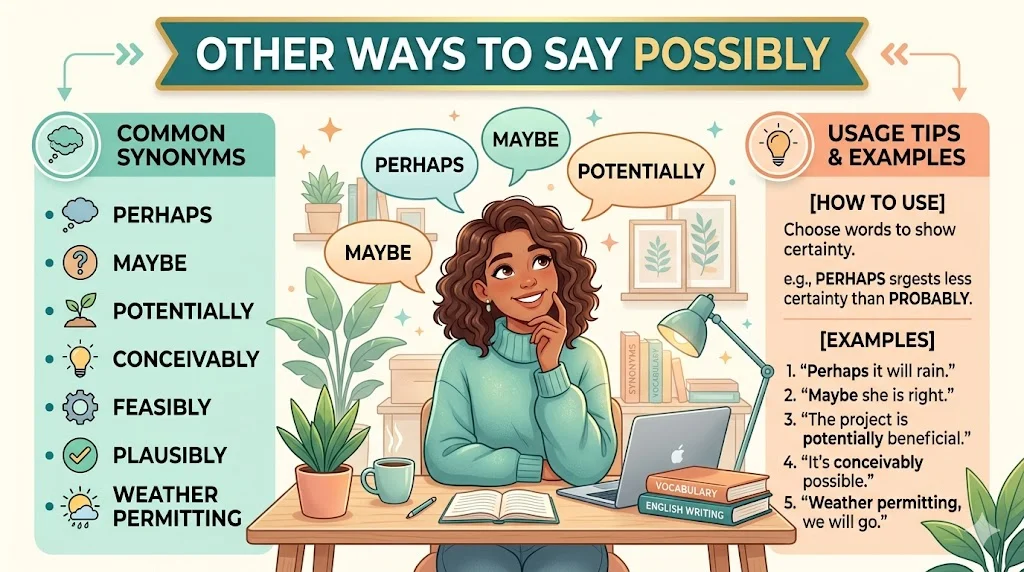
If you want alternatives to “possibly”, try: perhaps, maybe, potentially, it’s possible, conceivably.
These options help you sound more precise, natural, and appropriate in both casual and professional English.
The word “possibly” is commonly used to express uncertainty or a chance that something may happen. It’s simple and widely understood, making it a go-to choice for many English learners.
However, relying on just one word can limit your ability to communicate clearly across different situations. Using a variety of alternatives to “possibly” helps you sound more fluent, confident, and context-aware.
Expanding your vocabulary also allows you to adjust tone whether you want to be formal, casual, or professional and even express excitement in English more naturally.
“The right word doesn’t just communicate meaning it shapes your tone.”
Quick Categories Section
Formal Alternatives to “Possibly”
- Perhaps
- Conceivably
- Potentially
- It is plausible
- There is a chance
Pro Tip: Use formal phrases in writing, presentations, or academic contexts for clarity and credibility.
Casual Alternatives
- Maybe
- Could be
- Might
- There’s a chance
Pro Tip: Casual phrases work best in conversations and informal messages.
Professional Alternatives
- It is possible that
- There is a possibility
- This may occur
- Likely (context-dependent)
Pro Tip: Choose neutral and precise language in workplace communication.
Informal Expressions
- Who knows
- Could happen
- Might just
- You never know
Pro Tip: Avoid informal expressions in emails or formal documents.
“Fluent speakers don’t repeat words they adapt them.”
Common Mistakes
- Overusing “possibly”
- ❌ This could possibly maybe work.
- ✔️ Use one uncertainty word only.
- Using in formal writing incorrectly
- ❌ Possibly we will approve this.
- ✔️ It is possible that we will approve this.
- Stacking uncertainty words
- ❌ It might possibly happen.
- ✔️ Choose one: It might happen.
- Wrong tone in business emails
- ❌ We’ll possibly do it.
- ✔️ We may proceed.
- Using vague language unnecessarily
- ❌ Possibly I think it’s good.
- ✔️ I think it’s good.
What Does “Possibly” Mean?
Definition:
“Possibly” means something may happen or be true, but it is not certain.
Grammar:
It is an adverb used to modify verbs, adjectives, or entire sentences.
Example:
We could possibly finish this today.
When to Use “Possibly”
- Expressing uncertainty
- Suggesting a potential outcome
- Softening a statement
- Making polite assumptions
Spoken vs Written:
Common in both, but more casual in tone.
Formal vs Informal:
Leans slightly informal; better alternatives exist for professional use.
Is It Professional or Polite to Say “Possibly”?
Polite? ✔️ Yes
Professional? ❌ No (in most cases)
Business Example:
It is possible that the project will be delayed. (Better than “possibly”)
Pros and Cons of Using “Possibly”
Pros
- Simple and natural
- Friendly tone
- Common usage
- Easy to understand
Cons
- Too informal for work
- Overused
- Limited emotional range
- Not suitable for formal writing
“Professional English replaces vague words with precise alternatives.”
Other Ways to Say “Possibly” With Examples
These other ways to say “possibly” will help you sound more fluent, confident, and natural in different situations.
Use them based on tone, context, and audience.
1. Phrase: Perhaps
Meaning: Indicates uncertainty politely
Explanation: Slightly formal alternative
Example Sentence: Perhaps we should try another approach.
Best Use: formal writing
Worst Use: slang talk
Tone: polite, neutral
Context Variability: professional / written
2. Phrase: Maybe
Meaning: Something might happen
Explanation: Most common casual option
Example Sentence: Maybe I’ll join you later.
Best Use: casual speech
Worst Use: formal email
Tone: informal, relaxed
Context Variability: casual / spoken
3. Phrase: Potentially
Meaning: Has the capacity to happen
Explanation: More formal and analytical
Example Sentence: This could potentially improve results.
Best Use: reports
Worst Use: casual chat
Tone: formal, precise
Context Variability: professional
4. Phrase: Conceivably
Meaning: Imagined as possible
Explanation: Formal and less common
Example Sentence: This could conceivably lead to success.
Best Use: academic
Worst Use: everyday talk
Tone: formal, thoughtful
Context Variability: written
5. Phrase: It’s possible
Meaning: Something may happen
Explanation: Neutral and clear
Example Sentence: It’s possible we’ll finish early.
Best Use: general use
Worst Use: none
Tone: neutral
Context Variability: all contexts
6. Phrase: There’s a chance
Meaning: Indicates probability
Explanation: Conversational tone
Example Sentence: There’s a chance it might rain.
Best Use: spoken
Worst Use: formal report
Tone: casual, friendly
Context Variability: casual
7. Phrase: It may be
Meaning: Suggests uncertainty
Explanation: Slightly formal
Example Sentence: It may be the right decision.
Best Use: professional
Worst Use: slang
Tone: neutral
Context Variability: mixed
8. Phrase: Might
Meaning: Weak possibility
Explanation: Short and flexible
Example Sentence: We might go out tonight.
Best Use: casual
Worst Use: academic writing
Tone: simple, neutral
Context Variability: spoken
9. Phrase: Could be
Meaning: Something is possible
Explanation: Informal alternative
Example Sentence: It could be true.
Best Use: everyday
Worst Use: formal docs
Tone: casual
Context Variability: spoken
10. Phrase: It is plausible
Meaning: Seems reasonable
Explanation: Formal usage
Example Sentence: It is plausible that results will improve.
Best Use: academic
Worst Use: casual talk
Tone: formal
Context Variability: written
11. Phrase: Likely
Meaning: High chance
Explanation: Stronger than “possibly”
Example Sentence: This is likely to happen.
Best Use: prediction
Worst Use: uncertainty
Tone: confident
Context Variability: mixed
12. Phrase: Feasible
Meaning: Can be done
Explanation: Focus on practicality
Example Sentence: This plan is feasible.
Best Use: business
Worst Use: casual
Tone: professional
Context Variability: professional
13. Phrase: Within reason
Meaning: Reasonably possible
Explanation: Suggests limitation
Example Sentence: We can adjust within reason.
Best Use: negotiation
Worst Use: informal chat
Tone: balanced
Context Variability: professional
14. Phrase: In all likelihood
Meaning: Probably
Explanation: More confident
Example Sentence: In all likelihood, we’ll succeed.
Best Use: formal
Worst Use: casual
Tone: confident
Context Variability: written
15. Phrase: There is a possibility
Meaning: Something may happen
Explanation: Formal tone
Example Sentence: There is a possibility of delay.
Best Use: reports
Worst Use: casual
Tone: formal
Context Variability: professional
16. Phrase: It could happen
Meaning: Event may occur
Explanation: Conversational
Example Sentence: It could happen anytime.
Best Use: casual
Worst Use: formal
Tone: informal
Context Variability: spoken
17. Phrase: You never know
Meaning: Uncertain outcome
Explanation: Informal expression
Example Sentence: You never know, it might work.
Best Use: friendly talk
Worst Use: business
Tone: informal
Context Variability: casual
18. Phrase: Perchance
Meaning: Possibly (rare)
Explanation: Old-fashioned
Example Sentence: Perchance we shall meet again.
Best Use: literature
Worst Use: modern speech
Tone: archaic
Context Variability: literary
19. Phrase: By any chance
Meaning: Asking possibility
Explanation: Used in questions
Example Sentence: Do you, by any chance, know him?
Best Use: polite questions
Worst Use: statements
Tone: polite
Context Variability: spoken
20. Phrase: If all goes well
Meaning: Conditional possibility
Explanation: Depends on outcome
Example Sentence: If all goes well, we’ll finish early.
Best Use: planning
Worst Use: speculation
Tone: hopeful
Context Variability: mixed
21. Phrase: It may happen
Meaning: Something could occur
Explanation: A simple, neutral way to express uncertainty
Example Sentence: It may happen sooner than we expect.
Best Use: general use
Worst Use: formal reports
Tone: neutral, simple
Context Variability: spoken / casual
22. Phrase: Could potentially
Meaning: Has the possibility to occur
Explanation: Adds emphasis to possibility in a professional tone
Example Sentence: This strategy could potentially increase revenue.
Best Use: business context
Worst Use: casual chat
Tone: formal, analytical
Context Variability: professional
23. Phrase: There’s some chance
Meaning: A small possibility exists
Explanation: Suggests low probability
Example Sentence: There’s some chance we’ll finish today.
Best Use: casual talk
Worst Use: formal writing
Tone: informal, mild
Context Variability: spoken
24. Phrase: It’s within the realm of possibility
Meaning: Something is realistically possible
Explanation: Formal and slightly expressive
Example Sentence: It’s within the realm of possibility that the plan succeeds.
Best Use: formal speech
Worst Use: casual conversation
Tone: formal, expressive
Context Variability: professional / written
25. Phrase: May well
Meaning: Quite likely to happen
Explanation: Indicates stronger possibility
Example Sentence: This may well be the best option.
Best Use: semi-formal
Worst Use: informal slang
Tone: confident, neutral
Context Variability: mixed
26. Phrase: It remains possible
Meaning: Still possible despite circumstances
Explanation: Often used after discussing limitations
Example Sentence: It remains possible to complete the task.
Best Use: professional
Worst Use: casual chat
Tone: formal, cautious
Context Variability: written / business
27. Phrase: Not out of the question
Meaning: Still a possibility
Explanation: Suggests something is unlikely but possible
Example Sentence: A promotion is not out of the question.
Best Use: discussion
Worst Use: strict formal writing
Tone: conversational, thoughtful
Context Variability: spoken / semi-formal
28. Phrase: Could very well
Meaning: Strong possibility
Explanation: Emphasizes likelihood
Example Sentence: This could very well change everything.
Best Use: prediction
Worst Use: formal reports
Tone: confident, expressive
Context Variability: spoken / semi-formal
29. Phrase: There’s a likelihood
Meaning: A probability exists
Explanation: More formal and analytical
Example Sentence: There’s a likelihood of delays due to weather.
Best Use: reports
Worst Use: casual talk
Tone: formal, objective
Context Variability: professional
30. Phrase: It cannot be ruled out
Meaning: Cannot be excluded as a possibility
Explanation: Common in formal or cautious communication
Example Sentence: A delay cannot be ruled out at this stage.
Best Use: professional writing
Worst Use: casual speech
Tone: formal, cautious
Context Variability: business / academic
“Expanding your vocabulary isn’t about complexity it’s about choosing the right word for the right moment.”
Mini Quiz / Self-Check
1. Which is most formal?
A. Maybe
B. Perhaps
C. You never know
✔️ Answer: B
2. Best for business email?
A. Could be
B. It is possible that
C. Might
✔️ Answer: B
3. Informal expression?
A. Conceivably
B. Potentially
C. You never know
✔️ Answer: C
Comparison Table: Top Alternatives
| Phrase | Tone | Best Use |
| Perhaps | Formal | Writing |
| Maybe | Casual | Conversation |
| Potentially | Professional | Reports |
| Conceivably | Formal | Academic |
| It’s possible | Neutral | All contexts |
| Might | Casual | Speech |
| Could be | Informal | Everyday |
| Plausible | Formal | Analysis |
| Likely | Semi-formal | Prediction |
| There’s a chance | Casual | Conversation |
FAQs
1. What are the best alternatives to “possibly”?
Top choices include perhaps, maybe, potentially, and it’s possible depending on tone.
2. Is “possibly” too informal for business writing?
Yes, in many cases. Use “it is possible that” instead.
3. Can I use “maybe” instead of “possibly”?
Yes, but only in casual contexts.
4. What is the most formal synonym of “possibly”?
Conceivably or potentially are strong formal options.
5. How can I sound more professional than “possibly”?
Use structured phrases like “there is a possibility” or “it is plausible.”
Conclusion
Learning other ways to say “possibly” helps you communicate with clarity, confidence, and precision. It allows you to match your tone with the situation whether casual, formal, or professional.
Practice these alternatives daily and pay attention to tone. Over time, your English will sound more natural, polished, and effective.
CTA: Which alternative do you use most often? Try replacing “possibly” today and notice the difference.