Last Updated on May 16, 2026
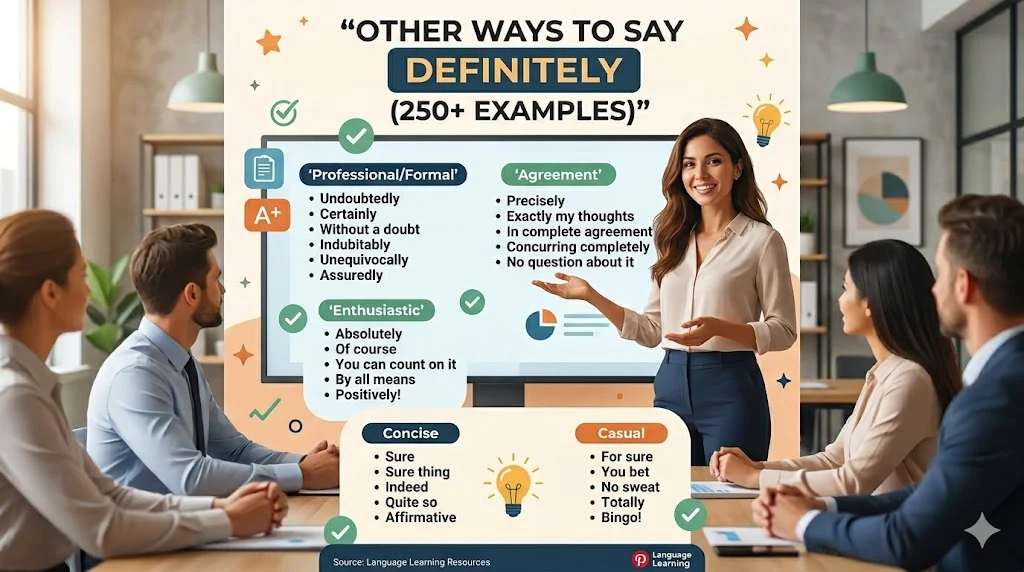
Other ways to say definitely include: certainly, absolutely, of course, for sure, without a doubt.
These alternatives help you sound more natural, confident, and appropriate across formal, casual, and professional situations.
The word “definitely” is commonly used to show strong agreement, certainty, or enthusiasm. It’s simple, clear, and widely understood in both spoken and written English.
However, relying on just one word can make your speech repetitive. Learning alternatives to definitely helps you vary your tone, sound more fluent, and communicate more effectively in different contexts.
Whether you’re trying to express excitement in English, agree professionally, or sound more natural in conversation, expanding your vocabulary is key.
Quick Categories Section
Formal Alternatives to “Definitely”
- Certainly
- Undoubtedly
- Without a doubt
- Assuredly
Pro Tip: Use these in emails, presentations, or academic writing for a polished tone.
Casual Alternatives
- For sure
- Totally
- Yup
- No doubt
Pro Tip: Great for conversations with friends, but avoid in formal writing.
Professional Alternatives
- Absolutely
- Of course
- I confirm
- That is correct
Pro Tip: Choose neutral, respectful phrases in workplace communication.
Informal Expressions
- 100%
- You bet
- For real
- No way (positive tone)
Pro Tip: Use only in relaxed settings; these are strong informal expressions in English.
“The right word choice can instantly elevate your confidence and clarity.”
Common Mistakes Section
- Overusing “definitely”
- ❌ I definitely think this is definitely the best option.
- Using it in formal documents
- ❌ We will definitely complete the project by Friday.
- Using it without emphasis
- ❌ I definitely like tea. (Sounds unnecessary)
- Wrong tone in professional settings
- ❌ Definitely! (Too casual in emails)
- Misplacing in sentences
- ❌ I will go definitely tomorrow.
What Does “Definitely” Mean?
Definition: “Definitely” means without any doubt or with complete certainty.
Grammar Note: It is an adverb used to emphasize certainty.
Example: I will definitely attend the meeting.
When to Use “Definitely”
- To show strong agreement
- To confirm plans
- To express certainty
- To respond enthusiastically
Spoken vs Written:
- Spoken: Very common
- Written: Use carefully in formal texts
Formal vs Informal:
- Informal: ✔️ Common
- Formal: ❌ Limited use
Is It Professional or Polite to Say “Definitely”?
- Polite? ✔️ Yes
- Professional? ❌ Not always
Business Example:
✔️ We will certainly complete the task on time.
Pros and Cons of Using “Definitely”
Pros
- Simple and natural
- Friendly tone
- Common usage
- Easy to understand
Cons
- Too informal for work
- Overused
- Limited emotional range
- Not suitable for formal writing
“Professional English is about choosing the right tone, not just the right words.”
Other Ways to Say “Definitely” With Examples
These alternatives will help you sound more fluent, confident, and natural in different situations.
Use them according to tone, context, and audience to express excitement, admiration, or approval.
1. Phrase: Certainly
Meaning: With complete confidence
Explanation: Formal and polite alternative
Example Sentence: I will certainly assist you with that.
Best Use: formal replies
Worst Use: casual chat
Tone: polite, formal
Context Variability: professional
2. Phrase: Absolutely
Meaning: Strong agreement
Explanation: Widely used in both formal and informal contexts
Example Sentence: Absolutely, I agree with your idea.
Best Use: general use
Worst Use: very formal writing
Tone: confident, clear
Context Variability: all contexts
3. Phrase: Of course
Meaning: Naturally yes
Explanation: Friendly and polite agreement
Example Sentence: Of course, you can join us.
Best Use: polite speech
Worst Use: strict formal
Tone: warm, polite
Context Variability: casual/professional
4. Phrase: Without a doubt
Meaning: No uncertainty
Explanation: Emphasizes strong certainty
Example Sentence: This is without a doubt the best option.
Best Use: emphasis
Worst Use: casual texting
Tone: strong, assertive
Context Variability: spoken/professional
5. Phrase: For sure
Meaning: Definitely yes
Explanation: Very common in casual speech
Example Sentence: I’ll be there for sure.
Best Use: casual talk
Worst Use: formal email
Tone: relaxed, friendly
Context Variability: casual
6. Phrase: Undoubtedly
Meaning: Certainly true
Explanation: Formal and academic tone
Example Sentence: This is undoubtedly a significant improvement.
Best Use: academic
Worst Use: casual
Tone: formal, strong
Context Variability: professional
7. Phrase: Assuredly
Meaning: Confidently certain
Explanation: Formal and less common
Example Sentence: The results are assuredly accurate.
Best Use: formal writing
Worst Use: everyday talk
Tone: formal, refined
Context Variability: formal
8. Phrase: No doubt
Meaning: Surely
Explanation: Casual agreement
Example Sentence: No doubt, that’s a great idea.
Best Use: informal
Worst Use: business
Tone: relaxed, confident
Context Variability: casual
9. Phrase: You bet
Meaning: Yes, definitely
Explanation: Informal and enthusiastic
Example Sentence: You bet I’ll come!
Best Use: friendly chat
Worst Use: workplace
Tone: energetic, casual
Context Variability: spoken
10. Phrase: 100%
Meaning: Completely certain
Explanation: Modern informal expression
Example Sentence: I’m 100% ready.
Best Use: texting
Worst Use: formal writing
Tone: emphatic, modern
Context Variability: casual
11. Phrase: Exactly
Meaning: Completely correct
Explanation: Confirms agreement
Example Sentence: Exactly, that’s what I meant.
Best Use: discussion
Worst Use: formal docs
Tone: clear, supportive
Context Variability: spoken
12. Phrase: Sure thing
Meaning: Yes, no problem
Explanation: Friendly agreement
Example Sentence: Sure thing, I’ll handle it.
Best Use: casual
Worst Use: formal
Tone: easygoing, friendly
Context Variability: casual
13. Phrase: Affirmative
Meaning: Yes (formal)
Explanation: Used in official or military tone
Example Sentence: Affirmative, the task is complete.
Best Use: official
Worst Use: casual
Tone: formal, direct
Context Variability: professional
14. Phrase: I confirm
Meaning: Official agreement
Explanation: Used in business communication
Example Sentence: I confirm the meeting for Monday.
Best Use: business
Worst Use: casual
Tone: formal, precise
Context Variability: professional
15. Phrase: That’s correct
Meaning: True statement
Explanation: Confirms accuracy
Example Sentence: That’s correct, the report is finished.
Best Use: professional
Worst Use: emotional talk
Tone: neutral, factual
Context Variability: professional
16. Phrase: Definitely yes
Meaning: Strong confirmation
Explanation: Emphasizes agreement
Example Sentence: Definitely yes, I support this.
Best Use: emphasis
Worst Use: formal
Tone: strong, clear
Context Variability: spoken
17. Phrase: No question
Meaning: Absolutely certain
Explanation: Emphatic agreement
Example Sentence: There’s no question about it.
Best Use: emphasis
Worst Use: formal writing
Tone: confident, assertive
Context Variability: spoken
18. Phrase: By all means
Meaning: Certainly, go ahead
Explanation: Polite permission
Example Sentence: By all means, take a seat.
Best Use: polite
Worst Use: casual slang
Tone: polite, formal
Context Variability: professional
19. Phrase: Naturally
Meaning: As expected
Explanation: Calm agreement
Example Sentence: Naturally, we support the decision.
Best Use: formal
Worst Use: casual
Tone: calm, refined
Context Variability: formal
20. Phrase: Positively
Meaning: With certainty
Explanation: Strong affirmation
Example Sentence: This is positively the best choice.
Best Use: emphasis
Worst Use: casual
Tone: strong, formal
Context Variability: professional
21. Phrase: For certain
Meaning: Definitely
Explanation: Slightly formal
Example Sentence: I know this for certain.
Best Use: general
Worst Use: slang
Tone: clear, neutral
Context Variability: all
22. Phrase: Indeed
Meaning: Truly
Explanation: Formal agreement
Example Sentence: Indeed, this is impressive.
Best Use: formal
Worst Use: casual chat
Tone: formal, thoughtful
Context Variability: professional
23. Phrase: Sure
Meaning: Yes
Explanation: Simple casual confirmation
Example Sentence: Sure, I can help.
Best Use: casual
Worst Use: formal
Tone: relaxed, neutral
Context Variability: spoken
24. Phrase: Without question
Meaning: No doubt
Explanation: Strong formal certainty
Example Sentence: This is without question effective.
Best Use: formal
Worst Use: casual
Tone: strong, formal
Context Variability: professional
25. Phrase: I agree completely
Meaning: Full agreement
Explanation: Clear and professional
Example Sentence: I agree completely with your plan.
Best Use: meetings
Worst Use: casual texting
Tone: professional, clear
Context Variability: professional
26. Phrase: Absolutely yes
Meaning: Strong agreement
Explanation: Adds emphasis
Example Sentence: Absolutely yes, let’s proceed.
Best Use: spoken
Worst Use: formal writing
Tone: energetic, clear
Context Variability: spoken
27. Phrase: No hesitation
Meaning: Immediate agreement
Explanation: Shows confidence
Example Sentence: I accepted with no hesitation.
Best Use: storytelling
Worst Use: formal
Tone: confident, natural
Context Variability: spoken
28. Phrase: Count on it
Meaning: Guaranteed
Explanation: Strong promise
Example Sentence: Count on it, I’ll be there.
Best Use: casual
Worst Use: formal
Tone: confident, friendly
Context Variability: casual
29. Phrase: Undeniably
Meaning: Clearly true
Explanation: Strong formal emphasis
Example Sentence: This is undeniably effective.
Best Use: formal
Worst Use: casual
Tone: formal, strong
Context Variability: professional
30. Phrase: Absolutely certain
Meaning: Completely sure
Explanation: Strong emphasis
Example Sentence: I am absolutely certain about this.
Best Use: emphasis
Worst Use: casual
Tone: strong, formal
Context Variability: professional
“Fluency comes from flexibility use different phrases for different situations.”
Mini Quiz / Self-Check
1. Which is best for a formal email?
A. For sure
B. Certainly
C. Yup
2. Which is most informal?
A. Undoubtedly
B. You bet
C. Assuredly
3. Best professional alternative?
A. 100%
B. I confirm
C. No way
Comparison Table: Top Alternatives
| Phrase | Tone | Best Use |
| Certainly | Formal | Emails |
| Absolutely | Neutral | General |
| Of course | Polite | Conversation |
| Without a doubt | Strong | Emphasis |
| Undoubtedly | Formal | Writing |
| For sure | Casual | Friends |
| I confirm | Professional | Business |
| Indeed | Formal | Discussion |
| Sure | Informal | Speech |
| By all means | Polite | Permission |
FAQs
1. What are the best formal alternatives to definitely?
Use certainly, undoubtedly, without a doubt, and indeed.
2. Can I use “definitely” in professional emails?
It’s polite but slightly informal; better use professional reaction phrases like certainly.
3. What is a stronger word than definitely?
Undoubtedly or without question sound stronger and more formal.
4. What are casual alternatives to definitely?
For sure, you bet, 100%, sure thing are common casual options.
5. How can I express excitement in English instead of definitely?
Use absolutely, 100%, you bet, or count on it for enthusiastic responses.
Conclusion
Learning other ways to say definitely helps you communicate with clarity, confidence, and flexibility. It allows you to match your tone to different situations whether formal, casual or professional.
Make it a habit to practice these phrases daily. Over time, you’ll naturally choose the right expression and sound more fluent in real conversations.
CTA: Which alternative do you use most? Practice one new phrase today and upgrade your English instantly.