Last Updated on May 15, 2026
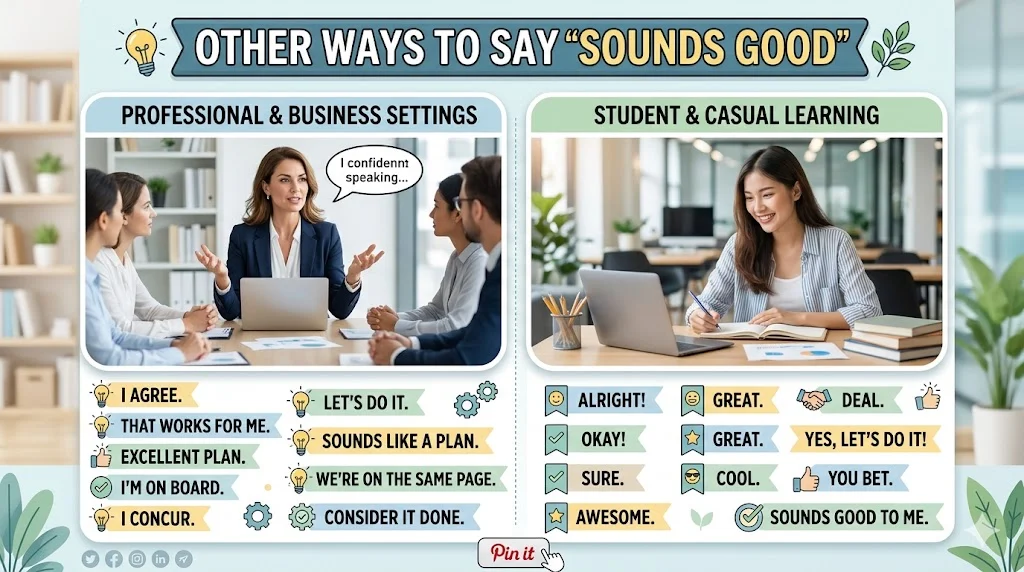
If you want alternatives to “sounds good,” try: That works for me, I agree, looks great, perfect, I’m on board.
These options help you express excitement in English more clearly and adjust your tone for casual or professional situations.
The phrase “sounds good” is one of the most common ways to show agreement or approval in English. People use it in conversations, emails, and quick responses to plans or suggestions.
However, relying on the same phrase repeatedly can make your English sound limited. Learning alternatives to “sounds good” helps you communicate more precisely and naturally.
By expanding your vocabulary, you can better express excitement in English, sound more professional, and adapt your tone depending on the situation.
“The right phrase doesn’t just show agreement it shows confidence and clarity.”
Quick Categories
Formal alternatives to “sounds good”
- That is acceptable
- I approve
- That seems appropriate
- That is satisfactory
Pro Tip: Use these in formal writing or academic communication.
Casual alternatives
- Cool
- Awesome
- Nice
- Great
Pro Tip: Best for friends and informal conversations.
Professional alternatives
- That works for me
- I agree with that
- This looks good
- I’m aligned with this
Pro Tip: Choose neutral, polite phrases in workplace communication.
Informal expressions
- Sure thing
- Works for me
- Okay, great
- All good
Pro Tip: Keep tone friendly but avoid overusing them in formal settings.
“Fluent speakers don’t repeat phrases they adapt them.”
Common Mistakes
- Using it in formal emails
❌ “Sounds good, sir.”
✔️ Use: “That works well” - Overusing the phrase
❌ Saying “sounds good” in every reply - Using it without context
❌ “Sounds good” (unclear response) - Wrong tone in serious situations
❌ “Sounds good” for important decisions - Using it in writing where clarity is needed
❌ “Sounds good” in reports
What Does “Sounds Good” Mean?
Definition:
It means you agree with something or think it is a good idea.
Grammar Note:
It is an informal response phrase, often used after hearing a suggestion.
Example:
“That plan sounds good to me.”
When to Use “Sounds Good”
- Agreeing with a suggestion
- Responding to plans
- Casual conversations
- Quick confirmations
Spoken vs Written: Mostly spoken
Formal vs Informal: Informal
Is It Professional or Polite to Say “Sounds Good”?
Polite? ✔️ Yes
Professional? ❌ No (in most cases)
Business Example:
“Your proposal looks good. I approve the plan.”
“Professional English is not complicated it’s intentional.”
Pros and Cons of Using “Sounds Good”
Pros
- Simple and natural
- Friendly tone
- Common usage
- Easy to understand
Cons
- Too informal for work
- Overused
- Limited emotional range
- Not suitable for formal writing
Other Ways to Say “Sounds Good” With Examples)
These alternatives will help you sound more fluent, confident, and natural in different situations.
Use them based on tone, context, and audience.
1. Phrase: That works for me
Meaning: I agree with the plan
Explanation: Common in professional settings
Example Sentence: “Monday works for me.”
Best Use: workplace
Worst Use: slang talk
Tone: neutral, polite
Context Variability: professional / spoken
2. Phrase: I agree
Meaning: I share the same opinion
Explanation: Direct and clear
Example Sentence: “I agree with your suggestion.”
Best Use: formal talk
Worst Use: casual jokes
Tone: direct, formal
Context Variability: professional / spoken
3. Phrase: Looks great
Meaning: It appears very good
Explanation: Used for visual approval
Example Sentence: “The design looks great.”
Best Use: feedback
Worst Use: decisions
Tone: positive, friendly
Context Variability: casual / professional
4. Phrase: Perfect
Meaning: Exactly right
Explanation: Shows strong approval
Example Sentence: “Perfect, let’s proceed.”
Best Use: quick approval
Worst Use: formal writing
Tone: enthusiastic, brief
Context Variability: spoken / casual
5. Phrase: I’m on board
Meaning: I support the idea
Explanation: Often used in teams
Example Sentence: “I’m on board with this plan.”
Best Use: teamwork
Worst Use: academic
Tone: collaborative, modern
Context Variability: professional / spoken
6. Phrase: That’s fine with me
Meaning: I accept it
Explanation: Neutral agreement
Example Sentence: “That’s fine with me.”
Best Use: casual
Worst Use: formal
Tone: neutral, relaxed
Context Variability: spoken
7. Phrase: Sounds great
Meaning: Very good idea
Explanation: Stronger than “sounds good”
Example Sentence: “Dinner at 7 sounds great.”
Best Use: plans
Worst Use: formal docs
Tone: positive, friendly
Context Variability: casual
8. Phrase: I approve
Meaning: I officially agree
Explanation: Formal tone
Example Sentence: “I approve this proposal.”
Best Use: formal work
Worst Use: casual chat
Tone: formal, authoritative
Context Variability: professional
9. Phrase: That’s acceptable
Meaning: Meets requirements
Explanation: Formal and neutral
Example Sentence: “This solution is acceptable.”
Best Use: academic
Worst Use: friendly talk
Tone: formal, neutral
Context Variability: professional
10. Phrase: Good idea
Meaning: Smart suggestion
Explanation: Positive feedback
Example Sentence: “That’s a good idea.”
Best Use: casual talk
Worst Use: reports
Tone: friendly, simple
Context Variability: casual
11. Phrase: Works for me
Meaning: I agree
Explanation: Short version
Example Sentence: “8 PM works for me.”
Best Use: casual
Worst Use: formal
Tone: relaxed, informal
Context Variability: spoken
12. Phrase: All set
Meaning: Everything is okay
Explanation: Confirms readiness
Example Sentence: “We’re all set.”
Best Use: coordination
Worst Use: formal writing
Tone: confident, casual
Context Variability: spoken
13. Phrase: That’s perfect
Meaning: Ideal situation
Explanation: Strong approval
Example Sentence: “That’s perfect timing.”
Best Use: casual
Worst Use: reports
Tone: enthusiastic
Context Variability: spoken
14. Phrase: I’m okay with that
Meaning: I accept it
Explanation: Mild agreement
Example Sentence: “I’m okay with that option.”
Best Use: neutral talk
Worst Use: formal docs
Tone: calm, neutral
Context Variability: casual
15. Phrase: That makes sense
Meaning: Logical idea
Explanation: Shows understanding
Example Sentence: “That makes sense to me.”
Best Use: discussions
Worst Use: emotional talk
Tone: logical
Context Variability: professional / spoken
16. Phrase: I’m happy with that
Meaning: I feel positive about it
Explanation: Emotional approval
Example Sentence: “I’m happy with the result.”
Best Use: feedback
Worst Use: strict formal
Tone: positive
Context Variability: casual
17. Phrase: That’s good
Meaning: It is acceptable
Explanation: Basic approval
Example Sentence: “That’s good.”
Best Use: casual
Worst Use: formal
Tone: neutral
Context Variability: spoken
18. Phrase: No problem
Meaning: I accept easily
Explanation: Informal agreement
Example Sentence: “No problem, let’s do it.”
Best Use: casual
Worst Use: formal
Tone: relaxed
Context Variability: spoken
19. Phrase: Fine by me
Meaning: I agree
Explanation: Informal approval
Example Sentence: “That’s fine by me.”
Best Use: casual
Worst Use: formal
Tone: relaxed
Context Variability: spoken
20. Phrase: Great idea
Meaning: Excellent suggestion
Explanation: Strong approval
Example Sentence: “That’s a great idea.”
Best Use: casual
Worst Use: formal
Tone: enthusiastic
Context Variability: spoken
21. Phrase: Absolutely
Meaning: Strong agreement
Explanation: Emphasizes approval
Example Sentence: “Absolutely, let’s proceed.”
Best Use: emphasis
Worst Use: unclear context
Tone: confident
Context Variability: spoken
22. Phrase: Definitely
Meaning: Certain agreement
Explanation: Shows certainty
Example Sentence: “Definitely, I agree.”
Best Use: strong agreement
Worst Use: formal writing
Tone: confident
Context Variability: spoken
23. Phrase: That’s reasonable
Meaning: Fair idea
Explanation: Logical agreement
Example Sentence: “That’s a reasonable plan.”
Best Use: discussions
Worst Use: casual chat
Tone: neutral
Context Variability: professional
24. Phrase: I support that
Meaning: I back the idea
Explanation: Shows support
Example Sentence: “I support that decision.”
Best Use: teamwork
Worst Use: casual
Tone: formal
Context Variability: professional
25. Phrase: That will work
Meaning: It is suitable
Explanation: Practical agreement
Example Sentence: “That will work for us.”
Best Use: planning
Worst Use: emotional talk
Tone: neutral
Context Variability: professional
26. Phrase: Agreed
Meaning: I accept
Explanation: Short and formal
Example Sentence: “Agreed. Let’s move forward.”
Best Use: meetings
Worst Use: casual
Tone: formal
Context Variability: professional
27. Phrase: That’s great
Meaning: Very good
Explanation: Positive response
Example Sentence: “That’s great news.”
Best Use: casual
Worst Use: formal
Tone: positive
Context Variability: spoken
28. Phrase: Sounds perfect
Meaning: Ideal idea
Explanation: Strong approval
Example Sentence: “That sounds perfect.”
Best Use: plans
Worst Use: formal
Tone: enthusiastic
Context Variability: casual
29. Phrase: I’m satisfied with that
Meaning: Fully acceptable
Explanation: Formal approval
Example Sentence: “I’m satisfied with the outcome.”
Best Use: formal
Worst Use: casual
Tone: formal
Context Variability: professional
30. Phrase: That’s settled
Meaning: Decision is final
Explanation: Confirms agreement
Example Sentence: “Okay, that’s settled.”
Best Use: decisions
Worst Use: early discussion
Tone: decisive
Context Variability: professional / spoken
“Your vocabulary is your voice make it flexible.”
Mini Quiz / Self-Check
1. Which is best for a formal email?
A) Cool
B) That is acceptable ✔️
2. Which shows strong enthusiasm?
A) Perfect ✔️
B) That’s acceptable
3. Best for workplace agreement?
A) That works for me ✔️
B) Awesome
Comparison Table: Top Alternatives
| Phrase | Tone | Best Use |
| That works for me | Neutral | Workplace |
| I agree | Formal | Meetings |
| Looks great | Friendly | Feedback |
| Perfect | Enthusiastic | Quick replies |
| I’m on board | Collaborative | Teams |
| That’s acceptable | Formal | Reports |
| Works for me | Casual | Chat |
| Absolutely | Strong | Agreement |
| Agreed | Formal | Decisions |
| That will work | Neutral | Planning |
FAQs
What are the best professional alternatives to “sounds good”?
Use phrases like “That works for me,” “I agree,” or “That is acceptable” for professional communication.
Is “sounds good” informal?
Yes, it is considered informal and mostly used in spoken English.
How can I express excitement in English instead of “sounds good”?
Try “Perfect,” “That’s great,” or “Absolutely” to show enthusiasm.
What are polite alternatives to “sounds good”?
“That works well,” “I’m happy with that,” and “That seems appropriate” are polite options.
Can I use “sounds good” in emails?
Yes, but only in informal or semi-formal emails, not formal business writing.
Conclusion
Learning other ways to say “sounds good” helps you communicate more effectively and confidently. It allows you to adapt your tone for different situations, from casual chats to professional meetings.
Practice these alternatives to “sounds good” daily, and focus on choosing the right phrase for the right context. Over time, your English will sound more natural, polished, and expressive.
CTA: Try using 3 new phrases today in your conversations.