Last Updated on June 19, 2026
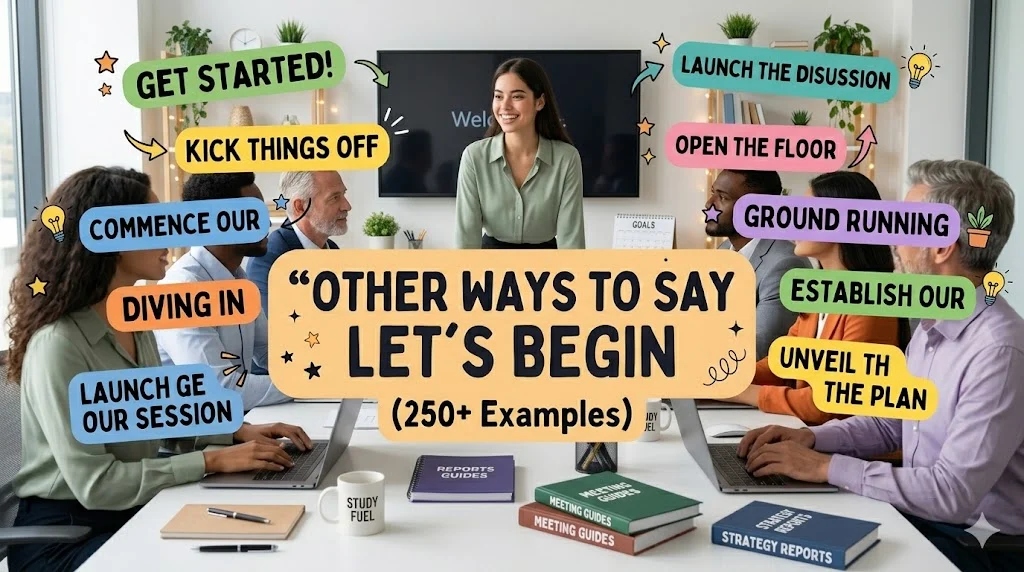
“Let’s begin” means starting something together. Some top alternatives include: Let’s get started, Shall we begin?, Let’s kick things off, Let’s dive in, Let’s commence.
The phrase “let’s begin” is commonly used to signal the start of an activity, meeting, or discussion. It’s simple, friendly, and widely understood across both spoken and written English.
However, relying on the same phrase repeatedly can limit your fluency. Learning alternatives to “let’s begin” helps you sound more natural, expressive, and adaptable in different situations.
Whether you want to express excitement in English or sound more professional, choosing the right variation can instantly elevate your communication. For example, understanding the let’s begin meaning can help you use this common phrase confidently in meetings, presentations, classrooms, and everyday conversations while selecting the most appropriate alternative for different situations.
“The words you choose at the beginning set the tone for everything that follows.”
Quick Categories Section
Formal Alternatives to “Let’s Begin”
- Let us commence
- Shall we begin?
- Let us proceed
- We shall begin now
Pro Tip: Use these in presentations, ceremonies, or formal writing.
Casual Alternatives
- Let’s get started
- Let’s kick things off
- Let’s dive in
- Here we go
Pro Tip: Perfect for conversations, classes, and friendly group settings.
Professional Alternatives
- Let’s get started with the agenda
- We’ll begin shortly
- Let’s start the discussion
- Let’s move forward
Pro Tip: Add context (agenda, discussion) to sound more workplace-appropriate.
Informal Expressions
- Let’s roll
- Let’s go
- Time to start
- Off we go
Pro Tip: Great for spoken English but avoid in formal emails.
“Fluency isn’t about knowing more words it’s about choosing the right one.”
Common Mistakes
- Using it in very formal writing
Incorrect: Let’s begin the legal document. - Overusing the phrase
Example: Let’s begin every paragraph. - Using it without context in meetings
Example: Let’s begin (without stating topic). - Using casual tone in professional emails
Example: Let’s begin, guys! - Incorrect grammar expansion
Incorrect: Let us begins the session.
What Does “Let’s Begin” Mean?
“Let’s begin” is a contraction of “let us begin.” It is used to suggest starting something together.
Example: Let’s begin the lesson now.
When to Use “Let’s Begin”
- Starting a class or lecture
- Beginning a meeting
- Launching an activity
- Giving instructions
Spoken vs Written: More common in spoken English
Formal vs Informal: Neutral but slightly informal
Is It Professional or Polite to Say “Let’s Begin”?
“Let’s begin” is polite but not always fully professional.
Business Example:
Let’s begin with today’s agenda.
Polite? ✔️ Yes
Professional? ❌ No (in most cases)
Pros and Cons of Using “Let’s Begin”
Pros
- Simple and natural
- Friendly tone
- Common usage
- Easy to understand
Cons
- Too informal for work
- Overused
- Limited emotional range
- Not suitable for formal writing
“Professional English is about precision, not just politeness.”
Other Ways to Say “Let’s Begin” With Examples
These other ways to say “let’s begin” will help you sound more fluent and confident. Use them based on tone, audience, and context.
1. Phrase: Let’s get started
Meaning: Begin something now
Explanation: A very common and friendly alternative
Example Sentence: Let’s get started with the project.
Best Use: casual meetings
Worst Use: formal writing
Tone: friendly, neutral
Context Variability: casual / professional
2. Phrase: Shall we begin?
Meaning: Suggest starting politely
Explanation: Formal and respectful
Example Sentence: Shall we begin the presentation?
Best Use: formal events
Worst Use: casual chat
Tone: polite, formal
Context Variability: professional / spoken
3. Phrase: Let’s kick things off
Meaning: Start energetically
Explanation: Adds excitement
Example Sentence: Let’s kick things off with introductions.
Best Use: team meetings
Worst Use: formal reports
Tone: energetic, casual
Context Variability: spoken
4. Phrase: Let’s dive in
Meaning: Start quickly and deeply
Explanation: Suggests focus and action
Example Sentence: Let’s dive in and analyze the data.
Best Use: discussions
Worst Use: ceremonies
Tone: direct, active
Context Variability: casual / professional
5. Phrase: Let us commence
Meaning: Begin formally
Explanation: Very formal expression
Example Sentence: Let us commence the ceremony.
Best Use: formal events
Worst Use: casual talk
Tone: formal, serious
Context Variability: professional
6. Phrase: Here we go
Meaning: Start now
Explanation: Informal and conversational
Example Sentence: Here we go, the class is starting.
Best Use: casual speech
Worst Use: business email
Tone: relaxed, informal
Context Variability: spoken
7. Phrase: Let’s start
Meaning: Begin
Explanation: Simple and direct
Example Sentence: Let’s start the meeting.
Best Use: general use
Worst Use: formal writing
Tone: neutral, direct
Context Variability: all
8. Phrase: We’ll begin shortly
Meaning: Start soon
Explanation: Used for announcements
Example Sentence: We’ll begin shortly, please take your seats.
Best Use: events
Worst Use: casual chat
Tone: polite, formal
Context Variability: professional
9. Phrase: Time to start
Meaning: It’s time to begin
Explanation: Slightly informal
Example Sentence: Time to start the session.
Best Use: classrooms
Worst Use: formal documents
Tone: neutral, casual
Context Variability: spoken
10. Phrase: Let’s move forward
Meaning: Proceed
Explanation: Focuses on progress
Example Sentence: Let’s move forward with the plan.
Best Use: business
Worst Use: casual talk
Tone: professional, neutral
Context Variability: professional
11. Phrase: Let’s proceed
Meaning: Continue or begin formally
Explanation: Common in structured or professional settings
Example Sentence: Let’s proceed with the next topic.
Best Use: business meetings
Worst Use: casual chat
Tone: formal, neutral
Context Variability: professional
12. Phrase: Let’s get going
Meaning: Start moving or begin
Explanation: Slightly informal and conversational
Example Sentence: Let’s get going before it gets late.
Best Use: casual settings
Worst Use: formal writing
Tone: relaxed, friendly
Context Variability: spoken
13. Phrase: Let’s launch into it
Meaning: Start something with energy
Explanation: Suggests enthusiasm and momentum
Example Sentence: Let’s launch into the discussion.
Best Use: team discussions
Worst Use: ceremonies
Tone: energetic, semi-casual
Context Variability: spoken / professional
14. Phrase: We’ll start now
Meaning: Begin immediately
Explanation: Clear and direct
Example Sentence: We’ll start now, please pay attention.
Best Use: classrooms
Worst Use: informal chat
Tone: neutral, direct
Context Variability: spoken / professional
15. Phrase: Let’s initiate
Meaning: Begin formally
Explanation: Often used in technical or business contexts
Example Sentence: Let’s initiate the process.
Best Use: formal/business
Worst Use: casual talk
Tone: formal, technical
Context Variability: professional
16. Phrase: Let’s set things in motion
Meaning: Start a process
Explanation: Emphasizes action and progress
Example Sentence: Let’s set things in motion for the project.
Best Use: business
Worst Use: casual chat
Tone: professional, motivational
Context Variability: professional
17. Phrase: Let’s open with
Meaning: Begin with something specific
Explanation: Used when introducing a first step
Example Sentence: Let’s open with a quick overview.
Best Use: presentations
Worst Use: informal talk
Tone: structured, professional
Context Variability: professional
18. Phrase: Let’s begin now
Meaning: Start immediately
Explanation: Slightly more emphatic than “let’s begin”
Example Sentence: Let’s begin now to save time.
Best Use: general
Worst Use: none
Tone: neutral, direct
Context Variability: all
19. Phrase: Off we go
Meaning: Start moving or begin
Explanation: Informal and lighthearted
Example Sentence: Off we go, let’s start the journey.
Best Use: casual speech
Worst Use: business email
Tone: playful, informal
Context Variability: spoken
20. Phrase: Let’s start things off
Meaning: Begin an activity
Explanation: Slightly more expressive than “let’s start”
Example Sentence: Let’s start things off with introductions.
Best Use: meetings
Worst Use: formal writing
Tone: friendly, semi-casual
Context Variability: spoken / professional
“Choosing the right phrase can instantly make your English sound more natural.”
21. Phrase: Let’s take the first step
Meaning: Begin a process
Explanation: Focuses on starting gradually
Example Sentence: Let’s take the first step toward our goal.
Best Use: motivation
Worst Use: urgent situations
Tone: encouraging, thoughtful
Context Variability: professional / spoken
22. Phrase: Let’s begin the process
Meaning: Start a procedure
Explanation: Formal and structured
Example Sentence: Let’s begin the process of evaluation.
Best Use: formal/business
Worst Use: casual chat
Tone: formal, neutral
Context Variability: professional
23. Phrase: Let’s start the ball rolling
Meaning: Begin something that continues
Explanation: Idiomatic expression
Example Sentence: Let’s start the ball rolling with ideas.
Best Use: brainstorming
Worst Use: formal writing
Tone: informal, idiomatic
Context Variability: spoken
24. Phrase: Let’s get this underway
Meaning: Begin something officially
Explanation: Often used in events or projects
Example Sentence: Let’s get this underway without delay.
Best Use: events
Worst Use: casual talk
Tone: professional, active
Context Variability: professional
25. Phrase: Let’s begin our work
Meaning: Start working
Explanation: Clear and instructional
Example Sentence: Let’s begin our work for today.
Best Use: classrooms
Worst Use: informal chat
Tone: neutral, instructional
Context Variability: spoken / professional
26. Phrase: Let’s jump in
Meaning: Start quickly
Explanation: Suggests immediate action
Example Sentence: Let’s jump in and solve this problem.
Best Use: discussions
Worst Use: formal settings
Tone: energetic, casual
Context Variability: spoken
27. Phrase: Let’s make a start
Meaning: Begin something
Explanation: Common in British English
Example Sentence: Let’s make a start on the assignment.
Best Use: general
Worst Use: formal documents
Tone: neutral, slightly formal
Context Variability: spoken / professional
28. Phrase: Let’s get down to business
Meaning: Start serious work
Explanation: Focuses on productivity
Example Sentence: Let’s get down to business and review the report.
Best Use: workplace
Worst Use: casual chat
Tone: professional, direct
Context Variability: professional
29. Phrase: Let’s begin right away
Meaning: Start immediately
Explanation: Emphasizes urgency
Example Sentence: Let’s begin right away to meet the deadline.
Best Use: urgent tasks
Worst Use: relaxed settings
Tone: direct, urgent
Context Variability: all
30. Phrase: Let’s start off
Meaning: Begin something
Explanation: Slight variation of “start”
Example Sentence: Let’s start off with a quick recap.
Best Use: meetings
Worst Use: formal writing
Tone: neutral, friendly
Context Variability: spoken / professional
“Small changes in wording can make a big difference in how confident you sound.”
Mini Quiz / Self-Check
1. Which is the most formal alternative?
A. Let’s go
B. Let us commence ✔️
C. Here we go
2. Best phrase for a meeting?
A. Let’s roll
B. Let’s get started ✔️
C. Off we go
3. Which is too informal for email?
A. Shall we begin?
B. Let’s dive in
C. Let’s roll ✔️
Comparison Table: Top Alternatives
| Phrase | Tone | Best Use |
| Let’s get started | Neutral | Meetings |
| Shall we begin? | Formal | Presentations |
| Let’s dive in | Active | Discussions |
| Let us commence | Formal | Ceremonies |
| Here we go | Informal | Speech |
| Let’s start | Neutral | General |
| We’ll begin shortly | Formal | Events |
| Time to start | Casual | Class |
| Let’s move forward | Professional | Business |
| Let’s kick things off | Energetic | Teams |
FAQs
1. What are the best alternatives to “let’s begin”?
Top options include “let’s get started,” “shall we begin,” and “let’s dive in.”
2. Is “let’s begin” formal or informal?
It’s neutral but slightly informal, especially in professional settings.
3. How can I express excitement in English when starting something?
Use phrases like “let’s kick things off” or “let’s dive in.”
4. What are professional reaction phrases for starting meetings?
Try “let’s begin with the agenda” or “we’ll start shortly.”
5. Why should I learn other ways to say “let’s begin”?
It improves fluency, tone awareness, and communication flexibility.
Conclusion
Learning other ways to say “let’s begin” helps you communicate more effectively in both casual and professional situations. It allows you to match your tone with the context and audience.
Practice these phrases daily and pay attention to tone. The more you use varied expressions, the more natural and confident your English will become.
CTA: Try using 3 new alternatives today in your conversations or writing.