
Last Updated on May 15, 2026
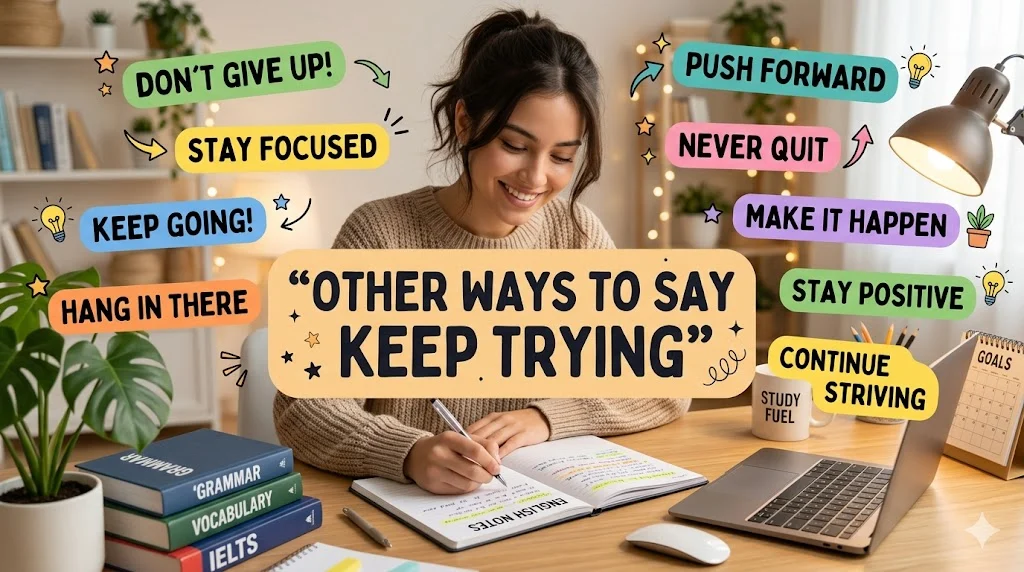
“Keep trying” means continuing your effort despite difficulties or failure. It is commonly used for encouragement and motivation in both spoken and written English.
Top alternatives: keep going, don’t give up, stay persistent, keep at it, push through
The phrase “keep trying” is used to encourage someone to continue their effort even when success is not immediate. It is a common motivational expression in everyday English.
Learning alternatives to keep trying helps you avoid repetition and improves fluency in both casual and professional communication. It also helps you express excitement in English in more natural and context-appropriate ways.
Using varied expressions makes your English sound more confident, polished, and native-like.
Quick Categories
Formal alternatives to “keep trying”
- Continue your efforts
- Persevere
- Remain persistent
- Maintain your effort
Pro Tip: Use formal alternatives in academic writing, reports, and professional emails.
Casual alternatives
- Keep going
- Don’t stop
- Hang in there
- Stick with it
Pro Tip: These are perfect for friendly conversations and informal encouragement.
Professional alternatives
- Stay committed
- Continue working toward it
- Maintain consistency
- Keep pushing forward
Pro Tip: Ideal for workplace motivation and leadership communication.
Informal expressions
- Give it another shot
- Try again
- Keep at it
- One more try
Pro Tip: Best used in relaxed, spoken English with friends or peers.
“The way you encourage someone changes how motivated they feel.”
Common Mistakes
- Using “keep trying” in formal reports
Example: The company must keep trying to improve revenue. - Repeating “keep trying” too often
Example: Keep trying, keep trying, keep trying. - Using it without context
Example: Keep trying!” (without explaining what to do) - Mixing tone incorrectly
Example: Don’t give up bro in a business email. - Overusing informal tone in professional settings
Example: Just keep at it in a board presentation.
What Does “Keep Trying” Mean?
“Keep trying” means to continue making effort after difficulty or failure. It is a motivational phrase encouraging persistence.
Grammar note: It is an imperative verb phrase often used for encouragement.
Example: Keep trying until you succeed.
When to Use “Keep Trying”
- Encouraging someone after failure
- Motivating students or teammates
- Casual conversations with friends
- Coaching or mentoring situations
Spoken vs Written
- Spoken: very common
- Written: acceptable but often replaced in formal writing
Formal vs Informal
- Formal: limited use
- Informal: highly common
Is It Professional or Polite to Say “Keep Trying”?
“Keep trying” is polite and encouraging, but not always professional in formal business communication.
Example (business style):
We encourage you to remain persistent in achieving your project goals.
Polite? ✔️ Yes
Professional? ❌ No (in most cases)
Pros and Cons of Using “Keep Trying”
Pros
- Simple and natural
- Friendly tone
- Common usage
- Easy to understand
Cons
- Too informal for work
- Overused
- Limited emotional range
- Not suitable for formal writing
Other Ways to Say “Keep Trying” With Examples
These alternatives will help you sound more fluent, confident, and natural in different situations.
Use them according to tone, context, and audience to express motivation, encouragement, or persistence.
1. Phrase: Keep going
Meaning: Continue without stopping
Explanation: Encourages ongoing effort
Example Sentence: Keep going, you’re doing great in your project.
Best Use: encouragement
Worst Use: legal writing
Tone: supportive, casual
Context Variability: spoken, informal
2. Phrase: Don’t give up
Meaning: Do not stop trying
Explanation: Strong motivational phrase
Example Sentence: Don’t give up, success is close.
Best Use: motivation
Worst Use: formal report
Tone: emotional, strong
Context Variability: spoken, casual
3. Phrase: Persevere
Meaning: Continue despite difficulty
Explanation: Formal expression of persistence
Example Sentence: Students must persevere through challenges.
Best Use: academic writing
Worst Use: casual chat
Tone: formal, strong
Context Variability: professional, written
4. Phrase: Stay persistent
Meaning: Keep consistent effort
Explanation: Focus on ongoing determination
Example Sentence: Stay persistent in your job search.
Best Use: career advice
Worst Use: slang context
Tone: professional, motivational
Context Variability: workplace, spoken
5. Phrase: Keep at it
Meaning: Continue working on something
Explanation: Informal encouragement phrase
Example Sentence: You’re improving keep at it!
Best Use: friendly advice
Worst Use: academic writing
Tone: casual, supportive
Context Variability: spoken
6. Phrase: Push through
Meaning: Overcome difficulty by continuing
Explanation: Encourages resilience
Example Sentence: Push through this difficult phase.
Best Use: motivation
Worst Use: formal documents
Tone: strong, energetic
Context Variability: spoken, informal
7. Phrase: Stay committed
Meaning: Maintain dedication
Explanation: Professional persistence expression
Example Sentence: Stay committed to your goals.
Best Use: workplace
Worst Use: casual slang
Tone: professional, serious
Context Variability: formal, spoken
8. Phrase: Try again
Meaning: Make another attempt
Explanation: Simple repetition of effort
Example Sentence: You didn’t pass, but try again next time.
Best Use: learning context
Worst Use: formal reports
Tone: neutral, casual
Context Variability: spoken
9. Phrase: Hang in there
Meaning: Stay strong in difficulty
Explanation: Emotional support phrase
Example Sentence: Hang in there, things will improve soon.
Best Use: emotional support
Worst Use: corporate writing
Tone: empathetic, casual
Context Variability: spoken
10. Phrase: Remain persistent
Meaning: Continue steady effort
Explanation: Formal motivational phrase
Example Sentence: Remain persistent during your research process.
Best Use: academic/professional
Worst Use: casual chat
Tone: formal, structured
Context Variability: written
11. Phrase: Stay the course
Meaning: Continue without changing direction
Explanation: Encourages long-term consistency
Example Sentence: Stay the course even when results are slow.
Best Use: strategy
Worst Use: casual chat
Tone: formal, motivational
Context Variability: professional, spoken
12. Phrase: Keep working at it
Meaning: Continue making effort
Explanation: Emphasizes gradual improvement
Example Sentence: Keep working at it and you’ll improve.
Best Use: learning
Worst Use: formal report
Tone: casual, supportive
Context Variability: spoken
13. Phrase: Don’t quit
Meaning: Do not stop trying
Explanation: Direct motivational command
Example Sentence: Don’t quit you’re almost there.
Best Use: motivation
Worst Use: corporate writing
Tone: strong, informal
Context Variability: spoken
14. Phrase: Stay determined
Meaning: Maintain strong willpower
Explanation: Focus on mental strength
Example Sentence: Stay determined despite setbacks.
Best Use: personal growth
Worst Use: slang context
Tone: motivational, firm
Context Variability: spoken/written
15. Phrase: Keep striving
Meaning: Continue aiming for success
Explanation: Emphasizes ambition and effort
Example Sentence: Keep striving for excellence in your work.
Best Use: professional growth
Worst Use: casual chat
Tone: formal, inspiring
Context Variability: written
16. Phrase: Put in the effort
Meaning: Actively work toward something
Explanation: Highlights action and consistency
Example Sentence: Put in the effort and results will follow.
Best Use: coaching
Worst Use: academic formal papers
Tone: neutral, practical
Context Variability: spoken
17. Phrase: Keep pushing
Meaning: Continue with strong effort
Explanation: Encourages resilience
Example Sentence: Keep pushing through the challenges.
Best Use: motivation
Worst Use: formal writing
Tone: energetic, informal
Context Variability: spoken
18. Phrase: Stay on track
Meaning: Maintain correct progress
Explanation: Focus on steady direction
Example Sentence: Stay on track with your study plan.
Best Use: planning
Worst Use: emotional support
Tone: professional, structured
Context Variability: written
19. Phrase: Keep up the effort
Meaning: Maintain current level of effort
Explanation: Encourages consistency
Example Sentence: Keep up the effort you’re improving.
Best Use: feedback
Worst Use: legal writing
Tone: supportive, neutral
Context Variability: spoken
20. Phrase: Never stop trying
Meaning: Continuous effort without stopping
Explanation: Strong motivational expression
Example Sentence: Never stop trying to achieve your goals.
Best Use: inspiration
Worst Use: formal report
Tone: emotional, strong
Context Variability: spoken
21. Phrase: Hold on and continue
Meaning: Stay strong and proceed
Explanation: Combines patience with persistence
Example Sentence: Hold on and continue working through it.
Best Use: emotional encouragement
Worst Use: professional emails
Tone: empathetic, soft
Context Variability: spoken
22. Phrase: Keep advancing
Meaning: Move forward continuously
Explanation: Focuses on progress
Example Sentence: Keep advancing in your career step by step.
Best Use: career development
Worst Use: casual talk
Tone: formal, positive
Context Variability: written
23. Phrase: Persist through it
Meaning: Continue despite difficulty
Explanation: Emphasizes endurance
Example Sentence: Persist through it, even when it feels hard.
Best Use: motivation
Worst Use: casual slang
Tone: firm, serious
Context Variability: spoken
24. Phrase: Stay motivated
Meaning: Keep your drive alive
Explanation: Focus on mental energy
Example Sentence: Stay motivated during exam preparation.
Best Use: self-improvement
Worst Use: legal/technical writing
Tone: supportive, positive
Context Variability: spoken/written
25. Phrase: Keep showing up
Meaning: Continue making effort consistently
Explanation: Emphasizes discipline
Example Sentence: Keep showing up and you’ll see progress.
Best Use: habits
Worst Use: formal writing
Tone: casual, encouraging
Context Variability: spoken
26. Phrase: Hold your ground
Meaning: Stay firm in effort or belief
Explanation: Focus on resilience and stability
Example Sentence: Hold your ground and don’t lose confidence.
Best Use: resilience
Worst Use: casual chat
Tone: strong, firm
Context Variability: spoken
27. Phrase: Keep the momentum
Meaning: Maintain progress
Explanation: Focus on continuous flow
Example Sentence: Keep the momentum after your first success.
Best Use: productivity
Worst Use: emotional support
Tone: professional, dynamic
Context Variability: written
28. Phrase: Stick it out
Meaning: Continue until the end
Explanation: Emphasizes endurance
Example Sentence: Stick it out even when it gets tough.
Best Use: informal motivation
Worst Use: academic writing
Tone: casual, strong
Context Variability: spoken
29. Phrase: Continue pushing forward
Meaning: Keep moving toward goals
Explanation: Strong motivational phrase
Example Sentence: Continue pushing forward despite obstacles.
Best Use: leadership
Worst Use: slang
Tone: formal, inspiring
Context Variability: professional
30. Phrase: Don’t lose heart
Meaning: Stay hopeful and keep trying
Explanation: Emotional encouragement
Example Sentence: Don’t lose heart you’re improving every day.
Best Use: emotional support
Worst Use: corporate tone
Tone: soft, encouraging
Context Variability: spoken
Scroll-Stopping Pull Quotes
“Better vocabulary leads to better confidence in English communication.”
“Choosing the right expression depends on tone, not just meaning.”
“Professional English is about precision, not repetition.”
Mini Quiz / Self-Check
- Which phrase is most formal?
a) Keep going
b) Persevere
c) Try again - Best workplace option for “keep trying”:
a) Hang in there
b) Stay committed
c) Keep at it - Which is too informal for a report?
a) Remain persistent
b) Don’t give up
c) Maintain effort - Choose the best motivational phrase:
a) Keep pushing forward
b) Yo keep trying
c) Try maybe
Comparison Table: Top Alternatives
| Phrase | Tone | Best Use |
| Keep going | Casual | Encouragement |
| Don’t give up | Emotional | Motivation |
| Persevere | Formal | Academic |
| Stay persistent | Professional | Career |
| Keep at it | Informal | Friendly advice |
| Push through | Strong | Motivation |
| Stay committed | Professional | Workplace |
| Try again | Neutral | Learning |
| Hang in there | Supportive | Emotional |
| Remain persistent | Formal | Writing |
FAQs
1. What is another word for keep trying?
“Keep going,” “don’t give up,” and “persevere” are common alternatives depending on tone.
2. Is “keep trying” formal or informal?
It is mostly informal and better suited for spoken English.
3. What is the most professional way to say keep trying?
“Remain persistent” or “stay committed” are more professional options.
4. Can I use keep trying in emails?
Yes, but formal alternatives are usually better in business communication.
5. What is the best motivational alternative?
“Don’t give up” is one of the strongest motivational expressions.
Conclusion
Learning other ways to say keep trying helps you communicate more naturally and professionally in English. Instead of repeating one phrase, you can choose expressions that match tone, context, and audience.
Practice these variations daily to improve fluency and sound more confident in both spoken and written English.