Last Updated on May 15, 2026
“Indeed” is a versatile word used to confirm, agree, or emphasize a statement. Top alternatives include: certainly, absolutely, definitely, truly, and of course.
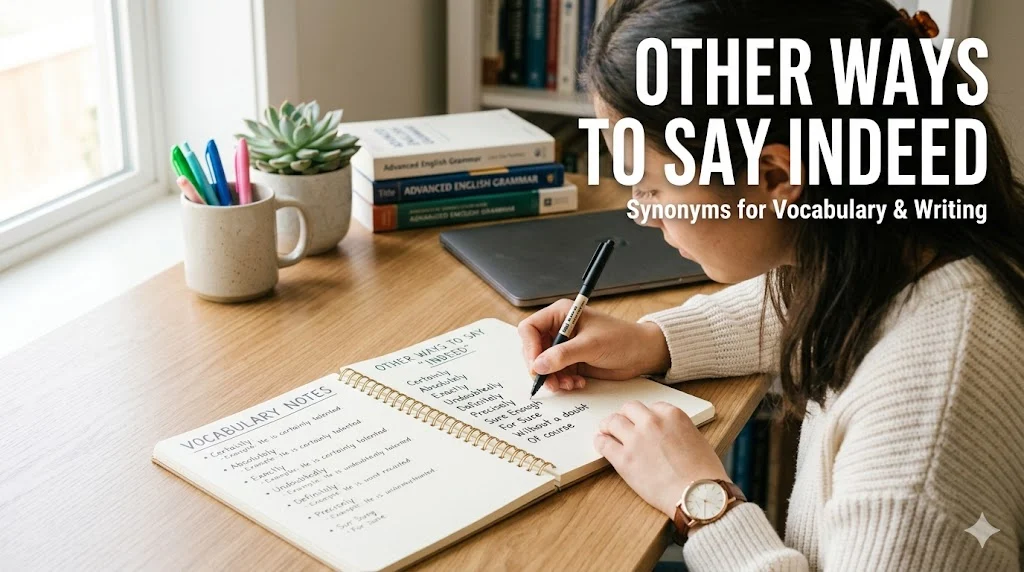
The word “indeed” is commonly used to confirm something or show strong agreement. It can also add emphasis in both spoken and written English.
However, relying too much on one word can make your communication repetitive. Learning alternatives to “other ways to say indeed” helps you sound more fluent and natural.
Expanding your vocabulary also helps you express excitement in English, adapt your tone, and communicate more effectively in professional and casual settings.
“The right word can transform simple agreement into confident communication.”
Quick Categories Section
Formal Alternatives to “Indeed”
- Certainly
- Undoubtedly
- Assuredly
- Truly
Pro Tip: Use these in academic writing, presentations, or formal emails.
Casual Alternatives
- Yep
- Yeah
- Totally
- For sure
Pro Tip: Great for conversations, but avoid in professional writing.
Professional Alternatives
- Absolutely
- Certainly
- Of course
- That is correct
Pro Tip: Choose neutral, respectful phrases in workplace communication.
Informal Expressions
- You bet
- No doubt
- Definitely
- 100%
Pro Tip: These add personality but may sound too relaxed in formal contexts.
“Fluency grows when you match your words to your audience.”
Common Mistakes
- Overusing “indeed”
Example: “Yes, indeed, I indeed agree.” - Using it in very casual chats
Example: “Indeed bro, that was fun.” - Using it incorrectly for emphasis
Example: “I am indeed go now.” - Placing it awkwardly in sentences
Example: “I will go indeed tomorrow.” - Using it in emotional situations where stronger words fit better
Example: “Indeed, I am excited!”
What Does “Indeed” Mean?
“Indeed” means in fact, truly, or certainly, and it is used to confirm or emphasize a statement.
Example:
“Yes, that is indeed correct.”
When to Use “Indeed”
- To confirm a statement
- To emphasize a point
- In formal writing
- In polite agreement
Spoken vs Written: More common in writing
Formal vs Informal: Mostly formal or neutral
Is It Professional or Polite to Say “Indeed”?
Polite? ✔️ Yes
Professional? ❌ No (in most cases)
While “indeed” is polite, it can sound slightly stiff or outdated in modern business communication.
Example:
“Indeed, I agree with your proposal.”
Pros and Cons of Using “Indeed”
Pros
- Simple and natural
- Friendly tone
- Common usage
- Easy to understand
Cons
- Too informal for work
- Overused
- Limited emotional range
- Not suitable for formal writing
“Professional English depends on clarity, not just correctness.”
Other Ways to Say “Indeed” With Examples
These alternatives will help you sound more fluent, confident, and natural in different situations.
Use them according to tone, context, and audience to express excitement, admiration, or approval.
1. Phrase: Certainly
Meaning: Shows strong agreement
Explanation: Formal and confident
Example Sentence: “I will certainly attend the meeting.”
Best Use: formal writing
Worst Use: casual chat
Tone: polite, formal
Context Variability: professional, spoken
2. Phrase: Absolutely
Meaning: Strong agreement
Explanation: Common in professional speech
Example Sentence: “Absolutely, I agree with your idea.”
Best Use: workplace
Worst Use: academic paper
Tone: confident, positive
Context Variability: professional, casual
3. Phrase: Definitely
Meaning: No doubt
Explanation: Widely used in speech
Example Sentence: “I will definitely join you.”
Best Use: conversation
Worst Use: formal essay
Tone: clear, friendly
Context Variability: spoken
4. Phrase: Truly
Meaning: Really or genuinely
Explanation: Adds emphasis
Example Sentence: “This is truly impressive.”
Best Use: formal tone
Worst Use: slang talk
Tone: sincere, formal
Context Variability: writing
5. Phrase: Of course
Meaning: Naturally
Explanation: Shows agreement or permission
Example Sentence: “Of course, you can join us.”
Best Use: polite reply
Worst Use: strict formal
Tone: polite, warm
Context Variability: professional, spoken
6. Phrase: Undoubtedly
Meaning: Without doubt
Explanation: Strong formal emphasis
Example Sentence: “She is undoubtedly talented.”
Best Use: academic
Worst Use: casual talk
Tone: formal, strong
Context Variability: writing
7. Phrase: Assuredly
Meaning: Certainly
Explanation: Formal and rare
Example Sentence: “This will assuredly succeed.”
Best Use: formal writing
Worst Use: casual speech
Tone: formal, confident
Context Variability: writing
8. Phrase: For sure
Meaning: Definitely
Explanation: Casual agreement
Example Sentence: “I’ll come, for sure.”
Best Use: casual
Worst Use: business email
Tone: relaxed, friendly
Context Variability: spoken
9. Phrase: No doubt
Meaning: Certainly true
Explanation: Informal emphasis
Example Sentence: “He will win, no doubt.”
Best Use: informal talk
Worst Use: formal report
Tone: confident, casual
Context Variability: spoken
10. Phrase: You bet
Meaning: Yes, definitely
Explanation: Very informal
Example Sentence: “You bet I’ll help.”
Best Use: friendly talk
Worst Use: workplace
Tone: casual, energetic
Context Variability: spoken
11. Phrase: Without question
Meaning: Completely certain
Explanation: Strong emphasis with confidence
Example Sentence: “She is without question the best candidate.”
Best Use: formal speech
Worst Use: casual chat
Tone: strong, confident
Context Variability: professional, writing
12. Phrase: Precisely
Meaning: Exactly correct
Explanation: Used to confirm accuracy
Example Sentence: “Precisely, that’s what I meant.”
Best Use: discussions
Worst Use: emotional talk
Tone: sharp, precise
Context Variability: professional, spoken
13. Phrase: Exactly
Meaning: Completely true
Explanation: Common agreement phrase
Example Sentence: “Exactly, I agree with you.”
Best Use: conversation
Worst Use: formal report
Tone: neutral, clear
Context Variability: spoken, casual
14. Phrase: Affirmative
Meaning: Yes (formal/military style)
Explanation: Formal confirmation
Example Sentence: “Affirmative, the task is complete.”
Best Use: official context
Worst Use: casual talk
Tone: formal, direct
Context Variability: professional
15. Phrase: That’s right
Meaning: Correct
Explanation: Confirms accuracy
Example Sentence: “That’s right, you understood it well.”
Best Use: teaching
Worst Use: formal writing
Tone: friendly, supportive
Context Variability: spoken
16. Phrase: Sure
Meaning: Yes or okay
Explanation: Simple and common
Example Sentence: “Sure, I can help you.”
Best Use: casual
Worst Use: formal email
Tone: relaxed, neutral
Context Variability: spoken
17. Phrase: Indeed so
Meaning: Yes, exactly
Explanation: Formal variation of indeed
Example Sentence: “It is indeed so.”
Best Use: formal writing
Worst Use: daily conversation
Tone: formal, classic
Context Variability: writing
18. Phrase: Unquestionably
Meaning: Beyond doubt
Explanation: Strong formal agreement
Example Sentence: “This is unquestionably true.”
Best Use: academic
Worst Use: casual talk
Tone: formal, strong
Context Variability: writing
19. Phrase: Positively
Meaning: Certainly
Explanation: Adds emphasis
Example Sentence: “He is positively brilliant.”
Best Use: descriptive writing
Worst Use: casual reply
Tone: expressive, formal
Context Variability: writing
20. Phrase: Surely
Meaning: Certainly or obviously
Explanation: Expresses expectation
Example Sentence: “Surely, this will work.”
Best Use: semi-formal
Worst Use: strict business
Tone: thoughtful, soft
Context Variability: spoken, writing
“Choosing the right synonym helps you sound both natural and intentional.”
21. Phrase: Beyond doubt
Meaning: Absolutely certain
Explanation: Strong emphasis
Example Sentence: “He is beyond doubt qualified.”
Best Use: formal
Worst Use: casual
Tone: strong, formal
Context Variability: writing
22. Phrase: Indubitably
Meaning: Without doubt
Explanation: Very formal and rare
Example Sentence: “This is indubitably correct.”
Best Use: academic
Worst Use: everyday talk
Tone: formal, sophisticated
Context Variability: writing
23. Phrase: Right
Meaning: Correct
Explanation: Quick agreement
Example Sentence: “Right, let’s begin.”
Best Use: conversation
Worst Use: formal writing
Tone: casual, direct
Context Variability: spoken
24. Phrase: Correct
Meaning: Accurate
Explanation: Confirms correctness
Example Sentence: “That is correct.”
Best Use: professional
Worst Use: emotional talk
Tone: neutral, formal
Context Variability: professional
25. Phrase: Naturally
Meaning: As expected
Explanation: Shows something obvious
Example Sentence: “Naturally, she succeeded.”
Best Use: writing
Worst Use: casual chat
Tone: smooth, confident
Context Variability: writing
26. Phrase: Sure thing
Meaning: Definitely yes
Explanation: Friendly agreement
Example Sentence: “Sure thing, I’ll do it.”
Best Use: informal
Worst Use: workplace email
Tone: friendly, casual
Context Variability: spoken
27. Phrase: Absolutely right
Meaning: Completely correct
Explanation: Strong agreement
Example Sentence: “You are absolutely right.”
Best Use: discussion
Worst Use: formal report
Tone: confident, supportive
Context Variability: spoken, professional
28. Phrase: Quite so
Meaning: Exactly (formal British tone)
Explanation: Polite agreement
Example Sentence: “Quite so, I agree.”
Best Use: formal
Worst Use: casual talk
Tone: polite, refined
Context Variability: formal
29. Phrase: Fair enough
Meaning: Acceptable or reasonable
Explanation: Shows agreement with condition
Example Sentence: “Fair enough, that makes sense.”
Best Use: discussion
Worst Use: formal writing
Tone: balanced, casual
Context Variability: spoken
30. Phrase: Agreed
Meaning: Mutual agreement
Explanation: Common in meetings
Example Sentence: “Agreed, let’s proceed.”
Best Use: workplace
Worst Use: casual chat
Tone: professional, concise
Context Variability: professional
“Mastering alternatives to ‘indeed’ helps you communicate with precision and confidence in every situation.”
Mini Quiz / Self-Check
1. Which is best for a formal email?
A. Yep
B. Certainly ✔️
C. You bet
2. Which is most casual?
A. Undoubtedly
B. You bet ✔️
C. Assuredly
3. Fill in: “I will ___ attend the meeting.”
A. Definitely ✔️
B. Yep
Comparison Table: Top Alternatives
| Phrase | Tone | Best Use |
| Certainly | Formal | Business |
| Absolutely | Confident | Workplace |
| Definitely | Friendly | Conversation |
| Truly | Sincere | Writing |
| Of course | Polite | General use |
| Undoubtedly | Formal | Academic |
| For sure | Casual | Friends |
| No doubt | Confident | Informal |
| Exactly | Neutral | Discussion |
| Agreed | Professional | Meetings |
FAQs
1. What are the best alternatives to “other ways to say indeed”?
Top options include certainly, absolutely, definitely, and truly.
2. Is “indeed” too formal?
Yes, it can sound slightly formal or outdated in casual speech.
3. How can I express excitement in English instead of “indeed”?
Use words like absolutely, definitely, or for sure.
4. What are professional reaction phrases instead of “indeed”?
Use certainly, absolutely, or that is correct.
5. Are informal expressions in English acceptable at work?
Generally no; stick to neutral or formal alternatives.
Conclusion
Learning other ways to say indeed helps you sound more natural, fluent, and confident in English. It allows you to adapt your tone for different situations, whether casual or professional.
Practice these alternatives daily and pay attention to context. Over time, you will develop stronger communication skills and a more polished English style.
CTA: Which alternative do you use the most? Try using three new ones today.
Other Ways to Say “Indeed” (11–30 Continued)
These additional alternatives to “other ways to say indeed” will further improve your fluency and help you express excitement in English across different contexts.