Last Updated on June 8, 2026
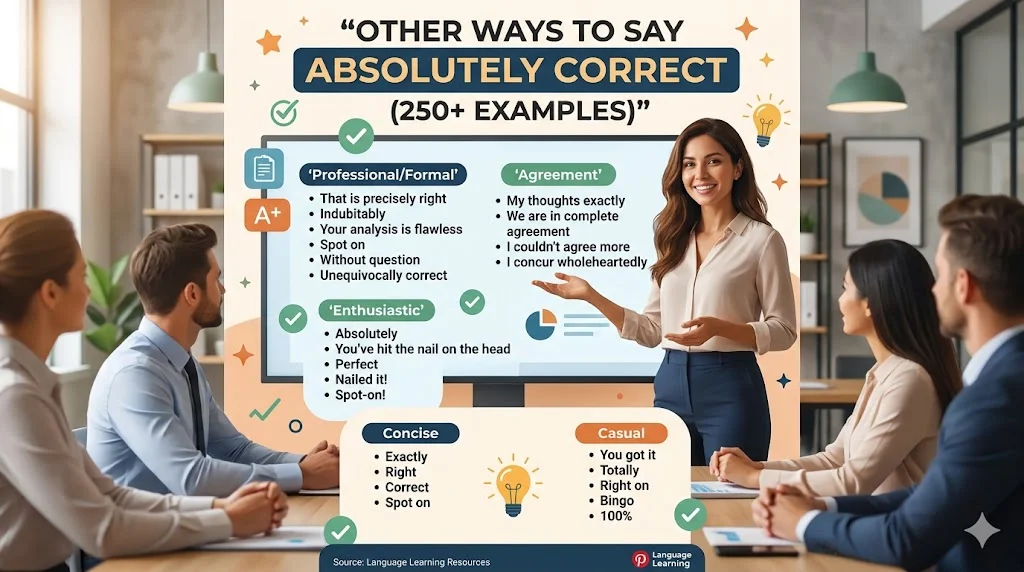
If you want alternatives to “absolutely correct,” try: exactly right, spot on, completely accurate, perfectly true, you’re right.
These expressions help you sound more natural, confident, and appropriate in both casual and professional English.
The phrase “absolutely correct” is used to strongly agree with someone or confirm that something is 100% accurate. It’s clear and direct, but it can feel repetitive or overly strong depending on the context.
Learning alternatives to “absolutely correct” helps you adapt your tone for different situations. Whether you want to sound formal, casual, or professional, the right phrase makes a big difference.
Expanding your vocabulary also helps you express excitement in English, agree politely, and communicate with more confidence in conversations and writing.
Quick Categories Section
Formal alternatives to “absolutely correct”
- Entirely accurate
- Precisely correct
- Fully valid
- Undeniably true
Pro Tip: Use these in academic or formal writing to sound polished and precise.
Casual alternatives
- Spot on
- You nailed it
- That’s right
- Totally right
Pro Tip: Keep your tone relaxed and friendly in conversations.
Professional alternatives
- That is correct
- I agree completely
- That is accurate
- You are correct
Pro Tip: Choose neutral, respectful phrases in workplace communication.
Informal expressions
- Yup, exactly
- 100% right
- No doubt about it
- Couldn’t be more right
Pro Tip: Use informal expressions only in relaxed settings, not in formal writing.
“The right phrase can turn simple agreement into confident communication.”
Common Mistakes Section
- Overusing “absolutely correct”
Example: You’re absolutely correct absolutely correct absolutely correct. - Using it in casual chats repeatedly
Example: Friend: That movie was great.
You: Absolutely correct. (Too formal) - Sounding too strong in uncertain situations
Example: I think this might work. → Absolutely correct. (Not appropriate) - Using it sarcastically (confusing tone)
Example: Oh yes, absolutely correct (may sound rude) - Using it in emails where softer tone is better
Example: Absolutely correct. → Better: That seems accurate.
What Does “Absolutely Correct” Mean?
Definition:
It means something is completely true, accurate, or without any error.
Grammar Note:
It combines an adverb (absolutely) with an adjective (correct) for strong emphasis.
Example:
You are absolutely correct about the results.
When to Use “Absolutely Correct”
- Confirming facts
- Strong agreement
- Academic discussions
- Giving feedback
Spoken vs Written:
- Spoken: Common but sometimes strong
- Written: Better in formal contexts
Formal vs Informal:
- Formal: ✔️ Yes
- Informal: ⚠️ Use sparingly
Is It Professional or Polite to Say “Absolutely Correct”?
- Polite? ✔️ Yes
- Professional? ❌ Not always
While respectful, it can sound too strong or rigid in business communication.
Business Example:
That is correct, and I appreciate your attention to detail.
Pros and Cons of Using “Absolutely Correct”
Pros
- Simple and natural
- Friendly tone
- Common usage
- Easy to understand
Cons
- Too informal for work
- Overused
- Limited emotional range
- Not suitable for formal writing
“Strong agreement is powerful but only when used at the right moment.”
Other Ways to Say “Absolutely Correct” With Examples
These alternatives will help you sound more fluent, confident, and natural in different situations.
Use them according to tone, context, and audience to express excitement, admiration, or approval.
1. Phrase: Exactly right
Meaning: Completely correct
Explanation: Emphasizes precision
Example Sentence: You are exactly right about the issue.
Best Use: Daily talk
Worst Use: Formal reports
Tone: clear, confident
Context Variability: casual / spoken
2. Phrase: Spot on
Meaning: Perfectly accurate
Explanation: Common informal agreement
Example Sentence: Your answer is spot on.
Best Use: Casual chat
Worst Use: Academic writing
Tone: friendly, natural
Context Variability: casual / spoken
3. Phrase: Completely accurate
Meaning: Fully correct
Explanation: Neutral and professional
Example Sentence: Your analysis is completely accurate.
Best Use: Work emails
Worst Use: Slang talk
Tone: neutral, formal
Context Variability: professional / written
4. Phrase: Perfectly true
Meaning: Totally true
Explanation: Slightly expressive agreement
Example Sentence: That’s perfectly true.
Best Use: Discussions
Worst Use: Technical docs
Tone: warm, clear
Context Variability: casual / spoken
5. Phrase: You’re right
Meaning: Correct statement
Explanation: Simple agreement
Example Sentence: You’re right about that.
Best Use: Everyday
Worst Use: Formal writing
Tone: neutral, friendly
Context Variability: casual / spoken
6. Phrase: That is correct
Meaning: Accurate statement
Explanation: Professional confirmation
Example Sentence: That is correct according to the data.
Best Use: Business
Worst Use: Casual slang
Tone: formal, neutral
Context Variability: professional / written
7. Phrase: Precisely
Meaning: Exactly correct
Explanation: Concise agreement
Example Sentence: Precisely, that’s the point.
Best Use: Formal speech
Worst Use: Casual texting
Tone: sharp, confident
Context Variability: professional / spoken
8. Phrase: Absolutely right
Meaning: Strong agreement
Explanation: Similar intensity
Example Sentence: You are absolutely right.
Best Use: Emphasis
Worst Use: Overuse
Tone: strong, clear
Context Variability: casual / spoken
9. Phrase: That’s accurate
Meaning: Factually correct
Explanation: Neutral tone
Example Sentence: That’s accurate based on the report.
Best Use: Workplace
Worst Use: Emotional talk
Tone: neutral, professional
Context Variability: professional / written
10. Phrase: No doubt about it
Meaning: Completely certain
Explanation: Confident agreement
Example Sentence: No doubt about it, you’re right.
Best Use: Conversation
Worst Use: Formal writing
Tone: confident, informal
Context Variability: casual / spoken
“Fluent speakers don’t repeat they vary.”
11. Phrase: Undeniably true
Meaning: Cannot be denied
Explanation: Strong formal agreement
Example Sentence: That is undeniably true.
Best Use: Formal
Worst Use: Casual
Tone: strong, formal
Context Variability: written / professional
12. Phrase: Entirely correct
Meaning: Fully accurate
Explanation: Formal version
Example Sentence: Your conclusion is entirely correct.
Best Use: Academic
Worst Use: Slang
Tone: formal, precise
Context Variability: professional / written
13. Phrase: That’s right
Meaning: Correct
Explanation: Basic agreement
Example Sentence: That’s right!
Best Use: Casual
Worst Use: Reports
Tone: simple, friendly
Context Variability: casual / spoken
14. Phrase: You nailed it
Meaning: Perfect answer
Explanation: Informal praise
Example Sentence: You nailed it with that explanation.
Best Use: Friendly talk
Worst Use: Formal writing
Tone: upbeat, informal
Context Variability: casual / spoken
15. Phrase: Fully valid
Meaning: Completely justified
Explanation: Professional tone
Example Sentence: Your point is fully valid.
Best Use: Meetings
Worst Use: Casual
Tone: formal, respectful
Context Variability: professional
16. Phrase: That checks out
Meaning: Seems correct
Explanation: Slightly informal
Example Sentence: That checks out logically.
Best Use: Analysis
Worst Use: Formal writing
Tone: relaxed, logical
Context Variability: casual / spoken
17. Phrase: Couldn’t be more right
Meaning: Completely correct
Explanation: Emphasized agreement
Example Sentence: You couldn’t be more right.
Best Use: Strong agreement
Worst Use: Reports
Tone: expressive, strong
Context Variability: casual / spoken
18. Phrase: That’s perfectly accurate
Meaning: Totally correct
Explanation: Balanced tone
Example Sentence: That’s perfectly accurate.
Best Use: Work
Worst Use: Slang
Tone: neutral, clear
Context Variability: professional
19. Phrase: Exactly
Meaning: Correct
Explanation: Short agreement
Example Sentence: Exactly! That’s what I meant.
Best Use: Conversation
Worst Use: Formal writing
Tone: quick, confident
Context Variability: casual / spoken
20. Phrase: True indeed
Meaning: Certainly true
Explanation: Slightly formal
Example Sentence: True indeed, that is the case.
Best Use: Writing
Worst Use: Slang
Tone: formal, thoughtful
Context Variability: written
“Choosing the right tone is as important as choosing the right words.”
21. Phrase: 100% correct
Meaning: Completely right
Explanation: Informal emphasis
Example Sentence: You’re 100% correct.
Best Use: Casual
Worst Use: Formal
Tone: strong, informal
Context Variability: casual
22. Phrase: That’s valid
Meaning: Reasonable and correct
Explanation: Modern usage
Example Sentence: That’s a valid point.
Best Use: Discussion
Worst Use: Formal writing
Tone: neutral, modern
Context Variability: casual / professional
23. Phrase: You are correct
Meaning: Accurate statement
Explanation: Neutral tone
Example Sentence: You are correct in your observation.
Best Use: Professional
Worst Use: Informal chat
Tone: formal, respectful
Context Variability: professional
24. Phrase: Perfectly correct
Meaning: Fully accurate
Explanation: Strong agreement
Example Sentence: That answer is perfectly correct.
Best Use: Teaching
Worst Use: Casual
Tone: clear, formal
Context Variability: written
25. Phrase: That’s true
Meaning: Correct
Explanation: Simple confirmation
Example Sentence: That’s true.
Best Use: Everyday
Worst Use: Academic
Tone: neutral, simple
Context Variability: casual
26. Phrase: Absolutely true
Meaning: Completely true
Explanation: Strong emphasis
Example Sentence: That is absolutely true.
Best Use: Emphasis
Worst Use: Overuse
Tone: strong, confident
Context Variability: spoken
27. Phrase: Without a doubt
Meaning: No uncertainty
Explanation: Confident agreement
Example Sentence: Without a doubt, you’re right.
Best Use: Conversation
Worst Use: Formal writing
Tone: confident, expressive
Context Variability: casual
28. Phrase: That’s on point
Meaning: Very accurate
Explanation: Informal modern phrase
Example Sentence: Your idea is on point.
Best Use: Casual
Worst Use: Formal
Tone: trendy, relaxed
Context Variability: casual
29. Phrase: Correct indeed
Meaning: Truly correct
Explanation: Slightly formal
Example Sentence: Correct indeed, that matches the data.
Best Use: Writing
Worst Use: Casual
Tone: formal, thoughtful
Context Variability: written
30. Phrase: That is spot on accurate
Meaning: Exactly correct
Explanation: Emphasized clarity
Example Sentence: That explanation is spot on accurate.
Best Use: Mixed contexts
Worst Use: Slang
Tone: clear, expressive
Context Variability: casual / professional
Mini Quiz / Self-Check
1. Which phrase is best for a business email?
A. Spot on
B. That is correct ✔️
C. You nailed it
2. Which is informal?
A. Entirely correct
B. Precisely
C. You nailed it ✔️
3. Best phrase for casual agreement?
A. Exactly ✔️
B. Undeniably true
C. Fully valid
Comparison Table: Top Alternatives
| Phrase | Tone | Best Use |
| Exactly right | Neutral | Daily use |
| Spot on | Informal | Conversations |
| Completely accurate | Formal | Work |
| That is correct | Professional | Business |
| Precisely | Formal | Presentations |
| You nailed it | Informal | Friendly talk |
| Entirely correct | Formal | Academic |
| That’s true | Neutral | Everyday |
| Without a doubt | Informal | Strong agreement |
| Fully valid | Professional | Meetings |
FAQs
1. What are the best alternatives to “absolutely correct”?
Some of the best include exactly right, completely accurate, precisely, spot on, and that is correct.
2. Is “absolutely correct” formal or informal?
It can be both, but it often sounds too strong for professional communication.
3. How can I express agreement professionally?
Use phrases like that is correct, I agree completely, or that is accurate.
4. What are informal expressions in English for agreement?
Examples include spot on, you nailed it, and exactly.
5. Why should I learn other ways to say “absolutely correct”?
It improves fluency, tone control, and helps you communicate more naturally.
Conclusion
Learning other ways to say “absolutely correct” helps you communicate with precision, confidence, and flexibility. Different situations require different tones, and having multiple options makes your English more natural.
Practice these phrases daily and pay attention to tone and context. The more you use these professional reaction phrases and informal expressions in English, the more fluent and confident you will become.
See also: Other Ways to Say “I Agree” | Professional English Phrases for Workplace Communication
CTA: Which phrase do you use most often? Try a new one today and upgrade your English instantly.