Last Updated on May 15, 2026
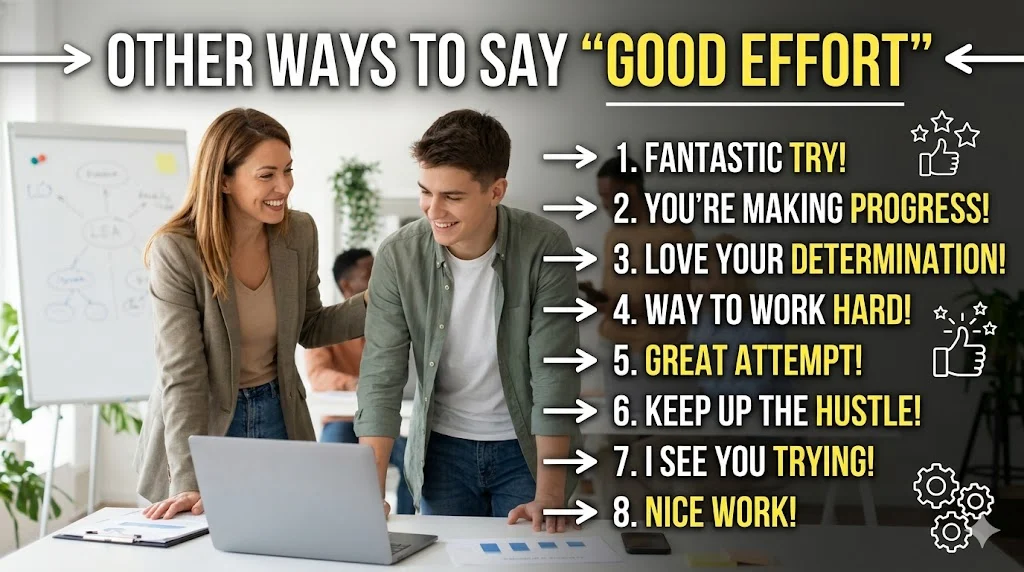
Some of the best other ways to say good effort include: well done, nice try, great attempt, solid effort, impressive work.
These alternatives help you sound more natural, expressive, and appropriate in both casual and professional communication.
The phrase “good effort” is commonly used to acknowledge someone’s attempt, even if the result wasn’t perfect. It shows encouragement, appreciation, and support.
People use it in school, workplaces, sports, and everyday conversations. However, relying on the same phrase repeatedly can make your English sound limited.
Learning alternatives to “good effort” helps you express excitement in English, improve tone awareness, and communicate more effectively in different situations.
Quick Categories Section
Formal Alternatives to “Good Effort”
- Commendable effort
- Admirable attempt
- Noteworthy work
- A respectable effort
Pro Tip: Use formal phrases in reports, evaluations, or academic feedback.
Casual Alternatives
- Nice try
- Good job
- Way to go
- You did well
Pro Tip: Casual phrases work best in friendly conversations and informal settings.
Professional Alternatives
- Strong performance
- Solid contribution
- Valuable effort
- Well-executed attempt
Pro Tip: In the workplace, choose phrases that highlight impact and professionalism.
Informal Expressions
- You gave it your best
- That was decent
- Not bad at all
- Good hustle
Pro Tip: Informal expressions are great for relaxed, spoken English but avoid them in formal writing.
“The right phrase doesn’t just praise effort it builds confidence and clarity.”
Common Mistakes When Using “Good Effort”
- Using it in formal reports
Incorrect: Good effort on the quarterly analysis. - Sounding passive-aggressive
Example: Good effort… but this isn’t acceptable. - Overusing the phrase
Example: Repeating “good effort” for every situation. - Using it for excellent performance
Incorrect: Good effort (when the result was outstanding). - Wrong tone in serious contexts
Example: Good effort during critical evaluations.
What Does “Good Effort” Mean?
Definition:
“Good effort” means someone tried hard or put in noticeable work, even if the result wasn’t perfect.
Grammar Note:
It is a noun phrase often used as a short expression of praise.
Example:
That presentation wasn’t perfect, but it was a good effort.
When to Use “Good Effort”
- Encouraging someone after trying
- Acknowledging partial success
- Supporting learners or beginners
- Motivating team members
Spoken vs Written:
More common in spoken English
Formal vs Informal:
Mostly informal
Is It Professional or Polite to Say “Good Effort”?
Polite? ✔️ Yes
Professional? ❌ No (in most cases)
While polite, it may sound vague or slightly dismissive in business contexts.
Business Example:
Thank you for your effort on this project; let’s refine a few areas further.
Pros and Cons of Using “Good Effort”
Pros
- Simple and natural
- Friendly tone
- Common usage
- Easy to understand
Cons
- Too informal for work
- Overused
- Limited emotional range
- Not suitable for formal writing
“Small changes in wording can instantly elevate your professional communication.”
Other Ways to Say “Good Effort” With Examples
These alternatives will help you sound more fluent, confident, and natural in different situations.
Use them according to tone, context, and audience to express excitement, admiration, or approval.
1. Phrase: Well done
Meaning: You performed successfully
Explanation: A common praise for positive results
Example Sentence: Well done on completing the task ahead of time.
Best Use: General praise
Worst Use: Poor results
Tone: Positive, encouraging
Context Variability: casual / professional / spoken
2. Phrase: Nice try
Meaning: Acknowledges effort despite failure
Explanation: Encouraging but slightly informal
Example Sentence: Nice try you were very close.
Best Use: Learning stage
Worst Use: Formal review
Tone: Light, supportive
Context Variability: casual / spoken
3. Phrase: Great attempt
Meaning: Strong effort made
Explanation: Highlights effort over outcome
Example Sentence: That was a great attempt at solving the problem.
Best Use: Feedback
Worst Use: Final success
Tone: Encouraging, neutral
Context Variability: casual / professional
4. Phrase: Solid effort
Meaning: Reliable and consistent work
Explanation: Suggests dependable performance
Example Sentence: That was a solid effort from the whole team.
Best Use: Teamwork
Worst Use: Weak results
Tone: Neutral, approving
Context Variability: professional / spoken
5. Phrase: Impressive work
Meaning: Work that stands out positively
Explanation: Stronger than “good effort”
Example Sentence: Impressive work on the presentation.
Best Use: High quality
Worst Use: Average work
Tone: Strong, positive
Context Variability: professional
“Using the right alternative helps you express excitement in English more naturally.”
6. Phrase: Admirable effort
Meaning: Worth respect
Explanation: Formal praise
Example Sentence: Your dedication shows an admirable effort.
Best Use: Formal feedback
Worst Use: Casual talk
Tone: Formal, respectful
Context Variability: professional
7. Phrase: Great job
Meaning: Task completed well
Explanation: Common informal praise
Example Sentence: Great job on finishing early.
Best Use: Everyday praise
Worst Use: Formal writing
Tone: Friendly, upbeat
Context Variability: casual
8. Phrase: You did well
Meaning: Positive performance
Explanation: Simple and versatile
Example Sentence: You did well on your test.
Best Use: General use
Worst Use: Strong praise
Tone: Neutral, supportive
Context Variability: all contexts
9. Phrase: Strong performance
Meaning: High-quality execution
Explanation: Professional evaluation
Example Sentence: That was a strong performance during the meeting.
Best Use: Workplace
Worst Use: Casual chat
Tone: Professional, confident
Context Variability: professional
10. Phrase: Good attempt
Meaning: A fair try
Explanation: Similar but softer than “good effort”
Example Sentence: That was a good attempt keep practicing.
Best Use: Learning
Worst Use: High success
Tone: Gentle, supportive
Context Variability: casual
11. Phrase: Respectable effort
Meaning: A decent and worthy attempt
Explanation: Shows moderate approval in a formal tone
Example Sentence: That was a respectable effort given the time constraints.
Best Use: Academic feedback
Worst Use: Casual chat
Tone: Formal, neutral
Context Variability: professional / written
12. Phrase: Decent attempt
Meaning: A fairly good try
Explanation: Indicates average but acceptable effort
Example Sentence: That was a decent attempt keep improving.
Best Use: Learning stage
Worst Use: High praise
Tone: Neutral, mild
Context Variability: casual / spoken
13. Phrase: Not bad at all
Meaning: Better than expected
Explanation: Informal praise with a positive tone
Example Sentence: Not bad at all you’re getting better.
Best Use: Friendly feedback
Worst Use: Formal report
Tone: Casual, encouraging
Context Variability: spoken / casual
14. Phrase: Excellent try
Meaning: A very strong attempt
Explanation: More positive than “good effort”
Example Sentence: Excellent try you were very close to the solution.
Best Use: Encouragement
Worst Use: Weak performance
Tone: Positive, uplifting
Context Variability: casual / professional
15. Phrase: You gave it your best
Meaning: You tried as hard as possible
Explanation: Focuses on effort rather than outcome
Example Sentence: You gave it your best, and that matters.
Best Use: Emotional support
Worst Use: Formal writing
Tone: Warm, supportive
Context Variability: spoken / personal
16. Phrase: Keep it up
Meaning: Continue doing well
Explanation: Encourages ongoing effort
Example Sentence: Great progress keep it up!
Best Use: Motivation
Worst Use: Formal feedback
Tone: Encouraging, casual
Context Variability: spoken / casual
17. Phrase: That was solid
Meaning: Reliable and good quality
Explanation: Informal but confident praise
Example Sentence: That presentation was solid.
Best Use: Peer feedback
Worst Use: Formal writing
Tone: Casual, confident
Context Variability: spoken
18. Phrase: Worthy effort
Meaning: Effort deserving recognition
Explanation: Slightly formal and respectful
Example Sentence: Your work reflects a worthy effort.
Best Use: Formal tone
Worst Use: Casual talk
Tone: Formal, respectful
Context Variability: written / professional
19. Phrase: Nicely done
Meaning: Completed well
Explanation: Polished and positive praise
Example Sentence: Nicely done on finishing the task early.
Best Use: General praise
Worst Use: Weak results
Tone: Friendly, positive
Context Variability: all contexts
20. Phrase: Great work
Meaning: High-quality performance
Explanation: Stronger than “good effort”
Example Sentence: Great work on the project report.
Best Use: Workplace
Worst Use: Poor results
Tone: Positive, confident
Context Variability: professional / casual
“Upgrading simple phrases like ‘good effort’ can instantly improve your communication impact.”
21. Phrase: Good hustle
Meaning: Energetic effort
Explanation: Common in sports or teamwork
Example Sentence: Good hustle out there today.
Best Use: Sports/team
Worst Use: Formal setting
Tone: Informal, energetic
Context Variability: spoken
22. Phrase: You’re improving
Meaning: Showing progress over time
Explanation: Encourages continued effort
Example Sentence: You’re improving with each attempt.
Best Use: Learning feedback
Worst Use: Final evaluation
Tone: Supportive, positive
Context Variability: all contexts
23. Phrase: Keep going
Meaning: Continue your effort
Explanation: Motivational and forward-focused
Example Sentence: Keep going you’re almost there.
Best Use: Motivation
Worst Use: Formal writing
Tone: Encouraging, casual
Context Variability: spoken
24. Phrase: That’s progress
Meaning: Improvement is visible
Explanation: Focuses on growth
Example Sentence: That’s progress you’re getting closer.
Best Use: Coaching
Worst Use: Final success
Tone: Positive, constructive
Context Variability: professional / casual
25. Phrase: Encouraging effort
Meaning: Effort that shows promise
Explanation: Formal and supportive
Example Sentence: This is an encouraging effort for a first attempt.
Best Use: Formal feedback
Worst Use: Casual talk
Tone: Formal, supportive
Context Variability: written
26. Phrase: You handled that well
Meaning: Managed the situation effectively
Explanation: Focuses on performance
Example Sentence: You handled that challenge well.
Best Use: Workplace
Worst Use: Weak performance
Tone: Professional, positive
Context Variability: professional
27. Phrase: Strong attempt
Meaning: A solid and capable try
Explanation: Slightly more professional tone
Example Sentence: That was a strong attempt well done.
Best Use: Feedback
Worst Use: Poor effort
Tone: Neutral, confident
Context Variability: professional / casual
28. Phrase: That was effective
Meaning: Produced good results
Explanation: Focuses on outcome
Example Sentence: That approach was effective.
Best Use: Professional
Worst Use: Casual chat
Tone: Formal, analytical
Context Variability: professional
29. Phrase: You’re on the right track
Meaning: Moving in the correct direction
Explanation: Encourages continuation
Example Sentence: You’re on the right track keep refining it.
Best Use: Guidance
Worst Use: Final praise
Tone: Supportive, constructive
Context Variability: all contexts
30. Phrase: Promising work
Meaning: Shows future potential
Explanation: Suggests improvement ahead
Example Sentence: This is promising work keep developing it.
Best Use: Evaluation
Worst Use: Casual chat
Tone: Professional, optimistic
Context Variability: professional
Mini Quiz / Self-Check
1. Which is best for a formal report?
A. Nice try
B. Admirable effort
C. Not bad
Answer: B
2. Which sounds casual?
A. Strong performance
B. Good hustle
C. Commendable effort
Answer: B
3. Best phrase for workplace feedback?
A. Great job
B. Strong performance
C. Nice try
Answer: B
Comparison Table: Top Alternatives
| Phrase | Tone | Best Use |
| Well done | Positive | General praise |
| Nice try | Light | Learning |
| Great attempt | Encouraging | Feedback |
| Solid effort | Neutral | Teamwork |
| Impressive work | Strong | High quality |
| Admirable effort | Formal | Reports |
| Great job | Friendly | Casual |
| Strong performance | Professional | Workplace |
| You did well | Neutral | General |
| Respectable effort | Formal | Academic |
FAQs
1. What are the best professional alternatives to “good effort”?
Use strong performance, commendable effort, or valuable contribution in professional settings.
2. Is “good effort” negative or positive?
It is generally positive but can sound slightly neutral or weak depending on tone.
3. How can I express excitement in English instead of “good effort”?
Use phrases like impressive work, excellent job, or fantastic effort.
4. What are casual alternatives to “good effort”?
Try nice try, good job, or not bad at all.
5. Why should I learn other ways to say “good effort”?
It improves fluency, avoids repetition, and helps you sound more natural and confident.
Conclusion
Expanding your vocabulary with other ways to say good effort allows you to communicate more clearly, professionally, and confidently. It helps you match your tone to the situation whether casual, formal, or workplace communication.
Practice using these alternatives daily. The more you vary your expressions, the more natural and fluent your English will sound.
CTA: Which alternative do you use most often? Try using a new one today in your next conversation.