Last Updated on May 15, 2026
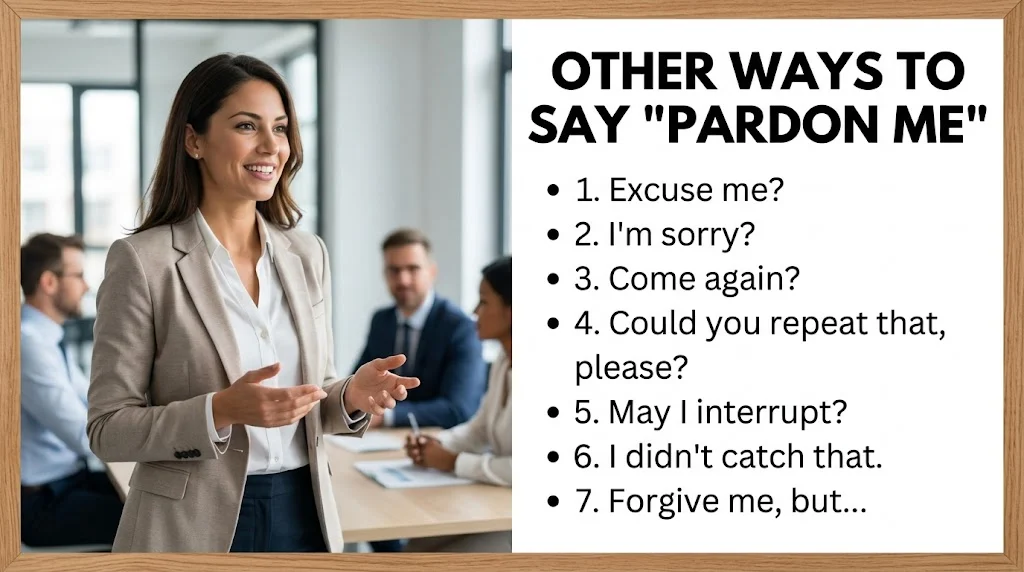
If you want alternatives to “pardon me”, try: excuse me, I beg your pardon, sorry, could you repeat that, my apologies.
These options help you adjust tone from polite and formal to casual and conversational depending on the situation.
The phrase “pardon me” is commonly used to politely ask someone to repeat something, get attention, or apologize lightly. It’s simple, respectful, and widely understood.
However, relying on just one phrase can limit your fluency. Learning alternatives to “pardon me” allows you to sound more natural and confident in different settings.
Expanding your vocabulary also helps you express excitement in English, react appropriately, and adapt your tone for both professional and informal conversations.
“The right phrase at the right moment can instantly elevate your English fluency.”
Quick Categories Section
Formal Alternatives to “Pardon Me”
- I beg your pardon
- My apologies
- Would you mind repeating that?
- Kindly repeat that
Pro Tip: Use these in formal meetings, presentations, or when speaking to seniors.
Casual Alternatives
- Sorry?
- What was that?
- Come again?
- Huh?
Pro Tip: Keep casual phrases for friends and relaxed conversations.
Professional Alternatives
- Could you please repeat that?
- I didn’t catch that
- Would you mind clarifying?
- Could you say that again?
Pro Tip: In the workplace, clarity matters more than politeness alone.
Informal Expressions
- Say that again?
- What did you say?
- Sorry, what?
- Repeat that?
Pro Tip: Avoid overly informal expressions in professional environments.
“Fluency is not just vocabulary it’s choosing the right tone.”
Common Mistakes Section
- Overusing “pardon me” in every situation
Example: Pardon me, can you pass the salt? (too formal casually) - Using it in professional emails
Example: Pardon me, I didn’t understand the report. - Using informal alternatives in formal settings
Example: Huh? (in a meeting) - Using it incorrectly as an apology
Example: Pardon me for breaking your laptop (too weak) - Incorrect tone with strangers
Example: What? (sounds rude)
What Does “Pardon Me” Mean?
“Pardon me” is a polite expression used to:
- Ask someone to repeat something
- Apologize lightly
- Get someone’s attention
Example: Pardon me, could you repeat that?
When to Use “Pardon Me”
- Asking someone to repeat information
- Interrupting politely
- Passing by someone
- Light apologies
Spoken vs Written: Mostly spoken
Formal vs Informal: Neutral, slightly formal
Is It Professional or Polite to Say “Pardon Me”?
“Pardon me” is polite, but not always ideal in professional communication.
Business Example:
Pardon me, could you clarify the last point?
Polite? ✔️ Yes
Professional? ❌ No (in most cases)
Pros and Cons of Using “Pardon Me”
Pros
- Simple and natural
- Friendly tone
- Common usage
- Easy to understand
Cons
- Too informal for work
- Overused
- Limited emotional range
- Not suitable for formal writing
“Small changes in wording create big improvements in professionalism.”
Other Ways to Say “Pardon Me” With Examples
These alternatives will help you sound more fluent, confident, and natural in different situations.
Use them according to tone, context, and audience.
1. Phrase: Excuse me
Meaning: Polite attention-getter
Explanation: Most versatile alternative
Example: Excuse me, could you repeat that?
Best Use: daily speech
Worst Use: none
Tone: polite, neutral
Context Variability: casual / professional
2. Phrase: I beg your pardon
Meaning: Very formal request
Explanation: Strong politeness
Example: I beg your pardon, I didn’t hear you.
Best Use: formal
Worst Use: casual chat
Tone: formal, respectful
Context Variability: professional
3. Phrase: Sorry
Meaning: Casual apology or request
Explanation: Common in daily speech
Example: Sorry, what did you say?
Best Use: casual
Worst Use: formal writing
Tone: informal, friendly
Context Variability: spoken
4. Phrase: Could you repeat that?
Meaning: Request repetition
Explanation: Clear and professional
Example: Could you repeat that, please?
Best Use: workplace
Worst Use: none
Tone: polite, professional
Context Variability: professional
5. Phrase: I didn’t catch that
Meaning: Missed hearing
Explanation: Natural conversational phrase
Example: I didn’t catch that, could you say it again?
Best Use: meetings
Worst Use: formal writing
Tone: neutral, polite
Context Variability: spoken / professional
6. Phrase: Say that again?
Meaning: Ask for repetition
Explanation: Informal
Example: Say that again?
Best Use: friends
Worst Use: office
Tone: casual
Context Variability: spoken
7. Phrase: Come again?
Meaning: Repeat request
Explanation: Slightly informal
Example: Come again?
Best Use: casual
Worst Use: formal
Tone: informal
Context Variability: spoken
8. Phrase: My apologies
Meaning: Formal apology
Explanation: Professional tone
Example: My apologies, could you repeat that?
Best Use: business
Worst Use: casual
Tone: formal, respectful
Context Variability: professional
9. Phrase: What was that?
Meaning: Clarification request
Explanation: Neutral tone
Example: What was that? I missed it.
Best Use: casual
Worst Use: formal
Tone: neutral
Context Variability: spoken
10. Phrase: Could you say that again?
Meaning: Repeat request
Explanation: Polite and clear
Example: Could you say that again, please?
Best Use: work
Worst Use: none
Tone: polite
Context Variability: professional
“Professional communication depends on clarity, not just politeness.”
11. Phrase: Kindly repeat that
Meaning: Polite request for repetition
Explanation: Slightly formal and respectful
Example Sentence: Kindly repeat that point for clarity.
Best Use: formal speech
Worst Use: casual chat
Tone: polite, formal
Context Variability: professional / spoken
12. Phrase: Would you mind repeating that?
Meaning: Polite indirect request
Explanation: Softens the request using courtesy
Example Sentence: Would you mind repeating that, please?
Best Use: meetings
Worst Use: urgent situations
Tone: polite, respectful
Context Variability: professional / spoken
13. Phrase: Please say that again
Meaning: Direct repetition request
Explanation: Simple and neutral phrase
Example Sentence: Please say that again more clearly.
Best Use: daily use
Worst Use: very formal writing
Tone: neutral, polite
Context Variability: casual / professional
14. Phrase: Repeat that, please
Meaning: Direct request
Explanation: Short and clear
Example Sentence: Repeat that, please I missed it.
Best Use: quick requests
Worst Use: formal emails
Tone: neutral, direct
Context Variability: spoken
15. Phrase: I’m sorry, could you clarify?
Meaning: Ask for explanation
Explanation: Combines apology with clarification
Example Sentence: I’m sorry, could you clarify your point?
Best Use: workplace
Worst Use: casual chat
Tone: polite, professional
Context Variability: professional
16. Phrase: Could you clarify that?
Meaning: Request explanation
Explanation: Focuses on understanding, not hearing
Example Sentence: Could you clarify that section of the report?
Best Use: meetings
Worst Use: casual talk
Tone: professional, clear
Context Variability: professional
17. Phrase: What did you say?
Meaning: Ask for repetition
Explanation: Direct but can sound blunt
Example Sentence: What did you say? I didn’t hear you.
Best Use: informal
Worst Use: formal settings
Tone: direct, neutral
Context Variability: casual
18. Phrase: Sorry, what?
Meaning: Casual clarification
Explanation: Very common in everyday speech
Example Sentence: Sorry, what did you mean?
Best Use: friends
Worst Use: workplace
Tone: informal, friendly
Context Variability: spoken
19. Phrase: Can you repeat that?
Meaning: Ask for repetition
Explanation: Simple and widely used
Example Sentence: Can you repeat that, please?
Best Use: general use
Worst Use: none
Tone: neutral, polite
Context Variability: casual / professional
20. Phrase: I didn’t quite hear you
Meaning: Missed hearing
Explanation: Soft and polite
Example Sentence: I didn’t quite hear you could you say it again?
Best Use: polite speech
Worst Use: none
Tone: gentle, polite
Context Variability: spoken / professional
“Politeness isn’t about long phrases it’s about the right tone.”
21. Phrase: Could you restate that?
Meaning: Ask for repetition in different words
Explanation: More formal than “repeat”
Example Sentence: Could you restate that for clarity?
Best Use: formal
Worst Use: casual talk
Tone: formal, professional
Context Variability: professional
22. Phrase: Please clarify
Meaning: Request explanation
Explanation: Short and direct
Example Sentence: Please clarify your last point.
Best Use: work
Worst Use: casual chat
Tone: direct, professional
Context Variability: professional
23. Phrase: Would you explain that again?
Meaning: Request explanation
Explanation: Slightly softer than “clarify”
Example Sentence: Would you explain that again more simply?
Best Use: learning context
Worst Use: urgent situations
Tone: polite, clear
Context Variability: professional / spoken
24. Phrase: I missed that
Meaning: Didn’t hear something
Explanation: Casual and natural
Example Sentence: I missed that can you repeat it?
Best Use: casual
Worst Use: formal
Tone: informal, neutral
Context Variability: spoken
25. Phrase: Can you go over that again?
Meaning: Ask for review
Explanation: Implies detailed explanation
Example Sentence: Can you go over that again step by step?
Best Use: learning
Worst Use: quick chats
Tone: polite, detailed
Context Variability: professional / spoken
26. Phrase: I didn’t understand
Meaning: Lack of comprehension
Explanation: Focuses on meaning, not sound
Example Sentence: I didn’t understand could you explain?
Best Use: learning
Worst Use: formal writing
Tone: honest, neutral
Context Variability: spoken
27. Phrase: Could you rephrase that?
Meaning: Say differently
Explanation: Useful for clarity
Example Sentence: Could you rephrase that more simply?
Best Use: professional
Worst Use: casual
Tone: polite, professional
Context Variability: professional
28. Phrase: Please repeat
Meaning: Direct request
Explanation: Very short and clear
Example Sentence: Please repeat the instructions.
Best Use: formal
Worst Use: friendly chat
Tone: direct, formal
Context Variability: professional
29. Phrase: I didn’t hear that clearly
Meaning: Partial misunderstanding
Explanation: Softens the request
Example Sentence: I didn’t hear that clearly could you repeat it?
Best Use: polite speech
Worst Use: none
Tone: polite, neutral
Context Variability: spoken / professional
30. Phrase: Say it again, please
Meaning: Repeat request
Explanation: Friendly and natural
Example Sentence: Say it again, please I’m listening.
Best Use: casual
Worst Use: formal writing
Tone: friendly, casual
Context Variability: spoken
“Mastering alternatives to ‘pardon me’ helps you sound natural in every situation.”
Mini Quiz / Self-Check
1. Which is best for a meeting?
A. Huh?
B. Could you clarify that?
C. What?
Answer: B
2. Which is too informal for work?
A. My apologies
B. Come again?
C. Could you repeat that?
Answer: B
3. Best casual option?
A. I beg your pardon
B. Sorry?
C. Kindly repeat that
Answer: B
Comparison Table: Top Alternatives
| Phrase | Tone | Best Use |
| Excuse me | Neutral | All situations |
| I beg your pardon | Formal | Formal events |
| Sorry | Casual | Friends |
| Could you repeat that? | Professional | Workplace |
| I didn’t catch that | Neutral | Meetings |
| My apologies | Formal | Business |
| Come again? | Informal | Casual talk |
| Kindly repeat that | Formal | Emails |
| Could you clarify? | Professional | Work |
| Say that again? | Casual | Conversations |
FAQs
1. What are the best alternatives to “pardon me”?
The best options include excuse me, sorry, could you repeat that, and my apologies depending on context.
2. Is “pardon me” formal or informal?
It is slightly formal but still used in everyday conversation.
3. What should I say instead of “pardon me” at work?
Use professional reaction phrases like could you clarify or I didn’t catch that.
4. Can “sorry” replace “pardon me”?
Yes, in casual situations, “sorry” works perfectly.
5. How do I sound more fluent in English?
Use a mix of alternatives to “pardon me” and adjust your tone based on context.
Conclusion
Learning other ways to say “pardon me” helps you communicate more naturally and effectively. It allows you to adjust your tone for formal, casual, and professional situations.
Practice these phrases daily, and focus on tone awareness. The more you vary your expressions, the more confident and fluent your English will become.
CTA: Start using 2–3 new phrases today in your conversations to build natural fluency.