
Last Updated on June 18, 2026
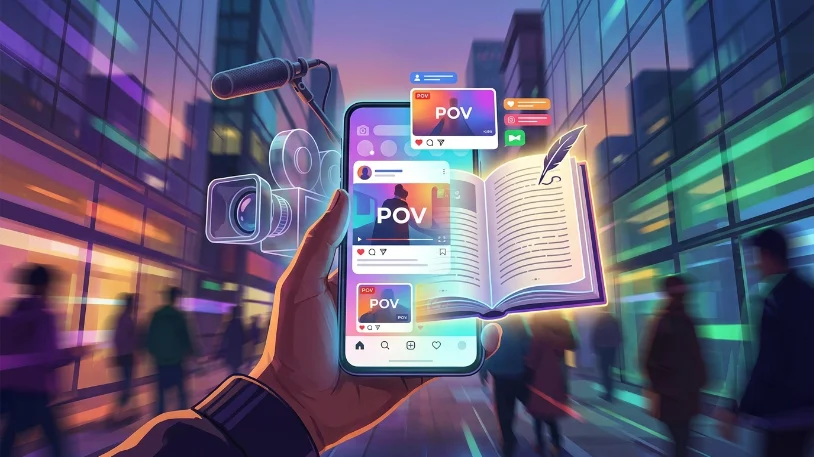
POV meaning stands for Point of View, which refers to a specific perspective or angle from which a situation, story, or experience is presented. In social media, POV is used to create immersive content where the viewer feels part of the scene. In writing and film, it defines how a story is told first-person, second-person, or third-person.
You’ve seen POV everywhere. A video starts with “POV:” followed by a scenario that instantly pulls you in. It feels personal almost like the story is happening to you. If you’ve ever wondered about the POV full form, what is the full form of POV, or full form of POV in Reels, the term stands for Point of View. The POV meaning is the perspective from which a story, video, or situation is presented.
On platforms like Instagram, TikTok and YouTube Shorts, POV meaning on Instagram and POV meaning in social media refer to videos designed to place the viewer in a specific role or situation. That’s why many people search what does POV mean on social media, what is POV, what is the meaning of POV, meaning of POV, what is meaning of POV, POV means, or what is POV means before they fully understand how creators use the term in online content.
So, what does POV mean?
POV stands for “Point of View.”
At its core, it describes the perspective from which something is experienced, told, or shown.
That sounds simple. Yet, the way people use POV today goes far beyond a dictionary definition.
Think of it like this:
POV is the lens through which you experience a moment.
Sometimes that lens is yours. Sometimes it belongs to someone else. Either way, it shapes how you understand what’s happening.
What Does POV Mean in Everyday Language?
In plain terms, POV meaning is about who is experiencing something.
Here’s a quick breakdown:
- POV = Perspective
- POV = Viewpoint
- POV = Angle of experience
Simple Examples
- POV: You forgot your homework and the teacher calls your name.
- POV: You just got your first paycheck.
In both examples, the viewer becomes part of the situation. That’s the magic.
POV Full Form and Core Definition
| Term | Meaning |
|---|---|
| POV | Point of View |
| Type | Acronym / Abbreviation |
| Usage | Writing, film, social media, communication |
Definition:
Point of View (POV) refers to the position or perspective from which something is observed, narrated, or presented.
POV Meaning in Social Media
Scroll through TikTok or Instagram for five minutes. You’ll spot “POV” everywhere.
But here’s the twist POV in social media has evolved into its own language.
What is POV in Social Media?
On platforms like TikTok, Instagram Reels, and YouTube Shorts, POV means you’re placing the viewer inside a scenario.
It’s not just storytelling. It’s interactive storytelling.
How POV Content Works
- The creator sets a situation
- The viewer becomes the main character
- The story unfolds from that perspective
Example
- POV: You walk into a job interview and realize you know nothing.
You’re not watching someone. You are that someone.
Why POV Content Dominates TikTok
POV isn’t trending by accident. It taps into how people think and feel.
Key Reasons
- Instant immersion – No explanation needed
- Relatable scenarios – Everyday experiences
- Emotional connection – Feels personal
- High engagement – People comment and share
Psychology Behind It
When you see a POV video, your brain fills in the gaps. It imagines the situation. That mental participation makes the content more memorable.
Common POV Formats on TikTok and Instagram
Popular Styles
- “POV: You are” scenarios
- Roleplay situations
- Funny or awkward moments
- Emotional storytelling
Examples
- POV: You meet your childhood best friend after years
- POV: Your phone dies at 1% during an important call
POV Meaning in Texting and Chat
In texting, POV works slightly differently. It’s less visual and more expressive.
What Does POV Mean in Text?
It signals that a message is written from a specific perspective or scenario.
Example
- POV: You finally understand math after failing all year.
Here, POV sets the context instantly. No long explanation needed.
POV Meaning Slang Explained
POV has become internet slang. That means people use it casually, sometimes even incorrectly.
Slang Characteristics
- Short
- Relatable
- Often exaggerated
- Sometimes humorous
Important Note
Not all POV usage online is technically correct. Still, language evolves. What matters is how people understand it.
POV in Writing and Storytelling
Long before social media, POV shaped storytelling.
Writers rely on it to control how readers experience a story.
The Three Main Types of POV
First-Person Point of View
- Uses: I, me, we
- The narrator is part of the story
Example:
I walked into the room and felt the tension immediately.
Effect:
- Personal
- Emotional
- Limited knowledge
Second-Person POV
- Uses: you
- The reader becomes the character
Example:
You walk into the room. Everyone turns to stare.
Effect:
- Immersive
- Rare but powerful
Third-Person POV
- Uses: he, she, they
- Narrator stands outside the story
Example:
She walked into the room and noticed the silence.
Effect:
- Flexible
- Widely used
Quick Comparison Table
| POV Type | Pronouns | Strength | Limitation |
|---|---|---|---|
| First-person | I, we | Emotional depth | Limited view |
| Second-person | You | Immersive | Hard to sustain |
| Third-person | He, she, they | Flexible | Less personal |
POV in Movies and Cinematography
In film, POV isn’t just about storytelling. It’s visual.
What is a POV Shot?
A POV shot shows exactly what a character sees.
Examples
- Looking through binoculars
- Seeing through a character’s eyes
- First-person camera angles
Why Directors Use POV Shots
- Create realism
- Build tension
- Make scenes more engaging
A good POV shot makes you feel like you’re inside the scene.
POV vs Perspective: What’s the Difference?
People often confuse these two.
Let’s clear it up.
Simple Explanation
- POV = where you are looking from
- Perspective = how you interpret what you see
Analogy
Imagine standing on a mountain.
- POV = your physical position
- Perspective = your thoughts about the view
Common Mistakes People Make With POV
Even though POV seems simple, people misuse it often.
Top Mistakes
- Using POV without a clear perspective
- Writing general statements instead of scenarios
- Mixing perspectives in one sentence
Wrong Example
- POV: People hate Mondays
Correct Example
- POV: You wake up on Monday morning and realize it’s not the weekend
How to Use POV Correctly
You don’t need to overthink it. Just follow a few simple steps.
Step-by-Step Guide
- Identify the viewer’s role
- Create a clear scenario
- Stay consistent
- Keep it relatable
Before vs After Example
Before:
- POV: Studying is hard
After:
- POV: You’ve been staring at the same page for 20 minutes and still don’t understand anything
POV in Different Contexts
POV adapts depending on where it’s used.
Quick Breakdown
| Context | Meaning |
|---|---|
| Social media | Immersive scenario |
| Writing | Narrative voice |
| Film | Camera perspective |
| Gaming | Player viewpoint |
POV in Gaming
Gamers know POV as first-person vs third-person gameplay.
Types
- First-person (see through character’s eyes)
- Third-person (see the character externally)
Why POV Became So Popular
POV didn’t just appear overnight.
Key Reasons
- Rise of short-form video
- Need for fast storytelling
- Audience craving immersion
POV Content Ideas (For Creators)
Want to create POV content? Start here.
Ideas
- Daily life struggles
- School or work situations
- Emotional reunions
- Funny misunderstandings
POV Meaning in Different Languages
Understanding POV globally helps.
Examples
- Urdu: نقطہ نظر
- Hindi: दृष्टिकोण
Both translate to Point of View.
Frequently Asked Questions
What does POV mean on TikTok?
It means creating a scenario where the viewer feels part of the story.
Is POV always first-person?
No. It can be first, second, or third-person.
Why is POV trending?
Because it creates immersive, relatable content.
Can POV be used in writing?
Yes. It’s a core storytelling technique.
Final Thoughts
POV isn’t just a buzzword. It’s a powerful tool.
It shapes stories. It builds connection. It pulls people in.
Once you understand POV meaning, you start noticing it everywhere from viral videos to novels to blockbuster movies.
And more importantly, you’ll know how to use it.
- POV stands for Point of View
- It defines perspective
- It’s widely used in social media, writing, and film
- It creates immersive experiences