Last Updated on May 13, 2026
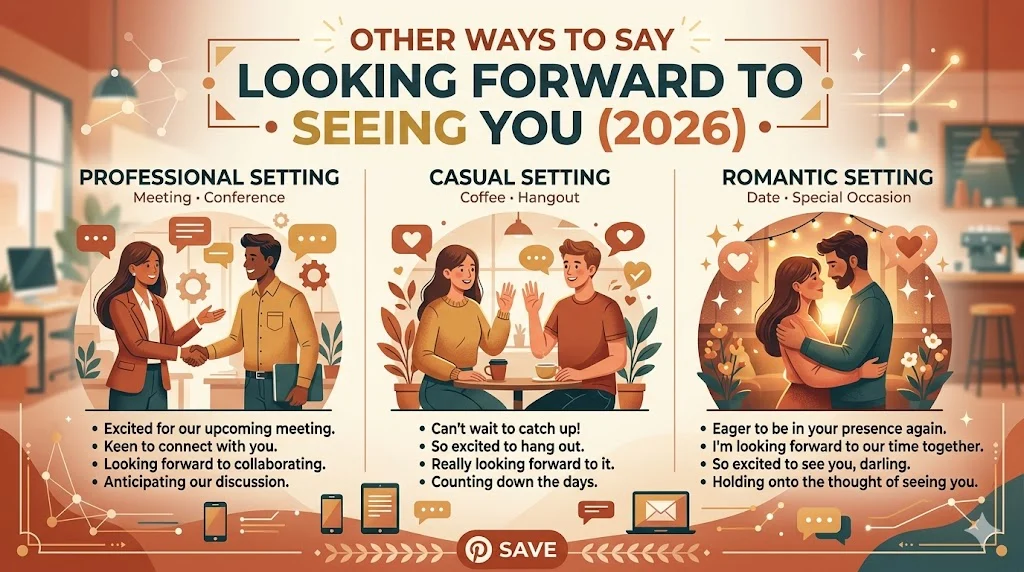
Looking for other ways to say looking forward to seeing you? Try:
Can’t wait to see you, Excited to meet you, I’m eager to catch up, Looking forward to our time together, I’ll be happy to see you.
These alternatives help you sound more natural, professional, warm, or romantic depending on the context.
The phrase “looking forward to seeing you” is commonly used in emails, texts, and conversations to express anticipation about meeting someone. While it’s polite and widely accepted, repeating it too often can make your communication sound repetitive or generic.
Learning alternatives to “looking forward to seeing you” helps improve fluency and allows you to match the right tone for professional meetings, friendly gatherings, or romantic situations. It also helps you express excitement in English more naturally.
Using varied expressions makes your communication sound more engaging, confident, and memorable.
“A thoughtful phrase can make your message feel warmer and more personal instantly.”
Quick Categories
Formal alternatives to “looking forward to seeing you”
- I anticipate our meeting
- I look forward to our discussion
- I’ll be pleased to see you
Pro Tip: Best for business emails and professional networking.
Casual alternatives
- Can’t wait to see you
- See you soon
- Excited to hang out
Pro Tip: Great for friends, social plans, and texting.
Professional alternatives
- Looking forward to connecting
- Eager to meet with you
- I appreciate the opportunity to meet
Pro Tip: Ideal for interviews, meetings, and conferences.
Romantic or warm expressions
- I miss you already
- Counting down the days
- I’m excited to be with you
Pro Tip: Use these only in personal or close relationships.
Common Mistakes
- Overusing the same phrase
Example: “Looking forward to seeing you” in every email. - Being too informal in professional settings
Example: “Can’t wait!!!” in a corporate email. - Using overly romantic phrases casually
Example: “Counting down the days” to a coworker. - Adding too many exclamation marks
Example: “Excited to meet you!!!!” - Using vague closings
Example: “See you.” (too abrupt)
What Does “Looking Forward to Seeing You” Mean?
The phrase expresses positive anticipation about meeting someone in the future. It is commonly used in spoken and written English.
Grammar Tip
“Looking forward to” is followed by a noun or gerund (-ing verb).
Example Sentence
“I’m looking forward to seeing you next week.”
When to Use It
- Before meetings
- Before social gatherings
- In professional emails
- In personal texts
- During travel or event planning
Spoken vs Written
- Spoken: more casual and expressive
- Written: usually more polished and formal
Formal vs Informal
- Formal: “I anticipate our meeting”
- Informal: “Can’t wait to see you”
Is It Professional or Polite to Say “Looking Forward to Seeing You”?
Polite? ✔️ Yes
Professional? ✔️ Usually
However, in highly formal business communication, more polished alternatives may sound stronger.
Business Example
“I look forward to meeting with you next Tuesday regarding the project discussion.”
Pros and Cons
Pros
- Friendly and warm
- Easy to understand
- Professional enough for most contexts
- Commonly accepted
Cons
- Overused
- Can sound generic
- Limited emotional variety
- Sometimes too casual for executive communication
“The right phrase can make your email sound more human and engaging.”
Other Ways to Say “Looking Forward to Seeing You” With Examples
These alternatives will help you sound more fluent, confident, and natural in different situations.
Use them according to tone, context, and audience to express excitement, warmth, or professionalism.
1. Phrase: Can’t wait to see you
Meaning: Strong excitement about meeting
Explanation: Casual and enthusiastic
Example Sentence: “Can’t wait to see you this weekend!”
Best Use: friends, family
Worst Use: formal emails
Tone: warm, energetic
Context Variability: casual / spoken
2. Phrase: I’m excited to see you
Meaning: Expresses enthusiasm
Explanation: Friendly and versatile
Example Sentence: “I’m excited to see you tomorrow.”
Best Use: personal messages
Worst Use: executive meetings
Tone: positive, warm
Context Variability: both
3. Phrase: Looking forward to our meeting
Meaning: Professional anticipation
Explanation: Formal variation
Example Sentence: “Looking forward to our meeting next week.”
Best Use: work emails
Worst Use: romantic texts
Tone: professional, neutral
Context Variability: professional
4. Phrase: Eager to catch up
Meaning: Excited to reconnect
Explanation: Common among friends or colleagues
Example Sentence: “I’m eager to catch up soon.”
Best Use: networking, friends
Worst Use: formal letters
Tone: friendly, conversational
Context Variability: both
5. Phrase: I anticipate our meeting
Meaning: Formal expectation
Explanation: More polished and corporate
Example Sentence: “I anticipate our meeting on Friday.”
Best Use: executive communication
Worst Use: casual chats
Tone: formal, reserved
Context Variability: professional
6. Phrase: Excited to spend time together
Meaning: Happy anticipation
Explanation: Warm and personal
Example Sentence: “Excited to spend time together this weekend.”
Best Use: relationships
Worst Use: business emails
Tone: affectionate, warm
Context Variability: personal
7. Phrase: I’ll be happy to see you
Meaning: Pleasant anticipation
Explanation: Polite and natural
Example Sentence: “I’ll be happy to see you again.”
Best Use: polite conversation
Worst Use: highly formal settings
Tone: gentle, friendly
Context Variability: both
8. Phrase: Looking forward to connecting
Meaning: Anticipation of communication
Explanation: Modern professional phrase
Example Sentence: “Looking forward to connecting next week.”
Best Use: LinkedIn, networking
Worst Use: romantic context
Tone: modern, professional
Context Variability: professional
9. Phrase: I’m eager to meet with you
Meaning: Professional enthusiasm
Explanation: Appropriate for interviews and meetings
Example Sentence: “I’m eager to meet with you regarding the role.”
Best Use: job interviews
Worst Use: casual texts
Tone: professional, positive
Context Variability: professional
10. Phrase: See you soon
Meaning: Friendly anticipation
Explanation: Simple and natural
Example Sentence: “See you soon at the event.”
Best Use: casual conversation
Worst Use: formal letters
Tone: relaxed, warm
Context Variability: casual
11. Phrase: Counting down the days
Meaning: Strong excitement
Explanation: Emotional and personal
Example Sentence: “Counting down the days until I see you.”
Best Use: romantic relationships
Worst Use: work emails
Tone: affectionate, excited
Context Variability: personal
12. Phrase: I’m thrilled to see you
Meaning: Intense happiness
Explanation: Strong emotional excitement
Example Sentence: “I’m thrilled to see you after so long.”
Best Use: family, close friends
Worst Use: professional settings
Tone: emotional, enthusiastic
Context Variability: personal
13. Phrase: I’m excited for our conversation
Meaning: Looking forward to talking
Explanation: Professional but friendly
Example Sentence: “I’m excited for our conversation tomorrow.”
Best Use: interviews, networking
Worst Use: romantic texts
Tone: positive, professional
Context Variability: both
14. Phrase: Looking forward to spending time with you
Meaning: Warm anticipation
Explanation: Personal and caring
Example Sentence: “Looking forward to spending time with you this weekend.”
Best Use: close relationships
Worst Use: workplace
Tone: affectionate, warm
Context Variability: personal
15. Phrase: I can’t wait for our meetup
Meaning: Informal excitement
Explanation: Casual and youthful
Example Sentence: “I can’t wait for our meetup next week.”
Best Use: social plans
Worst Use: formal business
Tone: energetic, casual
Context Variability: informal
16. Phrase: I appreciate the opportunity to meet
Meaning: Professional gratitude
Explanation: Respectful and polished
Example Sentence: “I appreciate the opportunity to meet with you.”
Best Use: interviews, formal meetings
Worst Use: casual texting
Tone: professional, respectful
Context Variability: professional
17. Phrase: I’m looking forward to our time together
Meaning: Warm anticipation
Explanation: Personal but flexible
Example Sentence: “I’m looking forward to our time together.”
Best Use: personal relationships
Worst Use: executive emails
Tone: warm, thoughtful
Context Variability: personal
18. Phrase: Excited to reunite
Meaning: Happy to meet again
Explanation: Often used after long separation
Example Sentence: “Excited to reunite with everyone soon.”
Best Use: family, friends
Worst Use: professional meetings
Tone: emotional, warm
Context Variability: personal
19. Phrase: I’m happy we’ll meet soon
Meaning: Positive expectation
Explanation: Soft and polite
Example Sentence: “I’m happy we’ll meet soon.”
Best Use: polite conversations
Worst Use: formal reports
Tone: friendly, sincere
Context Variability: both
20. Phrase: Looking forward to catching up
Meaning: Excited to reconnect
Explanation: Common among acquaintances
Example Sentence: “Looking forward to catching up over coffee.”
Best Use: friends, colleagues
Worst Use: formal interviews
Tone: conversational
Context Variability: casual
21. Phrase: I’m eager for our discussion
Meaning: Professional anticipation
Explanation: Suitable for business contexts
Example Sentence: “I’m eager for our discussion next week.”
Best Use: corporate meetings
Worst Use: personal texts
Tone: formal, positive
Context Variability: professional
22. Phrase: I’m excited to reconnect
Meaning: Positive reunion
Explanation: Friendly and natural
Example Sentence: “I’m excited to reconnect after all this time.”
Best Use: networking, old friends
Worst Use: highly formal communication
Tone: warm, positive
Context Variability: both
23. Phrase: I’m looking forward to being together
Meaning: Personal anticipation
Explanation: Emotional and affectionate
Example Sentence: “I’m looking forward to being together again.”
Best Use: romantic situations
Worst Use: workplace
Tone: affectionate
Context Variability: personal
24. Phrase: Happy to see you soon
Meaning: Pleasant expectation
Explanation: Simple and friendly
Example Sentence: “Happy to see you soon at the conference.”
Best Use: casual/professional
Worst Use: executive-level writing
Tone: light, warm
Context Variability: both
25. Phrase: I’m excited for our meetup
Meaning: Casual anticipation
Explanation: Social and modern
Example Sentence: “I’m excited for our meetup this Friday.”
Best Use: social plans
Worst Use: formal business
Tone: casual, energetic
Context Variability: informal
26. Phrase: I’ll look forward to it
Meaning: Anticipation for future event
Explanation: Slightly indirect but polite
Example Sentence: “I’ll look forward to it.”
Best Use: polite replies
Worst Use: emotional contexts
Tone: neutral, polite
Context Variability: both
27. Phrase: It’ll be great to see you
Meaning: Friendly enthusiasm
Explanation: Natural spoken phrase
Example Sentence: “It’ll be great to see you again.”
Best Use: conversations
Worst Use: formal letters
Tone: warm, casual
Context Variability: spoken
28. Phrase: I’m enthusiastic about meeting you
Meaning: Professional excitement
Explanation: More formal enthusiasm
Example Sentence: “I’m enthusiastic about meeting you next week.”
Best Use: interviews, networking
Worst Use: close personal texts
Tone: professional, positive
Context Variability: professional
29. Phrase: Looking forward to your visit
Meaning: Anticipation of someone arriving
Explanation: Common host expression
Example Sentence: “We’re looking forward to your visit.”
Best Use: invitations
Worst Use: job interviews
Tone: welcoming
Context Variability: both
30. Phrase: I’m really looking forward to it
Meaning: Strong anticipation
Explanation: Flexible and natural
Example Sentence: “I’m really looking forward to it.”
Best Use: general communication
Worst Use: highly formal executive communication
Tone: warm, conversational
Context Variability: both
“Choosing the right tone makes your message feel more authentic and memorable.”
Mini Quiz / Self-Check
1. Which phrase is best for a formal business meeting?
A. Can’t wait to see you
B. I anticipate our meeting
C. Counting down the days
Answer: B
2. Which phrase sounds most romantic?
A. Looking forward to connecting
B. Counting down the days
C. I appreciate the opportunity to meet
Answer: B
3. Best for LinkedIn networking?
A. Looking forward to connecting
B. I miss you already
C. Can’t wait for our meetup
Answer: A
Comparison Table: Top Alternatives
| Phrase | Tone | Best Use |
|---|---|---|
| Looking forward to our meeting | Professional | Business emails |
| Can’t wait to see you | Casual | Friends/family |
| I’m eager to meet with you | Professional | Interviews |
| Excited to spend time together | Warm | Relationships |
| Looking forward to connecting | Modern | Networking |
| I anticipate our meeting | Formal | Executive communication |
| Counting down the days | Romantic | Relationships |
| Eager to catch up | Friendly | Friends/colleagues |
| I appreciate the opportunity to meet | Professional | Interviews |
| It’ll be great to see you | Casual | Conversations |
FAQs
1. What is the most professional alternative?
“I anticipate our meeting” or “Looking forward to our discussion.”
2. What can I say instead of “looking forward to seeing you” in an email?
Try “Looking forward to connecting” or “I’m eager to meet with you.”
3. Which alternatives are best for romantic situations?
“Counting down the days” and “Excited to spend time together.”
4. Is “Can’t wait to see you” professional?
Not usually. It’s better for personal or casual communication.
5. How do I sound more natural in English?
Use varied phrases depending on the tone and relationship.
Conclusion
Learning other ways to say looking forward to seeing you helps your communication sound more natural, expressive, and context-appropriate. Whether you’re writing a professional email, texting a friend, or speaking to someone special, the right phrase improves tone and connection.
Practice using these alternatives regularly to strengthen your confidence and sound more fluent in both spoken and written English.