Last Updated on April 12, 2026
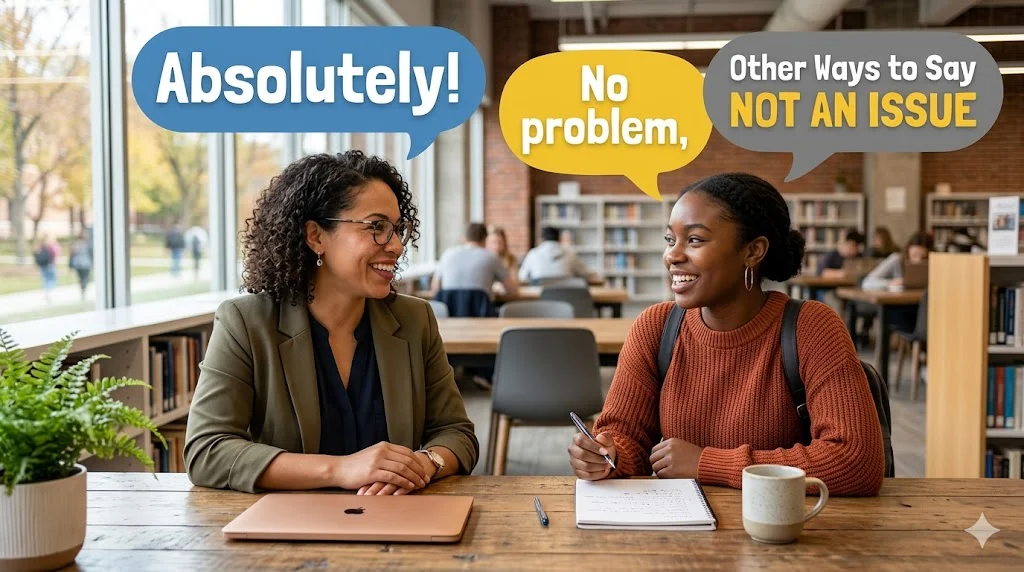
If you want alternatives to “not an issue,” try: no problem, no worries, that’s fine, absolutely, happy to help.
These phrases help you sound more natural, polite, and context-aware in both casual and professional communication.
The phrase “not an issue” is commonly used to reassure someone that something is acceptable or manageable. It’s a quick, friendly way to remove concern or show agreement.
People often use it in everyday conversations, emails, and workplace interactions. However, relying on the same phrase repeatedly can make your English sound repetitive or too informal.
Learning alternatives to “not an issue” helps you improve fluency, adjust tone, and express excitement in English or reassurance more effectively across different contexts.
“The right words don’t just communicate meaning they communicate confidence.”
Quick Categories Section
Formal Alternatives to “Not an Issue”
- Certainly
- That will be acceptable
- No inconvenience at all
- It is perfectly fine
Pro Tip: Use formal phrases in emails, presentations, or client communication to sound polished and respectful.
Casual Alternatives
- No problem
- No worries
- It’s all good
- Sure thing
Pro Tip: Casual phrases are perfect for friends, teammates, and relaxed workplace environments.
Professional Alternatives
- Happy to assist
- That works for me
- I can accommodate that
- Consider it done
Pro Tip: In professional settings, choose phrases that show willingness and competence.
Informal Expressions
- All good
- No big deal
- Totally fine
- Don’t sweat it
Pro Tip: Use informal expressions carefully avoid them in formal writing or with senior professionals.
“Fluent English isn’t about big words it’s about choosing the right tone.”
Common Mistakes Section
- Using it in very formal writing
Example: “Your delay is not an issue.” → Too casual for official reports - Overusing the phrase
Example: Saying “not an issue” in every reply - Using it without context
Example: “Not an issue.” (unclear what you mean) - Sounding dismissive unintentionally
Example: “That’s not an issue.” (may feel like ignoring concern) - Using it in serious situations
Example: “The error is not an issue.” (when it actually is serious)
What Does “Not an Issue” Mean?
Definition: It means something is not a problem or does not cause concern.
Grammar: It’s a short declarative phrase often used as a response.
Example:
“Can you finish this tomorrow?”
“Not an issue.”
When to Use “Not an Issue”
- Reassuring someone
- Accepting a request
- Downplaying a concern
- Responding quickly in conversation
Spoken vs Written:
More common in spoken English and informal emails
Formal vs Informal:
Mostly informal, sometimes semi-professional
Is It Professional or Polite to Say “Not an Issue”?
Polite? ✔️ Yes
Professional? ❌ No (in most cases)
Business Example:
“Completing the task by Friday is not an issue.” → Acceptable, but better phrased as “That will be completed by Friday.”
Pros and Cons of Using “Not an Issue”
Pros
- Simple and natural
- Friendly tone
- Common usage
- Easy to understand
Cons
- Too informal for work
- Overused
- Limited emotional range
- Not suitable for formal writing
“Professional communication is about clarity, tone, and intention not just vocabulary.”
Other Ways to Say “Not an Issue” With Examples
These other ways to say “not an issue” will help you sound more fluent, confident, and natural in different situations.
Use them according to tone, context, and audience to express reassurance or approval.
1. Phrase: No problem
Meaning: It’s easy or acceptable
Explanation: Very common casual reassurance
Example Sentence: No problem, I’ll handle it.
Best Use: casual talk
Worst Use: formal emails
Tone: relaxed, friendly
Context Variability: casual, spoken
2. Phrase: No worries
Meaning: Nothing to stress about
Explanation: Reassuring and friendly
Example Sentence: No worries, take your time.
Best Use: friendly chats
Worst Use: formal reports
Tone: warm, relaxed
Context Variability: casual, spoken
3. Phrase: That’s fine
Meaning: It’s acceptable
Explanation: Neutral and flexible
Example Sentence: That’s fine with me.
Best Use: general use
Worst Use: strong agreement
Tone: neutral, calm
Context Variability: casual, professional
4. Phrase: Absolutely
Meaning: Strong agreement
Explanation: Shows enthusiasm
Example Sentence: Absolutely, I can do that.
Best Use: confident replies
Worst Use: uncertain cases
Tone: positive, strong
Context Variability: professional, spoken
5. Phrase: Of course
Meaning: Naturally yes
Explanation: Polite agreement
Example Sentence: Of course, I’ll help.
Best Use: polite responses
Worst Use: dismissive tone
Tone: polite, warm
Context Variability: all contexts
6. Phrase: Happy to help
Meaning: Willing to assist
Explanation: Professional and friendly
Example Sentence: I’m happy to help anytime.
Best Use: workplace
Worst Use: refusal context
Tone: supportive, professional
Context Variability: professional
7. Phrase: That works for me
Meaning: Acceptable option
Explanation: Common in planning
Example Sentence: 3 PM works for me.
Best Use: scheduling
Worst Use: emotional support
Tone: neutral, practical
Context Variability: professional, casual
8. Phrase: Not a problem at all
Meaning: Completely fine
Explanation: Emphasizes ease
Example Sentence: It’s not a problem at all.
Best Use: reassurance
Worst Use: formal writing
Tone: friendly, reassuring
Context Variability: casual
9. Phrase: Sure thing
Meaning: Yes, gladly
Explanation: Informal agreement
Example Sentence: Sure thing, I’ll do it.
Best Use: casual talk
Worst Use: business email
Tone: upbeat, informal
Context Variability: casual
10. Phrase: Consider it done
Meaning: It will be completed
Explanation: Confident and professional
Example Sentence: Consider it done by tomorrow.
Best Use: workplace
Worst Use: uncertain tasks
Tone: confident, strong
Context Variability: professional
11. Phrase: No trouble at all
Meaning: It causes no difficulty
Explanation: A polite way to reassure someone
Example Sentence: Helping you was no trouble at all.
Best Use: polite replies
Worst Use: urgent issues
Tone: polite, calm
Context Variability: casual, professional
12. Phrase: It’s all good
Meaning: Everything is fine
Explanation: Informal reassurance
Example Sentence: It’s all good, don’t worry.
Best Use: casual talk
Worst Use: formal writing
Tone: relaxed, friendly
Context Variability: casual, spoken
13. Phrase: Don’t worry about it
Meaning: No need for concern
Explanation: Reassures and removes stress
Example Sentence: Don’t worry about it I’ll fix it.
Best Use: reassurance
Worst Use: serious problems
Tone: comforting, friendly
Context Variability: casual, spoken
14. Phrase: I’ve got it covered
Meaning: I will take care of it
Explanation: Shows responsibility and confidence
Example Sentence: You can relax I’ve got it covered.
Best Use: teamwork
Worst Use: uncertainty
Tone: confident, supportive
Context Variability: professional, casual
15. Phrase: That’s perfectly fine
Meaning: Completely acceptable
Explanation: Slightly more formal than “that’s fine”
Example Sentence: That’s perfectly fine with me.
Best Use: polite replies
Worst Use: urgent contexts
Tone: polite, neutral
Context Variability: professional, casual
“Choosing slightly more formal phrasing can instantly elevate your communication.”
16. Phrase: No inconvenience whatsoever
Meaning: No trouble at all
Explanation: Formal and emphatic reassurance
Example Sentence: Your request is no inconvenience whatsoever.
Best Use: formal writing
Worst Use: casual chat
Tone: formal, reassuring
Context Variability: professional
17. Phrase: It’s manageable
Meaning: It can be handled easily
Explanation: Suggests control over the situation
Example Sentence: The workload is manageable.
Best Use: workplace
Worst Use: emotional support
Tone: practical, calm
Context Variability: professional
18. Phrase: That’s acceptable
Meaning: It meets requirements
Explanation: Neutral and formal approval
Example Sentence: Your proposal is acceptable.
Best Use: formal feedback
Worst Use: casual talk
Tone: neutral, formal
Context Variability: professional
19. Phrase: No big deal
Meaning: Not important
Explanation: Downplays significance
Example Sentence: It’s no big deal, really.
Best Use: casual reassurance
Worst Use: serious matters
Tone: relaxed, dismissive
Context Variability: casual
20. Phrase: All set
Meaning: Everything is ready or handled
Explanation: Indicates completion
Example Sentence: We’re all set for tomorrow.
Best Use: preparation
Worst Use: unresolved issues
Tone: confident, brief
Context Variability: casual, professional
“Short phrases like ‘All set’ can sound confident and efficient in the workplace.”
21. Phrase: It’s under control
Meaning: Situation is managed
Explanation: Reassures authority and calm
Example Sentence: Don’t worry it’s under control.
Best Use: leadership
Worst Use: uncertainty
Tone: confident, calm
Context Variability: professional
22. Phrase: I can handle it
Meaning: I am capable of managing it
Explanation: Shows competence
Example Sentence: Leave it to me I can handle it.
Best Use: responsibility
Worst Use: lack of skills
Tone: confident, assertive
Context Variability: professional, casual
23. Phrase: That’s okay
Meaning: It’s acceptable
Explanation: Simple and neutral
Example Sentence: That’s okay, no problem.
Best Use: general use
Worst Use: formal writing
Tone: neutral, friendly
Context Variability: casual
24. Phrase: No harm done
Meaning: No negative impact occurred
Explanation: Reassures after a mistake
Example Sentence: No harm done we can fix it.
Best Use: mistakes
Worst Use: serious damage
Tone: forgiving, calm
Context Variability: casual, professional
25. Phrase: It’s nothing serious
Meaning: Not important or dangerous
Explanation: Reduces concern
Example Sentence: It’s nothing serious, just a minor issue.
Best Use: reassurance
Worst Use: real problems
Tone: calming, informal
Context Variability: casual
“Avoid downplaying serious situations tone must match reality.”
26. Phrase: Works perfectly
Meaning: Completely suitable
Explanation: Strong approval
Example Sentence: Your plan works perfectly.
Best Use: agreement
Worst Use: partial fit
Tone: positive, confident
Context Variability: professional, casual
27. Phrase: Completely fine
Meaning: Totally acceptable
Explanation: Emphasizes agreement
Example Sentence: That’s completely fine with me.
Best Use: general replies
Worst Use: strict contexts
Tone: neutral, clear
Context Variability: casual, professional
28. Phrase: I’m okay with that
Meaning: I accept it
Explanation: Personal agreement
Example Sentence: I’m okay with that decision.
Best Use: discussions
Worst Use: authority roles
Tone: neutral, personal
Context Variability: casual, professional
29. Phrase: No concerns here
Meaning: No problems identified
Explanation: Common in professional feedback
Example Sentence: No concerns here everything looks good.
Best Use: workplace
Worst Use: casual chat
Tone: professional, clear
Context Variability: professional
30. Phrase: That poses no problem
Meaning: It creates no difficulty
Explanation: Formal and precise
Example Sentence: Your request poses no problem.
Best Use: formal writing
Worst Use: casual talk
Tone: formal, neutral
Context Variability: professional
Mini Quiz / Self-Check
1. Which is best for a formal email?
A. No worries
B. Consider it done
C. Sure thing
2. Which phrase is most casual?
A. That is acceptable
B. No big deal
C. I can accommodate that
3. What should you avoid in professional writing?
A. Absolutely
B. No problem
C. That works for me
Comparison Table: Top Alternatives
| Phrase | Tone | Best Use |
| No problem | Casual | Friends |
| No worries | Casual | Reassurance |
| Absolutely | Positive | Confident reply |
| Of course | Polite | All contexts |
| Happy to help | Professional | Workplace |
| That’s fine | Neutral | General |
| Consider it done | Strong | Tasks |
| That works for me | Practical | Scheduling |
| Not a problem at all | Friendly | Reassurance |
| Sure thing | Informal | Casual talk |
FAQs
1. What are the best professional alternatives to “not an issue”?
Use happy to help, I can accommodate that, consider it done.
2. Is “not an issue” rude?
No, but it can sound dismissive depending on tone.
3. Can I use “not an issue” in emails?
Yes, but only in informal or semi-professional emails.
4. What is a more polite version of “not an issue”?
Of course or that’s perfectly fine are more polite.
5. Why should I learn alternatives to “not an issue”?
It improves fluency, tone control, and professional communication.
Conclusion
Learning other ways to say “not an issue” helps you communicate more effectively across casual and professional situations. It allows you to adapt your tone, sound more fluent, and avoid repetition.
Make it a habit to practice these alternatives to “not an issue” daily. The more you use them, the more natural and confident your English will become.
Try using 3 new phrases today in real conversations.