
Last Updated on September 30, 2026
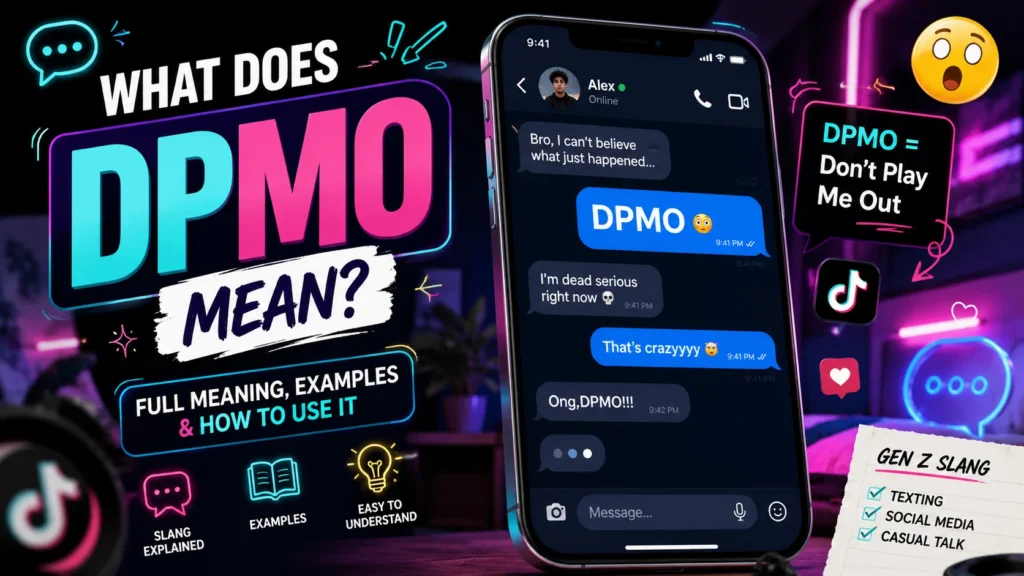
DPMO is an internet slang acronym that usually means “Don’t Piss Me Off.” It is commonly used in text messages, social media, TikTok comments, Snapchat chats, and online conversations to express annoyance, frustration, or a warning. Depending on the context and tone, DPMO can be playful between friends or convey serious irritation, essentially meaning “don’t annoy, provoke, or upset me.”
Internet slang changes quickly. A phrase that appears everywhere today may have been completely unknown just a few months ago. Among the many abbreviations used in online conversations, DPMO has become increasingly common across social media platforms, messaging apps, and digital communities.
If you’ve seen someone write “DPMO” on TikTok, Snapchat, Instagram, X, Discord, or in a text message, you might be wondering exactly what it means.
The good news is that the meaning is relatively straightforward once you understand the context.
In most situations, DPMO stands for “Don’t Piss Me Off.” It is an informal slang expression people use when they feel annoyed, irritated, frustrated, or when they want to warn someone not to continue a behavior that is bothering them.
However, internet slang is rarely limited to a single interpretation. Context matters. The way DPMO is used among friends may differ from how it appears in viral social media posts or online arguments.
This guide explains everything you need to know about the DPMO meaning slang, including its origins, social media usage, texting examples, variations, and common misunderstandings.
What Does DPMO Mean in Slang?
The most widely accepted DPMO slang meaning is:
DPMO = Don’t Piss Me Off
This phrase communicates irritation or a warning that someone is becoming annoying.
Unlike formal language, slang often exaggerates emotions for dramatic effect. As a result, people sometimes use DPMO even when they are not genuinely angry.
For example:
- “DPMO bro, you ate the last slice.”
- “Y’all really DPMO sometimes.”
- “Stop spamming my phone. DPMO.”
In these examples, the speaker is expressing frustration. The intensity can vary depending on the situation.
Sometimes it is playful.
Sometimes it is serious.
The surrounding conversation usually reveals the intended tone.
Simple Definition of DPMO
| Acronym | Meaning | Emotion Expressed |
| DPMO | Don’t Piss Me Off | Annoyance, frustration, warning |
The phrase acts as a shorthand way of saying:
- Don’t annoy me.
- Stop irritating me.
- You’re making me angry.
- Please stop before I get upset.
- You’re getting on my nerves.
DPMO Meaning in Text Messages
Text messaging helped popularize abbreviations long before social media existed.
People wanted faster ways to communicate. As a result, acronyms became common.
When someone uses DPMO in a text message, they are usually reacting to something irritating.
Example Text Conversations
Example 1
Friend 1: I posted that embarrassing picture.
Friend 2: DPMO 😭
Here, the phrase is playful and humorous.
Example 2
Friend 1: I forgot your birthday again.
Friend 2: Bro DPMO.
In this case, the frustration feels more genuine.
Example 3
Friend 1: I’m calling you for the tenth time.
Friend 2: DPMO please.
The person is asking the other individual to stop being annoying.
Why DPMO Became Popular in Texting
Several factors contributed to its popularity:
- Short and quick to type
- Easy to understand
- Expresses emotion efficiently
- Fits mobile communication styles
- Common among younger users
Modern messaging often favors speed over complete sentences.
Instead of typing:
“Please stop irritating me because you’re making me frustrated.”
A user simply types:
“DPMO.”
The message remains clear while requiring far less effort.
DPMO Meaning on TikTok
TikTok has become one of the biggest drivers of internet slang.
Many expressions that originate within niche communities quickly spread worldwide through viral videos and trending audio clips.
On TikTok, DPMO frequently appears in:
- Video captions
- Comments
- Replies
- Meme content
- Reaction videos
Common TikTok Uses
Users often write DPMO when reacting to something annoying.
Examples include:
- A frustrating challenge
- A controversial opinion
- An annoying trend
- A disappointing sports result
- A funny but irritating situation
Example caption:
“When your alarm goes off on your day off… DPMO.”
The phrase works because it combines humor with frustration.
Why TikTok Users Love DPMO
TikTok culture values:
- Brevity
- Humor
- Relatability
- Emotional reactions
DPMO checks all four boxes.
A single acronym instantly communicates a recognizable emotional response.
That efficiency makes it ideal for fast-moving social media content.
DPMO Meaning on Snapchat
Snapchat conversations tend to be informal and highly conversational.
Because users communicate quickly, abbreviations are extremely common.
When someone sends DPMO on Snapchat, it often means:
- Stop annoying me.
- You’re doing too much.
- You’re getting on my nerves.
- You’re testing my patience.
Snapchat Example
Person A: Sends 20 snaps in a row.
Person B: DPMO 😂
Notice the laughing emoji.
The emoji changes the tone dramatically.
Without it, the phrase might seem aggressive.
With it, the message feels playful and friendly.
This highlights an important aspect of internet slang:
Context matters more than the acronym itself.
DPMO Meaning on Instagram
Instagram users commonly use DPMO in:
- Story replies
- Comments
- Reels captions
- Direct messages
The expression often accompanies:
- Funny complaints
- Sports frustrations
- Relationship jokes
- Celebrity discussions
- Daily life annoyances
For instance:
“My phone battery died at 2%. DPMO.”
The phrase transforms a minor inconvenience into a relatable social media moment.
Why DPMO Fits Instagram Culture
Instagram rewards content that creates emotional connections.
People enjoy posts that make them think:
- “That’s so me.”
- “I can relate.”
- “That happened to me too.”
DPMO often appears in exactly those situations.
The acronym acts as a shortcut to shared frustration.
DPMO Meaning in Online Gaming
Gaming communities have their own vocabulary.
Players frequently use abbreviations during matches because typing speed matters.
In gaming chats, DPMO can appear when:
- A teammate makes mistakes
- A player loses repeatedly
- Lag causes problems
- An opponent behaves unfairly
Examples:
- “This lag DPMO.”
- “That camper DPMO.”
- “My teammate keeps quitting. DPMO.”
Competitive environments naturally create frustration.
As a result, expressions like DPMO spread quickly among gamers.
Why Internet Slang Like DPMO Exists
Language constantly evolves.
Every generation creates new ways to communicate.
Internet slang serves several practical purposes.
Faster Communication
Typing four letters is faster than typing an entire sentence.
Stronger Emotional Expression
Acronyms can carry emotional weight.
People instantly recognize the feeling behind them.
Group Identity
Slang helps communities establish shared culture.
Using common phrases creates a sense of belonging.
Digital Efficiency
Modern online communication favors brevity.
Short expressions often perform better than lengthy explanations.
The Evolution of Online Language
| Traditional Phrase | Slang Version |
| Don’t piss me off | DPMO |
| Laughing out loud | LOL |
| Oh my God | OMG |
| Be right back | BRB |
| In my opinion | IMO |
Each abbreviation reduces typing while preserving meaning.
Is DPMO Always Negative?
Not necessarily.
Many people assume DPMO always signals anger.
That isn’t true.
The phrase exists on a spectrum.
Playful Usage
Friends often use DPMO jokingly.
Example:
“You beat me again? DPMO 😂”
The speaker isn’t genuinely angry.
They’re teasing.
Mild Frustration
Sometimes the phrase reflects real annoyance.
Example:
“The internet keeps disconnecting. DPMO.”
The frustration is authentic but manageable.
Serious Irritation
Occasionally DPMO communicates genuine anger.
Example:
“I’ve told you three times already. DPMO.”
The tone becomes more confrontational.
Understanding which meaning applies requires reading the surrounding conversation.
Common Emotional Tones Behind DPMO
The same acronym can communicate different emotions.
Annoyance
The most common interpretation.
Frustration
Used when situations become irritating.
Warning
A signal that patience is running out.
Humor
Frequently used among friends.
Sarcasm
Sometimes employed ironically for comedic effect.
Understanding tone is one of the most important skills in digital communication.
Without tone indicators such as emojis, slang can easily be misunderstood.
Origins of DPMO Slang and How It Became Popular
Unlike some internet abbreviations that can be traced to a specific website or online community, DPMO emerged gradually through digital communication.
The phrase “Don’t Piss Me Off” existed long before smartphones, social media, or messaging apps. People used it in everyday speech for decades. Eventually, internet users shortened it into an acronym to save time while typing.
This pattern follows the evolution of many online abbreviations.
Consider these examples:
| Full Phrase | Acronym |
| Laugh Out Loud | LOL |
| Oh My God | OMG |
| For Your Information | FYI |
| Be Right Back | BRB |
| Don’t Piss Me Off | DPMO |
As texting became more common, users looked for quicker ways to express emotions.
DPMO fit perfectly into that trend.
The phrase was short.
It carried a strong emotional message.
Most importantly, it felt natural in casual conversation.
The Rise of DPMO in Social Media Culture
Several factors helped DPMO spread online:
- Growth of short-form communication
- Expansion of texting culture
- Viral social media trends
- Meme communities
- Gen Z internet language
Today, many users recognize DPMO immediately even if they have never searched for its meaning.
Alternative DPMO Meanings You Might See
Although “Don’t Piss Me Off” is the most common interpretation, internet acronyms occasionally develop multiple meanings.
Context determines the correct definition.
Less Common Interpretations
In certain conversations, users may create personalized meanings.
Examples include:
- Don’t Play Me Out
- Don’t Put Me On
- Don’t Push Me Over
These variations are uncommon.
When someone asks, “What does DPMO mean?”, the answer is almost always:
Don’t Piss Me Off
That remains the dominant and widely accepted slang definition.
How to Identify the Correct Meaning
Look at:
- The conversation topic
- The emotional tone
- Emojis used
- Previous messages
- Platform context
For example:
“DPMO 😂”
likely indicates joking frustration.
Meanwhile:
“DPMO. I’m serious.”
signals genuine irritation.
DPMO Meaning in Gen Z Slang
Gen Z has transformed internet communication.
Many phrases that become mainstream originate within younger online communities.
DPMO fits naturally into Gen Z communication because it delivers emotion quickly.
Modern users often prefer:
- Short responses
- Fast reactions
- Emotion-packed abbreviations
- Meme-friendly language
Instead of saying:
“You’re really getting on my nerves today.”
Someone might simply write:
“DPMO.”
The emotional meaning remains clear.
The message becomes more concise.
Why Gen Z Uses Acronyms So Frequently
Several reasons explain this trend:
Speed
Typing less saves time.
Familiarity
Friends understand the abbreviations immediately.
Humor
Many acronyms sound funnier than complete sentences.
Online Identity
Slang helps people feel connected to digital culture.
DPMO reflects all these characteristics.
DPMO in Internet Culture
Internet slang often evolves beyond its literal meaning.
DPMO is a good example.
Many users employ it dramatically for comedic effect.
Imagine these situations:
- Dropping food on the floor
- Losing Wi-Fi during a movie
- Forgetting a password
- Missing a sale by one minute
None of these events are major life problems.
Yet social media users may still write:
“DPMO.”
The exaggeration creates humor.
People relate because everyone experiences small frustrations.
The Meme Effect
Memes often amplify emotional reactions.
As a result, phrases like DPMO become more popular.
A typical meme format might look like:
Expectation: Perfect day.
Reality: Phone battery dies.
Reaction: DPMO.
The simplicity makes the joke effective.
DPMO Meaning Compared to Similar Slang Terms
Many internet abbreviations express frustration.
However, each carries slightly different emotional weight.
Comparison Table
| Slang Term | Meaning | Emotional Intensity |
| DPMO | Don’t Piss Me Off | Moderate |
| SMH | Shaking My Head | Mild |
| IDC | I Don’t Care | Low |
| WTF | What The F*** | High |
| FML | F*** My Life | Moderate to High |
| ISTG | I Swear To God | Moderate |
| DPMO | Don’t Annoy Me / Stop Irritating Me | Moderate |
DPMO occupies a middle ground.
It is stronger than mild disappointment.
It is usually less intense than outright rage.
Examples of DPMO Used Correctly
Understanding real-world usage helps clarify meaning.
Example: School
“The teacher assigned another project. DPMO.”
Example: Sports
“My team conceded in the final minute. DPMO.”
Example: Gaming
“The server crashed during the match. DPMO.”
Example: Friendship
“You ate my fries again? DPMO 😂”
Example: Family
“My brother changed the TV channel. DPMO.”
Example: Technology
“I forgot my password for the fifth time. DPMO.”
Notice how the phrase adapts to different situations.
The core idea remains the same.
Something is causing annoyance.
Examples of DPMO Used Incorrectly
Not every situation calls for DPMO.
Incorrect Example
“I got promoted today. DPMO.”
This makes little sense because the event is positive.
Incorrect Example
“I won the lottery. DPMO.”
Again, the emotional context doesn’t match.
Incorrect Example
“Happy birthday! DPMO.”
The phrase contradicts the intended message.
Understanding emotional context is essential when using internet slang.
When You Should Avoid Using DPMO
Although common online, DPMO is not suitable everywhere.
Professional Communication
Avoid using it in:
- Business emails
- Workplace messages
- Corporate reports
- Professional networking
Academic Writing
Schools and universities generally expect formal language.
Formal Documents
Legal, government, and official communications require professionalism.
Professional Alternatives
Instead of DPMO, use:
- This is frustrating.
- Please stop.
- I disagree.
- This situation is concerning.
- That behavior is inappropriate.
The appropriate choice depends on the audience.
Why Context Matters More Than the Acronym
One challenge of internet slang is interpretation.
The same four letters can communicate different emotions.
Consider these examples:
Friendly Context
“You beat me again? DPMO 😂”
Meaning: playful teasing.
Frustrated Context
“My phone froze during the update. DPMO.”
Meaning: genuine annoyance.
Angry Context
“Stop doing that. DPMO.”
Meaning: serious warning.
The acronym remains unchanged.
The context changes everything.
How Social Media Platforms Influence Slang
Different platforms encourage different communication styles.
TikTok
Fast reactions and humor dominate.
Snapchat
Private conversations encourage casual slang.
Captions and comments often use abbreviations.
Discord
Gaming communities frequently adopt shorthand expressions.
X (Twitter)
Character limits encourage concise language.
DPMO works across all these platforms because it is brief and emotionally expressive.
The Psychology Behind Slang Acronyms
People often underestimate the role psychology plays in digital communication.
Acronyms serve several emotional functions.
Emotional Compression
Complex feelings become condensed into a few letters.
Shared Understanding
Community members recognize the meaning instantly.
Social Belonging
Using common slang signals membership within a group.
Reduced Effort
Short messages require less typing.
DPMO succeeds because it satisfies all four needs simultaneously.
Most Popular Slang Terms Related to DPMO
If you understand DPMO, you’ll likely encounter these terms as well.
Common Internet Slang Dictionary
| Slang | Meaning |
| LOL | Laugh Out Loud |
| BRB | Be Right Back |
| IMO | In My Opinion |
| IDC | I Don’t Care |
| SMH | Shaking My Head |
| TBH | To Be Honest |
| FOMO | Fear Of Missing Out |
| GOAT | Greatest Of All Time |
| ISTG | I Swear To God |
| DPMO | Don’t Piss Me Off |
These expressions form part of modern digital communication.
Frequently Asked Questions
What does DPMO mean in texting?
DPMO usually means “Don’t Piss Me Off.” It expresses annoyance, frustration, or a warning to stop irritating someone.
What is the DPMO slang meaning on TikTok?
On TikTok, DPMO commonly means “Don’t Piss Me Off” and is often used in humorous, relatable, or mildly frustrating situations.
What does DPMO mean on Snapchat?
On Snapchat, DPMO typically communicates irritation, playful annoyance, or joking frustration during conversations.
Is DPMO rude?
It can be.
The phrase contains mild profanity. However, many friends use it casually and humorously without intending offense.
Is DPMO popular among Gen Z?
Yes.
Gen Z users frequently use abbreviations and internet slang. DPMO fits naturally within that communication style.
Does DPMO always mean anger?
No.
It can express:
- Humor
- Teasing
- Mild annoyance
- Frustration
- Genuine anger
Context determines the intended meaning.
Can DPMO have other meanings?
Occasionally, people create alternative interpretations. However, the overwhelmingly accepted slang meaning remains “Don’t Piss Me Off.”
Final Thoughts
The internet constantly creates new words, abbreviations, and expressions. Some disappear quickly. Others become part of everyday online language.
DPMO has established itself as one of the more recognizable modern slang acronyms.
In most situations, the DPMO meaning slang users intend is:
Don’t Piss Me Off
People use it across:
- Text messages
- TikTok
- Snapchat
- Discord
- Gaming chats
- Social media comments
The phrase communicates annoyance, frustration, teasing, or a warning depending on context.
Understanding DPMO isn’t just about learning one acronym.
It’s also about understanding how digital communication works today.
Modern internet culture values speed, emotion, relatability, and efficiency.
DPMO delivers all four.
The next time you see someone type “DPMO” in a conversation, you’ll know exactly what they’re trying to say and why this simple four-letter acronym has become such a recognizable part of online slang culture.