Last Updated on June 18, 2026
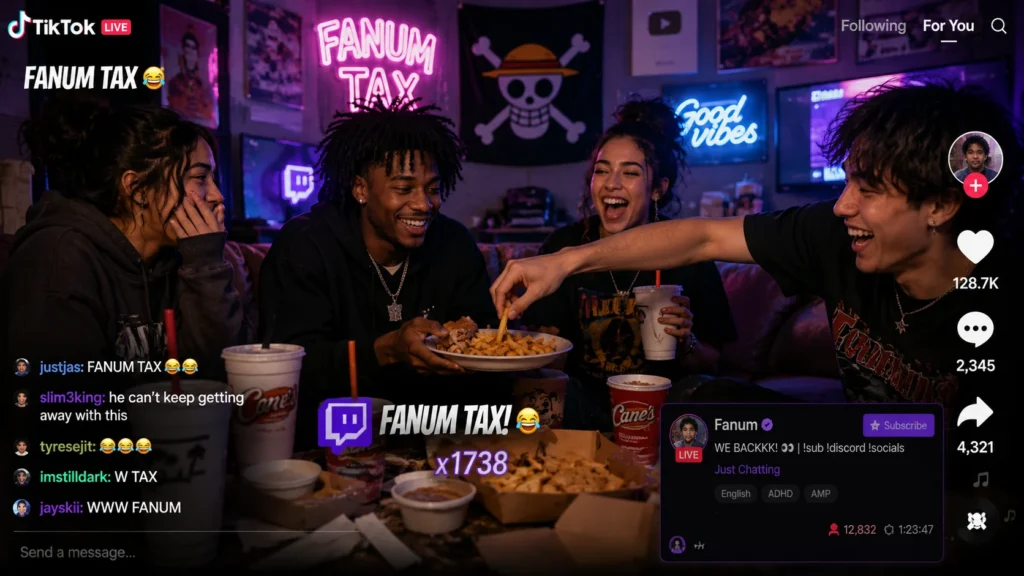
If you’ve been online lately, you’ve probably seen the phrase “Fanum tax” pop up in TikTok comments, Twitch chats, or meme videos. At first, it sounds like something from government or finance. Like a weird bill you didn’t sign up for.But it’s not that at all. Fanum tax meaning slang refers to a joke where someone takes food from another person without asking, usually among friends, and it’s treated like a “mandatory tax.”
In simple terms:
If your friend takes your fries, chips, or snacks without asking, that’s the Fanum tax.
It’s not serious. It’s not real stealing in a harmful sense. It’s a funny internet way of describing food sharing chaos among friends.
Why the Phrase Sounds So Strange
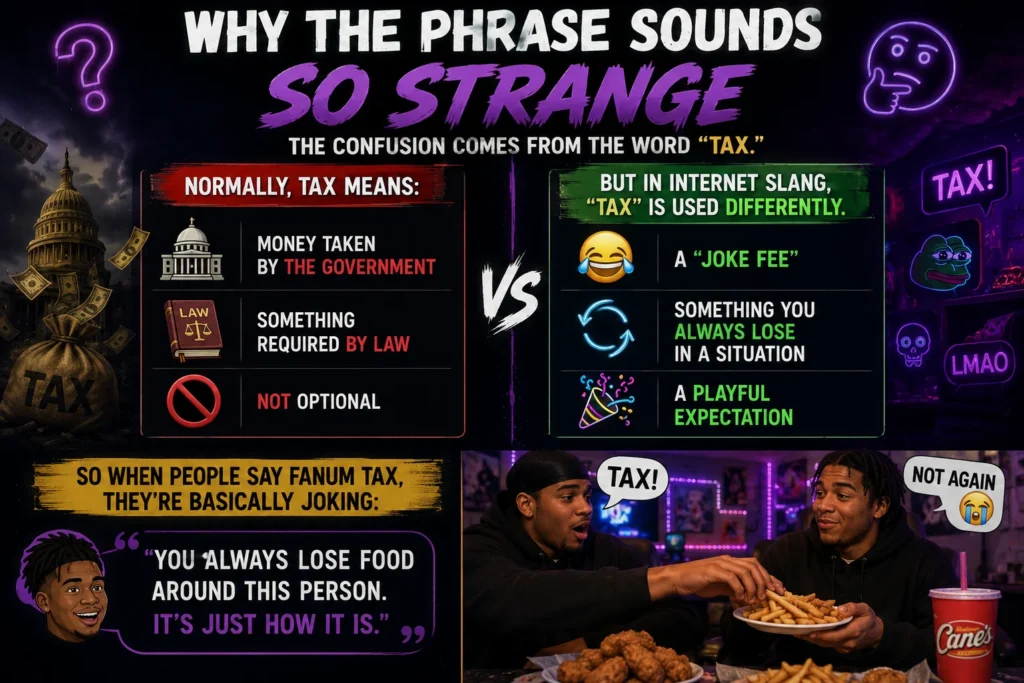
The confusion comes from the word “tax.”
Normally, tax means:
- Money taken by the government
- Something required by law
- Not optional
But in internet slang, “tax” is used differently.
Here, it means:
- A “joke fee”
- Something you always lose in a situation
- A playful expectation
So when people say Fanum tax, they’re basically joking:
“You always lose food around this person. It’s just how it is.”
Where Fanum Tax Came From (Basic Origin)
To understand fanum tax origin, we need to look at a streamer named Fanum, part of the AMP content group.
AMP includes creators like:
- Kai Cenat
- Duke Dennis
- Agent 00
- ChrisNxtDoor
- Fanum
They are known for:
- Group livestreams
- Comedy content
- Reaction videos
- Challenge-based entertainment
The moment that created the meme
Fanum became famous for one repeated behavior:
- He would take food from other people during streams
- No long explanation
- Just walk in and grab bites
- Everyone would laugh instead of getting mad
It became a running joke inside the group.
Viewers started calling it:
“The Fanum tax”
And that’s where the internet slang began.
How the Meme Spread Online
Once clips started circulating, things escalated quickly.
Platforms that pushed the trend:
- TikTok (short meme edits)
- Twitch (live chat reactions)
- YouTube (compilation videos)
People began using it in captions like:
- “Bro got hit with the Fanum tax 💀”
- “Not the fries getting taxed again”
It became part of internet meme culture almost overnight.
Fanum Tax Meaning in Real Life (Simple Examples)
Let’s make this even clearer.
Example 1: Friends eating fries
You order fries. Your friend grabs a handful.
That moment = Fanum tax.
Example 2: Sharing snacks
Someone opens chips in a group.
Everyone suddenly starts taking some.
That moment = Fanum tax.
Example 3: Surprise food loss
You turn away for 2 seconds.
Half your food disappears.
That’s a high-level Fanum tax event.
Quick Table: Understanding Fanum Tax
| Situation | Meaning | Fanum Tax Level |
|---|---|---|
| One bite taken | Normal joke | Low |
| Several bites taken | Funny loss | Medium |
| Whole meal gone | Chaos | High |
Why People Love This Slang
The reason fanum tax slang meaning became popular is simple.
It feels real.
Everyone has experienced:
- A friend stealing fries
- Someone saying “lemme try a bite”
- Food mysteriously disappearing in groups
So when people hear “Fanum tax,” they instantly understand the joke without explanation.
How Fanum Tax Became a Viral TikTok and Twitch Trend
Once the phrase “Fanum tax” hit the internet, it didn’t stay small for long.
It spread the way most modern slang spreads:
- Short clips
- Reactions
- Memes
- Reposts
- Re-edits
And it all started with one thing: relatable chaos around food.
TikTok turned it into a meme engine
On TikTok, creators quickly realized something important:
If you show food + friends + stealing = instant engagement.
So they started posting videos like:
- POV: your friend “taxes” your fries again
- “When you blink and your food disappears”
- “Bro said one bite and cleared half my plate 💀”
The phrase “Fanum tax TikTok meaning” basically became shorthand for:
funny food stealing moments in friendship groups
The more exaggerated the video, the better it performed.
Twitch chat made it a reaction weapon
On Twitch, things moved even faster.
When streamers:
- Ate on stream
- Shared food on camera
- Or got food stolen mid-content
Chat would explode with:
“FANUM TAX 😭😭😭”
It became a live reaction phrase, not just a meme caption.
That’s important because Twitch slang spreads differently:
- It happens in real time
- It repeats thousands of times in seconds
- It reinforces the joke instantly
So the phrase locked in fast.
YouTube helped it stick permanently
YouTube gave Fanum tax something TikTok and Twitch couldn’t:
long-term visibility
Creators uploaded:
- “Fanum tax moments compilation”
- AMP funniest food clips
- Reaction breakdowns
This turned the phrase from a trend into a recognizable internet term.
Why Fanum Tax Blew Up So Fast (Real Reasons)
A lot of slang goes viral and dies quickly. Fanum tax didn’t.
Here’s why it worked so well.
1. Everyone relates to it
You don’t need to be online to understand it.
Most people have experienced:
- Friends stealing fries
- Family members grabbing bites
- Someone saying “lemme try that” and never stopping
So when people hear it, they think:
“Yeah… that’s happened to me.”
Relatability drives virality more than anything else.
2. It feels like a “rule of life”
Internet humor loves fake systems.
Fanum tax sounds like:
- A law
- A system
- A rule everyone follows
That makes it funnier.
It turns random behavior into something “official.”
3. It connects to streamer culture
Fanum isn’t just a random name.
He’s part of AMP (Any Means Possible), a major creator group including:
- Kai Cenat
- Duke Dennis
- Agent 00
- ChrisNxtDoor
Because AMP already had a huge audience, anything they did spread faster.
So when Fanum repeatedly took food on stream, it became:
- A running joke inside AMP
- A shared audience meme
- A repeatable clip format
That combination is powerful.
4. It’s short, punchy, and funny
Good slang usually has:
- 2–4 syllables
- Easy pronunciation
- Instant meaning
“Fanum tax” checks all boxes:
- Short
- Funny sounding
- Easy to repeat in chat
That matters more than people realize.
Fanum Tax Meaning in Different Online Platforms
The meaning stays the same, but usage changes slightly depending on where you see it.
TikTok meaning (visual humor)
On TikTok, fanum tax meaning TikTok usually shows:
- Friends eating together
- Food disappearing suddenly
- POV-style jokes
It’s used as:
- Caption slang
- Audio joke reference
- Meme punchline
Twitch meaning (instant reaction slang)
On Twitch, it’s pure reaction language.
Used when:
- Someone eats on stream
- A streamer grabs food
- AMP members appear
Chat response:
“FANUM TAX LMAO”
It becomes instant crowd humor.
YouTube meaning (explained + replay culture)
YouTube is where people:
- Learn the meaning
- Watch compilations
- Understand the origin
So here, Fanum tax becomes:
- A explained meme
- A cultural reference
- A repeated joke in comments
Fanum Tax vs Normal Food Sharing
This is where a lot of confusion happens.
People ask:
“Isn’t this just sharing food?”
Not exactly.
Normal sharing
- You agree first
- You offer food
- It’s controlled
Example:
“Do you want some fries?”
Fanum tax behavior
- No warning
- Sudden bite or grab
- Treated as inevitable
Example:
Friend silently takes fries while you’re distracted
Key difference
| Type | Control | Mood | Intent |
|---|---|---|---|
| Sharing | Mutual | Friendly | Planned |
| Fanum Tax | Unplanned | Funny | Impulsive joke |
Fanum tax is basically:
“Uninvited but accepted friendship chaos.”
Why Gen Z Loves the Term So Much
To understand fanum tax Gen Z slang, you need to understand Gen Z humor.
It tends to:
- Turn everyday life into memes
- Use exaggeration
- Make jokes feel like systems or rules
- Blend real life with absurd logic
Fanum tax fits perfectly.
It turns:
“My friend took my fries”
into:
“I got taxed.”
That exaggeration is what makes it funny.
Fanum Tax Meaning in Text Messages
In texting culture, it’s used casually.
Examples:
- “Bro stop hitting me with the Fanum tax 😭”
- “Not my sandwich getting taxed again”
- “I knew I shouldn’t have brought food around you”
It usually carries:
- Humor
- No anger
- Friendly complaint
We’ve already covered what fanum tax meaning slang is and how it went viral across TikTok, Twitch, and YouTube. Now we’re going deeper into something more interesting: what this phrase actually says about internet culture itself.
Because Fanum tax isn’t just a joke about food.
It’s a snapshot of how modern online language works.
Fanum Tax Internet Culture Meaning (Beyond the Joke)
At surface level, fanum tax slang meaning is simple: friends taking your food.
But under the surface, it reflects a bigger pattern in online communication.
Internet slang today often:
- Turns real-life moments into labels
- Adds humor through exaggeration
- Creates “fake systems” for normal behavior
- Spreads through short-form video culture
Fanum tax fits all of that perfectly.
It takes something ordinary:
someone grabbing your fries
And turns it into something structured:
a “tax system” you always have to pay
That transformation is the core of modern meme culture.
Why “Tax” Works So Well in Internet Slang
The word “tax” is powerful in slang because it implies:
- Something unavoidable
- Something automatic
- Something you can’t escape
- A “rule” of reality
So when people say:
“You got hit with the Fanum tax”
They’re not being literal.
They’re saying:
“This always happens. You had no chance.”
That’s why it feels funny instead of confusing.
It exaggerates reality just enough to be meme-worthy.
Fanum Tax as a “Social Rule Meme”
Internet culture loves pretending random behavior is a rule.
Examples:
- “Speedrunners always win”
- “Bro code rules”
- “NPC behavior detected”
Fanum tax joins that category.
It acts like a fake rule:
If food is nearby and Fanum (or a friend) is present, it will be taken.
Of course, that’s not real.
But humor doesn’t need reality. It needs recognition.
How Streaming Culture Created Modern Slang Like Fanum Tax
To understand fanum tax origin meaning in internet slang, you need to understand streaming culture.
Platforms like:
- Twitch
- YouTube Live
- Kick (in newer creator spaces)
have changed language completely.
Instead of slang spreading slowly through:
- music
- movies
- TV
It now spreads through:
- live reactions
- chat spam
- clipped moments
Why streamers matter
Streamers create:
- repeated phrases
- inside jokes
- community reactions
Fanum tax came from:
- repeated behavior on stream
- audience recognition
- meme amplification
It’s slang born in real time, not written culture.
Fanum Tax Meaning in Modern Meme Language
If you zoom out, Fanum tax belongs to a bigger category:
“Event-based slang”
This is slang created from:
- one person’s action
- one repeated behavior
- one viral moment
Other examples include:
- rizz (flirting style behavior)
- sigma (internet personality meme)
- NPC (robotic behavior joke)
Fanum tax fits because:
- it started from behavior
- it became a label
- it turned into universal humor
That’s how modern slang evolves.
How to Use Fanum Tax Correctly
A lot of people use it, but not always correctly.
Here’s how it actually works in conversation.
Correct usage examples
- “Bro just took my fries… Fanum tax again.”
- “I left my food alone for one second and it got taxed.”
- “This group always applies Fanum tax rules.”
Where it fits best
You should use it when:
- Talking with friends
- Posting memes
- Reacting to food videos
- Commenting on Twitch or TikTok
Where NOT to use it
Avoid it in:
- Formal writing
- Work conversations
- Serious discussions
- Non-meme contexts
It’s casual slang only.
Common Misunderstandings About Fanum Tax
Let’s clear up confusion.
Misunderstanding 1: It’s actual theft
No. It’s not serious theft.
It’s a joke about shared food behavior.
Misunderstanding 2: It’s about money
No financial meaning exists.
Despite the word “tax,” it has nothing to do with currency.
Misunderstanding 3: It’s offensive
Usually not.
It’s meant to be:
- playful
- friendly
- humorous
Unless used aggressively, it stays harmless.
Fanum Tax Example Table (Real Usage Context)
| Situation | Phrase Used | Meaning |
|---|---|---|
| Friend takes fries | “Fanum tax again 💀” | Funny complaint |
| Group eating snacks | “Tax season started” | Everyone is stealing food |
| Streaming clip | “FANUM TAX LMAO” | Live chat reaction |
| Meme caption | “Got taxed by my own friend” | Humor exaggeration |
Why Fanum Tax Represents Gen Z Language Perfectly
Gen Z slang often:
- shortens ideas
- exaggerates reality
- turns emotions into labels
- mixes humor with logic
Fanum tax does all of that.
“My friend keeps taking my food”
Gen Z says:
“I’m getting taxed.”
That compression of meaning is what defines modern internet language.
Fanum Tax Urban Dictionary Style Definition
If you were to define it in a slang dictionary:
Fanum tax (noun): A humorous internet term describing the act of friends taking food from each other without asking, popularized by streamer Fanum and AMP livestream culture.
Simple. Direct. Meme-ready.
FAQs
What does fanum tax mean in slang?
It means friends jokingly taking your food without asking.
Why is it called Fanum tax?
It comes from streamer Fanum, known for taking food during AMP livestreams.
Is fanum tax still trending?
Yes, it still appears in TikTok, Twitch, and meme culture, especially in food-related content.
Is fanum tax serious?
No. It’s always a joke and part of internet humor.
What is fanum tax in simple words?
It’s a funny way of saying your friend stole your food.
Conclusion
The fanum tax meaning slang story shows something important about the internet:
Small moments become global language.
A simple habit on a livestream turned into:
- a meme
- a slang term
- a TikTok trend
- a Twitch reaction phrase
- a Gen Z cultural reference
At its core, Fanum tax is just about food.
But in reality, it represents something bigger:
how online communities turn everyday life into shared humor.
And that’s why it stuck.
Because almost everyone, at some point, has lost fries to a friend and laughed about it after.