
Last Updated on June 19, 2026
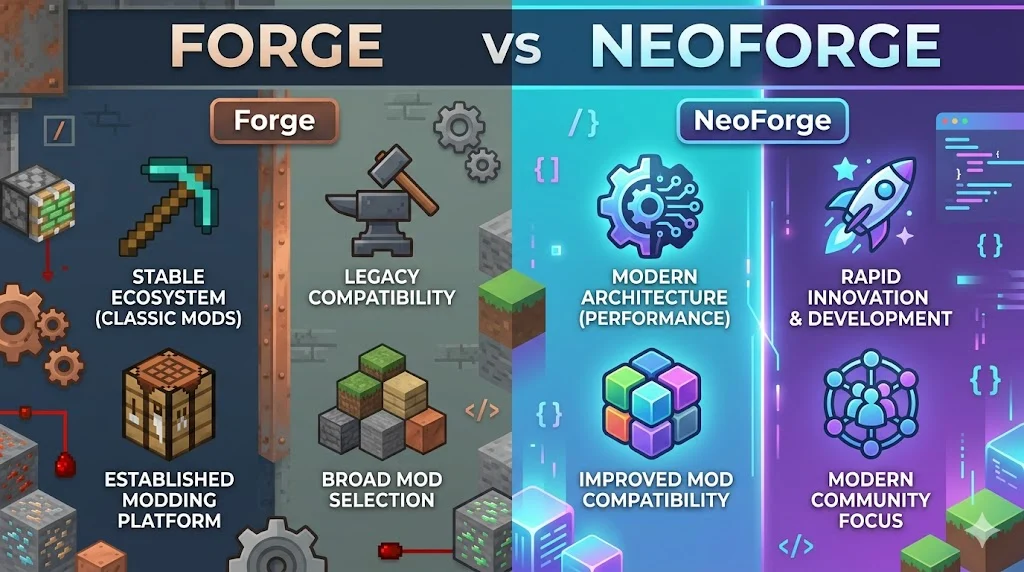
Forge and NeoForge are both modding platforms used in Minecraft to load and manage mods, but they differ in development direction and community support. Forge is the long-established mod loader, while NeoForge is a newer fork designed to modernize and continue development with improved structure and updates. Players and mod developers choose between them based on compatibility, performance, and mod ecosystem support.
Minecraft modding has grown into a massive ecosystem. Players use mods to change gameplay, add new items, improve graphics, and create entirely new worlds. At the center of this system are mod loaders, and one of the biggest decisions for players and developers is Forge vs NeoForge. When comparing NeoForge vs Forge, it’s important to understand how each loader differs in compatibility, performance, community support, and future development before choosing the right one for your mods.
Many players get confused when they install mods and see that some require Forge while others require NeoForge. Both look similar, both support mods, and both aim to improve Minecraft. But they are not the same.
Forge has been the backbone of Minecraft modding for many years. NeoForge is a newer evolution created to modernize the system and improve development speed and structure.
This confusion often leads to installation errors, broken mods, or incompatible setups. Understanding the difference helps players choose the right loader and avoid frustration. In this guide, you will learn what Forge vs NeoForge really means, how they work, where they differ, and which one you should use in 2026 and beyond.
Quick Answer Overview
Forge is the original Minecraft mod loader used for years to run mods. NeoForge is a newer fork of Forge designed to continue development with modern updates and cleaner architecture.
Both serve the same purpose, but NeoForge aims to improve performance, modularity, and long term maintainability, while Forge focuses on legacy compatibility and established mod ecosystems.
What is Forge in Minecraft Modding?
Forge is one of the oldest and most popular mod loaders for Minecraft. A mod loader is a tool that allows mods to run by connecting them to the game’s code.
How Forge Works
Forge acts like a bridge between Minecraft and mods. Without it, mods cannot interact with the game properly. It manages:
- Game events
- Item and block registration
- Mod compatibility
- Configuration systems
Why Forge Became Popular
Forge became the standard because:
- It supports thousands of mods
- It has strong community backing
- It is stable and widely documented
- It works with many Minecraft versions
Limitations of Forge
Despite its popularity, Forge has some drawbacks:
- Slower update cycles
- Complex legacy codebase
- Heavy structure in older versions
- Performance limitations in some cases
These limitations are part of why NeoForge emerged.
What is NeoForge?
NeoForge is a modern fork of Forge. A fork means it started from Forge’s code but is being developed independently.
NeoForge aims to modernize mod loading by improving structure, performance, and development flexibility.
Why NeoForge Was Created
NeoForge was created to address issues such as:
- Slow modernization of Forge
- Outdated internal architecture
- Difficulty adapting to newer Minecraft updates
- Need for cleaner development practices
Key Idea Behind NeoForge
NeoForge keeps compatibility ideas from Forge but rebuilds parts of the system to make it:
- More modular
- Easier to maintain
- Faster to update
- More developer friendly
Forge vs NeoForge: Core Differences
Understanding Forge vs NeoForge becomes easier when comparing them directly.
Development Model
Forge:
- Centralized long-term project
- Large legacy system
- Slower structural changes
NeoForge:
- Forked and independent development
- Faster modernization
- Cleaner code direction
Performance
Forge:
- Stable but sometimes heavy
- Optimized for compatibility
NeoForge:
- Designed for improved efficiency
- More modern optimization approaches
Mod Compatibility
Forge:
- Largest mod library
- Years of backward compatibility
NeoForge:
- Growing ecosystem
- Not all Forge mods are compatible
Update Speed
Forge:
- Slower updates for new Minecraft versions
NeoForge:
- Faster adaptation due to modern structure
Community Support
Forge:
- Massive established community
NeoForge:
- Smaller but rapidly growing community
Comparison Table: Forge vs NeoForge
| Feature | Forge | NeoForge |
| Age | Older system | Newer fork |
| Mod Support | Very high | Growing |
| Performance | Stable but heavy | Optimized design |
| Updates | Slower | Faster |
| Compatibility | Excellent | Improving |
| Code Structure | Legacy-based | Modernized |
| Community | Very large | Expanding |
Advantages and Disadvantages of Forge vs NeoForge
Advantages of Forge
- Huge mod library
- Very stable for older Minecraft versions
- Widely supported by mod developers
- Proven reliability
Disadvantages of Forge
- Slower updates
- Older architecture
- Can feel heavy on performance in some setups
Advantages of NeoForge
- Modern design approach
- Faster updates for new Minecraft versions
- Cleaner internal structure
- Better long term scalability
Disadvantages of NeoForge
- Smaller mod ecosystem
- Some Forge mods not yet compatible
- Still evolving and changing
Real-World Usage Examples
Example 1: Modded Survival Gameplay
A player wants to install 50+ mods including:
- New biomes
- Magic systems
- Technology mods
They choose Forge because most established mods support it.
Example 2: New Minecraft Version Testing
A developer wants to quickly update mods for the latest Minecraft release.
They choose NeoForge because it supports faster adaptation.
Example 3: Performance-Focused Modpack
A modpack creator wants smoother performance and modern structure.
They experiment with NeoForge to improve load times and system efficiency.
Regional and Global Usage Trends
Globally, Forge remains the dominant mod loader due to its long history and massive mod library.
However, NeoForge is gaining attention among:
- New mod developers
- Performance-focused communities
- Players using latest Minecraft versions
In regions with strong modding communities, Forge still leads, but NeoForge adoption is increasing steadily.
Common Mistakes When Choosing Forge vs NeoForge
Mistake 1: Mixing Mods
Some players install Forge mods on NeoForge or vice versa. This causes crashes.
Mistake 2: Ignoring Version Requirements
Mods are version-specific. Forge 1.20 mods may not work on NeoForge builds.
Mistake 3: Assuming They Are Identical
Even though NeoForge started from Forge, they are now separate systems.
Mistake 4: Not Checking Mod Loader Labels
Always check if a mod is marked:
- Requires Forge
- Requires NeoForge
Exercises with Answers
Exercise 1
Question: What is the main purpose of Forge and NeoForge?
Answer: Both are mod loaders that allow Minecraft mods to run by connecting them to the game engine.
Exercise 2
Question: Which has a larger mod ecosystem today?
Answer: Forge has a larger and more established mod ecosystem.
Exercise 3
Question: Why was NeoForge created?
Answer: To modernize Forge’s codebase and improve performance, structure, and update speed.
Exercise 4
Question: Can Forge mods always run on NeoForge?
Answer: No, compatibility is not guaranteed.
Exercise 5
Question: Which is better for new Minecraft versions?
Answer: NeoForge is often faster to adapt to new versions.
Related Concepts and Comparisons
To fully understand Forge vs NeoForge, it helps to know related terms:
Mod Loader
A tool that loads mods into Minecraft.
Fabric
Another lightweight mod loader competing with Forge and NeoForge.
Minecraft API
The system that allows mods to interact with game functions.
Mod Compatibility Layer
A system that ensures mods work together without conflicts.
FAQs
What is Forge vs NeoForge in simple terms?
Forge is the original mod loader, while NeoForge is a newer updated version built for modernization.
Is NeoForge better than Forge?
NeoForge is better in structure and updates, but Forge still has more mods and stability.
Can I use Forge mods on NeoForge?
Not always. Some mods work, but many require their specific loader.
Which is more popular, Forge or NeoForge?
Forge is still more popular due to its long history and large mod ecosystem.
Is NeoForge replacing Forge?
No. NeoForge is a fork, not a full replacement, but it may grow in importance.
Which should beginners use?
Beginners should use Forge if they want maximum mod availability and stability.
Does NeoForge improve performance?
In many cases, yes. It is designed with modern optimization principles.
Are Forge and NeoForge the same?
No. They are related but separate mod loaders.
Will all future mods use NeoForge?
Not necessarily. Both platforms are likely to coexist for a long time.
Can I switch between Forge and NeoForge easily?
Yes, but you must reinstall mods compatible with the selected loader.
Conclusion
Understanding Forge vs NeoForge is essential for anyone interested in Minecraft modding. Both systems allow players to extend the game, but they serve different purposes and development paths.
Forge remains the most stable and widely supported mod loader with a massive ecosystem. NeoForge, on the other hand, represents a modern evolution focused on performance, structure, and faster updates.
For most players, Forge is still the safest choice due to compatibility. For developers and advanced users, NeoForge offers exciting improvements and future-ready design.
The best choice depends on your needs. If you want stability and thousands of mods, choose Forge. If you want modern development and faster updates, explore NeoForge.