
Last Updated on April 24, 2026
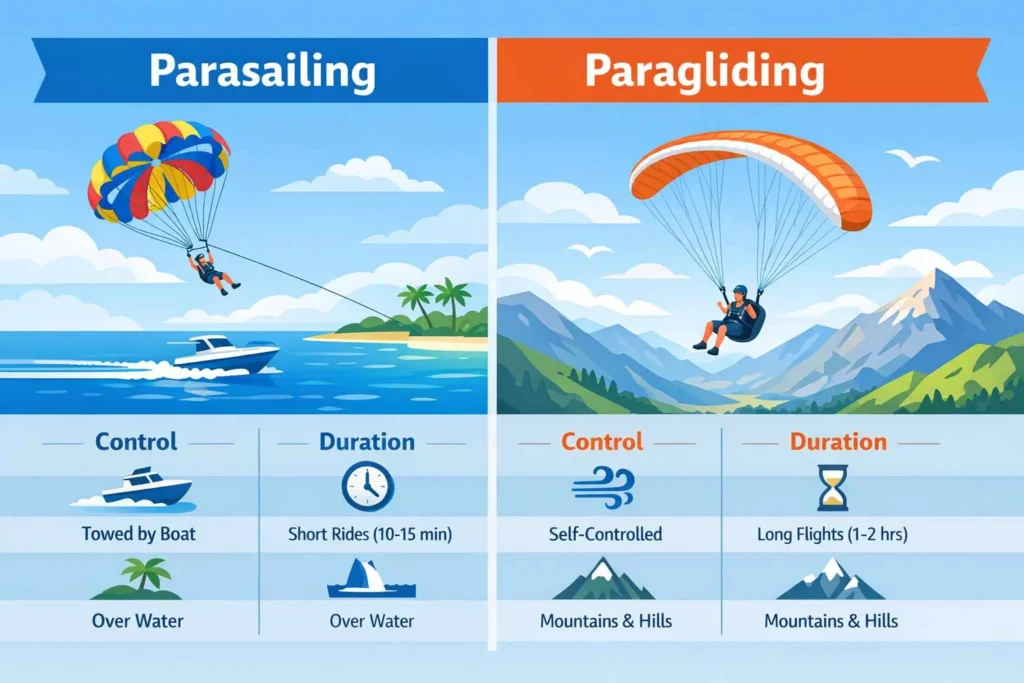
Parasailing vs paragliding refers to two different aerial activities that use a parachute-like canopy but operate in very different environments and methods. Parasailing is usually done over water and involves being towed by a boat, while paragliding is a free-flying sport launched from land using wind and elevation. The main difference lies in control, setup, and level of independence during flight.
Parasailing vs paragliding is one of the most common comparisons among adventure lovers who want to experience flying. Both activities give you the feeling of floating in the sky, but they are not the same at all. Many beginners confuse them because both use a parachute-like wing and offer a bird’s-eye view.
The confusion often leads to wrong expectations. Some people expect parasailing to feel like a long flight experience like paragliding, while others think paragliding is just a more advanced version of parasailing. In reality, they are built on completely different systems.
Understanding parasailing vs paragliding is important before booking an adventure. It helps you choose the right activity based on your comfort level, budget, fear of heights, and interest in adventure sports. In this guide, you will learn everything in simple language, including how each one works, safety, cost, advantages, disadvantages, real-life examples, and even common mistakes beginners make.
If you are planning your next adventure, this detailed comparison will help you make a smart and confident decision.
Quick Answer: Parasailing vs Paragliding Overview
Parasailing vs paragliding can be quickly understood like this:
- Parasailing is a passive flight experience where you are attached to a boat and lifted by a parachute-like canopy.
- Paragliding is an active flight sport where you control your movement using air currents and steering lines.
In simple words:
- Parasailing = short, controlled, boat-towed flight over water
- Paragliding = longer, free flight from hills or mountains with control
Definition and Explanation
What is Parasailing?
Parasailing is a recreational activity where a person is harnessed to a specially designed parachute called a parasail wing. This wing is attached to a speedboat. As the boat moves forward, the parachute lifts the person into the air.
You do not control the flight. The boat driver controls speed and direction.
Key Points of Parasailing:
- Usually done over oceans, seas, or lakes
- Requires a speedboat
- Flight lasts 5 to 15 minutes
- Minimal control for the rider
- Focus is on fun and scenic views
What is Paragliding?
Paragliding is a free-flight air sport where a pilot launches from a hill or mountain using a fabric wing called a paraglider. The pilot controls direction and speed using brake lines and body weight.
Unlike parasailing, no vehicle pulls you. You fly using wind and air currents.
Key Points of Paragliding:
- Done from elevated land areas
- No motor or boat required
- Flight can last 15 minutes to several hours
- Full control by pilot
- Requires training and skill
Parasailing vs Paragliding: Detailed Comparison Table
| Feature | Parasailing | Paragliding |
| Launch Method | Boat pulls parachute | Running takeoff from hill |
| Control | No control | Full control by pilot |
| Location | Water bodies | Mountains, hills, cliffs |
| Duration | Short (5–15 min) | Long (15 min to hours) |
| Skill Required | None | Training required |
| Safety Dependency | Boat operator | Pilot skill + weather |
| Equipment | Boat + parasail canopy | Paraglider wing + harness |
| Experience Type | Recreational | Adventure sport |
| Height Control | Controlled by boat speed | Controlled by air currents |
| Landing | Back on boat | On ground landing |
How Parasailing Works vs Paragliding Mechanics
Parasailing Mechanics
Parasailing works using a simple towing system:
- Rider wears a harness
- Parachute is attached to harness
- Boat accelerates forward
- Air fills parachute
- Lift is created
- Rider is lifted into the air
The higher the speed of the boat, the higher you go.
Paragliding Mechanics
Paragliding uses aerodynamic lift:
- Pilot inflates wing using wind
- Runs off a slope for takeoff
- Air pressure creates lift
- Pilot controls direction using brake lines
- Thermals help stay in air longer
- Gradual landing on open ground
Paragliding depends heavily on weather conditions and wind currents.
Advantages and Disadvantages
Parasailing Advantages
- Easy and beginner-friendly
- No training required
- Safe for most age groups
- Quick setup and experience
- Stunning water views
Paragliding Advantages
- Real flying experience
- Longer flight duration
- Full control and freedom
- Can cover large distances
- Strong adrenaline experience
Parasailing vs Paragliding Disadvantages
Parasailing Disadvantages
- Very short duration
- No control over movement
- Limited to water locations
- Weather dependent on wind and boat conditions
Paragliding Disadvantages
- Requires training and practice
- Weather sensitive
- Higher risk if poorly managed
- Not suitable for all beginners
Real-World Examples of Parasailing vs Paragliding
Parasailing Example
Imagine you are on a beach in a coastal city. A speedboat takes you into the water. You wear a harness and slowly rise into the air. You see blue ocean, boats, and coastline from above. After a few minutes, you are gently brought back to the boat.
This is classic parasailing vs paragliding difference in action: short, scenic, and controlled.
Paragliding Example
Now imagine standing on a hilltop. You run forward with a parachute wing above you. Suddenly, the wind lifts you. You are flying over valleys, rivers, and villages. You can turn left, right, or even climb higher using air currents.
This is full freedom flying.
Regional and Global Usage
Parasailing Around the World
Parasailing is popular in:
- Beach destinations
- Island resorts
- Tourist coastal cities
Common regions:
- Maldives
- Thailand
- Dubai
- Goa (India)
- Mediterranean beaches
It is mainly a tourist attraction.
Paragliding Around the World
Paragliding is popular in:
- Mountain regions
- Adventure tourism spots
Common regions:
- Switzerland Alps
- Turkey (Oludeniz)
- Nepal (Pokhara)
- India (Bir Billing)
- France (Annecy)
It is considered a serious adventure sport.
Safety Comparison: Parasailing vs Paragliding
Parasailing Safety
Parasailing is generally safe when:
- Equipment is maintained
- Weather is calm
- Operator is trained
Risks include:
- Rope failure (rare)
- Sudden wind changes
- Water landing issues
Paragliding Safety
Paragliding safety depends on:
- Pilot training
- Weather understanding
- Proper equipment
Risks include:
- Strong wind turbulence
- Incorrect landing
- Pilot error
Modern safety gear reduces risks significantly.
Cost Comparison: Parasailing vs Paragliding
Parasailing Cost
- Usually affordable
- Charged per ride
- No training cost
Paragliding Cost
- Higher cost
- Training courses required
- Equipment and instructor fees
Paragliding is more expensive but offers longer and deeper experience.
Common Mistakes in Parasailing vs Paragliding
Mistakes in Parasailing
- Thinking you control the ride
- Not checking safety gear
- Choosing unsafe operators
- Wearing improper clothing
Mistakes in Paragliding
- Ignoring training sessions
- Flying in bad weather
- Underestimating wind conditions
- Poor landing preparation
Exercises: Parasailing vs Paragliding Understanding Practice
Exercise 1: Identify the Activity
- You are pulled by a boat over the sea
- You run from a hill and fly using wind
- You have no control in the air
- You can steer using brake lines
Answers:
- Parasailing
- Paragliding
- Parasailing
- Paragliding
Exercise 2: True or False
- Paragliding requires training
- Parasailing is always longer than paragliding
- Paragliding uses natural wind currents
- Parasailing is done on mountains
Answers:
- True
- False
- True
- False
Related Concepts and Comparisons
Understanding parasailing vs paragliding also helps you understand:
- Skydiving vs paragliding
- Hang gliding vs paragliding
- Parachuting vs parasailing
- Adventure tourism sports
- Aerial sports safety systems
Each of these involves air travel but differs in control, duration, and risk level.
FAQs
What is the main difference between parasailing vs paragliding?
Parasailing is boat-towed and passive, while paragliding is wind-powered and fully controlled by the pilot.
Which is safer, parasailing or paragliding?
Both are safe when done correctly. Parasailing is simpler, while paragliding depends more on training and weather.
Do I need training for parasailing vs paragliding?
Parasailing requires no training. Paragliding requires professional training and practice.
Which gives a longer flight experience?
Paragliding offers much longer flight duration than parasailing.
Is parasailing vs paragliding suitable for beginners?
Parasailing is ideal for beginners. Paragliding is better after training.
Can children try parasailing vs paragliding?
Children may try parasailing with supervision. Paragliding usually has age and training restrictions.
Which is more expensive, parasailing or paragliding?
Paragliding is more expensive due to training and equipment.
Where is parasailing vs paragliding commonly done?
Parasailing is done on beaches, while paragliding is done in mountains and hills.
Which gives better views, parasailing or paragliding?
Both offer great views, but paragliding provides wider and longer scenic exposure.
Is parasailing vs paragliding physically demanding?
Parasailing is not physically demanding. Paragliding requires moderate physical effort and coordination.
Conclusion
Parasailing vs paragliding is a comparison between two exciting but very different air experiences. Parasailing is simple, short, and controlled by a boat, making it perfect for beginners and tourists who want a quick thrill. Paragliding, on the other hand, is a real adventure sport that gives freedom, control, and longer flight time, but it requires training and practice.
If you want a relaxed, safe, and scenic experience, parasailing is the better choice. If you want adventure, control, and a deeper flying experience, paragliding is ideal. Both activities offer unforgettable memories, but the right choice depends on your comfort level and interest.
Understanding parasailing vs paragliding helps you choose wisely, avoid confusion, and enjoy your adventure safely and fully.