
Last Updated on June 13, 2026
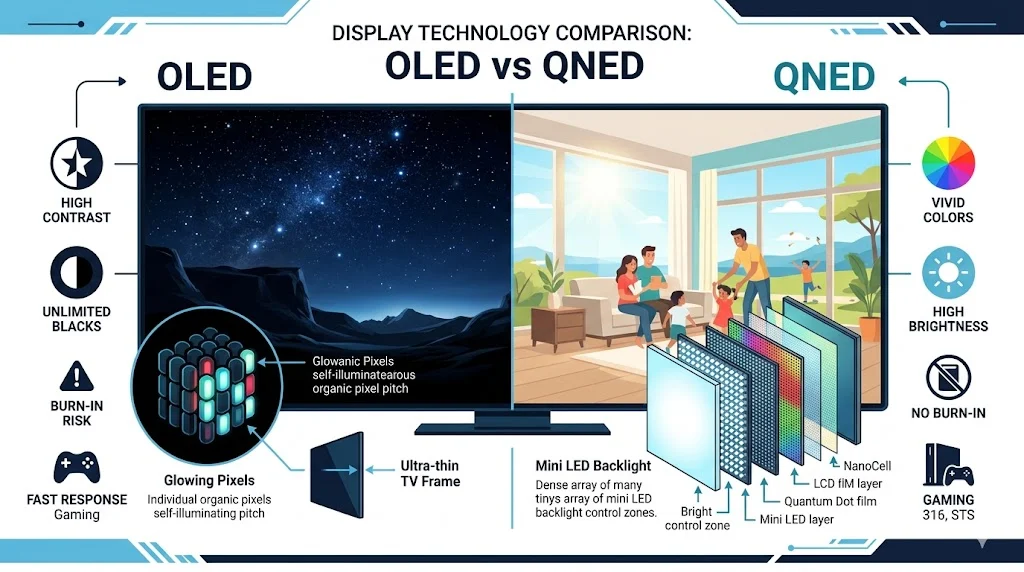
OLED vs QNED refers to two advanced display technologies used in modern TVs. OLED produces its own light at the pixel level for perfect blacks and infinite contrast, while QNED uses Mini LED backlighting with quantum dot and NanoCell layers for higher brightness and improved color volume. The main difference is that OLED focuses on perfect picture quality in dark environments, while QNED focuses on extreme brightness and durability.
Choosing a TV today is not easy. You will see many terms like OLED, QNED, QLED, and Mini LED. Most buyers get confused between OLED vs QNED because both promise stunning picture quality, rich colors, and advanced technology.
The problem is that they work in very different ways. OLED gives each pixel its own light. QNED uses a powerful backlight system behind the screen. This difference changes everything, from brightness to contrast, price, and lifespan.
Many people ask: Which one is better for movies, gaming, or bright rooms? The answer is not simple. It depends on where you live, how you use your TV, and what kind of viewing experience you prefer.
In this guide, you will learn OLED vs QNED in a simple way. You will see real examples, clear comparisons, advantages, disadvantages, and buying tips. By the end, you will know exactly which display suits your needs.
OLED vs QNED Quick Overview
What is OLED vs QNED in simple words?
OLED vs QNED is a comparison between self-emissive display technology and advanced LED-backlit technology.
- OLED uses organic light-emitting diodes
- QNED uses Mini LED + quantum dots + NanoCell filters
Simple analogy
Think of OLED like thousands of tiny flashlights that turn on and off individually.
Think of QNED like a powerful lamp behind a colored glass panel.
What is OLED?
OLED stands for Organic Light Emitting Diode. Each pixel produces its own light.
Key characteristics of OLED
- No backlight required
- True black levels
- Infinite contrast ratio
- Ultra-thin panels
- Fast response time
How OLED works
When a pixel is off, it is completely black. That is why OLED delivers perfect contrast.
Popular OLED brands
- LG OLED TVs
- Sony OLED TVs
- Panasonic OLED TVs
What is QNED?
QNED is a display technology mainly used by LG. It combines:
- Mini LED backlighting
- Quantum Dot layer
- NanoCell color filter
Key characteristics of QNED
- Very high brightness
- Improved color accuracy
- Better performance in bright rooms
- Reduced blooming (compared to standard LED)
How QNED works
Instead of each pixel lighting itself, a Mini LED backlight shines through layers that improve color and clarity.
OLED vs QNED Core Differences
| Feature | OLED | QNED |
| Light source | Self-emissive pixels | Mini LED backlight |
| Black levels | Perfect black | Very good but not perfect |
| Brightness | Medium | Very high |
| Color accuracy | Excellent | Excellent |
| Viewing angle | Wide | Good |
| Burn-in risk | Possible | No risk |
| Thickness | Ultra-thin | Thicker |
| Price | Expensive | Mid to high |
OLED vs QNED Advantages and Disadvantages
OLED Advantages
- Perfect black levels
- Infinite contrast
- Best for movies in dark rooms
- Extremely fast response time (great for gaming)
- Ultra-slim design
OLED Disadvantages
- Risk of burn-in with static images
- Lower peak brightness than QNED
- More expensive
- Not ideal for very bright rooms
QNED Advantages
- Very high brightness (ideal for daylight viewing)
- No burn-in risk
- More affordable than OLED (in many sizes)
- Good color accuracy
- Better longevity for static content
QNED Disadvantages
- Not true black (some light leakage)
- Slight blooming in dark scenes
- Thicker design compared to OLED
- Contrast not as strong as OLED
OLED vs QNED in Real-World Use Cases
Movie Watching
OLED is better for cinematic experience due to deep blacks and contrast.
Sports Viewing
QNED is better because it handles bright scenes and motion in daylight rooms.
Gaming
- OLED: Best response time and visual quality
- QNED: No burn-in risk for long gaming sessions
Office or Static Content
QNED is safer for static images like dashboards or CCTV screens.
OLED vs QNED in Different Room Conditions
Dark Room
OLED wins clearly due to perfect black levels.
Bright Room
QNED performs better because of higher brightness.
Mixed Lighting
Both perform well, but QNED has a slight advantage in reflections.
OLED vs QNED Technology Breakdown
OLED Technology Explained
OLED uses organic compounds that emit light when electricity passes through them. Each pixel works independently.
QNED Technology Explained
QNED combines:
- Mini LED: for precise backlighting
- Quantum Dot: for color enhancement
- NanoCell: for color filtering
This hybrid system improves brightness and color volume.
OLED vs QNED for Gaming
OLED Gaming Benefits
- 0.1 ms response time
- Perfect motion clarity
- No motion blur
QNED Gaming Benefits
- Higher brightness in HDR games
- No burn-in risk
- Stable performance for long sessions
Gaming Verdict
- Competitive gamers prefer OLED
- Casual long-session gamers prefer QNED
OLED vs QNED for HDR Content
HDR (High Dynamic Range) depends heavily on brightness and contrast.
- OLED: Better contrast, deeper HDR impact
- QNED: Brighter highlights, more visible in daylight
Common Mistakes When Choosing OLED vs QNED
Mistake 1: Thinking brighter is always better
Brightness is not everything. Contrast matters more for cinematic viewing.
Mistake 2: Ignoring room lighting
OLED is not ideal for very bright living rooms.
Mistake 3: Overestimating burn-in risk
Modern OLEDs have protection, but static images still matter.
Mistake 4: Choosing only based on price
Long-term viewing habits matter more than cost.
Exercises: Test Your Understanding of OLED vs QNED
Exercise 1
Which is better for dark room movie watching?
Answer: OLED
Exercise 2
Which has higher brightness?
Answer: QNED
Exercise 3
Which technology uses self-emissive pixels?
Answer: OLED
Exercise 4
Which has no burn-in risk?
Answer: QNED
Exercise 5
Which is better for daytime sports viewing?
Answer: QNED
OLED vs QNED Comparison Table (Detailed)
| Category | OLED Performance | QNED Performance |
| Contrast | Excellent | Good |
| Brightness | Medium | Very High |
| Color depth | Excellent | Excellent |
| Motion handling | Excellent | Very good |
| Burn-in safety | Moderate risk | No risk |
| Viewing angle | Excellent | Good |
| Lifespan | Good | Very good |
| Price | High | Moderate |
Related Concepts and Comparisons
OLED vs QLED
QLED uses quantum dots but still relies on LED backlight.
QNED vs Mini LED
QNED is basically Mini LED + quantum dots + NanoCell.
OLED vs MicroLED (future tech)
MicroLED aims to combine OLED quality with QNED brightness advantages.
Regional and Global Usage Trends
OLED Popularity
- Strong in Europe and North America
- Preferred for home theaters
QNED Popularity
- Growing in Asia and developing markets
- Popular for bright living rooms
FAQs
What is OLED vs QNED in simple terms?
OLED uses self-lighting pixels, while QNED uses a Mini LED backlight with color-enhancing layers.
Is OLED better than QNED?
OLED is better for contrast and movies, while QNED is better for brightness and daylight viewing.
Does QNED have burn-in problems like OLED?
No, QNED does not suffer from burn-in issues.
Which is more expensive, OLED vs QNED?
OLED is generally more expensive due to advanced panel technology.
Which is better for gaming, OLED vs QNED?
OLED is better for speed and visuals, QNED is safer for long gaming sessions.
Is QNED good for dark rooms?
It is good, but OLED performs better in dark environments.
Which lasts longer, OLED or QNED?
QNED generally has a longer lifespan due to no burn-in risk.
What is the main difference between OLED vs QNED?
OLED is self-emissive; QNED is backlit with advanced color layers.
Which is better for sports watching?
QNED is better because of higher brightness and clarity in daylight.
Should I buy OLED or QNED in 2026?
Choose OLED for cinematic quality. Choose QNED for brightness, durability, and mixed usage.
Conclusion
OLED vs QNED is not about which one is universally better. It is about which one matches your viewing environment and habits.
OLED delivers unmatched contrast, perfect blacks, and cinematic quality. It is ideal for movie lovers and gamers who watch in dark or controlled lighting conditions. However, it comes at a higher price and has some burn-in considerations.
QNED offers extreme brightness, strong color performance, and better durability. It is ideal for bright rooms, sports viewing, and long daily usage without worrying about burn-in.
The best choice depends on your lifestyle. If you want theater-like visuals, OLED is the winner. If you want a bright, practical, and long-lasting display, QNED is the smarter choice.