
Last Updated on June 15, 2026
Contingent meaning refers to a meaning that depends on specific conditions, context, or circumstances. It is not fixed or guaranteed and can change based on situation, intent, or external factors. For example, a statement like “I’ll join if I’m free” has a contingent meaning because it depends on availability.
What Does Contingent Meaning Actually Mean?
You’ll hear the word contingent in contracts, conversations, and even philosophy. Yet most people only grasp half of it. Let’s clear that up.
At its core, contingent meaning describes something that depends on conditions. It does not stand alone. It shifts. It adapts. It responds to context.
Think of it like a light with a dimmer switch. The brightness changes depending on how you adjust it. Meaning behaves the same way.
Here’s the simplest way to understand it:
Contingent meaning = meaning that changes based on situation, context, or conditions.
That’s it. No fluff. Just a clean, powerful idea.
Contingent Definition (Deep but Simple)
Let’s break it down clearly.
Contingent (adjective):
- Dependent on something else happening
- Subject to change
- Not certain or guaranteed
Key Characteristics
- Condition-based
- Flexible
- Uncertain outcome
- Context-driven
Quick Example
- “Your job offer is contingent on background checks.”
That means:
👉 You don’t have the job yet.
👉 You might get it.
👉 It depends on something else.
Contingent Meaning in English (Explained Simply)
In English, contingent meaning focuses on how interpretation changes.
Words don’t always mean the same thing. Context shapes everything.
Example:
- “That’s great.”
Now pause. What does it mean?
- Excitement → “That’s amazing!”
- Sarcasm → “That’s terrible.”
Same words. Different meanings.
Why? Because meaning is contingent on tone and situation.
Contingent Meaning in Urdu
Understanding this concept in another language makes it even clearer.
Contingent meaning in Urdu:
- مشروط معنی
- حالات پر منحصر معنی
Explanation:
It refers to meaning that depends on conditions (شرائط) or circumstances (حالات).
Example:
- “میں آؤں گا اگر وقت ملا”
- Translation: “I’ll come if I have time.”
That sentence carries a contingent meaning because it depends on time availability.
Why Contingent Meaning Matters More Than You Think
At first glance, this may feel like a technical idea. It isn’t.
You use contingent meaning every day.
It affects:
- Conversations
- Business deals
- Legal agreements
- Relationships
- Decision-making
Without understanding it:
- You misinterpret intentions
- You make wrong assumptions
- You miss hidden conditions
With it:
- You communicate clearly
- You negotiate smarter
- You avoid costly mistakes
Real-Life Examples of Contingent Meaning
Let’s make this practical.
Everyday Language
- “I’ll call you if I’m free.”
- “We’ll go out if it stops raining.”
These sentences are not promises. They depend on conditions.
Business Context
- “The contract is contingent upon approval.”
- “Payment is contingent on delivery.”
Here, meaning ties directly to conditions being met.
Social Situations
- “Sure, do whatever you want.”
This one’s tricky.
It could mean:
- Genuine permission
- Hidden frustration
The meaning depends on tone, body language, and context.
Contingent vs Non-Contingent Meaning
Understanding the contrast sharpens your thinking.
| Feature | Contingent | Non-Contingent |
|---|---|---|
| Depends on conditions | Yes | No |
| Flexible meaning | Yes | No |
| Guaranteed outcome | No | Yes |
| Context-driven | Yes | No |
| Example | “If approved” | “This is final” |
Key Insight
Contingent meaning lives in uncertainty.
Non-contingent meaning lives in certainty.
Contingent Meaning in Philosophy
Now let’s go deeper.
Philosophy treats contingency as a fundamental concept.
Two Types of Truth
| Type | Description | Example |
|---|---|---|
| Contingent Truth | Could be different | “It is raining” |
| Necessary Truth | Always true | “2 + 2 = 4” |
Why This Matters
Philosophers ask:
- Could this be false?
- Does it depend on conditions?
If yes → it’s contingent
Contingency in Logic and Reasoning
Logic thrives on conditions.
Conditional Structure
- If X happens → Y follows
This creates contingent outcomes.
Example:
- If you study → you pass
But what if you don’t study?
Outcome changes. Meaning shifts.
That’s contingency in action.
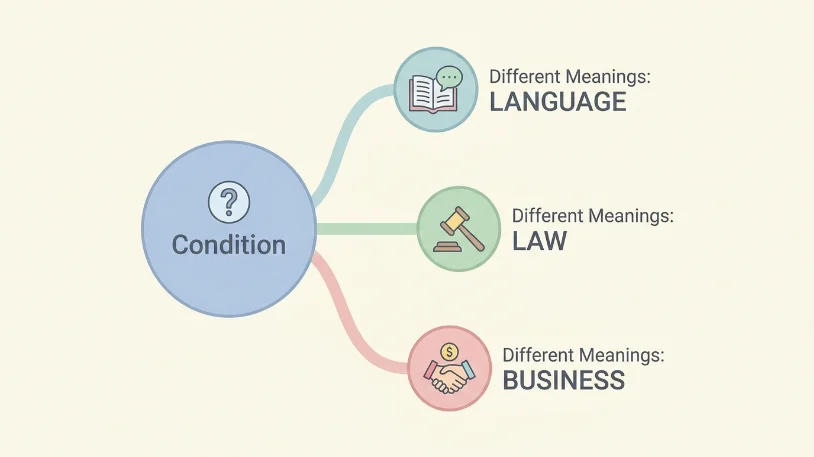
Contingent Meaning in Linguistics
Language is rarely fixed. It breathes. It shifts.
Key Concepts
Lexical Semantics
Focuses on word meanings.
Pragmatics
Focuses on how context changes meaning.
Polysemy
One word, many meanings.
Example:
- “Bank”
- Financial institution
- River edge
Meaning depends on context.
Disambiguation
This is how your brain chooses meaning.
You don’t think about it consciously. Still, it happens instantly.
Contingent Meaning in Law
Legal language depends heavily on contingency.
Common Legal Terms
Contingent Contract
A contract that depends on an event.
Example:
- Payment only happens if work is completed.
Contingent Liability
A possible future obligation.
Example:
- Lawsuit risk
- Warranty claims
Why It Matters in Law
- Reduces risk
- Defines responsibility
- Clarifies conditions
Contingent Meaning in Business and Finance
Business thrives on uncertainty.
Common Uses
Contingent Worker
- Freelancers
- Temporary staff
Contingent Plan
- Backup strategy
- Used when things go wrong
Contingent Assets
- Possible gains in future
Table: Business Applications
| Term | Meaning | Example |
|---|---|---|
| Contingent Plan | Backup strategy | Disaster recovery |
| Contingent Liability | Possible debt | Legal case |
| Contingent Worker | Temporary staff | Freelancer |
Common Phrases Using Contingent
These show up everywhere.
- Contingent upon → depends on
- Contingent plan → backup plan
- Contingent offer → depends on conditions
- Contingent situation → uncertain outcome
Example:
- “The deal is contingent upon funding.”
Contingent Synonyms (With Nuance)
Not all synonyms mean the same thing.
| Word | Meaning Difference |
|---|---|
| Conditional | Based on rules |
| Dependent | Relies on something |
| Provisional | Temporary |
| Subject to | Controlled by |
Insight
“Contingent” carries uncertainty + dependency together.
Contingent Antonyms
These represent stability.
- Absolute
- Certain
- Fixed
- Unconditional
How to Use Contingent in a Sentence
Use it naturally.
Examples:
- “Success is contingent on effort.”
- “Approval is contingent upon review.”
- “The outcome is contingent on market trends.”
Common Mistakes to Avoid
Even smart writers slip here.
Mistake 1: Treating it as “temporary”
Wrong.
Temporary ≠ contingent.
Mistake 2: Using it without conditions
If there’s no dependency, don’t use it.
Mistake 3: Overcomplicating sentences
Keep it clean.
Why Contingent Meaning Is Powerful
This concept sharpens how you think.
It helps you:
- Understand hidden conditions
- Read between the lines
- Make smarter decisions
Think of it like this:
Life itself is contingent.
Plans shift. Outcomes change. Meaning evolves.
Contingent Meaning in Communication
Communication often fails because people assume fixed meaning.
But meaning rarely stays fixed.
Three Factors That Shape Meaning
- Context
- Tone
- Intent
Remove any of these, and meaning collapses.
Diagram: How Contingent Meaning Works
Condition → Context → Interpretation → MeaningChange one element, and the meaning changes too.
Advanced Insight: Cause-and-Effect Relationship
Contingent meaning ties directly to cause and effect.
Structure:
- Cause (condition)
- Effect (meaning or outcome)
Without the cause, the meaning disappears.
Context-Driven Meaning in Real Life
Let’s look deeper.
Scenario:
Someone says:
- “Nice job.”
Now consider:
- Boss praising → genuine
- Rival saying → sarcastic
Same words. Different meaning.
That’s context-sensitive semantics.
Contingent Meaning vs Conditional Meaning
They overlap but differ slightly.
| Feature | Contingent | Conditional |
|---|---|---|
| Focus | Dependency + uncertainty | Rules |
| Flexibility | High | Medium |
| Use case | Broad | Structured |
FAQs
What is contingent meaning in simple words?
It means a meaning that depends on a situation or condition.
What does contingent mean in business?
It refers to something dependent on future events, like payments or plans.
What is a contingent example?
“I’ll go if it doesn’t rain.”
Is contingent the same as conditional?
Not exactly. Contingent includes uncertainty, while conditional focuses on rules.
What is contingent meaning in law?
It refers to agreements or obligations that depend on certain events.
Final Thought
Once you understand contingent meaning, you start seeing it everywhere.
In conversations.
In contracts.
In decisions.
Meaning isn’t always fixed. It bends with circumstances.
And once you notice that, you communicate with precision most people never reach.