

Last Updated on June 16, 2026
Nefarious meaning refers to something extremely wicked, immoral, or criminal. It describes actions, people, or plans that involve serious wrongdoing, harmful intent, or unethical behavior. The word carries a strong negative tone and is commonly used in formal writing, crime-related contexts, and storytelling.
Let’s get straight to it.
The nefarious meaning describes something extremely wicked, immoral, or criminal. It’s not a casual word. It carries weight. When you use it, you point to serious wrongdoing, not small mistakes.
Think of it like this:
If an action involves harmful intent, deception, or moral corruption, “nefarious” fits.
Simple Definition of Nefarious
- Nefarious (adjective): Extremely bad, wicked, or criminal
That’s the short version. Clean and direct.
Expanded Meaning With Real Nuance
Now let’s go deeper.
“Nefarious” doesn’t just mean bad. It suggests:
- Intentional harm
- Moral corruption
- Often illegal behavior
This word lives in serious territory. You’ll find it in discussions about:
- Fraud
- Corruption
- Criminal schemes
- Dark motives
Why “Nefarious” Feels Stronger Than “Bad”
Here’s where things get interesting.
Not all negative words carry the same force. Compare:
| Word | Strength | Meaning |
|---|---|---|
| Bad | Weak | General negativity |
| Wrong | Mild | Slight moral issue |
| Evil | Broad | Strong but vague |
| Nefarious | Very strong | Intentional, immoral wrongdoing |
“Nefarious” hits harder because it combines:
- Ethics
- Intent
- Serious consequences
It’s precise. It’s sharp. It doesn’t leave room for ambiguity.
Nefarious Pronunciation, Origin, and Linguistic Breakdown
Words have roots. Those roots shape meaning.
Correct Pronunciation
You don’t want to guess this one.
- Phonetic: /nɪˈfɛəriəs/
- Spoken: ni-FAIR-ee-us
Say it out loud. It flows better than it looks.
Word Origin (Latin Roots)
“Nefarious” comes from Latin:
- nefarius = wicked, criminal, unlawful
Break it further:
- “ne” = not
- “fas” = divine law or moral law
So the original idea was:
Something “not allowed by moral or divine law”
That’s powerful. It explains why the word feels so heavy.
Part of Speech and Grammar Usage
- Part of speech: Adjective
- Used to describe:
- Actions
- People
- Plans
Examples:
- A nefarious act
- A nefarious person
- A nefarious scheme
Semantic Meaning and Tone
From a linguistic angle, “nefarious” carries:
- Negative sentiment
- High intensity
- Moral judgment embedded in meaning
It’s not neutral. It always signals strong disapproval.
When and How to Use Nefarious in Real Life
Knowing the meaning of nefarious is one thing. Using it correctly is where most people slip.
Let’s fix that.
Crime and Illegal Activity
This is where the word shines.
Use “nefarious” when describing:
- Fraud schemes
- Organized crime
- Corruption
- Cybercrime
Examples:
- Authorities uncovered a nefarious operation involving identity theft.
- The group carried out nefarious activities across multiple countries.
Notice the pattern. These aren’t minor issues. They’re serious.
Business and Unethical Behavior
Not all wrongdoing is illegal. Some actions fall into gray areas.
Still, they can be nefarious.
Examples:
- The company engaged in nefarious practices to manipulate data.
- Executives were accused of nefarious financial behavior.
This context highlights unethical conduct, even if it skirts the law.
Fiction and Storytelling
Writers love efficiency. “Nefarious” delivers impact instantly.
Why it works:
- Suggests hidden motives
- Implies danger
- Builds tension
Examples:
- The villain revealed his nefarious plan.
- A nefarious organization controlled events behind the scenes.
One word. Full atmosphere.
Casual vs Formal Usage
Here’s where tone matters.
| Context | Usage |
|---|---|
| Formal writing | Common |
| News reports | Frequent |
| Academic text | Appropriate |
| Casual speech | Rare but expressive |
Casual Example (Slight Humor)
- “You’ve got a nefarious plan to avoid work, don’t you?”
Here, the word becomes playful. Still negative, just lighter.
Quick Insight Before Moving Forward
Use “nefarious” when the situation involves serious wrongdoing or dark intent.
Avoid it for small, everyday issues.
That single rule will save you from most mistakes.
What Comes Next
In the next part, we’ll go deeper into:
- Nefarious vs evil, sinister, and wicked
- Powerful synonyms and antonyms
- Real sentence examples that sound natural
- Mistakes that weaken your writing
And we’ll break everything down in a way that actually sticks.
Nefarious vs Similar Words (Deep Comparison That Actually Makes Sense)
Words like evil, sinister, and wicked often get mixed up with nefarious. At first glance, they seem interchangeable. Look closer, and the differences become clear.
Let’s break them down in a way that sticks.
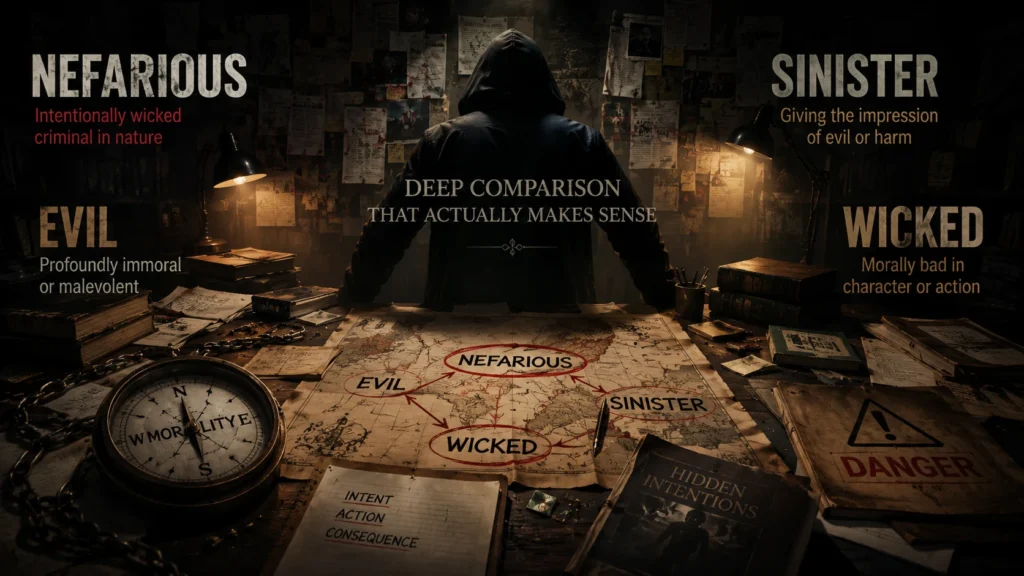
Nefarious vs Evil
These two feel similar. Still, they don’t function the same.
- Evil is broad. It can describe anything morally wrong.
- Nefarious is specific. It points to intentional wrongdoing, often with a criminal edge.
Example:
- “He had evil thoughts.” → vague
- “He carried out a nefarious plan.” → precise and serious
Key Insight:
Evil describes the nature. Nefarious describes action with intent.
Nefarious vs Sinister
Now this one gets interesting.
- Sinister suggests something hidden or threatening
- Nefarious confirms something morally wrong or criminal
Example:
- “She gave a sinister smile.” → suspicious
- “She had nefarious intentions.” → clearly harmful
Quick Rule:
- Sinister = feels dangerous
- Nefarious = is dangerous
Nefarious vs Wicked
“Wicked” plays in two worlds.
- It can mean morally bad
- Or casually playful (“wicked sense of humor”)
Nefarious stays serious. Always.
Example:
- “A wicked prank” → harmless
- “A nefarious scheme” → serious wrongdoing
Nefarious vs Immoral
This one comes down to intensity.
- Immoral = against moral principles
- Nefarious = immoral + harmful + often criminal
Think of it like levels:
| Level | Word | Meaning |
|---|---|---|
| Low | Immoral | Wrong behavior |
| Medium | Unethical | Questionable conduct |
| High | Nefarious | Serious, intentional wrongdoing |
Synonyms and Antonyms of Nefarious (With Real Context)
Expanding your vocabulary gives you flexibility. Still, not every synonym carries the same weight.
Strong Synonyms by Intensity
Extreme Level (Closest Match)
- Villainous
- Heinous
- Depraved
- Atrocious
These match the serious tone of “nefarious.”
Moderate Level
- Corrupt
- Dishonest
- Unethical
- Immoral
Useful in business or everyday discussions.
Dramatic / Literary Tone
- Sinister
- Malevolent
- Dark
- Malicious
These add emotional flavor but may not always imply crime.
Context-Based Synonyms
Choosing the right synonym depends on the situation.
| Context | Best Alternative |
|---|---|
| Crime | Criminal, villainous |
| Business | Corrupt, unethical |
| Writing | Sinister, malevolent |
| Casual | Shady, dishonest |
Antonyms (Clear Opposites)
Opposites matter just as much.
- Ethical
- Virtuous
- Honorable
- Lawful
- Upright
These words represent moral integrity, the complete opposite of nefarious behavior.
Nefarious in a Sentence (Natural, Real Examples)
Let’s move beyond textbook lines. These examples reflect real usage.
Formal Examples
- Authorities exposed a nefarious network involved in cybercrime.
- The report highlighted nefarious activities within the organization.
- Officials investigated a nefarious scheme targeting investors.
Casual Examples
- “That sounds like a nefarious plan to skip responsibilities.”
- “Don’t act like you’re plotting something nefarious.”
These feel lighter. Still, they keep the core meaning.
Storytelling Examples
- A nefarious villain controlled events from the shadows.
- The hero uncovered a nefarious plot that threatened the city.
- Behind the calm exterior, a nefarious mind worked silently.
Notice how the word builds tension instantly.
Common Mistakes When Using Nefarious
Even strong writers slip up here. Let’s fix the most common issues.
Using It for Small Problems
Wrong:
- “My friend forgot my birthday. That’s nefarious.”
Why it fails:
The situation lacks seriousness.
Correct thinking:
Use “nefarious” only when real harm or intent exists.
Confusing It With Similar Words
People often mix it with:
- Suspicious
- Notorious
- Mysterious
Each has a different meaning.
Quick Tip:
If there’s no clear wrongdoing, don’t use “nefarious.”
Overusing the Word
Repetition weakens impact.
Instead of:
- “A nefarious plan, nefarious act, nefarious person”
Mix it up:
- Corrupt plan
- Illegal act
- Dishonest individual
Variety keeps your writing sharp.
Is Nefarious Always Negative? Tone Explained Clearly
Short answer?
Yes. Always negative.
Still, tone can shift slightly depending on context.
Tone Breakdown
| Context | Tone |
|---|---|
| Legal | Serious |
| News | Formal |
| Fiction | Dramatic |
| Casual | Slightly humorous |
Even in jokes, the meaning doesn’t change. Only the intensity softens.
Example of Tone Shift
- Serious: “They carried out a nefarious operation.”
- Playful: “You’ve got a nefarious plan for the weekend.”
Same word. Different energy.
What This Means for Your Writing
If you want impact, use “nefarious” when:
- The stakes feel high
- The intent is harmful
- The tone needs strength
Avoid it when:
- The situation is minor
- You want a casual tone
- Simplicity works better
What Is a Nefarious Person? Traits, Behavior, and Real Meaning
When people hear the phrase nefarious person, they often imagine a villain. That’s not far off. Still, the real meaning goes deeper than fiction.
A nefarious person is someone who:
- Intentionally engages in wrongdoing
- Lacks moral boundaries
- Acts with harmful or deceptive intent
This isn’t about occasional bad behavior. It’s about consistent unethical conduct.
Key Traits of a Nefarious Person
Certain patterns show up again and again.
- Manipulative behavior
They influence others for personal gain. Often without remorse. - Deception
Lies, half-truths, and hidden agendas drive their actions. - Lack of empathy
They rarely consider the impact of their actions on others. - Calculated decisions
Their actions aren’t random. They plan and execute with intent. - Moral indifference
Right and wrong don’t guide their choices. Outcomes do.
Real-World Examples
You don’t need a movie villain to understand this.
- A fraudster running a large scam
- A corrupt official abusing power
- A hacker targeting vulnerable systems
Each case shows intentional harm combined with unethical behavior.
Psychological Angle
Here’s where things get interesting.
Nefarious behavior often connects to traits like:
- Narcissism
- Machiavellianism
- Lack of accountability
These traits don’t guarantee criminal behavior. Still, they often appear in individuals who engage in harmful, calculated actions.
Nefarious Meaning in Literature, Media, and Culture
Stories thrive on conflict. That’s why “nefarious” appears so often in storytelling.
Why Writers Use “Nefarious”
The word does heavy lifting.
It instantly suggests:
- Danger
- Secrecy
- Moral corruption
Instead of long explanations, writers use one word to create a strong impression.
Common Patterns in Media
You’ll often see phrases like:
- A nefarious villain
- A nefarious organization
- A nefarious plot
These patterns signal conflict immediately.
Impact on the Audience
When readers see “nefarious,” they expect:
- High stakes
- Hidden motives
- Serious consequences
It sets the tone fast. No buildup needed.
Simple Alternatives to Nefarious (Plain English Guide)
Sometimes, clarity beats complexity.
If “nefarious” feels too formal, use simpler alternatives.
Everyday Alternatives
- Very bad
- Illegal
- Dishonest
- Harmful
- Corrupt
When to Use Each
| Situation | Best Choice |
|---|---|
| Academic writing | Nefarious |
| Casual conversation | Simple words |
| Business context | Unethical, corrupt |
| General audience | Clear, simple terms |
Quick Tip
Use “nefarious” when you want:
- Precision
- Strong tone
- Formal impact
Switch to simpler words when readability matters more.
Nefarious Meaning in Urdu, Hindi, and Global Contexts
Language changes. Meaning stays consistent.
Urdu Meaning
- بدکار (badkaar)
- شریر (sharir)
- مجرمانہ (mujrimana)
These words reflect criminal or immoral behavior.
Hindi Meaning
- दुष्ट (dusht)
- पापपूर्ण (paappurn)
- अपराधी (apraadhi)
Again, the focus stays on wrongdoing and harmful intent.
Global Understanding
Across languages, “nefarious” always connects to:
- Immorality
- Harmful actions
- Ethical violation
That consistency makes it a powerful word worldwide.
Quick Summary (Fast, Clear, Useful)
Let’s bring everything together.
- Nefarious meaning: Extremely wicked or criminal
- Tone: Strongly negative
- Usage: Formal, serious, impactful
- Best for: Crime, storytelling, ethical discussions
- Avoid: Minor or everyday situations
One-Line Takeaway
“Nefarious” describes actions driven by intentional harm, corruption, or criminal behavior.
FAQs
What does nefarious mean in simple words?
It means very bad or criminal behavior, especially when done on purpose.
Is nefarious a strong word?
Yes. It describes serious wrongdoing, not small mistakes.
How do you use nefarious in a sentence?
Example:
- “They planned a nefarious scheme to deceive investors.”
Is nefarious the same as evil?
Not exactly.
- “Evil” is broad
- “Nefarious” focuses on intentional immoral actions, often involving crime
What is a nefarious person?
Someone who engages in harmful, unethical, or criminal behavior.
Final Insight
Some words fade into the background. Others stand out.
“Nefarious” belongs in the second group.
It doesn’t just describe bad behavior. It highlights:
- Intent
- Morality
- Consequences
Use it when the situation demands weight.
Use it when simple words fall short.
And most importantly, use it with purpose.
Because when you do, it says more than a sentence ever could.