
Last Updated on June 15, 2026
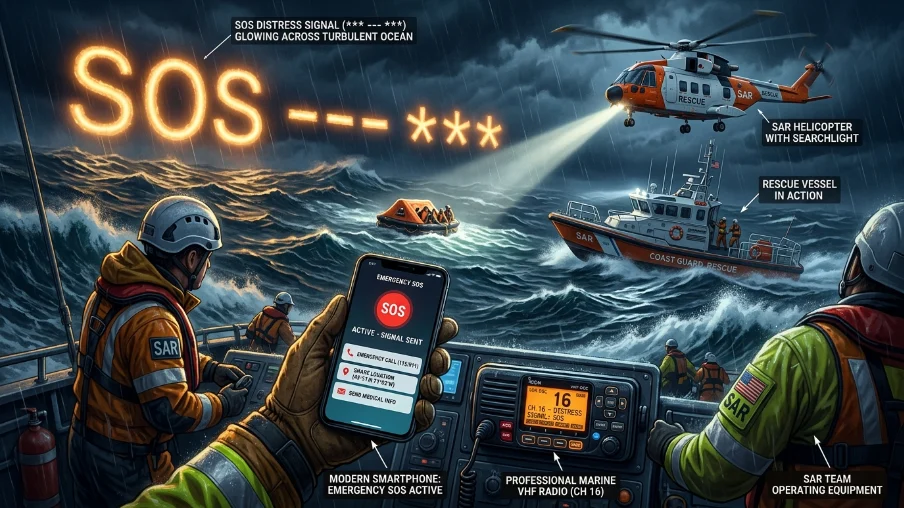
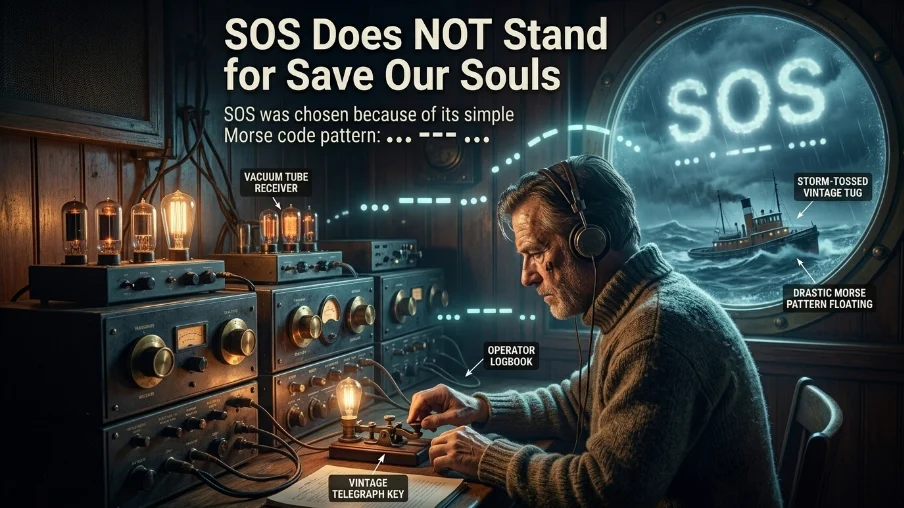
SOS is the international distress signal used to request emergency assistance. In Morse code, SOS is transmitted as three dots, three dashes, and three dots (… — …). Contrary to popular belief, SOS does not officially stand for any specific phrase. It was selected because its Morse code pattern is simple, recognizable, and difficult to misunderstand during emergencies.
When someone sends SOS, they’re usually asking for help.
The term has become one of the most recognized emergency signals in human history. People use it during maritime emergencies, survival situations, rescue operations, and even casual text conversations.
Yet many people still ask:
- What does SOS mean?
- What does SOS stand for?
- Is SOS an abbreviation?
- Why was SOS chosen?
- What is SOS in Morse code?
- How does Emergency SOS work on phones?
The answers are more interesting than most people realize.
SOS is not just a random collection of letters. It became the international standard distress signal because it was simple, unmistakable, and easy to transmit through Morse code.
Today, SOS remains a universal symbol for urgent assistance. It appears in emergency communications, smartphones, safety systems, rescue operations, and everyday online conversations.
This guide explains everything you need to know about the SOS meaning, its history, its use in emergencies, and how it evolved into a global symbol for help.
Understanding the Universal Distress Signal
SOS is a globally recognized signal that indicates someone needs immediate help.
People often associate SOS with:
- Emergencies at sea
- Search and rescue missions
- Survival situations
- Emergency phone features
- Urgent requests for assistance
The signal communicates a simple message:
“I need help immediately.”
Because SOS crosses language barriers, rescue teams worldwide understand its meaning.
Whether transmitted through Morse code, flashing lights, radio communication, or modern smartphone technology, the purpose remains the same.
The signal alerts emergency responders that someone faces a serious situation requiring urgent attention.
What Does SOS Mean?
The meaning of SOS is surprisingly straightforward.
SOS serves as an internationally recognized distress signal used to request emergency assistance.
Unlike many abbreviations, SOS was not originally chosen because of what the letters represent.
Instead, telecommunication authorities selected it because the Morse code pattern was exceptionally easy to recognize.
In Morse code:
S = ...
O = ---
S = ...
Combined, the signal appears as:
... --- ...This pattern creates a distinct sequence that operators could easily identify even under poor communication conditions.
That simplicity saved countless lives.
Why SOS Became So Famous
Several factors contributed to the widespread adoption of SOS.
Easy to Recognize
The pattern stands out clearly among other Morse code signals.
Difficult to Misinterpret
Three short signals followed by three long signals and then three short signals create a unique sequence.
Effective in Noisy Conditions
Radio interference often affected early communications.
SOS remained understandable even when signal quality deteriorated.
International Acceptance
Countries around the world adopted SOS as a universal emergency signal.
As a result, it became the standard distress communication method for ships, rescue services, and emergency responders.
Does SOS Actually Stand for Anything?
One of the most common misconceptions involves the SOS full form.
Many people believe SOS stands for:
- Save Our Souls
- Save Our Ship
- Save Our Spirits
- Send Out Succor
- Save Our Sailors
While these phrases became popular later, they are not the official meaning of SOS.
The truth is simple.
SOS was selected solely because of its Morse code structure.
No official documents from the original international telecommunications agreements assigned a full form to SOS.
The letters themselves were chosen for practical reasons.
Common Backronyms Associated With SOS
| Phrase | Official? |
|---|---|
| Save Our Souls | No |
| Save Our Ship | No |
| Save Our Sailors | No |
| Save Our Spirits | No |
| Send Out Succor | No |
These phrases emerged after SOS became famous.
People naturally wanted the letters to represent words, so various interpretations appeared over time.
Is SOS an Acronym?
Technically, no.
An acronym forms from the initial letters of a phrase.
Examples include:
- NASA
- UNESCO
- NATO
SOS does not originate from a phrase.
Therefore, it is not an acronym.
It is simply a distress signal represented by the letters S-O-S because of the Morse code pattern.
SOS in Morse Code: Three Dots, Three Dashes, Three Dots
The Morse code version of SOS is perhaps the most famous communication signal ever created.
It looks like this:
... --- ...Or visually:
• • • — — — • • •This pattern consists of:
| Symbol | Meaning |
|---|---|
| … | Letter S |
| — | Letter O |
| … | Letter S |
The sequence creates a distinctive rhythm.
Even inexperienced operators could often recognize it immediately.
Why the Morse Code Pattern Was Ideal
Early radio operators faced many challenges.
Signals often became distorted.
Storms created interference.
Equipment sometimes malfunctioned.
A complicated distress code could easily become unreadable.
SOS solved that problem.
Benefits included:
- Short transmission time
- Easy memorization
- Strong recognition
- Reduced communication errors
- International consistency
These advantages made SOS a revolutionary emergency signal.
How SOS Sounds
Operators often describe SOS as:
short short short
long long long
short short short
This rhythm remains recognizable even today.
Many survival training courses still teach it.
History of SOS: How the Distress Signal Was Created
Before SOS existed, emergency communication lacked consistency.
Different organizations used different distress signals.
That created confusion.
Confusion during emergencies can cost lives.
The need for a universal distress signal became increasingly obvious as radio communication expanded across the world.
Emergency Signals Before SOS
One earlier distress signal was:
CQDCQ meant:
“Calling all stations.”
D represented:
“Distress.”
While CQD worked reasonably well, it wasn’t ideal.
The sequence took longer to transmit.
It also lacked the simplicity that later made SOS successful.
The Birth of SOS
International telecommunications authorities sought a better alternative.
In 1906, representatives gathered at the International Radiotelegraphic Convention.
Their goal was standardization.
The result was SOS.
The signal officially became the international distress code.
Its simplicity quickly made it popular among radio operators.
When SOS Became Official
SOS officially entered international use in the early twentieth century.
Ships gradually transitioned from older distress signals to the new standard.
Over time, SOS became universally accepted.
By the outbreak of World War I, it had already gained widespread recognition.
The Titanic and the Rise of the SOS Distress Signal
Few events helped cement the SOS meaning in public consciousness more than the sinking of the RMS Titanic.
When the Titanic struck an iceberg on April 14, 1912, wireless operators sent distress messages to nearby ships. Interestingly, they used both CQD and SOS during the disaster.
At the time, many radio operators still felt comfortable using CQD because they had trained with it for years. However, SOS had already become the official international distress signal.
The tragedy demonstrated why standardized emergency communication mattered.
Rescue ships receiving distress messages needed to understand the situation instantly. Any confusion could delay rescue efforts.
Although the Titanic disaster was devastating, it accelerated improvements in maritime safety, emergency communication, and international rescue procedures.
How the Titanic Used SOS
Wireless operators aboard the Titanic transmitted both distress codes.
Messages included:
- CQD
- SOS
- Position information
- Emergency updates
- Requests for immediate assistance
This event helped spread awareness of SOS around the world.
Newspapers reported extensively on the disaster. As millions read the coverage, they became familiar with the SOS distress signal.
Why SOS Is Used for Emergencies
Many people ask:
Why is SOS used for emergencies instead of another signal?
The answer lies in reliability.
A distress signal must work under the worst possible conditions.
During emergencies, people often face:
- Panic
- Poor visibility
- Equipment failures
- Bad weather
- Communication interference
SOS performs well despite these challenges.
Characteristics of an Effective Emergency Signal
An emergency signal should be:
| Requirement | Why It Matters |
|---|---|
| Easy to remember | Reduces mistakes |
| Fast to send | Saves time |
| Easy to recognize | Improves response speed |
| Internationally understood | Works worldwide |
| Difficult to confuse | Prevents communication errors |
SOS meets every one of these requirements.
That’s why it remained relevant for more than a century.
Why Three Dots and Three Dashes Work So Well
The pattern creates a clear contrast.
Consider the structure:
... --- ...The short-long-short arrangement stands out immediately.
Even if part of the message becomes distorted, operators often recognize the signal.
This reliability makes SOS ideal for emergency communication.
SOS Distress Signal in Maritime Communication
Ships have relied on SOS for decades.
Before satellites, GPS systems, and digital communications existed, radio operators represented the primary connection between ships and the outside world.
When emergencies occurred, SOS became a lifeline.
Maritime Emergencies That May Require SOS
Examples include:
- Ship collisions
- Fires onboard
- Flooding
- Engine failure
- Severe storms
- Grounding incidents
- Medical emergencies
- Pirate attacks
- Abandon-ship situations
In these circumstances, transmitting SOS alerts nearby vessels and rescue authorities.
How Coast Guards Respond to SOS Calls
When emergency services receive a distress signal, they begin a structured response process.
Initial Assessment
Authorities verify:
- Location
- Nature of emergency
- Number of people involved
- Weather conditions
- Available rescue resources
Rescue Coordination
Teams then coordinate:
- Rescue helicopters
- Patrol vessels
- Aircraft
- Medical personnel
- Search and rescue units
Recovery Operations
The final stage focuses on:
- Evacuation
- Medical treatment
- Transportation
- Investigation
A properly transmitted SOS can significantly improve rescue outcomes.
SOS Meaning in Aviation
Although aviation uses several emergency communication procedures, the concept behind SOS remains important.
Pilots rely on internationally recognized distress communications to indicate emergencies.
Modern aviation often uses specific voice calls such as:
- Mayday
- Pan-Pan
- Emergency declarations
However, the same principle applies.
The goal is rapid communication of distress.
SOS and Mayday: What’s the Difference?
People frequently confuse SOS and Mayday.
Although both indicate emergencies, they serve slightly different roles.
| Signal | Primary Use |
|---|---|
| SOS | Morse code distress signal |
| Mayday | Voice distress call |
SOS is transmitted using coded communication.
Mayday is spoken verbally.
Both communicate urgent danger requiring immediate assistance.
SOS Meaning in Texting and Chat
The meaning of SOS has expanded beyond traditional emergencies.
Today, people often use SOS in texting, social media, and online conversations.
In these situations, SOS usually represents a request for help rather than a life-threatening emergency.
SOS Meaning in Texting
When someone texts:
“SOS!”
They usually mean:
- Help me
- I need assistance
- I’m stuck
- I need advice
- Come rescue me
The message often appears humorously.
For example:
SOS. I’ve been shopping with my friends for six hours.
The sender isn’t facing actual danger.
Instead, they’re expressing frustration or seeking support.
SOS Meaning in Chat Messages
In online chats, SOS often signals urgency.
Examples include:
| Message | Meaning |
|---|---|
| SOS, my computer won’t start | Need technical help |
| SOS, I forgot my homework | Need assistance |
| SOS, call me ASAP | Urgent request |
| SOS, I’m lost | Need directions |
The context determines the seriousness.
Some situations are playful.
Others involve genuine emergencies.
SOS Meaning on Social Media
Social media users frequently use SOS metaphorically.
Examples include:
- SOS, I need coffee.
- SOS, exam week is destroying me.
- SOS, my flight got canceled.
- SOS, I locked myself out.
This casual usage demonstrates how deeply the term has entered everyday language.
Despite the humor, the core idea remains the same:
Someone needs help.
SOS Symbol Meaning Around the World
The SOS symbol has become one of humanity’s most recognizable signs.
Even people unfamiliar with Morse code often recognize the letters.
That’s a remarkable achievement for a communication system created over a century ago.
Why the SOS Symbol Is Universal
Several factors contributed to its global recognition.
Simplicity
Three letters are easy to remember.
International Adoption
Governments, rescue organizations, and transportation systems embraced SOS.
Media Exposure
Movies, books, documentaries, and news reports spread awareness.
Educational Programs
Schools and safety programs often teach SOS as part of emergency preparedness.
Where You Commonly See the SOS Symbol
Today, SOS appears in:
- Emergency phones
- Smartphones
- Safety equipment
- Vehicle emergency systems
- Outdoor survival guides
- Rescue beacons
- Maritime safety manuals
- Emergency response training
Its presence instantly communicates urgency.
How to Send an SOS Signal
Understanding how to send SOS could prove valuable in a genuine emergency.
Fortunately, there are several methods.
Morse Code Transmission
The traditional approach uses:
... --- ...This can be transmitted through:
- Radio
- Sound
- Flashlight signals
- Whistles
- Tapping
Flashlight SOS Signal
At night, a flashlight becomes an effective rescue tool.
Pattern:
Flash Flash Flash
Long Flash Long Flash Long Flash
Flash Flash Flash
Repeat continuously until help arrives.
Rescue teams are trained to recognize this pattern.
SOS Using a Whistle
If visibility is poor, sound signals may work better.
Use:
3 short blasts
3 long blasts
3 short blasts
Repeat the sequence.
Search and rescue teams often recognize this as a distress signal.
Ground-to-Air SOS Signals
Survival experts sometimes create large SOS symbols on the ground.
Common materials include:
- Rocks
- Branches
- Logs
- Fabric
- Snow markings
The symbol should be large enough for aircraft to spot from above.
SOS as a Survival Signaling Method
In wilderness emergencies, communication can mean the difference between rescue and prolonged danger.
That’s why many survival instructors still teach SOS.
Advantages of SOS in Survival Situations
Benefits include:
- Universal recognition
- No language barrier
- Multiple transmission methods
- Easy memorization
- Works without electricity
Whether stranded in mountains, deserts, forests, or open water, SOS remains useful.
Emergency Survival Checklist
If you’re lost or stranded:
- Stay calm.
- Assess injuries.
- Secure shelter.
- Preserve water.
- Conserve energy.
- Signal for help.
- Repeat SOS regularly.
- Remain visible.
A distress signal becomes much more effective when rescuers can locate you quickly.
SOS and Modern Emergency Response Systems
Technology has transformed emergency communication.
Yet the fundamental concept behind SOS remains unchanged.
Modern systems focus on:
- Speed
- Location accuracy
- Automatic alerts
- Direct emergency contact
Instead of manually transmitting Morse code, people now activate emergency features with a few button presses.
Evolution of SOS Communication
| Era | Primary Method |
|---|---|
| Early 1900s | Morse code radio |
| Mid-1900s | Maritime radio systems |
| Late 1900s | Emergency beacons |
| Early 2000s | Mobile phones |
| Modern Era | GPS-enabled Emergency SOS |
The technology changed.
The purpose did not.
The objective remains simple:
Get help as quickly as possible.
How Emergency SOS Features Work Today
Modern smartphones introduced a new generation of SOS tools.
With one action, users can:
- Contact emergency services
- Share GPS location
- Notify emergency contacts
- Trigger emergency alerts
- Start rescue procedures
These features dramatically improve emergency response times.
Unlike traditional SOS signals, modern systems can transmit exact location data.
That information helps rescuers reach people faster and more accurately.
Emergency SOS on iPhone: What It Means and How It Works
One of the most common modern searches related to SOS meaning is:
“What does SOS mean on iPhone?”
When an iPhone displays Emergency SOS, it refers to a built-in safety feature designed to connect users with emergency services quickly.
The feature can:
- Call emergency services automatically
- Share your location
- Notify emergency contacts
- Continue location updates for a period of time
- Help rescuers find you faster
Unlike traditional Morse code SOS signals, the iPhone version uses modern communication technology while keeping the same purpose: requesting urgent assistance.
What Happens When You Activate Emergency SOS on iPhone?
Several actions may occur depending on settings and region.
Emergency Services Contact
The phone initiates an emergency call.
Location Sharing
GPS coordinates can be shared with emergency responders.
Emergency Contact Notification
Selected contacts receive alerts.
Ongoing Location Updates
Some devices continue sending location changes to emergency contacts.
This feature provides an additional layer of personal safety.
Why iPhone Uses the Term SOS
Apple chose the SOS label because it is universally recognized.
People immediately understand that SOS relates to emergencies and requests for help.
The term transcends language barriers and cultural differences.
That makes it ideal for a global device used by millions.
SOS Meaning on Android Devices
Android smartphones also include emergency safety features.
The exact implementation varies by manufacturer, but the purpose remains similar.
Android Emergency SOS systems may include:
- Emergency calling
- GPS location sharing
- Medical information access
- Emergency contact notifications
- Safety checks
Many Android devices allow users to activate Emergency SOS by pressing the power button multiple times.
What Does SOS Mean on a Phone?
When a phone displays SOS or Emergency SOS, it generally indicates one of two situations:
Emergency Feature Activated
The device is ready to contact emergency services.
Emergency Network Availability
In some regions, a phone displaying SOS only means it can make emergency calls despite lacking normal cellular service.
This distinction is important.
Sometimes SOS on a phone does not indicate danger. Instead, it shows that emergency communication remains available.
Can You Send an SOS Without Internet?
Yes.
One of the most important facts about SOS is that it does not require internet access.
Historically, SOS existed long before the internet.
People transmitted it using:
- Morse code
- Radio signals
- Flashing lights
- Sound signals
- Visual markings
Today, many emergency systems continue functioning without internet connectivity.
Ways to Send SOS Without Internet
| Method | Internet Required |
|---|---|
| Morse code flashlight | No |
| Whistle signals | No |
| Radio transmission | No |
| Ground markings | No |
| Emergency phone call via cellular network | Usually No |
| Satellite SOS systems | No |
This flexibility makes SOS one of the most reliable emergency communication methods ever created.
Satellite SOS Technology
Emergency communication has entered a new era.
Modern devices can now communicate through satellites.
This development dramatically expands emergency coverage.
People in remote locations can request assistance even when cellular networks are unavailable.
How Satellite SOS Works
The process generally follows these steps:
Emergency Initiation
The user activates Emergency SOS.
Satellite Connection
The device connects to an available satellite.
Emergency Data Transmission
Critical information is transmitted.
Rescue Coordination
Emergency services receive location and incident details.
Search and Rescue Deployment
Authorities coordinate assistance.
This technology benefits:
- Hikers
- Sailors
- Climbers
- Travelers
- Remote workers
- Outdoor enthusiasts
Why Satellite SOS Matters
Many emergencies occur outside traditional network coverage.
Examples include:
- Mountain ranges
- Oceans
- Deserts
- Forests
- Wilderness areas
Satellite communication helps bridge that gap.
As a result, emergency responders can receive alerts from previously unreachable locations.
SOS Emergency Alerts and Emergency Contacts
Modern emergency systems do much more than place a phone call.
They create an entire emergency communication network.
Emergency Contact Alerts
Many smartphones allow users to designate trusted contacts.
When Emergency SOS activates, these contacts may receive:
- Emergency notifications
- GPS coordinates
- Location updates
- Emergency status information
This ensures family members or trusted individuals remain informed.
Benefits of Emergency Contact Systems
Advantages include:
- Faster response times
- Better situational awareness
- Improved coordination
- Increased personal safety
- Enhanced emergency preparedness
These tools complement traditional emergency services rather than replacing them.
Common Myths About SOS
Despite its popularity, misinformation about SOS remains widespread.
Let’s separate fact from fiction.
Myth: SOS Means Save Our Souls
This is the most famous myth.
Reality:
SOS does not officially stand for Save Our Souls.
The phrase emerged after the signal became popular.
Myth: SOS Means Save Our Ship
Many people believe sailors created SOS to mean Save Our Ship.
Reality:
No official telecommunications authority assigned this meaning.
The Morse code pattern came first.
Myth: SOS Is Only for Ships
This misconception originated because maritime communication helped popularize SOS.
Reality:
SOS applies to any emergency situation requiring assistance.
Myth: SOS Requires Radio Equipment
Reality:
People can transmit SOS through:
- Light
- Sound
- Visual symbols
- Smartphones
- Satellite systems
- Emergency beacons
Myth: SOS Is Obsolete
Some assume modern technology replaced SOS.
Reality:
The symbol remains one of the world’s most recognized emergency signals.
Its meaning continues to influence modern safety systems and emergency communication protocols.
Interesting Facts About SOS
The history of SOS contains many fascinating details.
Quick Facts Table
| Fact | Detail |
|---|---|
| Official distress signal | Yes |
| Morse code pattern | … — … |
| Introduced internationally | 1906 |
| Originally an acronym | No |
| Universal recognition | Extremely high |
| Used in maritime emergencies | Yes |
| Used in survival situations | Yes |
| Used in smartphones | Yes |
| Can work without internet | Yes |
| Still relevant today | Absolutely |
Lesser-Known SOS Facts
- SOS can be transmitted using light, sound, radio, or physical markings.
- It became internationally standardized before the Titanic disaster.
- Many survival manuals still teach SOS signaling.
- Modern Emergency SOS features borrow their name from the original distress signal.
- SOS remains one of the most recognized communication symbols worldwide.
Why SOS Remains Important Today
Technology continues evolving.
Communication methods become faster every year.
Yet SOS remains relevant.
Why?
Because emergencies still happen.
People continue facing:
- Accidents
- Natural disasters
- Medical emergencies
- Wilderness incidents
- Maritime emergencies
- Transportation failures
A universally recognized distress signal provides clarity when clarity matters most.
The Enduring Power of Simplicity
One reason SOS survived for more than a century is its simplicity.
Consider the signal:
... --- ...Three dots.
Three dashes.
Three dots.
That’s it.
No complicated instructions.
No language requirements.
No translation needed.
Just a clear request for help.
In emergencies, simplicity saves lives.
SOS Meaning Compared With Other Emergency Signals
Understanding SOS becomes easier when comparing it with other emergency communications.
| Signal | Purpose |
|---|---|
| SOS | Morse code distress signal |
| Mayday | Voice distress call |
| Pan-Pan | Urgent situation not immediately life-threatening |
| Emergency SOS | Modern digital emergency feature |
| Distress Beacon | Automatic emergency location transmitter |
Each serves a different role.
However, all share a common objective:
Getting help to people who need it.
Frequently Asked Questions
What Does SOS Mean?
SOS is the international distress signal used to request emergency assistance. In Morse code, it appears as three dots, three dashes, and three dots.
What Does SOS Stand For?
Officially, SOS does not stand for any phrase. It was chosen because its Morse code pattern is simple and easy to recognize.
Is SOS an Acronym?
No. SOS is not an acronym because it was not derived from a longer phrase.
What Is SOS in Morse Code?
SOS in Morse code is:
... --- ...This translates to three dots, three dashes, and three dots.
Why Was SOS Chosen?
Telecommunication authorities selected SOS because it was easy to transmit, recognize, and distinguish from other signals.
Who Created the SOS Signal?
The signal emerged through international telecommunications agreements rather than being invented by a single individual.
When Was SOS First Used?
SOS became the international distress signal in the early twentieth century following international agreements on radio communication standards.
What Does SOS Mean in Texting?
In texting, SOS usually means “I need help” or “I need assistance.” It may be serious or humorous depending on context.
What Does SOS Mean in Chat Messages?
SOS in chat often signals urgency, frustration, or a request for assistance.
What Does SOS Mean on iPhone?
Emergency SOS on iPhone is a safety feature that helps users contact emergency services and notify emergency contacts.
What Does SOS Mean on Android?
Android devices use SOS features to facilitate emergency calls, location sharing, and personal safety functions.
Can You Send SOS Without Internet?
Yes. SOS can be transmitted through Morse code, whistles, flashlights, radios, emergency beacons, and some satellite communication systems.
What Happens When You Send an SOS?
Emergency responders, rescue teams, emergency contacts, or nearby helpers may receive your request and begin assistance procedures.
Conclusion
The SOS meaning goes far beyond three simple letters.
It represents one of the most successful communication systems ever developed. Created to provide a clear and unmistakable distress signal, SOS transformed emergency communication around the world.
Its famous Morse code pattern three dots, three dashes, three dots made it easy to transmit and difficult to misunderstand. Those qualities helped establish SOS as the international standard for emergency assistance.
Although technology has evolved dramatically since the early days of wireless telegraphy, the core purpose of SOS remains unchanged. Whether transmitted through Morse code, a flashlight, a whistle, a rescue beacon, or a smartphone’s Emergency SOS feature, the message is always the same:
Help is needed immediately.
More than a century after its adoption, SOS continues to serve as a powerful symbol of emergency communication, public safety, search and rescue operations, and humanity’s ability to respond when lives are at risk. Its simplicity, reliability, and universal recognition ensure that SOS remains one of the most important distress signals ever created.