
Last Updated on October 2, 2026
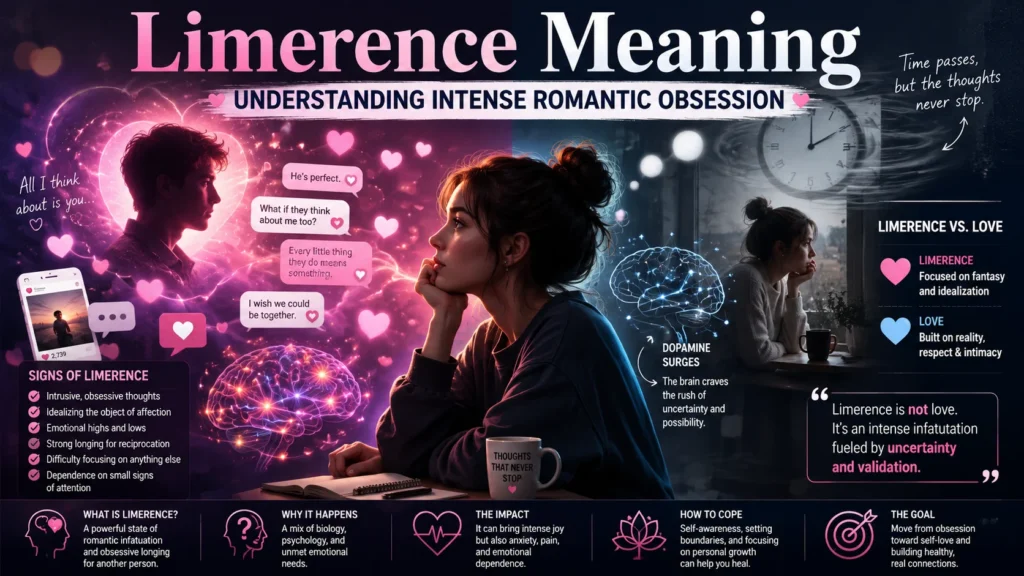
Limerence is an intense psychological state of romantic obsession marked by intrusive thoughts, emotional dependency, idealization, and a strong desire for reciprocation from another person. It can feel similar to being in love, but often involves uncertainty, obsessive thinking, emotional highs and lows, and a persistent need for reassurance or mutual affection.
You wake up and check your phone.
Nothing.
A strange mix of disappointment and anxiety creeps in. You replay yesterday’s conversation. You analyze every word. Did they sound interested? Did you say too much?
Hours pass. They cross your mind again. And again.
This isn’t just attraction. It’s not a simple crush either.
It’s something deeper. Stronger. Harder to control.
This is where understanding the limerence meaning changes everything.
Limerence explains why someone can dominate your thoughts without being part of your life. It explains why uncertainty feels addictive. It explains why your mood depends on their attention.
Once you see it clearly, the pattern stops feeling mysterious.
It starts making sense.
What Is Limerence? (Clear Definition + Psychology)
Let’s cut through confusion quickly.
Limerence is a psychological state of intense romantic obsession. It involves:
- Persistent intrusive thoughts
- Emotional dependency
- A deep need for reciprocation
Unlike love, limerence doesn’t grow from connection.
It grows from uncertainty and emotional craving.
Limerence Meaning in Simple Terms
Think of limerence like this:
Your brain becomes fixated on someone and treats their attention like a reward.
That reward feels powerful. Almost addictive.
So you chase it.
Key Characteristics of Limerence
- You think about the person constantly
- Your mood depends on their response
- You idealize them beyond reality
- You crave signs they feel the same
This isn’t random behavior. It follows a pattern.
Dorothy Tennov and the Origin of Limerence
The term limerence comes from psychologist Dorothy Tennov.
In her research, she noticed something fascinating. Many people described love as calm and stable. Others described something completely different.
They described obsession.
They described emotional dependency.
They described a rollercoaster.
Tennov gave that experience a name: limerence.
Her work revealed a critical truth.
Not all romantic feelings are the same.
Some are grounded.
Others are consuming.
Why Limerence Feels So Intense
Here’s where it gets interesting.
Limerence doesn’t just live in your emotions. It lives in your brain chemistry.
When you experience limerence:
- Dopamine spikes when you receive attention
- Uncertainty increases emotional intensity
- Your brain forms a reward loop
Simple Breakdown
| Trigger | Brain Response |
|---|---|
| They text you | Dopamine release |
| They ignore you | Anxiety spike |
| Mixed signals | Stronger attachment |
This cycle keeps you hooked.
Not because the person is perfect.
But because your brain is chasing the feeling.
What Does Limerence Feel Like? (Inside the Experience)
If you’ve ever wondered, “Why can’t I stop thinking about them?” this section answers it.
Limerence doesn’t feel neutral.
It feels intense. Emotional. Unpredictable.
Emotional Highs and Lows
One moment, you feel euphoric.
They liked your message. They smiled at you. They gave you attention.
Suddenly, everything feels right.
Then it shifts.
They don’t reply. They seem distant. Something feels off.
Your mood drops instantly.
Common Emotional Patterns
- Euphoria from small interactions
- Anxiety from silence
- Fear of rejection
- Emotional dependence
Your emotional state becomes tied to their behavior.
That’s the trap.
Intrusive Thoughts and Mental Loops
Limerence doesn’t ask for your attention.
It takes it.
You might notice:
- Replaying conversations repeatedly
- Imagining future scenarios
- Creating meaning from small actions
Example Thought Loop
- “Why did they say that?”
- “Do they like me?”
- “What if I lose them?”
These thoughts feel automatic. Hard to stop.
That’s because they are.
Physical and Behavioral Symptoms
Limerence isn’t just mental. It shows up physically too.
Physical Symptoms
- Increased heart rate
- Restlessness
- Trouble sleeping
- Loss of focus
Behavioral Patterns
- Checking your phone constantly
- Stalking social media
- Changing behavior to gain approval
You don’t always notice it happening.
Until it becomes your routine.
Signs and Symptoms of Limerence
Now let’s make it clear.
Emotional Signs
- You feel incomplete without them
- Your mood depends on their attention
- You crave validation
Cognitive Symptoms
- Intrusive romantic thoughts
- Idealizing the person
- Ignoring red flags
Behavioral Patterns
- Constant message checking
- Seeking reassurance
- Adjusting your personality
Quick Diagnostic Table
| Indicator | Limerence |
|---|---|
| Obsessive thinking | Very high |
| Emotional stability | Low |
| Reality awareness | Distorted |
| Dependency level | High |
Limerence Symptoms in Men vs Women
Limerence affects everyone. But expression can differ.
In Men
- Increased pursuit behavior
- Strong focus on winning attention
- Emotional suppression but mental obsession
In Women
- Deeper emotional processing
- Stronger rumination
- Higher emotional dependency
These are patterns, not rules.
The core experience remains the same.
Limerence vs Love vs Infatuation (The Difference That Changes Everything)
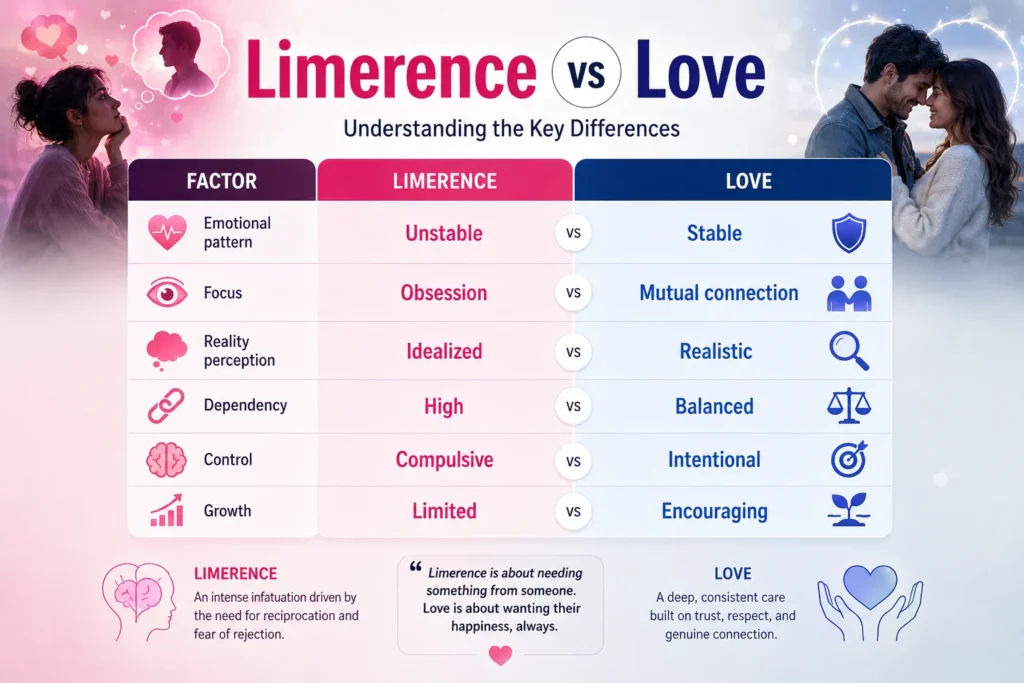
This is where most people get it wrong.
Limerence feels like love. It mimics it. It even convinces you it is love.
But once you break it down, the differences become obvious.
Limerence vs Love
At first glance, both feel intense. Both involve strong emotions. But the structure underneath tells a different story.
In limerence, you chase emotional highs.
In love, you build something steady.
Limerence vs Crush
A crush feels light. Almost playful.
Limerence feels heavy. Consuming.
Key Differences
| Aspect | Crush | Limerence |
|---|---|---|
| Duration | Short-term | Long-lasting |
| Intensity | Mild | Extreme |
| Obsession | Low | High |
| Emotional impact | Minimal | Intense |
A crush fades naturally.
Limerence lingers, even when it hurts.
Limerence vs Attachment
Attachment creates emotional bonds over time.
Limerence skips that process. It fast-forwards into emotional dependency without a real foundation.
Core Contrast
- Attachment: Built on shared experiences
- Limerence: Built on imagined connection
Reality Check: Limerence is about fantasy. Love is about truth.
What Causes Limerence? (Science Meets Psychology)
Limerence doesn’t appear randomly. It follows predictable triggers.
Understanding these triggers gives you control.
Attachment Theory and Limerence
Your attachment style plays a major role.
Anxious Attachment
- Fear of abandonment
- Constant need for reassurance
- Strong emotional dependency
This style creates the perfect environment for limerence.
Avoidant Attachment
- Emotional distance
- Attraction to unavailable partners
This dynamic often fuels limerence cycles.
Dopamine, Serotonin, and Brain Chemistry
Here’s the biological side.
Your brain reacts to romantic uncertainty like a reward system.
Neurochemical Breakdown
| Chemical | Effect in Limerence |
|---|---|
| Dopamine | Pleasure and motivation |
| Serotonin | Linked to obsessive thinking |
| Oxytocin | Emotional bonding |
When someone gives you attention, dopamine spikes.
When they withdraw, your brain craves that reward again.
This creates a loop.
Emotional Triggers and Past Experiences
Limerence often connects to deeper emotional patterns.
Common Triggers
- Unmet childhood needs
- Low self-worth
- Desire for validation
- Fear of rejection
You’re not just chasing a person.
You’re chasing a feeling.
Stages of Limerence (How It Develops Over Time)
Limerence isn’t random. It follows a sequence.
Recognizing the stage helps you break the cycle.
Attraction Stage
This is where it starts.
- You notice the person
- You feel excitement
- Curiosity builds
At this point, everything feels normal.
Obsession Stage
Now it intensifies.
- You think about them constantly
- You analyze every interaction
- You start idealizing them
This is where limerence takes control.
Crisis or Resolution Stage
Eventually, reality steps in.
Two outcomes appear:
Reciprocation
- The relationship forms
- Intensity may stabilize or fade
Rejection or Uncertainty
- Emotional distress increases
- Obsession may deepen
Many people get stuck here. That’s where limerence becomes painful.
How Long Does Limerence Last?
This question matters because it gives perspective.
Limerence feels endless. It isn’t.
Average Duration
- Typically 6 months to 3 years
That’s a wide range. The difference comes from reinforcement.
What Makes Limerence Last Longer
Certain conditions extend it.
- Inconsistent attention
- Lack of closure
- Limited interaction
- Fantasy reinforcement
Example
If someone responds occasionally, your brain stays hooked.
It keeps waiting for the next reward.
Is Limerence Healthy or Toxic?
Not all limerence is harmful. But it can become damaging.
When Limerence Is Harmless
- Short-term
- Doesn’t disrupt life
- Motivates self-growth
In this form, it feels like intense attraction.
When Limerence Becomes Emotional Addiction
This is where problems begin.
Warning Signs
- Constant emotional instability
- Neglecting responsibilities
- Anxiety and overthinking
- Loss of identity
Comparison Table: Healthy vs Toxic Limerence
| Aspect | Healthy | Toxic |
|---|---|---|
| Duration | Short | Long |
| Emotional impact | Mild | Severe |
| Control | Manageable | Compulsive |
| Life disruption | Low | High |
Key Insight: When your peace depends on someone else, limerence turns toxic.
Limerence in Relationships
This part surprises people.
Limerence doesn’t only happen when you’re single.
Limerence While in a Relationship
You can feel limerence toward:
- Someone outside your relationship
- A coworker
- A distant acquaintance
This creates emotional conflict.
Emotional Affairs and Fantasy Bonds
Even without physical action, limerence can become an emotional affair.
Signs
- You hide your thoughts
- You compare your partner
- You invest emotionally elsewhere
The connection exists mostly in your mind.
That’s what makes it powerful and dangerous.
How to Overcome Limerence (Proven Steps That Actually Work)
Understanding limerence meaning gives you awareness.
But awareness alone doesn’t break the cycle.
You need action. Clear, intentional, and consistent action.
Limerence feels powerful because it runs on habit loops in your brain.
Break the loop, and the intensity fades.
Step 1: Recognize the Pattern (Awareness Changes Everything)
Start here.
Limerence thrives in confusion. It weakens when you name it.
Instead of thinking:
- “I’m in love”
Shift to:
- “I’m experiencing limerence”
That small change creates distance.
Why This Works
- You separate emotion from identity
- You stop romanticizing the obsession
- You regain mental control
Clarity reduces intensity. Always.
Step 2: Cut the Reinforcement Cycle
Limerence survives on emotional rewards.
Every message. Every interaction. Every social media check feeds it.
What You Need to Do
- Stop checking their profiles
- Reduce or eliminate contact
- Avoid situations where you see them
Hard Truth
You can’t heal while constantly triggering the feeling.
Step 3: Challenge Idealization (Break the Fantasy)
Limerence builds a perfect version of someone.
That version doesn’t exist.
Exercise: Reality Check List
Write two columns:
| Fantasy | Reality |
|---|---|
| They’re perfect | They have flaws |
| They understand me completely | You barely know them |
| We’re meant to be | No real foundation |
Do this honestly.
Not emotionally. Logically.
Step 4: Redirect Your Emotional Energy
Your mind needs somewhere else to go.
If you don’t redirect it, it returns to the same loop.
Healthy Redirects
- Physical activity
- Learning new skills
- Strengthening friendships
- Creative work
Key Principle
You’re not removing emotion.
You’re reallocating it.
Step 5: Build Emotional Independence
Limerence feeds on dependency.
So you build independence.
How to Do It
- Focus on self-worth
- Develop personal goals
- Create a fulfilling routine
Simple Question to Ask Yourself
“If they disappeared today, would my life still feel meaningful?”
If the answer is no, that’s where your work begins.
Step 6: Understand Your Attachment Style
This step changes everything long-term.
Attachment Types Linked to Limerence
- Anxious: fears abandonment
- Avoidant: drawn to unavailable people
Why It Matters
Your pattern repeats until you understand it.
Once you see it, you can change it.
How to Stop Limerence Thoughts (Fast Mental Techniques)
Intrusive thoughts feel automatic.
But you can interrupt them.
Technique 1: Thought Labeling
Instead of engaging, label the thought:
- “This is a limerence thought.”
That’s it.
No analysis. No emotional reaction.
This weakens the loop over time.
Technique 2: Time Blocking the Obsession
Give yourself a limited window.
Example:
- 15 minutes to think about them
- Then stop
This reduces constant mental drift.
Technique 3: Pattern Interrupt
When the thought starts:
- Stand up
- Move your body
- Change your environment
Your brain resets faster than you expect.
Limerence Withdrawal Symptoms (What Recovery Feels Like)
Breaking limerence isn’t instant.
Your brain reacts.
Common Withdrawal Symptoms
- Anxiety
- Emotional emptiness
- Cravings to reconnect
- Mood swings
Why It Happens
Your brain loses its dopamine source.
It wants it back.
Timeline of Recovery
| Phase | Experience |
|---|---|
| Week 1 | Strong cravings |
| Week 2–3 | Emotional instability |
| Month 1+ | Gradual clarity |
Stay consistent. It gets easier.
Important Truth: Missing them doesn’t mean you need them.
Real-Life Examples of Limerence
These examples make it clear.
Example 1: The Message Loop
You send a message.
No reply.
You check your phone 20 times.
When they finally respond, your mood shifts instantly.
That’s limerence.
Example 2: The Fantasy Future
You imagine a life together.
Trips. Conversations. Connection.
In reality, you’ve barely spoken.
That’s limerence building a story.
Example 3: Ignoring Red Flags
They cancel plans repeatedly.
They show inconsistent interest.
You still believe they’re “perfect.”
That’s limerence overriding logic.
FAQs
What is limerence in simple terms?
A state of obsessive romantic attraction driven by intrusive thoughts and emotional dependency.
Is limerence a disorder?
No. It’s not classified as a mental disorder. But it can affect mental health significantly.
Why do I feel limerence?
It usually comes from attachment patterns, unmet emotional needs, and brain chemistry.
Can limerence be mutual?
Yes. But even when mutual, it often remains unstable.
Can limerence turn into love?
Sometimes. But only if it shifts from obsession to real connection.
How do you know if it’s limerence or love?
| Indicator | Limerence | Love |
|---|---|---|
| Emotional state | Intense and unstable | Calm and steady |
| Thoughts | Obsessive | Balanced |
| Focus | Validation | Connection |
Final Thoughts
Limerence feels overwhelming.
But it’s not permanent.
It’s a pattern.
And patterns can change.
You’re not weak for feeling this way.
You’re human.
The moment you understand limerence meaning, you take back control.
You stop chasing emotional highs.
You start building real stability.
And that’s where everything shifts.