Last Updated on June 17, 2026
What does “ops” mean in slang?
“Ops” is slang for opposition or enemies. It refers to rivals, haters, or anyone against you. The meaning depends on context. In street slang, it can mean real enemies. On social media, it’s often used casually or jokingly.
Scroll through TikTok. Open Instagram comments. Check your group chat.
You’ll see it.
“Ops.”
It shows up everywhere. Short. Sharp. Slightly mysterious.
At first glance, it looks simple. Just another slang word. But the truth runs deeper. This word carries history, culture, and layered meaning.
And if you don’t understand it, you’ll miss the tone completely.
Let’s fix that.
What Does Ops Mean in Slang? (Clear Definition First)
Start with the core idea.
Ops meaning slang = opposition or enemies.
That’s the foundation. Everything else builds on it.
But here’s where things get interesting.
The meaning shifts depending on context. Sometimes it’s serious. Sometimes it’s playful. Occasionally, it’s just exaggerated humor.
Core Definitions of “Ops”
- Enemies
- Opposition
- Rivals
- People against you
- Haters (modern usage)
Quick Examples in Real Life
- “Watch your moves. The ops are watching.”
- “They act friendly but they ops.”
- “You took my charger? You’re an op now.”
Notice the difference in tone. Same word. Different energy.
Ops Meaning in English Slang: Why Context Changes Everything
Slang doesn’t behave like formal language. It bends. It adapts.
“Ops” is a perfect example of contextual meaning.
How Meaning Shifts Based on Context
| Context | Ops Meaning | Tone |
|---|---|---|
| Street slang | Real enemies | Serious |
| Rap lyrics | Rival groups | Intense |
| Social media | Haters or critics | Casual |
| Friends joking | Playful enemy | Light |
| Gaming | Opponents | Neutral |
Why This Happens
Language follows people. Not rules.
As different groups use the word, they reshape it. Over time, the meaning expands.
This is called semantic variation. One word. Many interpretations.
Ops Meaning in Text and Chat (Modern Usage Explained)
Here’s where the word becomes flexible.
In texting, ops meaning in chat often feels less intense. It leans toward casual or expressive use.
Common Uses in Messaging
- Someone you don’t trust
- A fake friend
- A person acting against you
- Someone watching silently
Examples in Texting
- “Don’t tell him. He’s an op.”
- “Too many ops in this chat.”
- “They smiling but they ops.”
Short sentences. Strong tone.
Why “Ops” Works in Chat
People don’t type long explanations anymore.
They want speed. Emotion. Impact.
“Ops” delivers all three:
- 1 word replaces a full sentence
- It carries attitude instantly
- It feels culturally relevant
That’s why it spreads so fast.
Ops Meaning on Social Media (TikTok, Instagram, Snapchat)
Now things get even more interesting.
Social media softened the word. It turned something serious into something flexible.
Ops Meaning on TikTok
On TikTok, “ops” often means:
- People watching you silently
- Haters who don’t engage openly
- Anyone low-key against you
Example
“My ops watching but not liking.”
It’s subtle. Slightly dramatic. Very relatable.
Ops Meaning on Instagram
Instagram comments love this word.
You’ll see lines like:
- “Ops real quiet today.”
- “The ops mad in the comments.”
Here, it signals confidence. Sometimes sarcasm.
Ops Meaning in Snapchat
Snapchat use feels more personal.
- “Don’t post that. Ops might see.”
- “Keep it private. Too many ops.”
In this case, it’s about trust and privacy.
Ops Meaning in Gen Z Slang
Gen Z didn’t just adopt the word. They reshaped it.
They turned something intense into something flexible and even funny.
How Gen Z Uses “Ops”
- Mild rivalry
- Fake enemies
- Everyday frustrations
Examples
- “My alarm is my biggest op.”
- “You ate my snacks? You’re an op.”
It’s not about danger anymore. It’s about exaggeration.
Why Gen Z Changed the Meaning
- They prefer humor over seriousness
- They remix language constantly
- They blur the line between real and ironic
That’s modern slang culture.
The Psychology Behind “Ops” (Why It Feels So Powerful)
Words carry emotion. “Ops” carries tension.
Even in casual use, it hints at conflict.
Why People Love Using It
- It creates a sense of drama
- It signals awareness
- It sounds confident
- It feels culturally connected
Deeper Insight
People naturally group others into:
- Allies
- Neutrals
- Opponents
“Ops” gives a quick label to that third group.
Simple. Effective. Memorable.
Real-Life Sentence Examples (All Tones)
Let’s make it practical.
Serious Usage
- “Stay alert. The ops are active tonight.”
- “He switched sides. Now he’s with the ops.”
Casual Usage
- “My ops stay watching my stories.”
- “They acting cool but they ops.”
Funny Usage
- “My homework is my biggest op.”
- “Monday mornings are ops.”
Ops Meaning in Rap and Drill Music (The Real Origin)
If you want the true meaning of “ops”, you have to start here.
Not TikTok. Not memes.
Music. Specifically, drill and hip-hop culture.
What Does Ops Mean in Rap?
In rap, ops meaning slang is direct and serious:
“Ops” = real enemies or rival groups.
There’s no humor. No exaggeration.
It refers to:
- Opposing crews
- Rival neighborhoods
- People involved in conflict
Why the Word Matters in Music
Rap reflects reality. Especially drill music.
When artists say “ops,” they’re often talking about:
- Real tension
- Real rivalry
- Real consequences
Example Style of Usage in Lyrics
- “We stay ready. The ops always watching.”
- “Can’t trust nobody. Too many ops around.”
Notice the tone. It’s not casual.
How Music Pushed “Ops” Into Mainstream Language
Here’s how the word spread:
- Artists used it in songs
- Fans repeated it
- Social media amplified it
- New audiences adapted it
This is how street slang becomes global slang.
Ops Meaning Street Slang vs Internet Slang
This is where many people get confused.
Same word. Different weight.
Street Slang Meaning (Original)
- Real enemies
- People you actively avoid
- Serious opposition
Tone: Heavy and literal
Internet Slang Meaning (Modern)
- Haters
- Critics
- Annoying people
- Fake friends
Tone: Light, flexible, sometimes funny
Side-by-Side Comparison
| Aspect | Street Slang | Internet Slang |
|---|---|---|
| Meaning | Real enemies | Casual opposition |
| Tone | Serious | Light or humorous |
| Context | Real-life conflict | Social media, chat |
| Risk level | High | Low |
Important Insight
Using “ops” casually doesn’t erase its origin.
It simply shows how language evolves.
Ops vs Opps vs Opp (Full Breakdown)
Now let’s clear up one of the biggest confusions.
Do “Ops” and “Opps” Mean Different Things?
No.
Ops = Opps = Same meaning
Both refer to opposition or enemies.
Then Why Two Spellings?
It comes down to pronunciation.
People say it like:
“Opps” (with a stronger “p” sound)
So they spell it that way.
Understanding Each Variation
| Term | Meaning | Usage |
|---|---|---|
| Ops | Enemies/opposition | Standard spelling |
| Opps | Same meaning | More popular in slang |
| Opp | One enemy | Singular form |
Examples
- “Too many ops around.”
- “He’s an opp.”
- “Watch out for the opps.”
Which One Should You Use?
- Use “opps” for authenticity in slang
- Use “ops” for cleaner, broader readability
Both are correct.
Ops vs Oops Difference (Critical for Beginners)
This mistake is everywhere.
Let’s fix it clearly.
The Core Difference
| Word | Meaning | Use Case |
|---|---|---|
| Ops | Enemies/opposition | Slang |
| Oops | Mistake/accident | Everyday English |
Examples
- “Watch out for the ops.” ✅
- “Oops, I dropped my phone.” ✅
Common Mistake
- “Oops are watching you” ❌
That’s incorrect.
Quick Memory Trick
- Ops = people against you
- Oops = mistake you made
Simple and effective.
Ops Meaning in Gaming
Gamers use language differently. Faster. More tactical.
Gaming Definition of “Ops”
- Opponents
- Enemy team
- Rival players
Examples in Gaming Chat
- “The ops are pushing mid.”
- “Watch the ops sniper.”
Key Difference from Slang
In gaming:
- It’s neutral
- It’s not emotional
- It’s purely functional
Why Gamers Use It
- Saves time
- Fits fast communication
- Matches competitive language
Ops Meaning in Business and Professional Contexts
Now shift gears completely.
Same word. Totally different meaning.
Formal Definition of “Ops”
In business:
Ops = operations
Examples
- “The ops team handles logistics.”
- “We need better ops management.”
Important Note
This has nothing to do with slang.
Context separates meaning.
How to Use “Ops” Correctly (Without Sounding Forced)
Using slang wrong is obvious. Instantly.
Let’s make sure that doesn’t happen.
Rules for Using “Ops” Naturally
- Use it in casual conversations
- Match the tone of your audience
- Keep it short and direct
- Don’t overuse it
Where It Works Best
- Text messages
- Social media captions
- Informal conversations
- Meme-style content
Where You Should Avoid It
- Professional emails
- Academic writing
- Formal presentations
Good vs Bad Usage
| Type | Example | Result |
|---|---|---|
| Natural | “Too many ops watching.” | Sounds authentic |
| Forced | “I identify several ops in my environment.” | Sounds awkward |
Pro Tip
If it sounds like something you wouldn’t say out loud, don’t write it.
Why People Say “Ops” in Chat (Behavior Explained)
There’s a deeper reason behind this trend.
Communication Has Changed
People now prefer:
- Short messages
- High emotion
- Fast delivery
“Ops” Fits Perfectly Because It Is
- One word
- Easy to type
- Emotionally loaded
- Culturally relevant
It Also Signals Identity
Using slang shows:
- You understand trends
- You belong to a group
- You’re socially aware
Psychological Layer
Labeling someone as an “op” creates:
- Distance
- Drama
- Clarity
It simplifies social dynamics.
Advanced Usage: Subtle Meanings of “Ops”
Now let’s go deeper.
Because the word isn’t always literal.
Hidden Meanings Depending on Tone
- Suspicion → “He might be an op.”
- Disappointment → “They turned into ops.”
- Humor → “My bank account is an op.”
- Confidence → “Ops quiet now.”
Tone Matters More Than Words
The same sentence can mean different things depending on:
- Context
- Delivery
- Platform
Example
“Ops watching.”
Could mean:
- Real threat
- Online lurkers
- Joke about attention
Quick Reference Table: Ops Meaning Across Contexts
| Context | Meaning | Tone |
|---|---|---|
| Rap | Enemies | Serious |
| Street slang | Real rivals | Heavy |
| Social media | Haters | Casual |
| Chat | Fake friends | Light |
| Gaming | Opponents | Neutral |
| Business | Operations | Formal |
Real-World Scenarios: How “Ops” Is Actually Used
Understanding definitions is one thing. Seeing real-life usage is where it clicks.
Let’s walk through situations you’ll recognize.
Scenario: Group Chat Drama
You’re in a group chat. Someone leaks a private message.
Now trust is broken.
Response:
“Yeah he’s definitely an op.”
Here, “ops” means someone who acts against the group.
Scenario: Social Media Lurkers
You post regularly. Some people watch every story but never like or comment.
Reaction:
“My ops stay watching silently.”
In this case, it means quiet observers or low-key haters.
Scenario: Friendly Joke
Your friend eats your food without asking.
You say:
“You’re an op for that.”
No real hostility. Just playful exaggeration.
Scenario: Personal Struggles
You’re tired. Your alarm goes off early.
You mutter:
“This alarm is my biggest op.”
Now the word becomes metaphorical.
Common Mistakes People Make with “Ops”
Even though the word is simple, people misuse it often.
Let’s clean that up.
Mistake: Using It in Formal Situations
Wrong:
“We must identify potential ops in this business strategy.”
That sounds awkward. Forced.
Mistake: Confusing It with “Oops”
Wrong:
“Oops are everywhere.”
Correct:
“Ops are everywhere.”
Mistake: Overusing the Word
If every sentence includes “ops,” it loses impact.
Slang works best when used sparingly and naturally.
Mistake: Ignoring Context
Calling someone an “op” in a serious setting can sound aggressive.
Always read the room.
How Slang Like “Ops” Evolves Over Time
Language never stays still. Especially slang.
“Ops” is a perfect case study.
1: Origin
- Root word: opposition
- Used in specific communities
- Meaning was narrow and serious
2: Cultural Spread
- Music introduced it to wider audiences
- Fans adopted it
- Meaning stayed mostly intact
3: Internet Expansion
- Social media accelerated usage
- New users reinterpreted it
- Meaning started to broaden
4: Meme Culture
- Humor entered the picture
- Word became exaggerated
- Meaning became flexible
5: Mainstream Adoption
- Used globally
- Understood in multiple contexts
- No longer tied to one group
Key Insight
Slang evolves through use, not rules.
That’s why “ops” can mean something serious in one sentence and something funny in another.
Advanced Insight: The Linguistics Behind “Ops”
Now let’s go deeper. This is where your content stands out.
Polysemy (Multiple Meanings)
“Ops” has several meanings depending on context.
- Enemies
- Haters
- Opponents
- Problems
One word. Multiple layers.
Pragmatic Meaning
The meaning depends on:
- Who says it
- Where it’s said
- How it’s delivered
Discourse Context
In a serious conversation, “ops” feels intense.
In a meme, it feels light.
Same word. Different impact.
Language Efficiency
Modern communication favors:
- Short words
- High meaning density
- Fast interpretation
“Ops” fits perfectly.
Expert Tips: How to Use “Ops” Like a Native Speaker
Now let’s sharpen your usage.
Tip: Match the Energy
If the conversation is light, keep it playful.
If it’s serious, be careful.
Tip: Use It Sparingly
Overusing slang makes it sound forced.
A well-placed “ops” hits harder.
Tip: Combine with Tone Indicators
- “You’re an op 😂” → playful
- “He’s an op.” → serious
Small additions change meaning instantly.
Tip: Observe Before Using
Watch how others use it:
- In comments
- In messages
- In videos
Then mirror that style.
How to Use Ops in a Sentence (Practical Guide)
Let’s make this simple and actionable.
Sentence Patterns
- “Too many ops around.”
- “They acting like ops.”
- “I don’t trust him. He’s an op.”
Flexible Structure Examples
- “Even my phone acting like an op today.”
- “Funny how they turned into ops overnight.”
- “Keep your circle small. Ops everywhere.”
Quick Formula
[Subject] + is/are + ops
or
Too many + ops + around
Ops Meaning in Memes: Why It Works So Well
Memes thrive on exaggeration.
“Ops” amplifies everything.
Why It Fits Meme Culture
- Dramatic tone
- Easy to understand
- Flexible meaning
- Works in any situation
Common Meme Format
“Me vs [problem] = ops”
Examples
- “Me vs my alarm = ops”
- “Me vs my bank account = ops”
- “Me vs Monday = ops”
Simple formula. Endless variations.
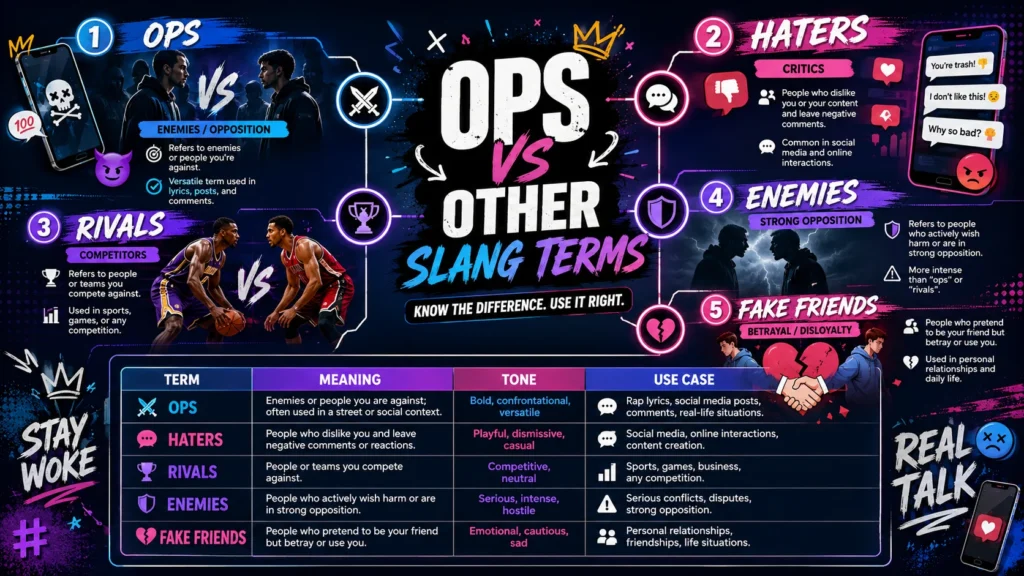
Deep Comparison: Ops vs Other Slang Terms
Key Difference
“Ops” is shorter, sharper, and more versatile than most alternatives.
Why “Ops” Will Stay Popular
Some slang fades. Some sticks.
“Ops” has staying power.
Reasons It Will Last
- Short and efficient
- Works across platforms
- Adapts easily
- Strong cultural roots
Future Outlook
Expect:
- More humorous uses
- Wider global adoption
- Continued presence in music and social media
Final Summary
Let’s bring it all together.
Core Truth
Ops meaning slang = opposition or enemies.
What You Should Remember
- It started in street and rap culture
- It originally meant real enemies
- Social media made it casual and flexible
- It can be serious, neutral, or funny
- Context decides everything
Simple Breakdown
- Serious context → real enemies
- Casual context → haters or rivals
- Funny context → exaggerated problems
FAQs
What does “ops” mean in slang?
In slang, “ops” usually means opponents, enemies, rivals, or people who are against you. The term is commonly used in rap music, social media, and street culture.
Why do people say “the ops”?
People say “the ops” to refer to a group of rivals or people they don’t trust. For example: “Watch out, the ops are around.”
Does “ops” mean police?
Sometimes. In certain contexts, especially in rap lyrics or online discussions, “ops” can refer to law enforcement. However, it more commonly means rivals or enemies.
What does “keeping an eye out for the ops” mean?
It means staying alert for rivals, enemies, or people who may cause problems.
Is “ops” a positive or negative term?
Generally, “ops” has a negative meaning because it refers to someone viewed as an opponent, enemy, or threat.
What does “he’s an op” mean?
Calling someone “an op” means you see them as an opponent, rival, traitor, or someone working against you.
What is the difference between “ops” and “opps”?
There is no major difference in meaning. “Opps” is simply an alternative spelling of “ops” and is very common on social media and in song lyrics.
How is “ops” used in a sentence?
Here are a few examples:
- “Stay away from the ops.”
- “He switched sides and became an op.”
- “The ops are watching.”
- “We don’t trust the ops.”
Is “ops” a Gen Z slang term?
While Gen Z frequently uses the term online, “ops” originated earlier in urban slang and hip-hop culture before becoming popular on social media platforms.
What does “ops” mean on TikTok?
On TikTok, “ops” usually refers to haters, rivals, enemies, or people who are against someone, often used jokingly or dramatically in videos and comments.
Can “ops” be used humorously?
Yes. Many people use “ops” humorously to describe minor rivals or annoyances. For example: “My alarm clock is my biggest op.”
Is “ops” the same as “opps” in rap songs?
Yes. In rap and hip-hop lyrics, “ops” and “opps” both refer to rivals, enemies, or competing groups. They are often used interchangeably.
Final Thoughts
Language isn’t fixed. It evolves with people.
“Ops” proves that perfectly.
One word. Multiple meanings. Endless usage.
Now you don’t just know what it means.
You know how and when to use it like it’s second nature.