
Last Updated on June 18, 2026
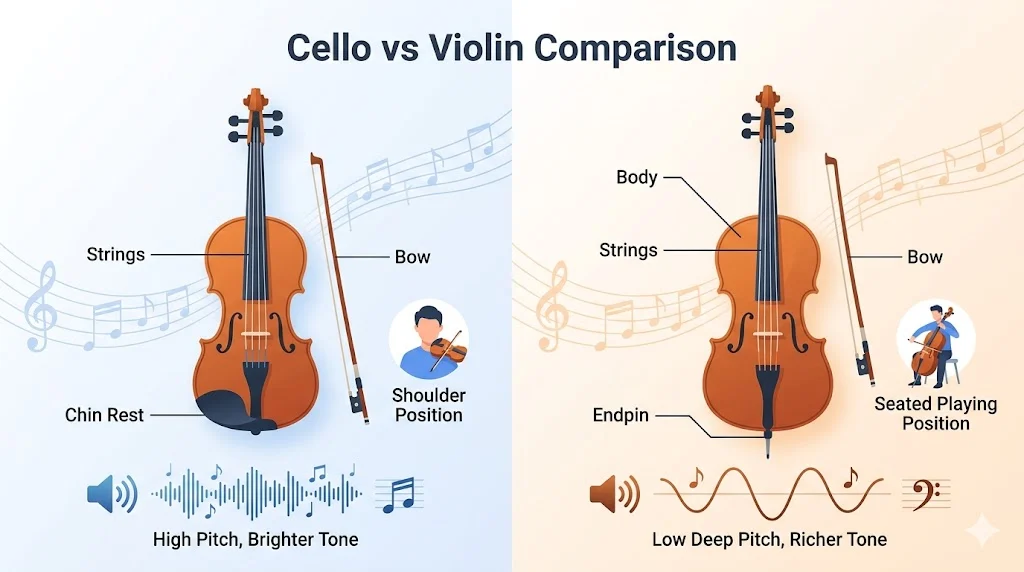
The cello vs violin comparison explains the key differences between two popular string instruments in the orchestra family. The violin is smaller, higher in pitch, and often plays melody lines, while the cello is larger, deeper in tone, and supports harmony or emotional bass lines. Both instruments are played with a bow but differ in size, sound range, technique, and musical role.
The cello vs violin debate is common among music learners, parents, and even casual listeners. Both instruments belong to the string family and are widely used in orchestras, solo performances, and modern music. At first glance, they may look similar because both are played with a bow and have strings. However, they are very different in size, sound, playing position, and musical role.
Many beginners struggle when choosing between cello vs violin because they do not understand these differences clearly. Some prefer the bright, high sound of the violin, while others love the deep, warm voice of the cello. Each instrument has its own learning curve, advantages, and challenges.
This article will explain cello vs violin in a simple and detailed way. You will learn their definitions, differences, benefits, real-world uses, mistakes to avoid, practice exercises, and FAQs. By the end, you will clearly understand which instrument fits your personality, goals, and musical journey.
Quick Answer: Cello vs Violin Overview
The main difference between cello vs violin is size, pitch range, and playing position.
- Violin: Small, high-pitched, played on the shoulder
- Cello: Large, low-pitched, played sitting down between the knees
Both are essential orchestral instruments, but they serve different musical roles.
What is a Violin?
The violin is the smallest and highest-pitched instrument in the string family. In the cello vs violin comparison, the violin is often used for melodies and fast musical passages.
It has four strings tuned in perfect fifths:
- G
- D
- A
- E
The violin is played by placing it under the chin and using a bow or plucking the strings.
Key Characteristics of Violin
- Small size and lightweight
- High pitch range
- Bright and sharp sound
- Used in classical, pop, jazz, and folk music
- Often leads the melody in orchestras
The violin is highly expressive and can produce both soft emotional tones and fast energetic notes.
What is a Cello?
The cello is a large string instrument known for its deep and warm sound. In the cello vs violin comparison, the cello covers lower musical ranges and adds emotional depth.
It also has four strings tuned in perfect fifths:
- C
- G
- D
- A
The cello is played while sitting, with the instrument placed between the knees and supported by an endpin on the floor.
Key Characteristics of Cello
- Large size and heavier build
- Low to mid-range pitch
- Rich, warm, emotional tone
- Used in orchestras, chamber music, and solo performances
- Often supports harmony or bass lines
The cello is often described as the instrument closest to the human voice.
Cello vs Violin: Key Differences Table
| Feature | Violin | Cello |
| Size | Small | Large |
| Pitch | High | Low |
| Playing position | Shoulder | Sitting |
| Sound | Bright, sharp | Deep, warm |
| Role in orchestra | Melody | Harmony / bass |
| Strings | E A D G | A D G C |
| Difficulty | Beginner-friendly start | Physically demanding |
This table gives a quick cello vs violin comparison for beginners.
Cello vs Violin: Sound Differences Explained
Sound is the biggest difference in cello vs violin.
Violin Sound
The violin produces a bright, sharp, and sometimes piercing sound. It is ideal for:
- Fast melodies
- Emotional solos
- High-pitched musical lines
Cello Sound
The cello produces a deep, warm, and rich sound. It is ideal for:
- Emotional background tones
- Slow melodies
- Harmonic support
In simple terms:
- Violin = light and high voice
- Cello = deep and emotional voice
Advantages and Disadvantages
Violin Advantages
- Easy to carry
- Wide musical use
- High demand in orchestras
- Great for fast melodies
Violin Disadvantages
- Difficult to produce perfect sound for beginners
- Requires precise finger placement
- Can sound harsh if not controlled
Cello Advantages
- Beautiful emotional tone
- Easier to produce good sound early
- Strong solo and orchestral presence
- Less strain on fingers for beginners
Cello Disadvantages
- Large and heavy
- Expensive compared to beginner violin
- Requires sitting posture and more space
Real-World Examples of Cello vs Violin
Classical Music
- Violin leads symphonies by composers like Mozart and Beethoven
- Cello supports harmony and emotional depth in orchestras
Film Music
- Violin is used for tension and excitement
- Cello is used for sadness and emotional scenes
Modern Music
- Violin appears in pop, EDM, and folk fusion
- Cello is used in cinematic soundtracks and acoustic covers
Regional and Global Usage of Cello vs Violin
The cello vs violin usage varies across cultures:
Western Classical Music
Both instruments are essential in orchestras and chamber music.
Indian Classical Fusion
- Violin is widely used in Carnatic music
- Cello is less common but growing in fusion music
Pop and Commercial Music
- Violin is more common in live performances
- Cello is often used in studio recordings for depth
Film Industry
Both instruments are heavily used in Hollywood and Bollywood soundtracks.
Common Mistakes in Cello vs Violin Learning
Choosing based on looks only
Many learners choose violin or cello based on appearance instead of sound preference.
Poor posture
- Violin: Incorrect shoulder position
- Cello: Bad sitting alignment
Ignoring bow control
Both instruments require strong bow technique for clean sound.
Skipping basics
Students often rush into songs without mastering scales.
Wrong size selection
Especially in cello vs violin for children, size matters greatly.
Exercises with Answers
Exercise 1: Identify Instrument
Which instrument is being described?
- Played on the shoulder
- Has a deep and warm sound
- Uses a bow and has four strings
Answer:
- Violin
- Cello
- Both
Exercise 2: Sound Matching
Match the instrument with its sound:
- Violin → ?
- Cello → ?
Answer:
- Violin → High, bright, sharp
- Cello → Low, warm, emotional
Exercise 3: True or False
- Cello is smaller than violin
- Violin plays higher notes
- Both use bow technique
Answers:
- False
- True
- True
Cello vs Violin: Related Concepts
String Family Instruments
- Viola (middle range)
- Double bass (lowest range)
Musical Techniques
- Vibrato
- Pizzicato
- Legato bowing
Music Theory Connections
- Pitch range
- Harmony
- Melody structure
Understanding cello vs violin becomes easier when you know how string instruments relate.
Cello vs Violin: Beginner Guide for Choosing
Choose Violin If You:
- Like bright, high-pitched sound
- Want portable instrument
- Prefer fast melodies
- Enjoy solo spotlight roles
Choose Cello If You:
- Love deep emotional sound
- Prefer slower expressive music
- Like supportive musical roles
- Enjoy rich tone quality
In cello vs violin, your personality matters more than difficulty level.
Cello vs Violin: Learning Difficulty Comparison
Violin Learning Curve
- Hard to produce good tone early
- Requires precise finger placement
- Fast progression after basics
Cello Learning Curve
- Easier sound production for beginners
- Physically larger instrument
- Requires strength and control
Overall:
- Violin is harder at the start
- Cello is physically more demanding
FAQs
What is the main difference between cello vs violin?
The main difference is size and pitch. Violin is small and high-pitched, while cello is large and low-pitched.
Which is harder, cello vs violin?
Violin is harder for beginners due to precision. Cello requires more physical effort.
Can a violinist learn cello easily?
Yes, but cello vs violin technique differs in posture and hand positioning.
Is cello better than violin?
Neither is better. It depends on musical preference in cello vs violin choice.
Which instrument is more expensive?
Cello is usually more expensive than violin due to size and materials.
Which is more popular, cello vs violin?
Violin is more popular globally, especially in orchestras and schools.
Can children learn cello or violin?
Yes, both are suitable, but size selection is important in cello vs violin for kids.
Which sounds more emotional, cello vs violin?
Cello is often considered more emotional due to its deep tone.
Do cello and violin use the same notes?
They use similar musical systems but have different pitch ranges.
Which is better for beginners?
Violin is easier to start physically, but cello is easier for producing good tone early.
Conclusion
The cello vs violin comparison shows that both instruments are beautiful but serve different musical purposes. The violin is small, bright, and expressive in the higher range, making it perfect for melodies and fast musical passages. The cello, on the other hand, is large, deep, and emotional, giving music its warmth and harmonic support.
Choosing between cello vs violin depends on your personal taste, physical comfort and musical goals. If you enjoy energetic, high-pitched music and want a portable instrument, the violin may be the right choice. If you prefer emotional, rich tones and a more grounded musical experience, the cello may suit you better.
Both instruments require patience, practice, and discipline. Neither is superior; they simply shine in different ways. The best approach is to listen to both, try them if possible, and choose the one that connects with your emotions.