
Last Updated on June 15, 2026
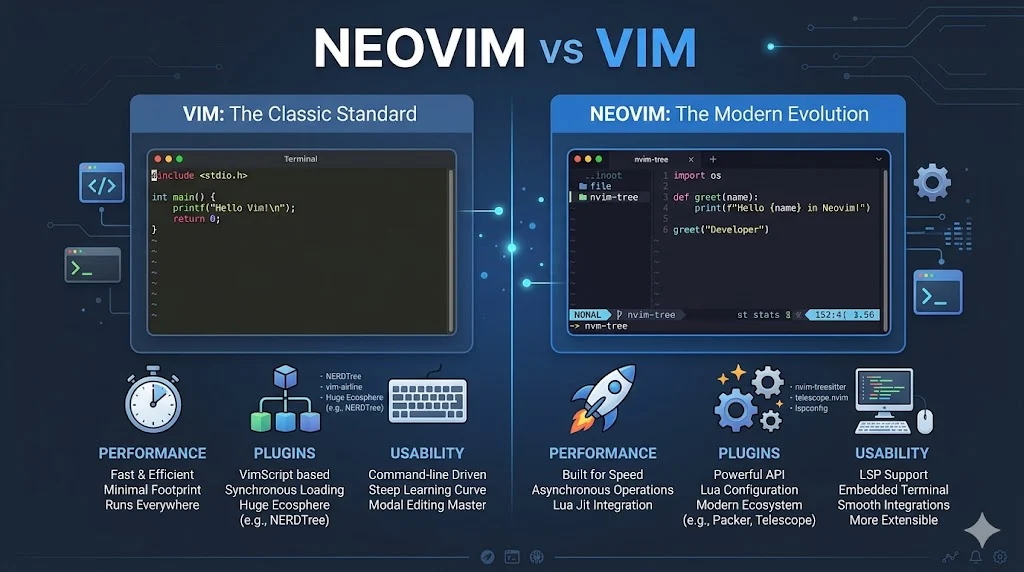
Neovim vs Vim is a comparison between two powerful text editors used by developers and system administrators. Vim is the original, stable editor, while Neovim is a modern fork designed for better performance, extensibility, and developer-friendly features. Both are highly efficient, but Neovim improves upon Vim with better plugin architecture and built-in enhancements.
The debate of Neovim vs Vim is one of the most common discussions in the developer community. Both are powerful text editors used for coding, scripting, and system editing. Vim has been around for decades and is known for its stability and simplicity. Neovim is a newer version that improves Vim with modern features and better performance.
Many beginners get confused when choosing between the two. They look similar, use similar commands, and even share configuration styles. But under the hood, they are different in important ways. One focuses on long-term stability, while the other focuses on innovation and extensibility.
Understanding Neovim vs Vim is important because your choice affects your workflow, productivity, and development experience. Whether you are a beginner learning Linux or a professional developer working on large projects, the right editor can save you time and effort. This guide explains everything in simple terms so you can confidently choose between Vim and Neovim.
Quick Answer Overview of Neovim vs Vim
At a high level, the difference between Neovim vs Vim is simple:
- Vim is a traditional, stable text editor focused on reliability.
- Neovim is a modern rewrite of Vim focused on speed, plugins, and developer experience.
Both editors are modal, keyboard-driven, and highly efficient. However, Neovim improves many internal limitations of Vim, such as plugin handling and asynchronous processing.
Simple analogy
Think of Vim as a reliable old car that runs forever with minimal maintenance. Neovim is the same car upgraded with a modern engine, GPS, and better fuel efficiency.
Definition and Explanation of Vim and Neovim
What is Vim?
Vim stands for “Vi Improved.” It is an enhanced version of the original Vi editor found in Unix systems. Vim is widely used in Linux environments and is known for its speed, simplicity, and low resource usage.
Key characteristics of Vim:
- Lightweight and fast
- Available on almost all Unix systems
- Stable and mature
- Uses modal editing (insert, normal, visual modes)
- Highly customizable through configuration files
Vim is often the default editor in many servers, making it a critical tool for system administrators.
What is Neovim?
Neovim is a modern fork of Vim created to improve usability, extensibility, and performance. It keeps Vim’s core editing model but removes outdated limitations.
Key characteristics of Neovim:
- Built for modern development workflows
- Supports asynchronous processing
- Better plugin architecture
- Embedded terminal support
- Active development and community contributions
Neovim focuses on making the editor more suitable for modern programming languages and tools like LSP (Language Server Protocol).
Neovim vs Vim Key Differences
The following table provides a clear comparison of Neovim vs Vim:
| Feature | Vim | Neovim |
| Release Model | Stable, slow updates | Fast, active development |
| Plugin System | Traditional | Asynchronous, modern |
| Configuration | Vimscript | Lua + Vimscript |
| Performance | Very fast | Faster in complex workflows |
| Terminal Integration | Limited | Built-in terminal |
| UI Extensibility | Limited | Highly extensible |
| LSP Support | External plugins required | Built-in support |
| Community Focus | Maintenance | Innovation |
This comparison shows that Neovim is designed for modern development needs, while Vim focuses on long-term reliability.
Advantages and Disadvantages of Neovim vs Vim
Advantages of Vim
Vim remains popular because of its simplicity and reliability.
- Extremely stable
- Available on almost every system
- Very low memory usage
- Works without internet or plugins
- Ideal for server environments
Vim is often preferred by system administrators and DevOps engineers who need quick editing tools on remote machines.
Disadvantages of Vim
Despite its strengths, Vim has limitations:
- Outdated plugin system
- Limited asynchronous support
- Requires more manual configuration for modern tools
- Slower adoption of new features
Advantages of Neovim
Neovim introduces many improvements:
- Modern plugin architecture
- Faster response in large projects
- Built-in terminal emulator
- Better support for IDE-like features
- Lua scripting for configuration
Neovim is designed for developers who want a lightweight IDE alternative.
Disadvantages of Neovim
Neovim also has some downsides:
- Slight learning curve for new features
- Not always pre-installed on systems
- Smaller default ecosystem compared to Vim
- Some legacy Vim scripts may not work perfectly
Real-World Examples of Neovim vs Vim
Example 1: Backend Developer Workflow
A backend developer working with Python or Node.js may prefer Neovim because:
- It supports LSP for auto-completion
- It integrates with linters and formatters
- It allows asynchronous builds and tests
Neovim reduces context switching between terminal and editor.
Example 2: System Administrator on Remote Server
A system administrator logging into a remote Linux server may prefer Vim because:
- Vim is pre-installed almost everywhere
- It loads instantly
- It does not require configuration
- It works in minimal environments
Example 3: Competitive Programmer
Competitive programmers often use Vim because:
- It is lightweight
- It starts instantly
- It focuses on speed over features
However, some are switching to Neovim for better code navigation tools.
Regional and Global Usage of Neovim vs Vim
Vim Usage
Vim is widely used in:
- Linux server environments
- Legacy enterprise systems
- Academic environments teaching Unix tools
- Minimal installations
Its stability makes it popular in infrastructure-heavy regions and industries.
Neovim Usage
Neovim is popular in:
- Modern software development teams
- Open-source communities
- Startups using modern tech stacks
- Developers using Linux, macOS, and Windows
Globally, Neovim adoption is increasing because of its IDE-like capabilities.
Common Mistakes in Neovim vs Vim Usage
Mistake 1: Thinking They Are Identical
Many beginners assume Neovim and Vim are the same. While similar, their internal architecture differs significantly.
Mistake 2: Using Vim Plugins in Neovim Without Testing
Not all Vim plugins are compatible with Neovim. Some require updates or alternatives.
Mistake 3: Ignoring Configuration Differences
Neovim uses Lua for modern configuration, while Vim relies heavily on Vimscript.
Mistake 4: Overcomplicating Setup
Many users try to turn both editors into full IDEs immediately, which leads to slow performance.
Mistake 5: Not Learning Basic Commands
Both editors require understanding of modal editing. Skipping fundamentals slows productivity.
Exercises with Answers
Exercise 1
What is the main difference between Vim and Neovim?
Answer: Vim is a stable traditional editor, while Neovim is a modern improved fork with better features and performance.
Exercise 2
Which editor supports built-in terminal integration?
Answer: Neovim supports built-in terminal integration.
Exercise 3
Name one scripting language used in Neovim configuration.
Answer: Lua.
Exercise 4
Which editor is more commonly pre-installed on Linux servers?
Answer: Vim.
Exercise 5
Why is Neovim preferred for modern development?
Answer: Because it supports asynchronous plugins, LSP integration, and modern workflows.
Related Concepts and Comparisons
Vim vs Emacs
Vim focuses on modal editing, while Emacs focuses on extensibility and full environment control.
Neovim vs VS Code
Neovim is lightweight and terminal-based, while VS Code is a full graphical IDE.
Vim vs Nano
Nano is simpler but less powerful. Vim is more advanced and efficient for long-term use.
Terminal Editors vs GUI Editors
Terminal editors like Vim and Neovim are faster for remote work, while GUI editors are easier for beginners.
FAQs
What is the main difference between Neovim vs Vim?
Neovim is a modernized version of Vim with better performance and plugin support, while Vim focuses on stability.
Is Neovim replacing Vim?
No, Vim is still widely used, especially on servers, but Neovim is gaining popularity among developers.
Which is faster, Vim or Neovim?
Both are fast, but Neovim performs better in complex development setups.
Can I use Vim plugins in Neovim?
Many Vim plugins work in Neovim, but some may require updates.
Is Neovim harder to learn than Vim?
No, the basic commands are the same. Only advanced features differ.
Why do developers prefer Neovim?
Because it supports modern tools like LSP, asynchronous plugins, and Lua configuration.
Does Vim still get updates?
Yes, Vim is actively maintained and improved, though slowly.
Which should a beginner choose in Neovim vs Vim?
Beginners can start with Vim for simplicity or Neovim for future-ready features.
Can Neovim fully replace Vim?
In most cases yes, but Vim is still preferred in minimal server environments.
Is Neovim good for professional development?
Yes, Neovim is widely used in modern professional software development.
Conclusion
The Neovim vs Vim comparison shows that both editors are powerful, efficient, and widely used. Vim remains a stable, lightweight choice for system-level tasks and server environments. It is reliable, fast, and available almost everywhere.
Neovim, on the other hand, is designed for modern development. It brings improvements like better plugin systems, Lua scripting, and built-in terminal support. This makes it more suitable for developers working on large, modern projects.
Choosing between Neovim vs Vim depends on your needs. If you want simplicity and universal availability, Vim is a strong choice. If you want modern features and an IDE-like experience inside the terminal, Neovim is better.
For most developers today, Neovim is becoming the preferred option, but Vim still holds an important place in system administration and legacy environments. Learning both gives you maximum flexibility and efficiency in any technical workflow.