Last Updated on May 16, 2026
K18 vs Olaplex is a comparison between two leading hair repair treatments that restore damaged hair at a molecular level. Olaplex works by reconnecting broken disulfide bonds inside the hair, while K18 uses a peptide technology to rebuild lost keratin chains. Both improve strength, shine, and elasticity, but they work in different ways and suit different types of hair damage.
Hair damage is one of the most common concerns in modern beauty care. Heat styling, coloring, bleaching, and pollution can all weaken hair over time. Many people turn to professional treatments to restore strength and shine. Among the most popular options are K18 and Olaplex, two advanced hair repair systems that promise to fix damage from the inside out.
The confusion between K18 vs Olaplex is very common. Both are often used in salons and at home, and both claim to repair broken hair bonds. However, they are not the same. They work in different ways and target different types of damage.
Understanding the difference between K18 vs Olaplex helps you choose the right treatment for your hair needs. This guide explains how each system works, their benefits, limitations, real world usage, and expert comparisons. It is written in simple language so beginners can easily understand, while still offering deeper insights for advanced users.
Quick Answer Overview of K18 vs Olaplex
If you are in a hurry, here is the simple breakdown of K18 vs Olaplex:
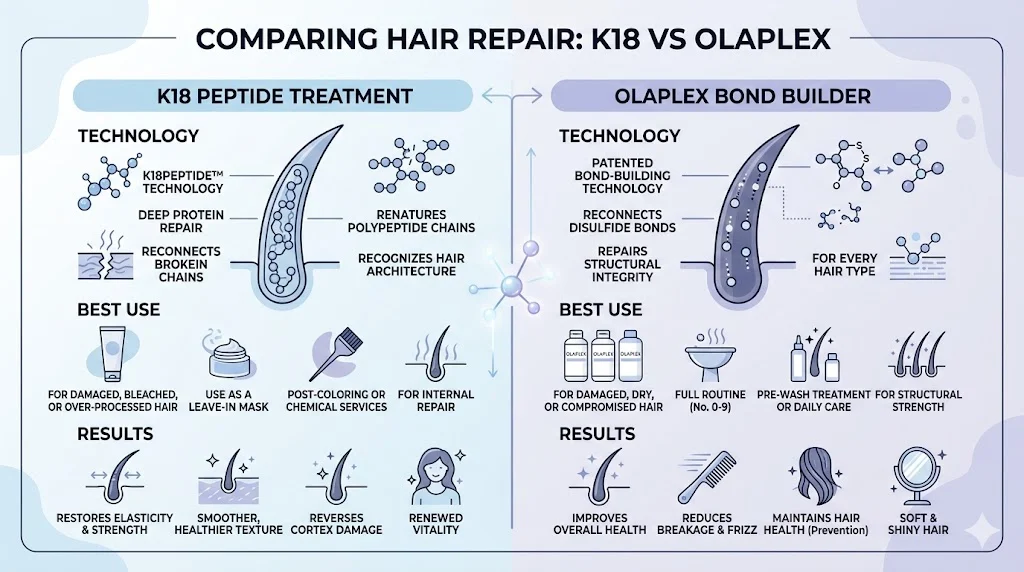
Olaplex repairs broken disulfide bonds in the hair structure, making it ideal for chemically damaged hair such as bleaching or coloring damage. K18 uses a biomimetic peptide to reconnect broken keratin chains, which helps restore elasticity, softness, and strength more quickly.
In simple terms:
- Olaplex focuses on bond rebuilding during and after chemical services
- K18 focuses on deep molecular repair and fast restoration of hair fiber structure
Both are effective, but the best choice depends on your hair condition and styling habits.
Understanding Hair Damage Before Comparing K18 vs Olaplex
To fully understand K18 vs Olaplex, it helps to know how hair gets damaged.
Hair is made of a protein called keratin. Inside each strand are three main structures:
- Disulfide bonds that give strength
- Hydrogen bonds that give flexibility
- Keratin chains that build the core structure
When hair is exposed to bleach, heat, or chemical treatments, these structures break down. The result is:
- Weak and brittle hair
- Split ends
- Loss of elasticity
- Frizz and dullness
Both K18 and Olaplex target this internal damage but in different ways.
What Is Olaplex
Olaplex is a professional hair treatment system designed to repair broken disulfide bonds in the hair.
How Olaplex Works
Olaplex uses a patented ingredient called bis aminopropyl diglycol dimaleate. This molecule works by finding broken disulfide bonds and reconnecting them.
When hair is bleached or colored, these bonds break. Olaplex helps rebuild them, restoring structural strength.
Key Olaplex Products
- Olaplex No. 1 Bond Multiplier (professional use)
- Olaplex No. 2 Bond Perfector (salon treatment)
- Olaplex No. 3 Hair Perfector (home treatment)
- Olaplex No. 4 Shampoo
- Olaplex No. 5 Conditioner
- Olaplex No. 6 Leave in Cream
- Olaplex No. 7 Bonding Oil
Main Benefits of Olaplex
- Repairs chemical damage from bleach and dye
- Strengthens weak hair bonds
- Reduces breakage
- Improves color retention
- Suitable for salon and home use
What Is K18
K18 is a newer molecular hair repair treatment that focuses on restoring keratin chains inside the hair.
How K18 Works
K18 uses a patented peptide called K18Peptide. This peptide mimics natural keratin structure and penetrates deep into the hair cortex.
Once inside, it reconnects broken polypeptide chains and restores hair’s original strength and elasticity.
Unlike Olaplex, K18 does not focus only on bonds. It repairs the deeper protein structure.
Key K18 Products
- K18 Leave In Molecular Repair Hair Mask
- K18 Shampoo
- K18 Conditioner
Main Benefits of K18
- Repairs extreme heat and bleach damage
- Works quickly, often in 4 minutes
- Restores softness and bounce
- Improves elasticity and smoothness
- Lightweight formula with no heavy coating
K18 vs Olaplex Key Differences
Here is a clear comparison of K18 vs Olaplex:
| Feature | Olaplex | K18 |
| Technology | Bond rebuilding | Peptide molecular repair |
| Target | Disulfide bonds | Keratin chains |
| Application time | 10 to 30 minutes | About 4 minutes |
| Best for | Chemical damage | Extreme structural damage |
| Product system | Multiple steps | Simple system |
| Salon use | Very common | Increasingly popular |
| Home use | Extensive range | Minimal steps |
Advantages and Disadvantages of K18 vs Olaplex
Advantages of Olaplex
- Proven long term track record
- Works during coloring and bleaching
- Wide product range
- Suitable for all hair types
- Trusted by salons worldwide
Disadvantages of Olaplex
- Requires multiple steps for best results
- Can take longer to show visible improvement
- Not always effective on severe internal damage alone
Advantages of K18
- Very fast application time
- Deep molecular repair
- Simple routine
- Strong results after a few uses
- Lightweight and non greasy
Disadvantages of K18
- More expensive per use
- Limited product variety
- Requires proper application rules
- Less flexibility during salon coloring processes
Real World Examples of K18 vs Olaplex
Example 1 Bleached Hair
A person who bleaches hair frequently may have broken disulfide bonds.
- Olaplex is used during bleaching to protect and rebuild bonds
- K18 is used after bleaching to restore deeper keratin structure
Example 2 Heat Damaged Hair
Someone who uses straighteners daily may experience dryness and breakage.
- K18 helps restore elasticity quickly
- Olaplex strengthens bonds over time
Example 3 Colored Hair Maintenance
For regular hair coloring:
- Olaplex is added during color application
- K18 is used as a weekly repair mask
Regional and Global Usage of K18 vs Olaplex
Olaplex is widely used in salons across North America, Europe, and Asia. It became a global salon standard for bond repair treatments.
K18 is newer but rapidly growing in popularity, especially in high end salons and influencer driven beauty markets.
In professional environments:
- Olaplex is often used as a protective treatment during chemical services
- K18 is used as a finishing repair system after damage
Both systems are now globally recognized in professional hair care.
Common Mistakes in Using K18 vs Olaplex
Mistake 1 Using Both Incorrectly
Many people layer both treatments at the same time. This can reduce effectiveness.
Mistake 2 Overusing Products
Using too much product does not improve results. It may lead to buildup.
Mistake 3 Wrong Application Order
- K18 should be used on clean, towel dried hair
- Olaplex No. 3 should be used before shampoo
Mistake 4 Expecting Instant Full Repair
Both treatments improve hair health but cannot fully restore extremely damaged hair instantly.
Exercises with Answers on K18 vs Olaplex
Exercise 1
Which treatment focuses on disulfide bond repair?
Answer: Olaplex
Exercise 2
Which treatment works in about 4 minutes?
Answer: K18
Exercise 3
True or False: K18 and Olaplex work in exactly the same way.
Answer: False
Exercise 4
Which is better during bleaching sessions?
Answer: Olaplex
Exercise 5
Which treatment targets keratin chains?
Answer: K18
Related Concepts and Comparisons
Understanding K18 vs Olaplex also connects to broader hair science concepts:
- Hair porosity and moisture retention
- Protein loss in damaged hair
- Heat protection systems
- Chemical processing effects
- Bond repair technology evolution
Other common comparisons include:
- Protein treatments vs bond builders
- Keratin treatments vs Olaplex
- Deep conditioning masks vs molecular repair systems
FAQs
What is the main difference between K18 vs Olaplex?
Olaplex repairs broken disulfide bonds, while K18 restores keratin chains inside hair structure.
Is K18 better than Olaplex?
It depends on hair type. K18 is faster for deep repair, while Olaplex is better during chemical treatments.
Can I use K18 and Olaplex together?
Yes, but not in the same step. They should be used at different times for best results.
Which is better for bleached hair, K18 vs Olaplex?
Olaplex is better during bleaching, while K18 is better for post bleaching recovery.
How often should I use K18?
Usually 1 to 2 times per week depending on damage level.
How often should I use Olaplex No. 3?
Typically once a week for maintenance or more for heavily damaged hair.
Which lasts longer, K18 vs Olaplex results?
Both provide long lasting improvements with consistent use, but Olaplex has cumulative bonding effects.
Is K18 safe for all hair types?
Yes, it is safe for straight, curly, colored, and chemically treated hair.
Does Olaplex stop hair breakage?
It significantly reduces breakage by rebuilding internal bonds.
Which is more expensive, K18 vs Olaplex?
K18 is generally more expensive per application, but requires fewer steps.
Conclusion
Choosing between K18 vs Olaplex depends on your hair condition, routine, and styling habits. Both are advanced treatments designed to repair internal hair damage, but they work in different ways. Olaplex focuses on rebuilding broken disulfide bonds, making it ideal for chemical treatments like bleaching and coloring. K18 goes deeper by restoring keratin chains, which helps reverse severe structural damage and improve elasticity quickly.
If your hair is regularly colored or bleached, Olaplex is often used during the process for protection. If your hair feels dry, weak, or over processed, K18 can provide faster visible recovery. In many cases, professionals even use both systems at different stages of hair care.
The key takeaway in K18 vs Olaplex is that neither is universally better. The best results come from understanding your hair’s needs and choosing the right treatment accordingly. With proper use, both systems can significantly improve hair strength, shine, and long term health.