
Last Updated on May 19, 2026
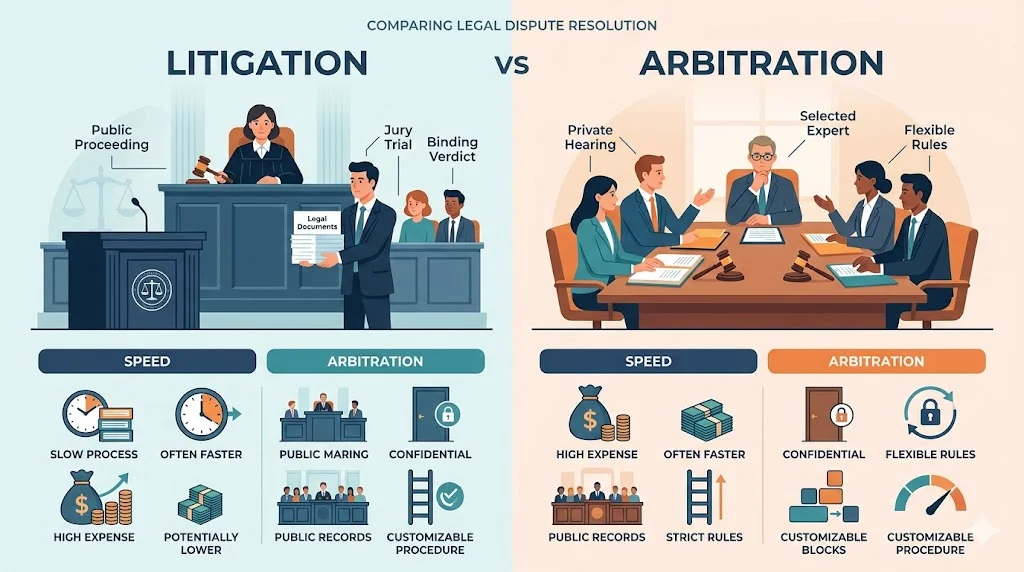
Litigation and arbitration are two methods of resolving disputes. Litigation takes place in court with a judge, while arbitration is a private process where a neutral arbitrator makes the decision. Arbitration is usually faster and more flexible, while litigation offers stronger legal protections and appeal rights.
When people face a legal dispute, they often hear two terms: litigation and arbitration. Both are ways to solve conflicts, but they work very differently. Many individuals and businesses feel confused when choosing between them. They want a method that is fast, fair, and cost-effective.
Litigation is the traditional court process. It follows strict rules and takes place in public courts. Arbitration, on the other hand, is a private process where a neutral third party decides the outcome.
Understanding the difference between litigation vs arbitration is important. It helps you choose the right path for your situation. Whether you are dealing with a business dispute, employment issue, or contract disagreement, the choice can affect time, cost, and results.
This guide explains both methods in simple terms. It also helps you decide which option suits your needs best.
Quick Answer / Overview
| Feature | Litigation | Arbitration |
| Location | Courtroom | Private setting |
| Decision Maker | Judge (sometimes jury) | Arbitrator |
| Formality | Highly formal | Less formal |
| Speed | Usually slow | Faster |
| Cost | Often high | Usually lower |
| Privacy | Public | Private |
| Appeal | Allowed | Limited |
| Flexibility | Low | High |
Short Summary:
Litigation is best for complex legal protection. Arbitration is better for speed and privacy.
Definition of Litigation vs Arbitration
What is Litigation?
Litigation is the process of resolving disputes through the court system. It involves filing a case, presenting evidence, and having a judge or jury decide the outcome.
Key points:
- Happens in a public court
- Follows strict legal procedures
- Can take months or years
- Decisions can be appealed
What is Arbitration?
Arbitration is a private dispute resolution process. A neutral person, called an arbitrator, hears both sides and makes a decision.
Key points:
- Takes place outside court
- More flexible rules
- Faster than litigation
- Decisions are usually final
How Litigation vs Arbitration Works
Litigation Process
- Filing a lawsuit
- Serving legal notice
- Discovery phase (evidence sharing)
- Trial
- Judgment
- Possible appeal
Arbitration Process
- Agreement to arbitrate
- Selection of arbitrator
- Hearing
- Submission of evidence
- Decision (award)
Advantages and Disadvantages
Advantages of Litigation
- Strong legal protections
- Right to appeal
- Suitable for serious disputes
- Public record ensures transparency
Disadvantages of Litigation
- Time-consuming
- Expensive
- Complex procedures
- Public exposure
Advantages of Arbitration
- Faster resolution
- Lower cost in many cases
- Private and confidential
- Flexible process
Disadvantages of Arbitration
- Limited appeal options
- Arbitrator bias risk
- Not always cheaper in complex cases
- Limited discovery
Litigation vs Arbitration: Detailed Comparison
| Aspect | Litigation | Arbitration |
| Control | Controlled by court | Controlled by parties |
| Rules | Strict legal rules | Flexible rules |
| Evidence | Formal evidence rules | Relaxed evidence rules |
| Decision | Judge or jury | Arbitrator |
| Confidentiality | Public | Private |
| Finality | Can appeal | Usually final |
| Speed | Slow | Fast |
Real-World Examples
Example 1: Business Dispute
Two companies disagree over a contract.
- Litigation: Case goes to court. It takes years. Judgment is enforceable.
- Arbitration: They settle within months. The arbitrator decides quickly.
Example 2: Employment Issue
An employee claims unfair treatment.
- Litigation: Public case. Long process.
- Arbitration: Private hearing. Faster resolution.
Example 3: International Trade
Companies from different countries have a dispute.
- Arbitration is often preferred because:
- Neutral ground
- Easier enforcement globally
Regional and Global Usage
Global Trends
- Arbitration is popular in international business.
- Many contracts include arbitration clauses.
In Developing Countries
- Litigation may be slow due to court backlog.
- Arbitration is gaining popularity for efficiency.
In Developed Countries
- Both systems are widely used.
- Arbitration is common in corporate contracts.
When to Choose Litigation vs Arbitration
Choose Litigation If:
- You need strong legal protection
- You want the option to appeal
- The dispute involves public interest
- Complex legal issues are involved
Choose Arbitration If:
- You want a quick decision
- Privacy is important
- You want flexibility
- You want to avoid lengthy court procedures
Common Mistakes
Mistake 1: Assuming Arbitration is Always Cheaper
Correction: Complex arbitration can be costly.
Mistake 2: Ignoring Arbitration Clauses
Correction: Always read contracts carefully.
Mistake 3: Choosing Litigation for Simple Disputes
Correction: Arbitration may save time and money.
Mistake 4: Not Understanding Finality
Correction: Arbitration decisions are usually final.
Exercises with Answers
Exercise 1
Question:
Which method is usually faster: litigation or arbitration?
Answer:
Arbitration
Exercise 2
Question:
Which process allows appeals?
Answer:
Litigation
Exercise 3
Question:
Which is more private?
Answer:
Arbitration
Exercise 4
Question:
Which method follows strict legal rules?
Answer:
Litigation
Exercise 5
Scenario:
A company wants a confidential dispute resolution.
Answer:
Arbitration
Related Concepts and Comparisons
Mediation vs Arbitration
- Mediation involves negotiation
- Arbitration involves decision-making
Negotiation vs Litigation
- Negotiation is informal
- Litigation is formal
ADR (Alternative Dispute Resolution)
- Includes arbitration and mediation
- Offers alternatives to court
FAQs
What is the main difference between litigation vs arbitration?
Litigation happens in court with strict rules, while arbitration is private and more flexible.
Is arbitration better than litigation?
It depends. Arbitration is faster, but litigation offers stronger legal protections.
Can arbitration decisions be appealed?
Usually no. Arbitration decisions are mostly final.
Is litigation more expensive than arbitration?
Often yes, but complex arbitration can also be costly.
Which is more private: litigation vs arbitration?
Arbitration is private, while litigation is public.
When should I choose arbitration over litigation?
Choose arbitration when you want speed, privacy, and flexibility.
Is arbitration legally binding?
Yes, arbitration decisions are legally binding in most cases.
Can all disputes go to arbitration?
No. Some disputes must go through courts.
Why do companies prefer arbitration?
Because it is faster, private, and efficient.
What is an arbitration clause in litigation vs arbitration context?
It is a contract term requiring disputes to be resolved through arbitration instead of litigation.
Conclusion
Understanding litigation vs arbitration is essential for making the right legal decision. Both methods serve the same purpose but operate in very different ways. Litigation provides a structured and transparent process with the option to appeal. It is ideal for complex or high-stakes disputes. However, it can be slow and expensive.
Arbitration offers a faster and more flexible alternative. It is often private and less formal, making it suitable for business and international disputes. But it comes with limited appeal rights and potential risks if the arbitrator’s decision is unfavorable.
The best choice depends on your needs. If you value speed and privacy, arbitration is a strong option. If you need full legal protection and the ability to challenge decisions, litigation may be better.
Always review contracts carefully and seek legal advice when needed. Making an informed choice can save time, money, and stress.