
Last Updated on August 6, 2026
Niche in slang refers to something that appeals to a small, specific group of people rather than the general public. On social media, people use the word to describe unique humor, specialized interests, uncommon aesthetics, fandoms, memes, or content that only a certain community understands. Calling something “niche” isn’t usually an insult. In many cases, it’s a compliment that highlights originality, individuality, or insider knowledge.
The internet has transformed countless ordinary words into modern slang. Some expressions keep their original meaning while gaining new cultural significance. Others evolve so much that they take on an entirely different identity. The word niche falls somewhere in between.
Although niche has existed in the English language for centuries, social media platforms have given it fresh life. Today, you’ll hear creators, influencers, gamers, meme lovers, and Gen Z users casually describe videos, jokes, aesthetics, or communities as “so niche.”
But what does that actually mean?
Does it simply mean rare? Does it describe something weird? Is it positive or negative? Why has the word become so popular across TikTok, Instagram, X, Reddit, YouTube, and countless online communities?
This guide answers every one of those questions. You’ll learn the true niche meaning slang, discover how people use it in everyday conversations, understand why it became popular online, and see real examples that make the meaning crystal clear.
By the end, you’ll recognize the word instantly whenever you encounter it in memes, comments, captions, or conversations.
What Does Niche Mean in Slang?
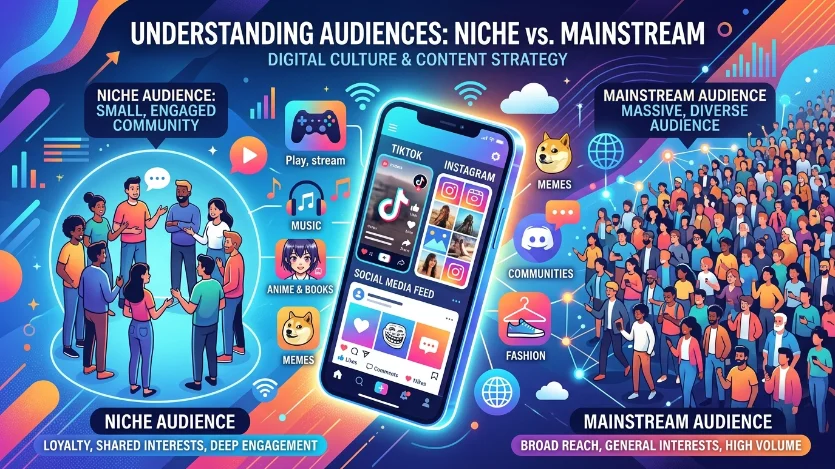
In modern slang, niche describes something that only a small group of people appreciates, understands, or enjoys.
Instead of being popular with everyone, niche content appeals to a specific audience that shares similar interests, experiences, or knowledge.
Think of it this way:
| Mainstream | Niche |
| Almost everyone understands it. | Only certain people understand it. |
| Appeals to a broad audience. | Appeals to a specific community. |
| Widely shared and recognized. | Popular within a smaller group. |
| Easy for most people to enjoy. | Requires shared interests or background knowledge. |
Someone might say:
“That meme is really niche.”
They’re saying the joke isn’t meant for everyone. Only people familiar with a certain hobby, fandom, profession, or online community will understand it.
Likewise, if someone comments:
“Your humor is niche.”
They’re usually saying your jokes appeal to a smaller audience with similar tastes.
Simple Definition
A simple way to remember the slang meaning is:
Niche = Something made for a specific group instead of everyone.
That group might consist of:
- Anime fans
- Gamers
- Programmers
- History enthusiasts
- Book lovers
- Car enthusiasts
- Fitness communities
- Music fans
- Fashion lovers
- Collectors
- Film buffs
- Meme communities
Each community develops its own language, jokes, references, and trends. That’s exactly where niche becomes useful.
Why the Slang Meaning Isn’t Completely New
Unlike many internet slang terms, niche didn’t suddenly receive a brand-new definition.
The original dictionary meaning already referred to a specialized position or segment.
Social media simply adapted that concept into everyday conversation.
Instead of saying:
“This content appeals to a specialized audience.”
People now say:
“This content is niche.”
The shorter version sounds more natural online.
The Core Idea Behind the Word
Every use of niche slang revolves around one central concept:
Specificity.
The smaller and more focused the audience becomes, the more niche something is considered.
Imagine three circles.
| Audience Type | Example |
| Everyone | Pop music |
| Many people | Horror movies |
| Smaller community | Vintage horror movies from the 1980s |
The last example represents a much more niche interest.
Niche Meaning on Social Media
Social media helped transform niche into one of the internet’s favorite descriptive words.
Today, creators use it constantly.
You’ll find comments like:
- “This is niche.”
- “Very niche humor.”
- “Extremely niche reference.”
- “Peak niche content.”
- “Only my niche understands this.”
- “This creator has a niche audience.”
Each phrase points to the same idea:
The content isn’t designed for everyone.
Instead, it’s intended for people who already belong to a certain community.
Why Social Media Loves the Word “Niche”
Modern algorithms encourage specialization.
Instead of trying to entertain everyone, creators often build content around one topic.
Examples include:
- Coffee brewing
- Mechanical keyboards
- Classic literature
- Wildlife photography
- Space exploration
- Crochet
- Chess
- Miniature painting
- Aquariums
- Fountain pens
- Home gyms
Each subject attracts its own dedicated audience.
Over time, users began describing these focused communities as niche communities.
Eventually, the word expanded beyond audiences and started describing:
- Humor
- Memes
- Videos
- Accounts
- Trends
- Fashion
- Music
- Art
- Aesthetics
How People Use Niche in Comments
You’ll often see comments like these:
“Only five people will understand this.”
That’s another way of saying:
“This is niche.”
Or:
“The right audience will love this.”
Again, the meaning stays the same.
People recognize that certain content isn’t intended for millions.
It’s designed for a smaller, passionate audience.
Common Social Media Phrases
Here are some expressions you’ll frequently encounter.
| Phrase | Meaning |
| Niche meme | A meme understood by a specific community |
| Niche humor | Jokes requiring insider knowledge |
| Niche audience | A small but dedicated group of followers |
| Niche content | Highly specialized content |
| Niche creator | Someone who focuses on one subject |
| Niche trend | A trend limited to one community |
| Niche interest | A hobby enjoyed by relatively few people |
| Niche community | People connected through a shared passion |
Notice how every phrase centers around specialization.
Niche Meaning on TikTok
TikTok arguably accelerated the popularity of the word more than any other platform.
Short-form videos spread trends incredibly fast, and users constantly discover communities they never knew existed.
One day your feed features cooking videos.
The next day you’re watching:
- Antique map collectors
- Keyboard sound enthusiasts
- Professional cake decorators
- Vintage camera restorers
- Historical reenactors
- Fossil hunters
These aren’t random.
They’re examples of niche communities thriving on TikTok.
What Does Niche Mean on TikTok?
On TikTok, niche usually means:
- Highly specific
- Made for one audience
- Based on insider knowledge
- Not universally relatable
- Focused on a particular interest
Someone may comment:
“This is my niche.”
They mean:
“This perfectly matches my interests.”
Examples of TikTok Usage
Imagine a video explaining the history of medieval armor.
General viewers might scroll away.
History lovers, however, watch every second.
Comments might include:
- “Finally, my niche.”
- “TikTok knows my niche.”
- “This is exactly my side of TikTok.”
- “I’ve found my people.”
Here, niche becomes almost synonymous with community.
The Algorithm Encourages Niche Content
TikTok’s recommendation system learns what users enjoy.
As your interests become clearer, your feed grows increasingly specialized.
Many users even describe this experience by saying:
“I’ve entered niche TikTok.”
That phrase means they’ve discovered a small corner of the platform centered around one passion.
Niche Meaning in Internet Slang
Internet slang changes quickly.
Some words disappear within months.
Others become permanent parts of online vocabulary.
Niche belongs to the second category.
Its flexibility allows people to describe almost anything.
For example:
- A niche joke
- A niche hobby
- A niche fandom
- A niche podcast
- A niche YouTube channel
- A niche subreddit
- A niche Discord server
Every example emphasizes focused interest rather than mass popularity.
Internet Slang vs Dictionary Meaning
The internet didn’t replace the dictionary definition.
Instead, it expanded it.
| Traditional Meaning | Internet Slang Meaning |
| Specialized market | Specialized online community |
| Particular role | Particular interest group |
| Specific function | Specific online audience |
| Specialized field | Specialized culture or humor |
The connection remains obvious.
The internet simply made the word much more casual.
How Online Communities Changed the Word
Years ago, marketers mainly used niche to describe products and businesses.
Today, almost everyone uses it.
Teenagers.
Gamers.
Artists.
Content creators.
Teachers.
Writers.
Movie fans.
Musicians.
Instead of staying within business vocabulary, niche has become part of everyday online language.
Niche Meaning in Text Messages and Online Chats
Text messaging has changed the way people communicate. Short messages, emojis, memes, and internet slang dominate conversations, especially among younger users. Within this digital language, niche has become a quick way to describe something that isn’t meant for everyone.
When someone says a joke, shares a meme, or sends a video that only a handful of people will understand, another person might simply reply:
“That’s so niche.”
The message is surprisingly positive. Instead of criticizing the content, the person is acknowledging that it caters to a very specific audience.
Unlike words such as “strange” or “random,” niche usually suggests there’s a dedicated group of people who genuinely appreciate it.
How People Use “Niche” in Texting
Here are some realistic examples.
| Text Message | Meaning |
| That’s so niche. | Only certain people will understand it. |
| Your humor is niche. | Your jokes appeal to a small audience. |
| This meme is niche. | The meme requires insider knowledge. |
| That’s a niche reference. | Not everyone will recognize it. |
| You’re in a very niche community. | Your interests are highly specialized. |
| My feed is becoming niche. | My recommendations now match my specific interests. |
The word often replaces much longer explanations.
Instead of saying:
“Only people who play this game and know its history will understand this joke.”
Someone simply says:
“It’s niche.”
Is Niche a Positive or Negative Word?
Most of the time, it’s positive.
Calling something niche doesn’t usually mean it’s unpopular in a bad way.
Instead, it often implies qualities such as:
- Original
- Creative
- Unique
- Specialized
- Authentic
- Interesting
- Designed for passionate fans
Many creators actually hope people describe their work as niche because it shows they’ve built a loyal community.
Niche Meaning for Gen Z
No generation has embraced the word niche more than Gen Z.
Across TikTok, Instagram Reels, YouTube Shorts, Discord, and X, Gen Z uses niche almost daily.
For them, the word isn’t limited to business or marketing anymore.
It has become part of everyday vocabulary.
Someone might describe:
- Music
- Clothing
- Humor
- Fashion
- Interests
- Aesthetic styles
- Friend groups
- Memes
- Online communities
All with one simple word.
Why Gen Z Uses “Niche” So Often
The internet no longer revolves around one shared culture.
Instead, millions of smaller communities exist.
One person watches cooking videos.
Another spends hours learning astronomy.
Someone else enjoys restoring vintage electronics.
Each person develops a unique online experience.
Because everyone’s algorithm looks different, Gen Z naturally needed a word that describes these personalized interests.
That word became niche.
Examples of Gen Z Conversations
Here are conversations you might actually encounter online.
Example 1
Person A:
“I watch videos about medieval farming.”
Person B:
“That’s incredibly niche.”
Example 2
Person A:
“I only listen to Japanese city pop from the 1980s.”
Person B:
“Your music taste is so niche.”
Example 3
Person A:
“TikTok keeps recommending fountain pen videos.”
Person B:
“You’ve entered niche TikTok.”
Notice that none of these examples sound insulting.
They’re simply acknowledging very specific interests.
Niche Meaning in Memes
Memes evolve faster than almost any other form of internet communication.
Some become worldwide sensations.
Others remain hidden inside small online communities.
Those are called niche memes.
What Is a Niche Meme?
A niche meme is a joke that only people with certain knowledge can understand.
That knowledge might involve:
- A particular video game
- A TV series
- An anime
- A programming language
- Academic subjects
- Professional careers
- Historical events
- Internet history
- Science
- Sports
Without that background, the meme simply doesn’t make sense.
Examples of Niche Memes
A meme about advanced mathematics probably won’t entertain everyone.
Mathematics students, however, might laugh immediately.
Likewise:
- Aviation memes mainly attract pilots and aviation enthusiasts.
- Medical memes appeal to doctors and nursing students.
- Coding memes resonate with software developers.
- Film editing memes make sense to video editors.
Each example represents a niche audience.
Why Niche Memes Often Feel Funnier
There’s an interesting psychological reason.
People enjoy feeling like insiders.
When you understand a joke that many others don’t, it creates a sense of belonging.
That shared understanding strengthens online communities.
In other words:
The smaller the audience, the stronger the connection often becomes.
Niche Content Meaning
The phrase niche content appears everywhere in today’s creator economy.
Whether someone produces YouTube videos, podcasts, newsletters, blogs, or TikTok clips, they’re often encouraged to “find a niche.”
But what does that actually mean?
Simply put, niche content focuses on one clearly defined topic rather than trying to appeal to everyone.
Examples of Broad vs Niche Content
| Broad Content | Niche Content |
| Fitness | Strength training for seniors |
| Cooking | Authentic Korean street food recipes |
| Gaming | Minecraft speedrunning tutorials |
| Travel | Budget backpacking across Iceland |
| Photography | Wildlife macro photography |
| Music | Vinyl jazz record collecting |
| Cars | Restoring classic muscle cars |
| Technology | Mechanical keyboard customization |
Notice how the niche version becomes much more specific.
Why Niche Content Performs Well
Specialized audiences are often:
- More engaged
- More loyal
- More active in discussions
- More likely to share content
- More likely to return regularly
Instead of attracting one million casual viewers, niche creators often build smaller communities filled with passionate followers.
Quality usually matters more than quantity.
Niche Audience Meaning
One of the most common phrases you’ll hear online is niche audience.
This simply means a group of people who share a particular interest.
These audiences may be small compared to mainstream entertainment, yet they’re often extremely dedicated.
Characteristics of a Niche Audience
A niche audience typically:
- Shares common interests.
- Understands insider references.
- Uses similar terminology.
- Enjoys specialized content.
- Actively participates in discussions.
- Values expertise over popularity.
For creators, this kind of audience is incredibly valuable because engagement tends to be much higher.
Examples of Niche Audiences
| Audience | Interest |
| Chess players | Chess strategies |
| Coffee enthusiasts | Specialty coffee brewing |
| Bird watchers | Bird identification |
| Astronomy lovers | Space observation |
| Aquarium hobbyists | Fish keeping |
| LEGO builders | Custom LEGO creations |
| Digital artists | Illustration techniques |
| Language learners | Studying foreign languages |
Each group forms its own online culture.
Niche Community Meaning
Communities naturally grow around shared interests.
When enough people enjoy the same topic, they begin exchanging ideas, creating jokes, and developing traditions.
Eventually, they become a niche community.
What Makes a Community Niche?
Several characteristics usually appear.
- Shared knowledge
- Insider terminology
- Common goals
- Specific humor
- Specialized discussions
- Passion for one subject
Members often recognize one another through references outsiders wouldn’t understand.
That’s why niche communities feel welcoming to enthusiasts while appearing confusing to newcomers.
Popular Examples of Niche Communities
Today’s internet contains thousands of niche communities, including:
- Retro gaming
- Mechanical keyboards
- Fountain pens
- Urban sketching
- Coin collecting
- Origami
- Astronomy
- Bonsai gardening
- Vinyl records
- Magic tricks
- Rubik’s Cube solving
- Model railroads
- Vintage cameras
- Chess puzzles
- Wildlife photography
Each community has developed its own language, traditions, and inside jokes.
Niche Humor Explained
Humor isn’t universal.
Some jokes make almost everyone laugh.
Others require years of experience within a particular hobby or profession.
That’s niche humor.
Examples of Niche Humor
A programmer may laugh at a joke about debugging software.
A doctor might appreciate medical humor.
A photographer may instantly understand a joke about camera lenses.
Everyone else?
They’ll probably wonder why anyone is laughing.
That’s the defining characteristic of niche humor.
Why Niche Humor Creates Strong Communities
Shared humor builds trust.
When two strangers understand the same obscure joke, they immediately recognize that they share similar experiences.
This creates a feeling of belonging.
That’s one reason online communities become so loyal over time.
Niche vs Mainstream Meaning
The easiest way to understand niche is to compare it with its opposite:
Mainstream.
| Niche | Mainstream |
| Small audience | Large audience |
| Specialized | Broad appeal |
| Insider knowledge | Easy for everyone |
| Focused interests | General interests |
| Passion-driven | Mass popularity |
| Community-based | Public appeal |
| Less common | Widely recognized |
Neither is inherently better.
Some people enjoy mainstream entertainment.
Others prefer discovering hidden communities with shared passions.
Many people enjoy both.
The internet has simply made it easier than ever for niche interests to thrive.
How to Use “Niche” in a Sentence
Learning a word becomes much easier when you see it used in everyday conversations. While niche may sound formal at first, people now use it casually across social media, messaging apps, and face-to-face conversations.
Below are natural examples that reflect how people actually use the word today.
Everyday Examples
- That podcast has a niche audience, but its listeners are incredibly loyal.
- His jokes are so niche that only gamers understand them.
- I’ve somehow ended up on the niche side of TikTok again.
- This meme is way too niche for most people.
- She creates niche content about restoring vintage cameras.
- The reference is pretty niche, but movie fans will recognize it immediately.
- Our group has a very niche sense of humor.
- The channel focuses on a niche community of astronomy enthusiasts.
- That trend is still niche, although it’s becoming more popular.
- I didn’t understand the joke because it was aimed at a niche audience.
These examples all share one thing in common: they describe something that appeals to a specific group rather than everyone.
Common Situations Where People Say “Niche”
Once you understand the concept, you’ll start noticing the word almost everywhere online.
Here are some of the most common situations where people use it.
When Discussing Social Media
People often say:
- “That’s niche TikTok.”
- “My Instagram feed is getting really niche.”
- “This creator makes niche videos.”
- “You’re definitely on the niche side of the algorithm.”
These comments refer to personalized content that matches a user’s specific interests.
When Talking About Humor
You’ll frequently hear:
- “That joke is niche.”
- “Only history nerds will get that.”
- “That’s incredibly niche humor.”
The speaker means the joke depends on insider knowledge.
When Discussing Hobbies
Someone might say:
- “Collecting antique maps is pretty niche.”
- “He’s into a really niche sport.”
- “That’s a niche hobby.”
Again, the meaning isn’t negative.
It simply indicates a specialized interest.
When Talking About Online Communities
Examples include:
- “It’s a niche Discord server.”
- “The subreddit is very niche.”
- “This Facebook group has a niche audience.”
Each statement highlights a focused community built around one shared passion.
Common Misunderstandings About the Word “Niche”
Despite its growing popularity, many people still misunderstand the slang meaning of niche.
Let’s clear up the most common misconceptions.
Myth: Niche Means Weird
Not true.
Something can be niche without being strange.
For example:
- Chess puzzles are niche.
- Bird photography is niche.
- Fountain pen collecting is niche.
None of these hobbies are weird. They simply appeal to smaller audiences.
Myth: Niche Means Unpopular
Not always.
Some niche communities include millions of members worldwide.
Compared to the general population, they’re still considered specialized.
Popularity and niche aren’t opposites.
Myth: Niche Is an Insult
Usually, it isn’t.
Many creators proudly describe themselves as niche creators.
They value serving a passionate community instead of chasing mass appeal.
Myth: Niche Only Applies to Businesses
Years ago, marketers used the word most often.
Today, anyone might use it when discussing:
- Music
- Fashion
- Humor
- Books
- Games
- Movies
- Art
- Sports
- Memes
- Online culture
The slang meaning has expanded far beyond business.
Why “Niche” Became So Popular Online
The rise of niche slang isn’t accidental.
Several internet trends made the word more useful than ever before.
Personalized Algorithms
Platforms now recommend content based on individual interests.
Instead of everyone watching the same videos, people receive highly customized feeds.
As a result, users naturally discovered smaller communities centered around shared passions.
Growth of Online Communities
The internet connects people with almost any interest imaginable.
Whether someone enjoys:
- Chess
- Bonsai trees
- Mechanical keyboards
- Miniature painting
- Astronomy
- Language learning
- Classic films
They can quickly find thousands of people with similar interests.
The word niche perfectly describes these focused communities.
Creator Economy
Modern creators no longer need millions of followers to succeed.
Many build successful channels around one specific topic.
Examples include:
- Drone photography
- Home coffee roasting
- Aquarium maintenance
- Digital illustration
- Camping gear reviews
- Vintage watches
Each creator serves a niche audience rather than trying to entertain everyone.
Changing Internet Culture
The internet has shifted from one massive shared experience into millions of smaller experiences.
Instead of everyone seeing identical content, people now explore entirely different corners of the web.
That’s exactly why niche has become one of today’s defining internet words.
Niche vs Similar Words
Although niche shares similarities with several words, each has its own meaning.
| Word | Meaning | Difference from Niche |
| Specific | Clearly defined | Broader than niche |
| Specialized | Focused on one area | Very close in meaning |
| Unique | One of a kind | Doesn’t always imply a small audience |
| Rare | Uncommon | Doesn’t necessarily involve a community |
| Exclusive | Limited access | Focuses on availability rather than audience |
| Underground | Outside mainstream culture | Often overlaps with niche but isn’t identical |
| Obscure | Not widely known | Can describe something difficult to recognize rather than specialized |
Understanding these differences helps you use the word more naturally.
Quick Comparison: Niche vs Mainstream
| Feature | Niche | Mainstream |
| Audience Size | Small to medium | Large |
| Interests | Specialized | General |
| Humor | Insider jokes | Universal jokes |
| Content | Focused | Broad |
| Communities | Passion-driven | Mass appeal |
| Recognition | Limited | Widely known |
| Social Media Reach | Targeted | Broad exposure |
Neither approach is better.
They simply serve different audiences.
## Frequently Asked Questions About Niche Meaning Slang
### What does niche mean in slang?
In slang, niche describes something that appeals to a small, specific group of people instead of a broad audience. It often refers to specialized humor, hobbies, communities, memes, or online content.
What does niche mean on TikTok?
On TikTok, niche usually describes videos or trends that target a particular interest group. A niche TikTok account focuses on one subject rather than creating general entertainment.
What does niche mean on social media?
Across social media, niche refers to content, creators, or communities that attract people with shared interests instead of appealing to everyone.
Is calling something niche a compliment?
Most of the time, yes.
People often use the word positively to describe original, creative, or highly specialized content.
Does niche mean unpopular?
No.
A niche topic can still have millions of fans.
The word describes who the content is for, not how many people enjoy it.
Can a person be called niche?
Yes.
Someone may describe another person’s humor, hobbies, music taste, or interests as niche if they appeal to a specific audience.
Is niche a Gen Z word?
No.
The word existed long before Gen Z.
However, Gen Z popularized its casual slang usage across modern social media.
What is a niche audience?
A niche audience is a group of people connected by a shared interest, hobby, profession, or passion.
What is niche content?
Niche content focuses on one clearly defined subject instead of trying to appeal to everyone.
Why do people say “that’s niche”?
They’re saying the content, joke, or reference is intended for a particular community rather than the general public
Final Thoughts
The modern niche meaning slang reflects how the internet has evolved. Instead of gathering around a handful of massive trends, people now form thousands of specialized communities built on shared interests, humor, and experiences. Whether it’s a meme that only software developers understand, a TikTok account devoted to antique watches, or a YouTube channel about restoring vintage arcade machines, the idea remains the same: the content is designed for a specific audience rather than everyone.
That’s why you’ll regularly see comments like “That’s so niche,” “I’ve found my niche,” or “This is niche humor.” These expressions don’t criticize the content. More often, they celebrate originality, expertise, and belonging. They recognize that some of the internet’s most engaging conversations happen in smaller communities where people share genuine enthusiasm for the same topics.
As online culture continues to become more personalized, the word niche will likely remain a core part of internet vocabulary. Understanding how it’s used helps you interpret social media conversations more accurately and communicate more naturally in today’s digital world. Whether you’re creating content, joining a new community, or simply scrolling through your feed, you’ll now recognize exactly what people mean when they describe something as niche.