Last Updated on October 2, 2026
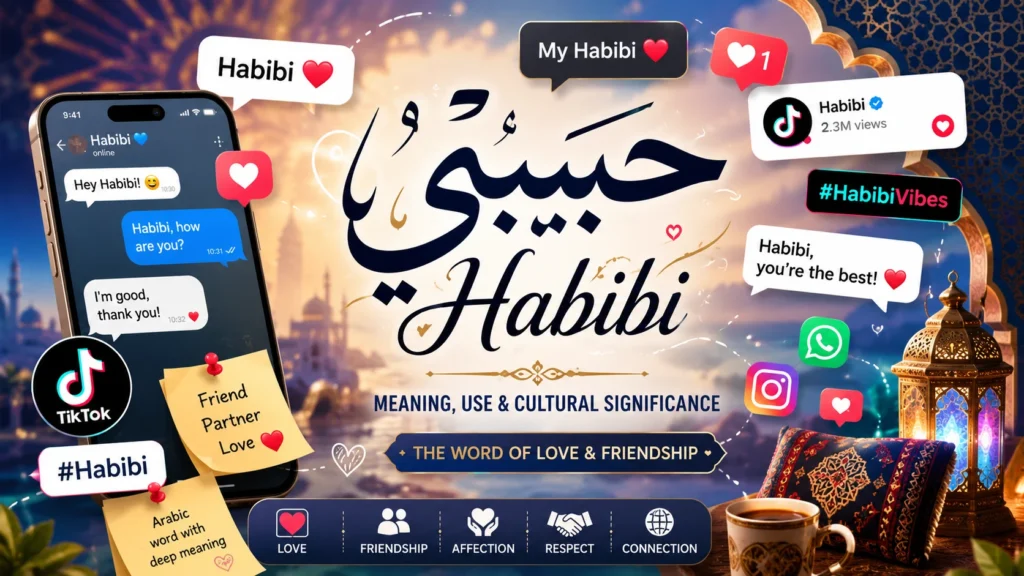
Habibi is an Arabic word meaning “my beloved,” “my dear,” or “my love,” and it can also mean “my friend” depending on the context. Commonly used as a term of endearment, habibi expresses affection toward friends, family members, romantic partners, and loved ones. In modern internet slang, people use it on TikTok, Instagram, WhatsApp, and other social media platforms to show love, friendship, or warmth in everyday conversations.
If you’ve spent any time on TikTok, Instagram, WhatsApp, Snapchat, or online forums, you’ve probably seen someone use the word habibi. The term appears in memes, videos, song lyrics, captions, and everyday conversations. That popularity leaves many people wondering about the real habibi meaning slang users are talking about online.
The short answer is simple.
Habibi is an Arabic word that means:
- My beloved
- My dear
- My love
- My darling
- My friend
The exact meaning depends on the situation and the relationship between the people speaking.
In traditional Arabic, the word expresses affection and warmth. In modern internet slang, people often use it playfully, casually, or humorously when talking to friends, followers, or romantic partners.
Quick Definition of Habibi
The most common habibi definition is:
“My beloved” or “my dear.”
However, translation alone doesn’t fully explain how people use the word.
A friend may call another friend habibi.
A parent may call a child habibi.
A husband may call his wife habibi.
A shop owner may even greet a customer with habibi in some Arabic-speaking countries.
That flexibility makes the word unique.
Habibi Meaning in English
Many people search for habibi meaning in English because direct translation can be confusing.
Here are the closest English equivalents:
| Arabic Word | English Meaning |
|---|---|
| Habibi | My dear |
| Habibi | My beloved |
| Habibi | My love |
| Habibi | Darling |
| Habibi | Dear friend |
| Habibi | Loved one |
Unlike some English terms, habibi isn’t limited to romantic relationships.
That’s one reason the word travels so well across cultures.
Literal Translation of Habibi
The habibi Arabic meaning comes from the Arabic word for love.
The word is built around the root ḥ-b-b, which relates to love, affection, caring, and emotional attachment.
Literally, habibi can be understood as:
“My beloved person.”
The ending often indicates possession, giving the sense of:
“My beloved.”
This deeper linguistic meaning explains why the word carries emotional warmth even when used casually.
Why the Word Has Become Popular Worldwide
Several factors helped habibi become a global expression:
- Social media growth
- Viral TikTok trends
- International music
- Middle Eastern influencers
- Cross-cultural communication
- Streaming platforms
- Global meme culture
Today, millions of non-Arabic speakers use habibi despite never studying Arabic.
The word has become part of modern online vocabulary.
Habibi Arabic Meaning and Language Origin
Understanding the history behind habibi helps explain why the word remains so powerful.
The Arabic Root Behind Habibi
Arabic relies heavily on root systems.
Most words develop from a group of core letters that carry a central meaning.
Habibi comes from a root associated with:
- Love
- Affection
- Emotional connection
- Admiration
- Fondness
Many related Arabic words stem from the same linguistic family.
Because of this connection, habibi naturally communicates emotional closeness.
How Native Arabic Speakers Use Habibi
Many non-Arabic speakers assume habibi is only romantic.
That isn’t accurate.
Native speakers use it in a wide variety of situations.
For example:
- Friends greeting friends
- Parents speaking to children
- Grandparents addressing grandchildren
- Couples expressing affection
- Family members showing warmth
- Hosts welcoming guests
In many Arabic-speaking communities, hearing habibi several times during a conversation isn’t unusual.
Historical Background of the Word
Habibi isn’t a modern internet invention.
The word has existed for centuries.
Long before smartphones and social media appeared, Arabic speakers used habibi in daily conversations, poetry, literature, and songs.
Classical Arabic writings frequently featured expressions built around love and affection.
Habibi became one of the most enduring examples.
Habibi as a Traditional Term of Endearment
Every language contains affectionate expressions.
English has:
- Honey
- Darling
- Sweetheart
- Dear
Spanish includes:
- Mi amor
- Cariño
French speakers use:
- Mon amour
- Mon cher
Arabic speakers often use:
- Habibi
- Habibti
Because the term carries emotional warmth without sounding overly formal, it remains one of the most widely used Arabic expressions today.
What Does Habibi Mean in Slang Today?
The internet transformed countless words.
Habibi is no exception.
While the traditional meaning remains intact, modern slang usage has expanded significantly.
Habibi Meaning in Internet Culture
Online users often employ habibi in playful ways.
Examples include:
- Greeting followers
- Addressing friends
- Creating memes
- Showing admiration
- Making jokes
- Expressing excitement
For many users, habibi simply means:
“Someone I like or feel friendly toward.”
This broader interpretation helped the term spread far beyond Arabic-speaking communities.
Habibi Meaning on TikTok
TikTok played a major role in popularizing the word.
Creators frequently use habibi when:
- Greeting audiences
- Making comedy videos
- Sharing relationship content
- Discussing friendships
- Creating cultural content
A creator might say:
“Come here, habibi.”
The phrase often sounds playful, welcoming, and friendly.
Habibi Meaning on Instagram
Instagram users frequently include habibi in:
- Captions
- Stories
- Reels
- Comments
Examples:
- “Miss you, habibi.”
- “Looking good, habibi.”
- “Happy birthday, habibi.”
In these situations, the word functions much like “dear” or “bestie.”
Habibi Meaning in Text Messages
Texting has created another layer of meaning.
When someone sends:
“Good morning, habibi.”
The interpretation depends on the relationship.
It may mean:
- Romantic affection
- Friendly affection
- Family affection
- Emotional closeness
Context matters more than the word itself.
Habibi Meaning in Online Chats and Memes
Memes often exaggerate the use of habibi.
Some creators use it humorously to imitate exaggerated friendliness.
Others use it to represent Middle Eastern culture in a lighthearted way.
Despite the jokes, the core meaning remains positive.
The word almost always communicates affection, friendliness, or warmth.
Is Habibi Romantic or Friendly?
One of the most common questions people ask after learning the habibi meaning slang definition is whether the word is romantic.
The answer depends entirely on context.
Unlike many English expressions, habibi doesn’t belong exclusively to romance. Arabic speakers use it in friendships, family relationships, professional settings, and romantic partnerships.
That flexibility is one reason the word remains so popular.
A single word can communicate affection, appreciation, warmth, respect, or emotional closeness without necessarily implying romantic feelings.
Habibi Meaning Between Friends
Among friends, habibi often means:
- My friend
- My dear friend
- Buddy
- Bro
- Someone I care about
For example:
“How are you today, habibi?”
In this case, the speaker isn’t expressing romantic interest.
They’re simply speaking warmly.
In many Middle Eastern countries, male friends frequently call each other habibi. Female friends may also use similar affectionate expressions among themselves.
The word creates a sense of familiarity and connection.
Habibi Meaning in Relationships
In romantic relationships, habibi takes on a deeper meaning.
Common interpretations include:
- My love
- My darling
- My sweetheart
- My beloved
Couples often use the word in daily conversations because it feels natural and affectionate.
Examples include:
- “Good morning, habibi.”
- “I miss you, habibi.”
- “I love you, habibi.”
Here, the emotional meaning becomes much stronger.
Habibi Meaning From a Guy
Many people search:
“Habibi meaning from a guy.”
The answer depends on the relationship.
| Situation | Possible Meaning |
|---|---|
| Male friend to friend | Buddy, friend |
| Brother to sibling | Dear brother |
| Father to child | My dear |
| Boyfriend to girlfriend | My love |
| Husband to wife | My beloved |
| Casual acquaintance | Friendly warmth |
The word alone doesn’t confirm romantic interest.
You need to consider:
- Tone
- Context
- Relationship history
- Frequency of use
Habibi Meaning From a Girl
The same principle applies when a woman says habibi.
Possible meanings include:
- Dear friend
- Loved one
- Someone appreciated
- Romantic partner
- Family member
For example:
A woman texting her best friend:
“Thanks for helping me today, habibi.”
This is usually friendly.
A woman texting her partner:
“Can’t wait to see you tonight, habibi.”
This clearly carries romantic meaning.
When Habibi Means Love and When It Doesn’t
The easiest way to understand habibi is to think about English words like:
- Dear
- Darling
- Sweetheart
- Love
Sometimes people use these words romantically.
Other times they use them casually.
Habibi works similarly.
The relationship determines the meaning.
Habibi vs Habibti
Another topic that confuses many learners is the difference between habibi and habibti.
These words are closely related yet not identical.
Understanding the distinction helps avoid embarrassing mistakes.
What Is Habibti?
Habibti is another common Arabic term of endearment.
Like habibi, it comes from the same root associated with love and affection.
Habibti generally means:
- My dear
- My beloved
- My darling
- My love
The key difference involves gender.
Key Differences Between Habibi and Habibti
| Word | Typical Usage |
|---|---|
| Habibi | Used when addressing a male |
| Habibti | Used when addressing a female |
This distinction exists because Arabic grammar uses gender-specific forms.
Examples:
- Male friend → Habibi
- Brother → Habibi
- Boyfriend → Habibi
Meanwhile:
- Female friend → Habibti
- Sister → Habibti
- Girlfriend → Habibti
Habibi and Habibti Difference Explained Simply
Think about it this way:
| English | Arabic Equivalent |
|---|---|
| Dear man | Habibi |
| Dear woman | Habibti |
The emotional meaning stays largely the same.
Only the grammatical gender changes.
Which One Should You Use?
Use:
Habibi when speaking to a male.
Use:
Habibti when speaking to a female.
Most native speakers appreciate when non-Arabic speakers make this distinction correctly.
Common Mistakes Non-Arabic Speakers Make
Many social media users mistakenly assume habibi works for everyone.
While people generally understand the intent, native speakers recognize the grammatical difference immediately.
Common errors include:
- Calling a woman habibi when habibti is appropriate
- Assuming habibi is exclusively romantic
- Believing habibi is internet slang only
- Thinking habibi originated on TikTok
None of these assumptions are correct.
How to Pronounce Habibi Correctly
Learning pronunciation helps you use the word confidently.
Correct Arabic Pronunciation
The standard pronunciation sounds similar to:
Ha-bee-bee
Breakdown:
- Ha
- Bee
- Bee
The emphasis usually falls naturally across the syllables without sounding exaggerated.
Habibi Pronunciation Guide
| Part | Sound |
|---|---|
| Ha | Like “ha” in “happy” |
| Bi | Like “bee” |
| Bi | Like “bee” |
Combined:
Ha-bee-bee
Common English Pronunciations
Non-native speakers often pronounce it:
- Huh-bee-bee
- Ha-bib-ee
- Hay-bee-bee
While these variations occur, the closest pronunciation remains:
Ha-bee-bee
Easy Memory Trick
Imagine saying:
“Happy bee bee.”
Now shorten it slightly.
You’ll get surprisingly close to the authentic pronunciation.
How to Use Habibi in Conversations
Understanding the definition is useful.
Knowing how to use the word naturally is even more valuable.
Habibi in Family Conversations
Family members frequently use habibi.
Examples:
Parent to child
“Come eat dinner, habibi.”
Grandparent to grandchild
“How was school today, habibi?”
Sibling to sibling
“Don’t worry, habibi. Everything will be okay.”
Notice the warmth.
The word immediately softens the conversation.
Habibi in Friendship Conversations
Friends use habibi constantly throughout many Arabic-speaking communities.
Examples:
Friend greeting friend
“Hey habibi, how are you?”
Friend offering support
“You’ve got this, habibi.”
Friend joking around
“Relax, habibi. It’s not that serious.”
These examples show that habibi often functions like:
- Friend
- Buddy
- Bro
- Dear friend
Habibi in Romantic Conversations
Among couples, the word becomes more intimate.
Examples:
Text message
“Good night, habibi.”
Date conversation
“You look amazing, habibi.”
Affectionate message
“I miss you, habibi.”
The emotional intensity depends on the situation.
Habibi in Social Media Captions
Social media users frequently include the word in captions.
Examples:
- “Vacation with my habibi.”
- “Miss you habibi.”
- “Best day ever, habibi.”
- “Thank you habibi.”
These captions often emphasize closeness and affection.
Habibi Meaning in Text Messages
Text messaging has expanded the word’s global reach.
Common text examples include:
| Message | Meaning |
|---|---|
| Good morning habibi | Warm greeting |
| Thanks habibi | Appreciation |
| Miss you habibi | Affection |
| What’s up habibi | Friendly greeting |
| Love you habibi | Romantic affection |
Again, context determines the exact interpretation.
Popular Variations of Habibi
As the word spread internationally, people began encountering related expressions.
Understanding these variations provides a fuller picture of Arabic affectionate language.
Ya Habibi Meaning
One of the most common phrases is:
Ya Habibi
The word ya acts as a form of direct address.
The phrase essentially means:
- Oh my dear
- My dear
- My beloved
- Dear friend
Examples:
“Ya habibi, come here.”
“Thank you, ya habibi.”
The phrase often sounds warmer and more expressive than habibi alone.
Habib Meaning
Another related word is:
Habib
This term generally means:
- Beloved
- Loved one
- Dear person
Habibi derives from the same linguistic family.
Habibati Meaning
You may also encounter:
Habibati
Depending on dialect and pronunciation, this word functions similarly to habibti.
It refers to a beloved female and carries the same affectionate tone.
Other Arabic Affectionate Expressions
Arabic contains many endearing expressions.
Some common examples include:
| Expression | Meaning |
|---|---|
| Habibi | My beloved (male) |
| Habibti | My beloved (female) |
| Ya habibi | Oh my dear |
| Ya habibti | Oh my dear (female) |
| Aziz | Dear |
| Azizati | Dear (female) |
These expressions highlight the importance of warmth and personal connection within Arabic communication.
Habibi in Arab Culture
To truly understand the habibi meaning, you need to look beyond translation.
Many people learn that habibi means “my dear” or “my beloved” and stop there. However, the cultural meaning runs much deeper. The word reflects values that have shaped Arabic-speaking societies for generations.
In many Arab communities, relationships matter. Family bonds matter. Hospitality matters. Respect matters.
Habibi helps express all of those things.
Rather than sounding overly emotional, the word often feels natural and effortless. Native speakers may use it dozens of times throughout the day without giving it a second thought.
The Cultural Significance of Habibi
The habibi cultural meaning goes beyond romance.
The word often communicates:
- Warmth
- Kindness
- Respect
- Affection
- Familiarity
- Hospitality
- Emotional connection
This explains why visitors to Arabic-speaking countries often hear habibi from people they just met.
A waiter may call you habibi.
A shopkeeper may call you habibi.
A taxi driver may call you habibi.
The speaker isn’t claiming a close relationship. Instead, they’re creating a friendly atmosphere.
Why Arabs Use Habibi So Frequently
People from outside the Middle East sometimes notice that Arabic speakers use habibi far more often than English speakers use equivalent expressions.
Several cultural factors contribute to this habit.
Relationship-Oriented Communication
Arabic communication often emphasizes personal relationships.
Many conversations begin with friendly greetings and expressions of goodwill before moving to the main topic.
Habibi naturally fits this style.
Hospitality Traditions
Hospitality remains highly valued throughout much of the Arab world.
Using warm language helps make guests feel welcome.
Habibi contributes to that sense of comfort.
Emotional Expressiveness
Many Arabic dialects encourage expressive communication.
Words of affection don’t always carry the same level of seriousness they might in some Western cultures.
As a result, habibi can appear in situations where English speakers might simply say “friend” or “buddy.”
Habibi as a Symbol of Warmth and Hospitality
Imagine entering a local café.
The owner smiles and says:
“Welcome, habibi.”
That greeting instantly changes the atmosphere.
The interaction feels more personal.
More human.
More welcoming.
That’s one reason the expression remains so powerful.
A single word can transform a routine conversation into a friendly interaction.
Regional Differences Across the Middle East
The Arabic language includes numerous regional dialects.
While habibi remains widely understood, pronunciation and frequency can vary.
| Region | Typical Usage |
|---|---|
| Gulf Countries | Extremely common |
| Saudi Arabia | Frequently used |
| United Arab Emirates | Very common |
| Kuwait | Common in daily speech |
| Qatar | Frequently heard |
| Egypt | Extremely popular |
| Jordan | Widely used |
| Lebanon | Common and versatile |
| Syria | Frequently used |
| Palestine | Common expression |
| Iraq | Widely understood |
| North Africa | Common with dialect variations |
Despite regional differences, the core meaning remains remarkably consistent.
Habibi and Arab Traditions
Traditional Arabic poetry often celebrated:
- Love
- Friendship
- Family
- Loyalty
- Honor
Many expressions built around affection became deeply embedded within everyday language.
Habibi survived because it remained useful across generations.
Unlike slang terms that disappear after a few years, habibi continues to thrive because it fulfills a genuine social function.
It helps people express connection.
Habibi Meaning on TikTok, Instagram, and Social Media
Social media transformed habibi from a regional expression into a global phenomenon.
Today, millions of people who don’t speak Arabic use the word regularly.
How Habibi Became Viral
Several factors fueled its popularity.
These include:
- Short-form video platforms
- International influencers
- Global music trends
- Cross-cultural content creators
- Meme culture
- Streaming platforms
As audiences became more international, Arabic expressions reached new communities.
Habibi emerged as one of the most recognizable examples.
Habibi Meaning on TikTok
TikTok introduced countless users to the word.
Creators often use habibi when:
- Greeting viewers
- Making comedy sketches
- Sharing relationship content
- Posting lifestyle videos
- Creating cultural content
A creator might say:
“Listen, habibi, let me explain.”
Or:
“Come here, habibi.”
These phrases sound welcoming and playful.
Why TikTok Users Love the Word
Several qualities helped habibi succeed on TikTok.
Easy to Pronounce
Unlike many foreign-language expressions, habibi is relatively simple for English speakers to pronounce.
Positive Meaning
The word carries positive emotional associations.
People enjoy using language connected to warmth and friendship.
Memorable Sound
The repeating syllables make the word catchy.
That memorability increases sharing and engagement.
Habibi Meaning on Instagram
Instagram users frequently include habibi in:
- Captions
- Reels
- Stories
- Comments
- Direct messages
Examples include:
“Miss you habibi.”
“Happy birthday habibi.”
“Looking amazing habibi.”
In these situations, the word often functions similarly to:
- Dear
- Love
- Bestie
- Friend
Habibi Meaning in WhatsApp Messages
WhatsApp conversations frequently feature habibi because messaging encourages casual communication.
Examples include:
| Message | Intended Meaning |
|---|---|
| Morning habibi | Friendly greeting |
| Thank you habibi | Appreciation |
| Miss you habibi | Affection |
| Safe travels habibi | Care and concern |
| Call me later habibi | Familiarity |
The word adds emotional warmth without requiring lengthy explanations.
Habibi Meaning on Snapchat
Snapchat users often incorporate habibi into:
- Private chats
- Story captions
- Photo messages
- Video messages
Because Snapchat focuses on personal communication, habibi fits naturally into the platform’s conversational style.
Habibi Meaning on X and Online Communities
Across online communities, habibi often serves as:
- A friendly greeting
- A humorous nickname
- A term of affection
- A cultural reference
Users sometimes adopt the word simply because they enjoy its positive energy.
Habibi Meme Meaning
Memes have played a major role in spreading the word globally.
Why Habibi Appears in Memes
The word works well in meme culture because it can express:
- Friendship
- Humor
- Encouragement
- Exaggerated affection
Many meme creators use habibi to create instantly recognizable Middle Eastern-themed jokes.
Common Habibi Meme Themes
Popular meme formats include:
- Friendly advice
- Relationship jokes
- Travel humor
- Food memes
- Gaming memes
- Cultural memes
Examples often follow patterns such as:
“Trust me, habibi.”
“Relax, habibi.”
“Listen carefully, habibi.”
The humor typically comes from the delivery rather than the word itself.
Is Habibi Internet Slang?
This question causes confusion.
The answer is both yes and no.
| Statement | True or False |
|---|---|
| Habibi is a real Arabic word | True |
| Habibi existed before the internet | True |
| Habibi is used online as slang | True |
| Habibi originated on social media | False |
| Habibi is only slang | False |
The word existed long before digital culture.
However, internet users adapted it into modern online slang.
Habibi in Music and Entertainment
Another reason for the word’s popularity is its frequent appearance in entertainment.
Habibi in Songs
Many Arabic songs include habibi because it naturally conveys affection.
The term appears in:
- Love songs
- Pop songs
- Dance music
- Traditional music
- Contemporary Arabic music
The emotional quality of the word makes it especially effective in lyrics.
Habibi in Movies and Television
Films and television programs often expose international audiences to Arabic expressions.
Viewers frequently hear characters say:
- Habibi
- Ya habibi
- Habibti
Over time, audiences become familiar with these phrases even if they don’t understand Arabic.
Habibi in Global Pop Culture
The word now appears in:
- Social media captions
- Song titles
- Fashion slogans
- Online usernames
- Entertainment content
- Internet memes
Few Arabic words have achieved the same level of international recognition.
Why Habibi Became Globally Recognizable
Several characteristics contributed to its success.
| Factor | Impact |
|---|---|
| Positive meaning | High |
| Easy pronunciation | High |
| Social media exposure | High |
| Music industry influence | High |
| Meme culture | High |
| Cross-cultural appeal | High |
Together, these factors transformed habibi into a global expression.
Habibi in Modern Internet Culture
Language evolves constantly.
The internet accelerates that evolution.
Habibi demonstrates how a traditional word can adapt to modern communication without losing its original meaning.
Today, someone may use habibi in:
- A family conversation
- A romantic text
- A TikTok comment
- A meme
- A gaming chat
- An Instagram caption
Despite these different environments, the underlying message remains remarkably consistent.
The speaker is communicating some form of affection, friendliness, appreciation, or emotional connection.
That’s why the word continues to thrive.
It works across cultures.
It works across generations.
And it works across digital platforms.
Most importantly, it expresses something people universally value:
Human connection.
Habibi Meaning From a Guy vs Habibi Meaning From a Girl
One of the biggest misconceptions surrounding the habibi slang meaning is the belief that the word always signals romantic interest.
In reality, context determines everything.
The same word can mean friendship, affection, respect, admiration, or romantic love depending on who says it and how they use it.
Habibi Meaning From a Guy
When a man says habibi, the meaning usually falls into one of several categories.
| Situation | Meaning |
|---|---|
| Friend to friend | Buddy, bro, my friend |
| Brother to sibling | Dear brother |
| Father to child | My dear |
| Husband to wife | My love |
| Boyfriend to girlfriend | My darling |
| Relative to relative | Beloved family member |
For example:
“How are you, habibi?”
This often sounds friendly.
Now compare it with:
“I miss you, habibi.”
In a romantic relationship, the emotional meaning becomes much stronger.
Habibi Meaning From a Girl
When a woman uses habibi, the interpretation works similarly.
She may use it to address:
- A romantic partner
- A close friend
- A family member
- A child
- Someone she appreciates
Examples:
“Thank you for helping me, habibi.”
This may be completely platonic.
Meanwhile:
“Good night, habibi. Sweet dreams.”
This often sounds more affectionate and intimate.
Is Habibi a Compliment?
Yes.
In most situations, habibi functions as a compliment.
The word communicates positive feelings.
It can express:
- Affection
- Appreciation
- Warmth
- Respect
- Caring
- Admiration
Being called habibi is generally viewed positively.
The speaker is showing friendliness or emotional connection.
Habibi for Friends, Family, and Romantic Partners
One reason habibi remains so popular is its flexibility.
The word works across multiple relationship types.
Habibi for Friends
Among friends, habibi often means:
- Friend
- Buddy
- Bro
- Dear friend
Examples:
“Let’s grab lunch, habibi.”
“You did great, habibi.”
Many Arabic-speaking men call their male friends habibi daily.
Habibi for Family Members
Family members commonly use habibi.
Examples include:
- Parent to child
- Child to parent
- Grandparent to grandchild
- Siblings speaking to one another
Examples:
“Come here, habibi.”
“Take care, habibi.”
In these situations, the word reflects affection and family closeness.
Habibi for a Boyfriend
In romantic relationships, habibi often translates as:
- My love
- My darling
- My sweetheart
- My beloved
Example:
“I can’t wait to see you, habibi.”
The romantic meaning becomes obvious through context.
Habibi for a Girlfriend
People also use habibi affectionately toward female partners in casual conversation, though many native speakers may use habibti when addressing women.
Examples:
“You look beautiful today, habibi.”
“Good morning, habibi.”
The intent is affectionate and loving.
Common Habibi Usage Examples
Seeing real examples helps clarify the meaning.
Friendly Examples
Example 1
“Thanks for helping me move, habibi.”
Meaning: Appreciation and friendship.
Example 2
“Don’t worry about it, habibi.”
Meaning: Comfort and reassurance.
Example 3
“See you tomorrow, habibi.”
Meaning: Warm farewell.
Romantic Examples
Example 1
“I love you, habibi.”
Meaning: Romantic affection.
Example 2
“Good night, habibi.”
Meaning: Emotional closeness.
Example 3
“You’re always on my mind, habibi.”
Meaning: Deep affection.
Family Examples
Example 1
“Eat your dinner, habibi.”
Meaning: Loving family interaction.
Example 2
“How was school today, habibi?”
Meaning: Caring concern.
Social Media Examples
Example 1
“Happy birthday habibi!”
Meaning: Affectionate greeting.
Example 2
“Miss you habibi.”
Meaning: Emotional connection.
Example 3
“You crushed it, habibi.”
Meaning: Encouragement.
Common Misconceptions About Habibi
The word’s popularity has created several myths.
Let’s clear them up.
Myth: Habibi Always Means Boyfriend or Girlfriend
False.
The word can describe:
- Friends
- Family
- Romantic partners
- Loved ones
Romance is only one possible meaning.
Myth: Habibi Is Just TikTok Slang
False.
Habibi existed for centuries before social media appeared.
TikTok helped popularize the term globally, but it did not create it.
Myth: Only Couples Use Habibi
False.
Many people use habibi with:
- Friends
- Relatives
- Children
- Colleagues
- Guests
Myth: Habibi Has One Exact English Translation
False.
Several English phrases may fit depending on context.
These include:
- My dear
- My beloved
- My friend
- My love
- Darling
- Sweetheart
No single translation captures every situation.
Quick Reference Table: Habibi Meaning Explained
| Context | Meaning |
|---|---|
| Friendship | My friend |
| Family | My dear |
| Romance | My love |
| Texting | Affectionate greeting |
| Social Media | Friendly nickname |
| Online Slang | Term of endearment |
| Arab Culture | Expression of warmth |
| Daily Conversation | Affection and respect |
Why Do People Say Habibi?
People use habibi because it helps create connection.
The word communicates positive emotions quickly.
It can:
- Strengthen friendships
- Show affection
- Create warmth
- Express appreciation
- Build rapport
- Make conversations feel more personal
In a world where many interactions feel rushed, a simple word like habibi can add a human touch.
Frequently Asked Questions
What Does Habibi Mean in Slang?
In modern slang, habibi generally means:
My dear, my friend, my love, or someone I care about.
The exact meaning depends on context.
What Does Habibi Mean in Arabic?
The literal Arabic meaning is:
“My beloved” or “my dear.”
It comes from an Arabic root associated with love and affection.
What Does Ya Habibi Mean?
Ya habibi means:
- My dear
- Oh my dear
- My beloved
The word ya is used when directly addressing someone.
Is Habibi Romantic?
Sometimes.
Habibi can be romantic, but it is also commonly used among friends and family members.
Context determines the meaning.
Can You Call a Friend Habibi?
Yes.
Many Arabic speakers regularly call close friends habibi.
The word often means:
- Buddy
- Friend
- Dear friend
What Is the Difference Between Habibi and Habibti?
The main difference involves gender.
| Word | Used For |
|---|---|
| Habibi | Male |
| Habibti | Female |
Both words express affection and warmth.
What Is the Literal Meaning of Habibi?
The literal meaning is:
“My beloved.”
However, everyday usage often extends beyond romance.
Is Habibi a Compliment?
Yes.
Being called habibi usually indicates affection, friendliness, appreciation, or emotional connection.
Final Thoughts
The meaning of habibi is much richer than a simple dictionary definition.
At its core, habibi is an Arabic term of endearment that expresses affection, warmth, friendship, and love. Depending on the context, it can mean my dear, my beloved, my friend, my darling, or my love.
The word has traveled far beyond its Arabic origins. Today, you’ll hear it in conversations, social media posts, TikTok videos, Instagram captions, text messages, songs, memes, and online communities around the world.
What makes habibi special is its versatility.
A parent can say it to a child.
Friends can say it to one another.
Couples can use it romantically.
Even strangers may use it as a friendly gesture.
That flexibility has helped habibi become one of the most recognized Arabic expressions worldwide.
If someone calls you habibi, they’re usually expressing warmth, affection, friendship, appreciation, or care. In most situations, it’s a positive and welcoming term that helps create a sense of connection.
In short, when people search “what does habibi mean” or “habibi meaning slang,” the best answer is simple:
Habibi is an Arabic word meaning “my beloved,” “my dear,” or “my friend,” used to express affection, warmth, and emotional connection in both traditional Arabic culture and modern online slang.