
Last Updated on April 22, 2026
3PL vs 4PL explains two different levels of logistics outsourcing. A 3PL provider handles physical logistics tasks like storage, packing, and shipping. A 4PL provider manages the entire supply chain, including coordination of multiple 3PLs and strategy. The main difference is execution versus full supply chain management.
The topic of 3PL vs 4PL is very important in modern logistics and supply chain management. Businesses today do not always handle shipping, storage, and delivery on their own. Instead, they outsource these tasks to expert companies.
This is where third party logistics and fourth party logistics come in. Many people confuse them because both deal with supply chains. However, they work at different levels.
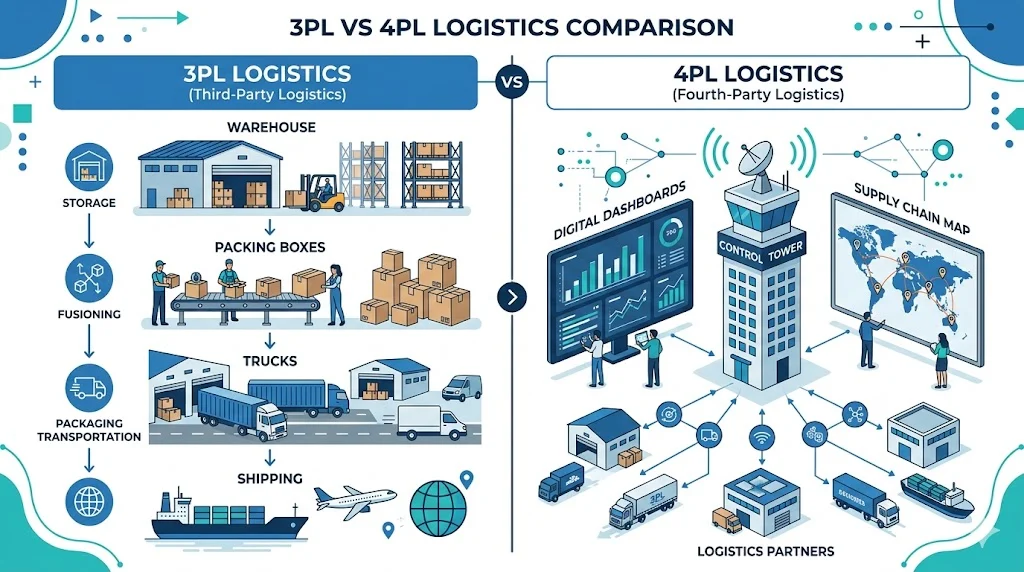
A 3PL company helps businesses move goods, store products, and manage order delivery. A 4PL company goes further. It manages the entire logistics system, often controlling multiple 3PL providers and making high level decisions.
This difference is important for businesses that want to grow, reduce costs, or improve efficiency. Choosing the wrong model can lead to delays, higher costs, or poor customer service.
In this article, you will learn everything about 3PL vs 4PL, including definitions, differences, advantages, examples, mistakes, exercises, and FAQs. The goal is to make this topic simple, clear, and easy to apply in real life.
Quick Answer Overview of 3PL vs 4PL
The simplest way to understand 3PL vs 4PL is this:
A 3PL provider handles operations. A 4PL provider handles management and strategy.
A 3PL focuses on:
- Warehousing
- Packing
- Shipping
- Inventory handling
- Order fulfillment
A 4PL focuses on:
- Supply chain planning
- Managing multiple logistics providers
- Technology integration
- End to end optimization
- Strategic decision making
In short, 3PL does the work, while 4PL manages the work.
What is 3PL in Logistics
A third party logistics provider (3PL) is a company that helps businesses manage physical logistics tasks.
Core Functions of 3PL
A 3PL provider usually offers:
- Warehousing services
- Inventory management
- Order packing
- Shipping and transportation
- Returns handling
- Freight forwarding
How 3PL Works
A business sends products to a 3PL warehouse. When a customer places an order, the 3PL:
- Picks the product
- Packs it safely
- Ships it to the customer
Simple Analogy
Think of a 3PL like a delivery kitchen. The restaurant makes the food, and the delivery kitchen handles storage and delivery.
What is 4PL in Logistics
A fourth party logistics provider (4PL) is a company that manages the entire supply chain system for a business.
It does not usually handle physical goods directly. Instead, it controls and coordinates other logistics companies.
Core Functions of 4PL
A 4PL provider offers:
- Supply chain strategy
- Coordination of multiple 3PL providers
- Technology and system integration
- Performance tracking
- Cost optimization
- End to end logistics design
How 4PL Works
A 4PL acts like a central control tower:
- It designs the supply chain
- It selects 3PL companies
- It monitors performance
- It improves efficiency continuously
Simple Analogy
A 4PL is like a film director. The director does not act in the movie but controls all actors, camera teams, and production units.
Key Differences Between 3PL vs 4PL
| Feature | 3PL | 4PL |
| Role | Operational | Strategic |
| Focus | Execution of logistics tasks | Full supply chain management |
| Warehousing | Yes | No direct handling |
| Transportation | Yes | Managed through partners |
| Control | Limited | High level control |
| Technology use | Moderate | Advanced integration |
| Relationship | Service provider | Supply chain manager |
| Complexity | Medium | High |
The table shows that 3PL vs 4PL is mainly about execution versus control.
Advantages and Disadvantages of 3PL vs 4PL
Advantages of 3PL
- Reduces shipping costs
- Saves time for businesses
- Easy to scale operations
- Access to logistics expertise
- Faster order fulfillment
Disadvantages of 3PL
- Limited control over operations
- Dependency on third party performance
- Less visibility of full supply chain
Advantages of 4PL
- Complete supply chain optimization
- Centralized control system
- Better visibility and data tracking
- Improved efficiency across providers
- Strategic decision making support
Disadvantages of 4PL
- Higher cost than 3PL
- Complex setup process
- Requires trust in provider
- Less direct control over operations
Real World Examples of 3PL vs 4PL
Example of 3PL
An online clothing store stores its products in a 3PL warehouse. When customers order clothes, the 3PL company packs and ships them directly.
Popular companies that offer 3PL services include:
- DHL Supply Chain
- FedEx Supply Chain
- XPO Logistics
Example of 4PL
A global electronics brand uses a 4PL provider to manage its entire supply chain. The 4PL:
- Selects multiple 3PL warehouses
- Chooses shipping partners
- Tracks global inventory
- Optimizes delivery routes
The brand does not deal with logistics directly. The 4PL manages everything.
Regional and Global Usage of 3PL vs 4PL
North America
In the United States and Canada, 3PL vs 4PL is widely used in e commerce, retail, and manufacturing. Many companies outsource logistics to reduce costs.
Europe
European businesses often use 4PL models for cross border trade because of complex regulations and multiple countries.
Asia
In countries like China and India, 3PL is more common due to fast growing e commerce markets.
Global Trend
The global trend is moving from simple 3PL usage toward hybrid models where 4PL manages multiple 3PLs.
Common Mistakes in Understanding 3PL vs 4PL
Mistake 1: Thinking they are the same
Many people believe 3PL and 4PL are similar. In reality, they are very different levels of service.
Mistake 2: Choosing 4PL too early
Small businesses often do not need 4PL. Starting with 3PL is usually better.
Mistake 3: Ignoring cost differences
4PL is more expensive. Businesses must evaluate budget carefully.
Mistake 4: Not checking integration ability
A good 4PL must integrate technology systems from different providers.
Mistake 5: Lack of performance tracking
Without proper tracking, even 4PL systems can fail.
Exercises on 3PL vs 4PL (With Answers)
Exercise 1
What does 3PL mainly focus on?
A. Strategy
B. Physical logistics
C. Marketing
Answer: B. Physical logistics
Exercise 2
What does 4PL manage?
A. Only warehouses
B. Entire supply chain
C. Only shipping
Answer: B. Entire supply chain
Exercise 3
Which is more strategic in 3PL vs 4PL?
Answer: 4PL is more strategic
Exercise 4
Name one advantage of 3PL.
Answer: Faster order fulfillment or lower cost
Exercise 5
Name one disadvantage of 4PL.
Answer: Higher cost or complex setup
Related Concepts and Comparisons
Understanding 3PL vs 4PL becomes easier when you compare related models.
1PL vs 2PL vs 3PL vs 4PL
- 1PL: Company handles everything itself
- 2PL: Basic transportation services
- 3PL: Logistics outsourcing
- 4PL: Full supply chain management
3PL vs Freight Forwarder
A freight forwarder mainly focuses on shipping coordination, while 3PL covers warehousing and fulfillment too.
4PL vs LLP (Lead Logistics Provider)
Some companies use LLP instead of 4PL. Both manage supply chains but differ in structure and control level.
3PL vs In House Logistics
- 3PL reduces workload
- In house logistics gives full control but higher cost
FAQs
What is the main difference between 3PL vs 4PL?
3PL handles logistics tasks like shipping and storage. 4PL manages the entire supply chain strategy and coordination.
Is 4PL better than 3PL?
Not always. 4PL is better for large companies. 3PL is better for small and medium businesses.
When should a business choose 3PL vs 4PL?
Choose 3PL when you need operational support. Choose 4PL when you need full supply chain management.
Does 4PL own warehouses?
Usually no. 4PL coordinates other providers instead of owning physical assets.
Can a company use both 3PL and 4PL?
Yes. Many businesses use 4PL to manage multiple 3PL providers.
Is Amazon a 3PL or 4PL?
Amazon acts as both in different areas. Its logistics network functions like a 3PL for sellers and like a 4PL in its ecosystem.
Is 3PL suitable for startups?
Yes. Startups often use 3PL to reduce costs and scale faster.
What industries use 3PL vs 4PL?
Retail, e commerce, manufacturing, healthcare, and automotive industries use both models.
What is the cost difference between 3PL vs 4PL?
4PL is generally more expensive due to its strategic and management role.
Can 4PL replace 3PL completely?
No. 4PL depends on 3PL providers to execute physical logistics tasks.
Conclusion
Understanding 3PL vs 4PL is essential for modern business success. Both models support supply chain efficiency, but they serve different roles.
A 3PL provider focuses on execution tasks like warehousing, packing, and shipping. It is ideal for businesses that want simple and cost effective logistics support. A 4PL provider manages the entire supply chain system, offering strategic control, coordination, and optimization.
Choosing between 3PL vs 4PL depends on business size, budget, and complexity. Small and medium businesses often benefit from 3PL services. Large global companies with complex supply chains often need 4PL solutions.
The key takeaway is simple. Use 3PL for operations. Use 4PL for strategy and full control. Businesses that understand this difference can improve efficiency, reduce costs, and scale faster in competitive markets.