
Last Updated on June 19, 2026
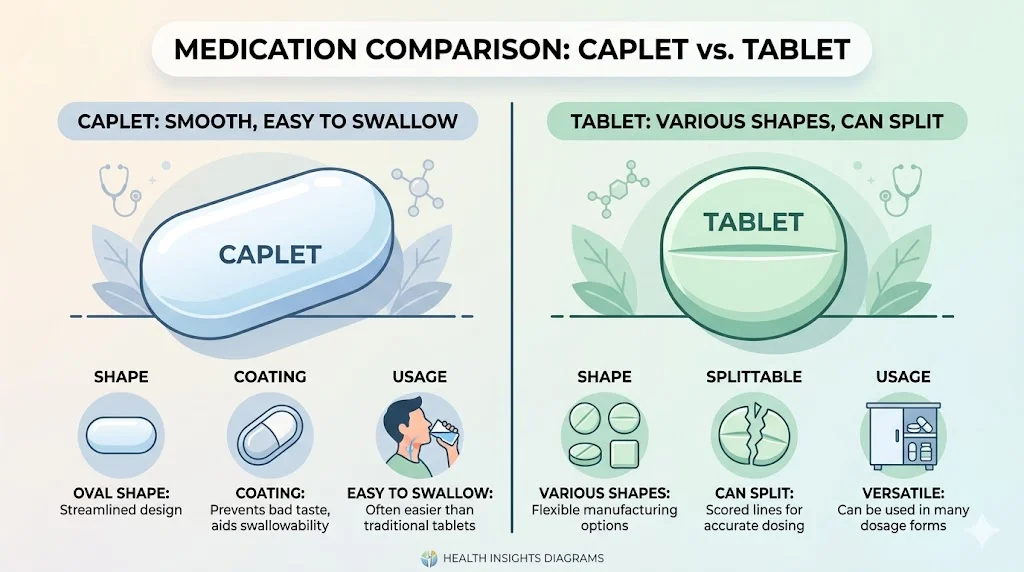
Caplet vs tablet: A caplet is a smooth, capsule-shaped tablet designed for easier swallowing, while a tablet is a compressed powder medication that comes in many shapes and forms. Both deliver medicine effectively, but they differ in design, coating, and user comfort.
When you go to a pharmacy, you often see medicines labeled as tablets or caplets. Many people think they are the same, but they are not exactly alike. Understanding caplets vs tablets can help you choose the right medication form for your needs. If you’ve ever wondered what is a caplet or what are caplets, you’re not alone. This guide explains the difference between caplet and tablet, compares caplet vs tablet in terms of shape, swallowing, and use, and also looks at capsule vs caplet to clear up another common source of confusion. By the end, you’ll have a clear understanding of caplets and how they differ from other medication forms.
The difference between caplet vs tablet matters more than you might think. It can affect how easy a medicine is to swallow, how fast it works, and even how it tastes.
Some people prefer one over the other. Others do not know there is a difference at all. This confusion can lead to wrong choices, especially for children, older adults, or people who struggle with swallowing pills.
In this guide, you will learn everything about caplet vs tablet in a simple way. We will explain what each one is, how they are made, and when to choose one over the other.
By the end, you will be able to pick the right option with confidence.
Quick Answer / Overview
| Feature | Caplet | Tablet |
| Shape | Capsule-like | Round, oval, or flat |
| Coating | Usually smooth coating | May or may not have coating |
| Swallowing | Easier | Can be harder |
| Taste | Often masked | Sometimes bitter |
| Breaking | Usually not meant to break | Can often be split |
| Use | Convenience and comfort | Versatility and flexibility |
Simple takeaway:
A caplet is a type of tablet shaped like a capsule for easier swallowing, while a tablet is a general form of compressed medicine.
Definition of Caplet vs Tablet
What Is a Tablet?
A tablet is a solid form of medicine made by compressing powdered ingredients into a firm shape.
Tablets are the most common form of medication worldwide. They come in many forms:
- Chewable tablets
- Effervescent tablets
- Extended-release tablets
- Scored tablets (can be split)
Example:
Paracetamol tablets used for fever or pain relief.
What Is a Caplet?
A caplet is a type of tablet, but it is shaped like a capsule.
It is smooth, oval, and often coated. This design helps people swallow it more easily.
Even though it looks like a capsule, it is still a compressed tablet inside.
Example:
Many pain relievers like ibuprofen are sold in caplet form.
Key Differences Between Caplet vs Tablet
Shape and Design
- Tablets can be round, flat, or even square
- Caplets are always oval or capsule-shaped
Coating
- Tablets may be coated or uncoated
- Caplets usually have a smooth coating
Swallowing Ease
- Tablets can feel rough or chalky
- Caplets slide down more easily
Taste
- Tablets may have a bitter taste
- Caplets often mask the taste with coating
Splitting
- Tablets often have a score line for splitting
- Caplets are harder to split
Advantages and Disadvantages
Advantages of Caplets
- Easy to swallow
- Smooth texture
- Taste is hidden
- Good for sensitive users
Disadvantages of Caplets
- Hard to split into smaller doses
- Sometimes more expensive
- Not suitable for all medications
Advantages of Tablets
- Can be split for flexible dosing
- Available in many forms
- Usually cheaper
- Easy to manufacture
Disadvantages of Tablets
- Harder to swallow
- May taste bitter
- Can break or crumble
Real-World Examples
Pain Relief
- Caplet: Ibuprofen caplets for quick swallowing
- Tablet: Paracetamol tablets for flexible dosing
Vitamins
- Caplet: Multivitamin caplets with coating
- Tablet: Chewable vitamin tablets
Prescription Medicine
Doctors may choose based on patient needs:
- Elderly patients → caplets for easy swallowing
- Children → chewable tablets
- Chronic patients → extended-release tablets
Regional and Global Usage
The use of caplets vs tablets varies by region:
In Developed Countries
- Caplets are popular due to comfort and convenience
- Many over-the-counter medicines use caplet design
In Developing Countries
- Tablets are more common due to lower cost
- Easier to produce and distribute
Global Trend
The demand for caplets is growing because:
- People prefer easier swallowing
- Pharmaceutical companies focus on user comfort
Common Mistakes and Misunderstandings
Thinking Caplets Are Capsules
Mistake: Caplets are the same as capsules
Correction: Caplets are compressed tablets, not filled shells
Assuming All Tablets Are Hard to Swallow
Mistake: All tablets are difficult
Correction: Many tablets are coated or chewable
Breaking Caplets
Mistake: Caplets can be split easily
Correction: Most caplets are not designed to be broken
Ignoring Instructions
Mistake: Taking tablets without reading labels
Correction: Always follow dosage instructions carefully
Exercises with Answers
Exercise 1: Identify the Type
- A smooth, oval pill → ______
- A round, chalky pill → ______
Answers:
- Caplet
- Tablet
Exercise 2: True or False
- Caplets are easier to swallow than tablets
- Tablets cannot be split
- Caplets are a type of tablet
Answers:
- True
- False
- True
Exercise 3: Fill in the Blank
- A ______ is usually coated and capsule-shaped
- A ______ can come in many shapes
Answers:
- Caplet
- Tablet
Related Concepts and Comparisons
Capsule vs Caplet
- Capsules contain liquid or powder inside a shell
- Caplets are solid compressed pills
Tablet vs Capsule
| Feature | Tablet | Capsule |
| Form | Solid compressed | Gel shell |
| Taste | May be bitter | Usually tasteless |
| Cost | Lower | Higher |
Extended-Release vs Immediate-Release
- Tablets can be designed for slow release
- Caplets can also have controlled release
FAQs
What is the main difference between caplet vs tablet?
The main difference is shape and coating. Caplets are smooth and capsule-shaped, while tablets come in many forms and may not be coated.
Are caplets better than tablets?
Caplets are better for swallowing comfort, but tablets offer more flexibility like splitting and varied forms.
Can you split a caplet like a tablet?
Most caplets should not be split because they lack score lines and may have special coatings.
Why do caplets cost more than tablets?
Caplets often require additional coating and shaping processes, which increase manufacturing cost.
Which is easier to swallow, caplet or tablet?
Caplets are generally easier to swallow due to their smooth coating and shape.
Are caplets stronger than tablets?
No, strength depends on the dosage, not the form. Caplets and tablets can contain the same amount of medicine.
Can children take caplets?
It depends on age and ability to swallow. Many children prefer chewable tablets instead.
Do caplets work faster than tablets?
Not necessarily. Speed depends on formulation, not just shape.
Are all coated tablets caplets?
No, not all coated tablets are caplets. Only capsule-shaped coated tablets are called caplets.
Which is more common worldwide, caplet or tablet?
Tablets are more common globally due to lower cost and wider availability.
Conclusion
Understanding caplet vs tablet helps you make better choices when taking medicine. While both forms deliver the same purpose, their design, comfort, and usability differ in important ways.
Caplets are ideal for people who struggle with swallowing pills. Their smooth coating and shape make them easier and more pleasant to take. On the other hand, tablets offer flexibility, affordability, and a wide range of options, including chewable and split forms.
The best choice depends on your needs. If you want convenience and comfort, choose caplets. If you need adjustable doses or lower cost, tablets are often better.
Always follow medical advice and read instructions carefully before taking any medication. Small differences in form can make a big impact on safety and effectiveness.