Last Updated on April 18, 2026
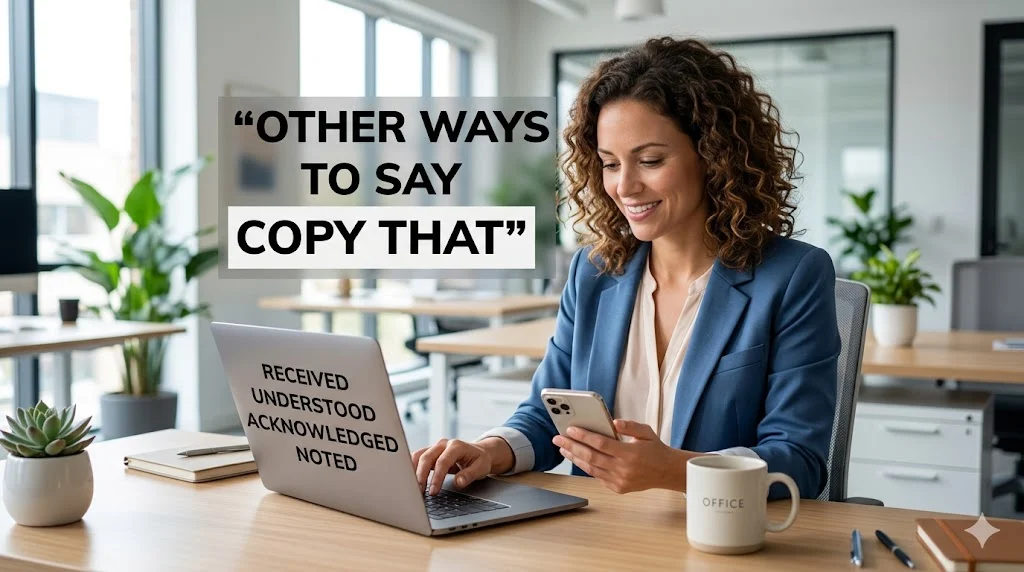
If you want alternatives to “copy that”, try: understood, got it, noted, I acknowledge, message received.
These options help you sound more natural, especially in professional communication and everyday conversations.
The phrase “copy that” comes from radio communication, especially in military and aviation contexts. It means “I understand” or “I have received your message.”
Today, people use it casually in conversations, chats, and even emails. However, relying on just one phrase can limit your ability to sound fluent and natural.
Learning other ways to say “copy that” helps you adapt your tone, improve clarity, and even express excitement in English when needed. It’s an essential step for both learners and professionals.
“Fluent speakers don’t repeat phrases they choose the right one for the moment.”
Quick Categories Section
Formal Alternatives to “Copy That”
- Understood
- Acknowledged
- Noted with thanks
- I confirm receipt
Pro Tip: Use these in emails or formal settings to sound polished and respectful.
Casual Alternatives
- Got it
- Okay
- I see
- Sure thing
Pro Tip: These work best in friendly chats or quick conversations.
Professional Alternatives
- I understand your message
- Received and noted
- I acknowledge receipt
- Duly noted
Pro Tip: Choose clarity over brevity in workplace communication.
Informal Expressions
- All good
- Cool
- Sounds good
- No problem
Pro Tip: Use only in relaxed contexts avoid in formal writing.
“The right tone makes your English sound professional and confident.”
Common Mistakes
Here are common errors learners make with “copy that”:
- Using it in formal emails
❌ Copy that, I will send the report
✔️ Noted, I will send the report - Overusing the phrase
❌ Copy that (in every reply)
✔️ Mix with “understood,” “got it,” etc. - Using it in emotional contexts
❌ Copy that, I’m sorry for your loss
✔️ I understand, I’m very sorry - Using it with unclear tone
❌ Copy that (sounds robotic)
✔️ Got it, thanks for letting me know - Using it without context
❌ Copy that
✔️ Got it, I’ll handle it now
What Does “Copy That” Mean?
“Copy that” means I have received and understood your message.
It functions as a fixed phrase (idiom) rather than a grammatical sentence.
Example:
“I’ll send the file by 5 PM.”
“Copy that.”
When to Use “Copy That”
- Quick acknowledgments
- Radio-style or technical communication
- Casual conversations
- Informal chats
Spoken vs Written: Mostly spoken or informal text
Formal vs Informal: Informal
Is It Professional or Polite to Say “Copy That”?
Polite? ✔️ Yes
Professional? ❌ No (in most cases)
While it’s not rude, it can sound too casual or even overly “military” in business settings.
Business Example:
“Noted. I will proceed accordingly.”
Pros and Cons of Using “Copy That”
Pros
- Simple and natural
- Friendly tone
- Common usage
- Easy to understand
Cons
- Too informal for work
- Overused
- Limited emotional range
- Not suitable for formal writing
“Professional communication is not about sounding complex it’s about sounding appropriate.”
Other Ways to Say “Copy That” With Examples
These alternatives to “copy that” will help you sound more fluent, confident, and natural in different situations.
Use them depending on tone, context, and audience to express clarity and even express excitement in English when appropriate.
1. Phrase: Understood
Meaning: I clearly understand.
Explanation: A neutral, widely accepted response.
Example Sentence: Understood, I’ll complete the task.
Best Use: formal work
Worst Use: emotional talk
Tone: neutral, clear
Context Variability: professional / spoken
2. Phrase: Got it
Meaning: I understand.
Explanation: Very common in casual English.
Example Sentence: Got it, thanks!
Best Use: casual chat
Worst Use: formal email
Tone: friendly, relaxed
Context Variability: casual / spoken
3. Phrase: Noted
Meaning: I have recorded the information.
Explanation: Common in professional writing.
Example Sentence: Noted. I’ll update the file.
Best Use: business email
Worst Use: friendly talk
Tone: formal, concise
Context Variability: professional
4. Phrase: Acknowledged
Meaning: I confirm receipt.
Explanation: Very formal and precise.
Example Sentence: Acknowledged. The request is approved.
Best Use: official work
Worst Use: casual chat
Tone: formal, authoritative
Context Variability: professional
5. Phrase: Message received
Meaning: I got your message.
Explanation: Slightly formal but flexible.
Example Sentence: Message received, I’ll respond soon.
Best Use: semi-formal
Worst Use: emotional talk
Tone: neutral, clear
Context Variability: mixed
6. Phrase: I see
Meaning: I understand now.
Explanation: Used when something becomes clear.
Example Sentence: I see, that makes sense.
Best Use: discussion
Worst Use: commands
Tone: thoughtful, calm
Context Variability: spoken
7. Phrase: Okay
Meaning: I accept or understand.
Explanation: Basic and versatile.
Example Sentence: Okay, I’ll do that.
Best Use: everyday talk
Worst Use: formal writing
Tone: neutral, simple
Context Variability: universal
8. Phrase: Sure thing
Meaning: Yes, understood and agreed.
Explanation: Friendly and cooperative.
Example Sentence: Sure thing, I’ll help.
Best Use: casual
Worst Use: formal
Tone: warm, positive
Context Variability: spoken
9. Phrase: Duly noted
Meaning: Officially recorded.
Explanation: Formal and slightly serious.
Example Sentence: Duly noted. We will review it.
Best Use: corporate
Worst Use: casual
Tone: formal, firm
Context Variability: professional
10. Phrase: Received and understood
Meaning: Fully clear message.
Explanation: Strong confirmation.
Example Sentence: Received and understood.
Best Use: formal
Worst Use: casual
Tone: clear, firm
Context Variability: professional
11. Phrase: I understand
Meaning: I clearly get the message.
Explanation: A simple and widely accepted response in both casual and professional contexts.
Example Sentence: I understand, I’ll proceed accordingly.
Best Use: general use
Worst Use: emotional replies
Tone: neutral, clear
Context Variability: professional / casual
12. Phrase: Noted with thanks
Meaning: I received and appreciate the information.
Explanation: A polite and professional variation commonly used in emails.
Example Sentence: Noted with thanks, I’ll review the document.
Best Use: business email
Worst Use: casual talk
Tone: polite, formal
Context Variability: professional
13. Phrase: I acknowledge receipt
Meaning: I confirm receiving your message.
Explanation: Very formal and precise, often used in official communication.
Example Sentence: I acknowledge receipt of your request.
Best Use: formal work
Worst Use: casual chat
Tone: formal, official
Context Variability: professional
14. Phrase: Sounds good
Meaning: I agree and understand.
Explanation: Friendly and commonly used in everyday conversations.
Example Sentence: Sounds good, I’ll join the meeting.
Best Use: casual plans
Worst Use: formal emails
Tone: positive, relaxed
Context Variability: casual / spoken
15. Phrase: All good
Meaning: Everything is fine and understood.
Explanation: Informal and often used to reassure someone.
Example Sentence: All good, I’ve taken care of it.
Best Use: informal chat
Worst Use: professional writing
Tone: relaxed, reassuring
Context Variability: casual
16. Phrase: No problem
Meaning: It’s okay, I understand and accept.
Explanation: Often used to show willingness or ease.
Example Sentence: No problem, I’ll handle it.
Best Use: casual help
Worst Use: formal context
Tone: easygoing, friendly
Context Variability: casual
17. Phrase: Will do
Meaning: I understand and will complete the task.
Explanation: Short and action-oriented response.
Example Sentence: Will do, I’ll send it shortly.
Best Use: quick reply
Worst Use: formal email
Tone: confident, direct
Context Variability: casual / spoken
18. Phrase: Consider it done
Meaning: The task will be completed.
Explanation: Shows confidence and commitment.
Example Sentence: Consider it done by tomorrow.
Best Use: task assurance
Worst Use: uncertain tasks
Tone: confident, proactive
Context Variability: casual / semi-professional
19. Phrase: Got your message
Meaning: I received what you said.
Explanation: Slightly more conversational than “message received.”
Example Sentence: Got your message, I’ll reply soon.
Best Use: quick confirmation
Worst Use: formal writing
Tone: neutral, friendly
Context Variability: casual
20. Phrase: I hear you
Meaning: I understand what you’re saying.
Explanation: Often used in discussions or emotional contexts.
Example Sentence: I hear you, that must be difficult.
Best Use: empathy
Worst Use: instructions
Tone: empathetic, thoughtful
Context Variability: spoken
21. Phrase: That’s clear
Meaning: The message is easy to understand.
Explanation: Neutral and slightly formal acknowledgment.
Example Sentence: That’s clear, I’ll follow the steps.
Best Use: instructions
Worst Use: casual slang
Tone: neutral, precise
Context Variability: mixed
22. Phrase: Crystal clear
Meaning: Completely understood with no confusion.
Explanation: Emphasizes clarity strongly.
Example Sentence: Crystal clear, I’ll get started.
Best Use: emphasis
Worst Use: formal email
Tone: expressive, confident
Context Variability: casual / spoken
23. Phrase: Roger that
Meaning: I understand (radio-style expression).
Explanation: Originates from military communication, similar to “copy that.”
Example Sentence: Roger that, moving forward.
Best Use: informal tone
Worst Use: business writing
Tone: casual, playful
Context Variability: spoken
24. Phrase: Confirmed
Meaning: I verify and accept the information.
Explanation: Common in business and logistics communication.
Example Sentence: Confirmed. The meeting is scheduled.
Best Use: business use
Worst Use: emotional talk
Tone: direct, professional
Context Variability: professional
25. Phrase: I follow
Meaning: I understand the explanation.
Explanation: Often used during discussions or explanations.
Example Sentence: I follow, that makes sense now.
Best Use: discussions
Worst Use: commands
Tone: thoughtful, engaged
Context Variability: spoken
26. Phrase: Makes sense
Meaning: I understand and agree.
Explanation: Common conversational phrase.
Example Sentence: Makes sense, let’s do that.
Best Use: casual agreement
Worst Use: formal writing
Tone: relaxed, agreeable
Context Variability: casual
27. Phrase: Understood clearly
Meaning: I fully understand.
Explanation: Adds emphasis to “understood.”
Example Sentence: Understood clearly, I’ll proceed.
Best Use: clarity emphasis
Worst Use: casual chat
Tone: formal, clear
Context Variability: professional
28. Phrase: Thanks, got it
Meaning: I understand and appreciate the info.
Explanation: Combines acknowledgment with gratitude.
Example Sentence: Thanks, got it I’ll update you.
Best Use: polite reply
Worst Use: formal report
Tone: friendly, polite
Context Variability: casual / semi-professional
29. Phrase: I’ll take care of it
Meaning: I understand and will handle the task.
Explanation: Shows responsibility and action.
Example Sentence: I’ll take care of it right away.
Best Use: task response
Worst Use: unclear tasks
Tone: responsible, proactive
Context Variability: professional / casual
30. Phrase: Everything is clear
Meaning: There is no confusion.
Explanation: Confirms full understanding.
Example Sentence: Everything is clear, thank you.
Best Use: confirmation
Worst Use: quick chat
Tone: calm, confident
Context Variability: professional / spoken
Mini Quiz / Self-Check
1. Which phrase is best for a formal email?
A. Got it
B. Noted
C. Cool
2. Which is most casual?
A. Acknowledged
B. Understood
C. Sure thing
3. What should you avoid in business writing?
A. Noted
B. Copy that
C. I confirm receipt
Comparison Table: Top Alternatives
| Phrase | Tone | Best Use |
| Understood | Neutral | Work |
| Noted | Formal | Emails |
| Got it | Casual | Chat |
| Acknowledged | Formal | Official |
| Message received | Neutral | Mixed |
| I see | Thoughtful | Discussion |
| Sure thing | Friendly | Casual |
| Duly noted | Formal | Corporate |
| Confirmed | Direct | Business |
| Sounds good | Positive | Informal |
FAQs
What are the best alternatives to “copy that” in professional emails?
Use “noted,” “acknowledged,” or “I confirm receipt” for clarity and professionalism.
Is “copy that” rude?
No, it’s not rude, but it can sound too casual or out of place in formal settings.
Can I use “copy that” at work?
Yes, but only in informal communication or team chats not in official emails.
What are casual alternatives to “copy that”?
Try “got it,” “okay,” or “sure thing” in relaxed conversations.
How can I sound more professional instead of saying “copy that”?
Use professional reaction phrases like “understood” or “noted with thanks.”
Conclusion
Expanding your vocabulary with other ways to say “copy that” helps you communicate more effectively across different situations. Whether you’re speaking casually or writing professionally, the right phrase improves clarity and tone.
Practice these alternatives daily and pay attention to context. Over time, you’ll naturally choose the most appropriate expression and sound more fluent and confident in English.
CTA: Which alternative do you use most often? Try switching it today and notice the difference.