
Last Updated on August 9, 2026
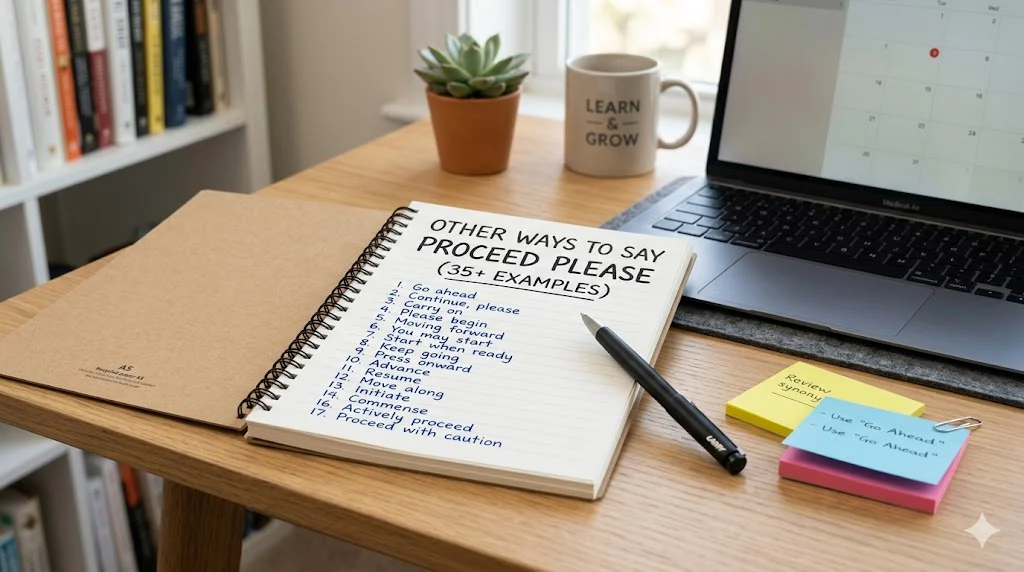
“Proceed please” is a polite but somewhat direct instruction used to ask someone to continue or move forward with an action. It is often replaced in English with more natural, formal, or context-specific phrases depending on tone and setting.
Top alternatives:
Please continue, Kindly proceed, You may go ahead, Please move forward, Carry on please
“Proceed please” is commonly used in instructions, conversations, meetings, and formal communication to ask someone to continue an action or step forward in a process. While understandable, it can sound slightly rigid or unnatural in modern English.
That is why learners often look for alternatives to proceed please to sound more fluent and context-appropriate. Choosing the right expression helps you express excitement in English, improve tone, and sound more professional.
Learning other ways to say proceed please also improves flexibility in both spoken and written communication, especially in workplaces, academic settings, and customer interactions.
Quick Categories Section
Formal alternatives to “proceed please”
- Kindly proceed
- Please continue
- You may proceed
- Please move forward
Pro Tip: Use these in official emails, instructions, and academic communication for a respectful tone.
Casual alternatives
- Go ahead
- Carry on
- Keep going
- Continue on
Pro Tip: These work best in friendly conversations or informal instructions.
Professional alternatives
- You may now proceed
- Please go ahead with the next step
- Feel free to continue
- Kindly move to the next stage
Pro Tip: Ideal for workplace communication, meetings, and project instructions.
Informal expressions
- Go for it
- Carry on then
- Keep it going
- Move ahead
Pro Tip: Avoid these in formal emails or business writing.
“Tone matters more than words — the same instruction can sound polite or abrupt depending on phrasing.”
Common Mistakes Section
- Using “proceed please” in casual speech
Example: “Proceed please, we are watching a movie.” - Overusing it in emails
Example: “Please proceed please with the report.” - Using it without context
Example: “Proceed please.” (No instruction given) - Mixing informal tone in formal settings
Example: “Go ahead proceed please in the meeting.” - Using it as a question instead of instruction
Example: “Proceed please?” (Incorrect tone)
What Does “Proceed Please” Mean?
“Proceed please” is a polite instruction asking someone to continue or move forward with an action.
It combines:
- Proceed = to continue or advance
- Please = politeness marker
Example sentence:
“Please proceed with your presentation.”
When to Use “Proceed Please”
- Giving instructions in meetings
- Academic or exam settings
- Workplace task direction
- Customer service communication
- Step-by-step procedures
Spoken vs Written:
- Spoken: Rare, slightly formal
- Written: More common in instructions or forms
Formal vs Informal:
- Formal: Yes (limited use)
- Informal: Not preferred
Is It Professional or Polite?
“Proceed please” is polite but not highly natural in modern professional English. It is often replaced with smoother alternatives.
Example (business style):
“You may proceed with the next agenda item.”
- Polite? ✔️ Yes
- Professional? ❌ Not commonly preferred
Pros and Cons of Using “Proceed Please”
Pros
- Simple and understandable
- Friendly tone
- Commonly recognized
- Easy instruction
Cons
- Too formal or stiff
- Overused in basic writing
- Limited expression range
- Not natural in modern speech
Other Ways to Say “Proceed Please” With Examples
These alternatives will help you sound more fluent, confident, and natural in different situations. Use them according to tone, context, and audience to express direction or continuation.
1. Phrase: Kindly proceed
Meaning: A polite request to continue
Explanation: Often used in formal instructions
Example Sentence: Kindly proceed with the verification process.
Best Use: formal emails
Worst Use: casual chat
Tone: polite, formal, respectful
Context Variability: professional / written / service
2. Phrase: Please continue
Meaning: Ask someone to keep going
Explanation: Neutral and widely used
Example Sentence: Please continue with your explanation.
Best Use: general use
Worst Use: slang-heavy chat
Tone: neutral, polite
Context Variability: spoken / written / academic
3. Phrase: You may proceed
Meaning: Permission to continue
Explanation: Common in formal approvals
Example Sentence: You may proceed with the project.
Best Use: workplace approval
Worst Use: casual talk
Tone: formal, authoritative
Context Variability: professional / instructional
4. Phrase: Go ahead
Meaning: Allow someone to start or continue
Explanation: Very natural conversational phrase
Example Sentence: Go ahead and present your idea.
Best Use: meetings
Worst Use: legal documents
Tone: friendly, natural
Context Variability: spoken / informal / workplace
5. Phrase: Carry on
Meaning: Continue doing something
Explanation: Common British English expression
Example Sentence: Please carry on with your work.
Best Use: classroom/work
Worst Use: strict formal writing
Tone: neutral, casual
Context Variability: spoken / semi-formal
6. Phrase: Feel free to continue
Meaning: Encouraging continuation
Explanation: Soft and polite phrasing
Example Sentence: Feel free to continue when ready.
Best Use: supportive settings
Worst Use: strict commands
Tone: polite, friendly
Context Variability: professional / spoken
7. Phrase: Move forward
Meaning: Advance to next step
Explanation: Common in business processes
Example Sentence: We can move forward with approval.
Best Use: business workflow
Worst Use: casual chat
Tone: professional, structured
Context Variability: corporate / written
8. Phrase: Continue on
Meaning: Keep progressing
Explanation: Slightly informal continuation phrase
Example Sentence: Continue on with the discussion.
Best Use: meetings
Worst Use: legal writing
Tone: neutral, smooth
Context Variability: spoken / semi-formal
9. Phrase: Proceed with the next step
Meaning: Advance in a process
Explanation: Instruction-based phrase
Example Sentence: Proceed with the next step of the form.
Best Use: procedures
Worst Use: casual talk
Tone: formal, instructional
Context Variability: technical / workplace
10. Phrase: You may go ahead
Meaning: Permission to continue
Explanation: Polite approval phrase
Example Sentence: You may go ahead with your plan.
Best Use: approvals
Worst Use: informal chat
Tone: formal, polite
Context Variability: business / academic
“The more natural your phrasing, the more confident your English sounds in professional settings.”
Mini Quiz / Self-Check
- Which is most formal?
A) Go ahead
B) Kindly proceed
C) Carry on - Which is best for casual speech?
A) You may proceed
B) Go ahead
C) Proceed with the process - Which phrase shows permission?
A) Kindly proceed
B) You may proceed
C) Continue please
Comparison Table: Top Alternatives
| Phrase | Tone | Best Use |
| Kindly proceed | Formal | Emails |
| Please continue | Neutral | General use |
| You may proceed | Formal | Approval |
| Go ahead | Casual | Meetings |
| Carry on | Neutral | Conversation |
| Feel free to continue | Friendly | Supportive talk |
| Move forward | Professional | Business process |
| Continue on | Neutral | Discussion |
| Proceed with next step | Formal | Instructions |
| You may go ahead | Polite formal | Permission |
FAQs
1. Is “proceed please” correct English?
Yes, but it sounds slightly unnatural in modern conversation.
2. What is the most professional alternative?
“Kindly proceed” or “You may proceed” are more professional.
3. Can I use “go ahead” in emails?
Yes, but only in semi-formal or internal communication.
4. What is the most polite version?
“Feel free to continue” or “Kindly proceed.”
5. Why should I learn alternatives to “proceed please”?
It improves fluency, tone control, and professional communication skills.
Conclusion
Learning other ways to say proceed please helps you communicate more naturally, confidently, and appropriately in different contexts. Instead of relying on one rigid phrase, you can choose expressions that match tone, audience, and formality.
Practice these alternatives daily to improve fluency and sound more native-like in both spoken and written English.