
Last Updated on May 8, 2026
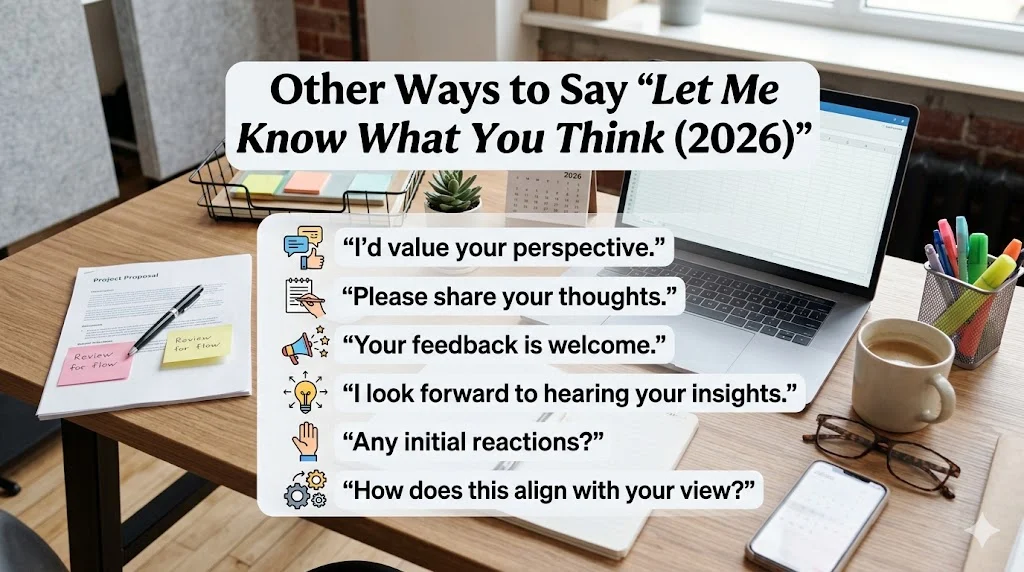
Looking for other ways to say let me know what you think? Try:
I’d appreciate your feedback, Please share your thoughts, I’d value your opinion, Let me know your perspective, I welcome your input.
These alternatives help you sound more professional, polite, and confident in emails and conversations.
The phrase “let me know what you think” is commonly used when asking for feedback. While it’s polite and simple, it can become repetitive or sound too casual in professional settings.
Learning alternatives to “let me know what you think” allows you to communicate more effectively, especially in emails, meetings, and collaborative work environments. It also helps you express excitement in English while maintaining professionalism.
Using varied phrasing ensures your requests sound engaging, respectful, and tailored to your audience.
“How you ask for feedback can influence the quality and speed of the response.”
Quick Categories
Formal alternatives to “let me know what you think”
- I would appreciate your feedback
- I welcome your thoughts
- I would value your opinion
- Please provide your input
Pro Tip: Use these in business emails or client communication.
Casual alternatives
- What do you think?
- Let me know your thoughts
- Thoughts?
- What’s your take?
Pro Tip: Best for quick chats or informal messages.
Professional alternatives
- I’d appreciate your perspective
- Please share your feedback
- I’d be interested in your input
- I welcome your insights
Pro Tip: Ideal for workplace communication and collaboration.
Informal expressions
- Any thoughts?
- What’s your opinion?
- Tell me what you think
- Curious to hear your thoughts
Pro Tip: Keep tone friendly but avoid overly casual phrases in formal contexts.
Common Mistakes
- Overusing the same phrase
Example: “Let me know what you think” in every email - Being too vague
Example: “Thoughts?” (without context) - Too casual for professional emails
Example: “Tell me what you think ASAP” - Lack of clarity
Example: Not specifying what feedback is needed - Sounding demanding
Example: “Let me know immediately what you think.”
What Does “Let Me Know What You Think” Mean?
It is a request asking someone to share their opinion, feedback, or evaluation about something.
Grammar Tip:
- Usually followed by a clause or context
- Example: “Let me know what you think about the proposal.”
When to Use It
- Asking for feedback on ideas or projects
- Sharing drafts or proposals
- Seeking opinions in discussions
- Email or message communication
Spoken vs Written:
- Spoken: more casual variations are common
- Written: often replaced with professional alternatives
Formal vs Informal:
- Formal: “I would appreciate your feedback”
- Informal: “What do you think?”
Is It Professional or Polite to Say “Let Me Know What You Think”?
Polite? ✔️ Yes
Professional? ⚠️ Sometimes
While polite, it can feel too generic or informal in business communication.
Business Example:
“Let me know what you think about the report.”
Better: “I would appreciate your feedback on the report.”
Pros and Cons
Pros
- Simple and clear
- Friendly tone
- Widely understood
- Easy to use
Cons
- Overused
- Can sound informal
- Lacks specificity
- Not impactful in professional writing
“Specific and thoughtful feedback requests lead to better responses.”
Other Ways to Say “Let Me Know What You Think” With Examples
These alternatives will help you sound more fluent, confident, and natural in different situations.
Use them according to tone, context, and audience to express excitement, curiosity, or professionalism.
1. Phrase: I would appreciate your feedback
Meaning: Polite request for input
Explanation: Formal and professional
Example Sentence: “I would appreciate your feedback on this proposal.”
Best Use: business emails
Worst Use: casual chats
Tone: formal, respectful
Context Variability: professional
2. Phrase: Please share your thoughts
Meaning: Asking for opinions
Explanation: Neutral and polite
Example Sentence: “Please share your thoughts on this idea.”
Best Use: workplace
Worst Use: urgent requests
Tone: neutral, polite
Context Variability: both
3. Phrase: I’d value your opinion
Meaning: Respectful request
Explanation: Shows importance of their input
Example Sentence: “I’d value your opinion on this matter.”
Best Use: professional
Worst Use: casual
Tone: respectful
Context Variability: professional
4. Phrase: Let me know your perspective
Meaning: Asking for viewpoint
Explanation: Slightly more specific
Example Sentence: “Let me know your perspective on this plan.”
Best Use: discussions
Worst Use: informal chats
Tone: thoughtful
Context Variability: both
5. Phrase: I welcome your input
Meaning: Inviting feedback
Explanation: Open and collaborative
Example Sentence: “I welcome your input on this project.”
Best Use: teamwork
Worst Use: casual
Tone: professional
Context Variability: professional
6. Phrase: I’d appreciate your insights
Meaning: Asking for expert opinion
Explanation: Slightly formal
Example Sentence: “I’d appreciate your insights on this strategy.”
Best Use: senior roles
Worst Use: casual
Tone: professional
Context Variability: professional
7. Phrase: What are your thoughts?
Meaning: Direct question
Explanation: Simple and clear
Example Sentence: “What are your thoughts on this design?”
Best Use: meetings
Worst Use: formal letters
Tone: neutral
Context Variability: both
8. Phrase: I’d be interested in your feedback
Meaning: Curious about opinion
Explanation: Polite and engaging
Example Sentence: “I’d be interested in your feedback on this draft.”
Best Use: emails
Worst Use: casual
Tone: professional
Context Variability: professional
9. Phrase: Please let me know your views
Meaning: Formal request
Explanation: Traditional tone
Example Sentence: “Please let me know your views on the proposal.”
Best Use: formal
Worst Use: casual
Tone: formal
Context Variability: professional
10. Phrase: I’d like to hear your thoughts
Meaning: Friendly request
Explanation: Less formal
Example Sentence: “I’d like to hear your thoughts on this.”
Best Use: conversations
Worst Use: formal docs
Tone: friendly
Context Variability: both
11. Phrase: Could you share your feedback?
Meaning: Polite request
Explanation: Question format
Example Sentence: “Could you share your feedback on this?”
Best Use: emails
Worst Use: casual
Tone: polite
Context Variability: professional
12. Phrase: I’d love your input
Meaning: Friendly tone
Explanation: Slightly informal
Example Sentence: “I’d love your input on this idea.”
Best Use: startups
Worst Use: formal
Tone: warm
Context Variability: both
13. Phrase: Please provide your feedback
Meaning: Direct request
Explanation: Clear and professional
Example Sentence: “Please provide your feedback by Friday.”
Best Use: deadlines
Worst Use: casual
Tone: direct
Context Variability: professional
14. Phrase: I’d appreciate your thoughts on this
Meaning: Polite variation
Explanation: Common alternative
Example Sentence: “I’d appreciate your thoughts on this document.”
Best Use: emails
Worst Use: casual
Tone: professional
Context Variability: both
15. Phrase: What’s your take?
Meaning: Casual opinion request
Explanation: Informal expression
Example Sentence: “What’s your take on this?”
Best Use: friends
Worst Use: formal
Tone: casual
Context Variability: informal
16. Phrase: Any feedback would be appreciated
Meaning: Open request
Explanation: Flexible and polite
Example Sentence: “Any feedback would be appreciated.”
Best Use: emails
Worst Use: urgent tasks
Tone: polite
Context Variability: professional
17. Phrase: I’m keen to hear your thoughts
Meaning: Interested in opinion
Explanation: Professional tone
Example Sentence: “I’m keen to hear your thoughts on this.”
Best Use: interviews
Worst Use: casual
Tone: professional
Context Variability: both
18. Phrase: Please let me know your opinion
Meaning: Direct request
Explanation: Clear and neutral
Example Sentence: “Please let me know your opinion on this.”
Best Use: emails
Worst Use: casual
Tone: neutral
Context Variability: both
19. Phrase: I welcome your feedback
Meaning: Open invitation
Explanation: Encouraging input
Example Sentence: “I welcome your feedback on this report.”
Best Use: professional
Worst Use: casual
Tone: professional
Context Variability: professional
20. Phrase: I’d appreciate your review
Meaning: Request for evaluation
Explanation: Focus on review
Example Sentence: “I’d appreciate your review of this document.”
Best Use: documents
Worst Use: casual
Tone: professional
Context Variability: professional
21. Phrase: Let me know your thoughts when you can
Meaning: Flexible request
Explanation: Less pressure
Example Sentence: “Let me know your thoughts when you can.”
Best Use: emails
Worst Use: urgent
Tone: polite
Context Variability: both
22. Phrase: I’m curious to hear your thoughts
Meaning: Friendly curiosity
Explanation: Engaging tone
Example Sentence: “I’m curious to hear your thoughts on this.”
Best Use: discussions
Worst Use: formal
Tone: friendly
Context Variability: both
23. Phrase: Please share your perspective
Meaning: Request for viewpoint
Explanation: Slightly formal
Example Sentence: “Please share your perspective on this issue.”
Best Use: meetings
Worst Use: casual
Tone: professional
Context Variability: professional
24. Phrase: I’d value your feedback on this
Meaning: Respectful request
Explanation: Shows importance
Example Sentence: “I’d value your feedback on this.”
Best Use: professional
Worst Use: casual
Tone: respectful
Context Variability: professional
25. Phrase: What do you think about this?
Meaning: Direct question
Explanation: Common and simple
Example Sentence: “What do you think about this plan?”
Best Use: conversations
Worst Use: formal docs
Tone: neutral
Context Variability: both
26. Phrase: Please let me know your suggestions
Meaning: Request for improvement ideas
Explanation: Specific feedback
Example Sentence: “Please let me know your suggestions.”
Best Use: revisions
Worst Use: casual
Tone: professional
Context Variability: professional
27. Phrase: I’d appreciate your comments
Meaning: Request for feedback
Explanation: Formal phrasing
Example Sentence: “I’d appreciate your comments on this draft.”
Best Use: formal
Worst Use: casual
Tone: formal
Context Variability: professional
28. Phrase: Your feedback would be valuable
Meaning: Emphasizes importance
Explanation: Encouraging
Example Sentence: “Your feedback would be valuable here.”
Best Use: teamwork
Worst Use: casual
Tone: professional
Context Variability: professional
29. Phrase: I’m open to your thoughts
Meaning: Inviting feedback
Explanation: Collaborative tone
Example Sentence: “I’m open to your thoughts on this.”
Best Use: discussions
Worst Use: formal
Tone: friendly
Context Variability: both
30. Phrase: Feel free to share your thoughts
Meaning: Encouraging response
Explanation: Relaxed tone
Example Sentence: “Feel free to share your thoughts.”
Best Use: informal work
Worst Use: formal
Tone: casual
Context
“The clearer your feedback request, the better the response you’ll receive.”
Mini Quiz / Self-Check
1. Most formal option?
A. What’s your take?
B. I would appreciate your feedback
C. Thoughts?
Answer: B
2. Best for casual conversation?
A. Please provide your feedback
B. What do you think?
C. I would value your opinion
Answer: B
3. Best for professional email?
A. I’d appreciate your insights
B. Tell me what you think
C. Thoughts?
Answer: A
Comparison Table: Top Alternatives
| Phrase | Tone | Best Use |
|---|---|---|
| I would appreciate your feedback | Formal | Business emails |
| Please share your thoughts | Neutral | Work discussions |
| I’d value your opinion | Respectful | Professional |
| I welcome your input | Professional | Teamwork |
| What are your thoughts? | Neutral | Meetings |
| I’d appreciate your insights | Professional | Senior roles |
| Please provide your feedback | Direct | Deadlines |
| I’d like to hear your thoughts | Friendly | Conversations |
| I’m curious to hear your thoughts | Casual | Informal work |
| Feel free to share your thoughts | Casual | Team chats |
FAQs
1. Is “let me know what you think” professional?
Yes, but it can sound generic—better alternatives are often preferred.
2. What is the most formal alternative?
“I would appreciate your feedback” or “I would value your opinion.”
3. Can I use casual alternatives at work?
Only in informal settings or team chats.
4. How do I sound more polite?
Add appreciation phrases like “I’d appreciate your feedback.”
5. What’s the best alternative for emails?
“Please share your thoughts” or “I’d appreciate your feedback.”
Conclusion
Using other ways to say let me know what you think helps you sound more professional, engaging and thoughtful. It also improves clarity and encourages better responses.
Practice these alternatives in your daily communication to adapt your tone, improve professionalism, and communicate more effectively.