Last Updated on October 2, 2026
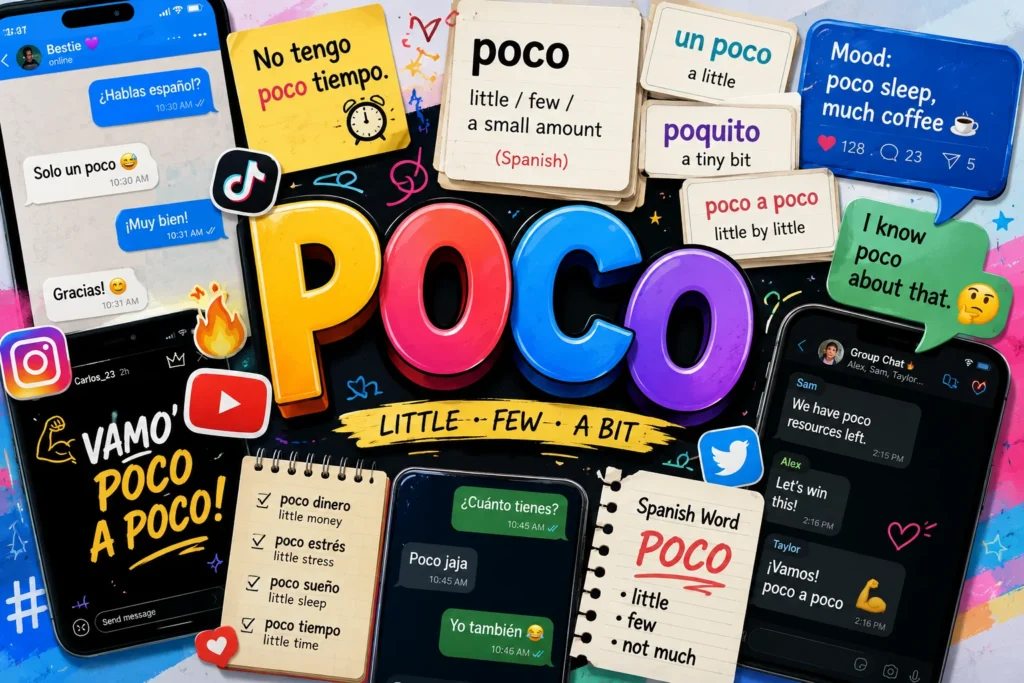
Poco slang meaning usually refers to the Spanish word “poco,” meaning “little,” “few,” or “a small amount.” Although poco is not primarily internet slang, it is commonly used in texting, social media, and online conversations to mean “a little,” “not much,” or “a small quantity.” Related Spanish expressions include un poco (a little), poquito (a tiny bit), and poco a poco (little by little).
Language evolves at lightning speed. One day a word belongs to a specific culture or language. The next day it appears in text messages, social media captions, memes, gaming chats, and online conversations around the world.
That is exactly what happened with poco.
Many people search for poco slang meaning, what does poco mean in slang, and poco meaning online after seeing the word on TikTok comments, Instagram captions, YouTube videos, gaming communities, or text messages.
The interesting part is that poco is not originally slang at all.
Instead, it comes from the Spanish language and has gradually become part of online communication among bilingual speakers, Hispanic communities, language learners, and internet users who enjoy mixing languages in casual conversation.
In this complete guide, you’ll learn:
- The exact poco meaning
- Whether poco is actually slang
- How people use poco on social media
- Poco meaning in text messages
- Poco urban dictionary interpretations
- The difference between poco and poquito
- Common examples and phrases
- How poco fits into modern internet culture
By the end, you’ll understand every major meaning associated with this popular expression.
Poco Slang Meaning Explained
The simplest answer is straightforward.
Poco means “little,” “few,” or “not much” in Spanish.
When people use the word online, they typically keep the same meaning.
For example:
“I know poco Spanish.”
This means:
“I know a little Spanish.”
Another example:
“I slept poco last night.”
This means:
“I slept very little last night.”
Unlike many internet slang terms that develop entirely new meanings, poco usually retains its original definition even when used in digital communication.
Is Poco Actually a Slang Word?
Technically, no.
Poco is a legitimate Spanish vocabulary word rather than a slang term.
However, language on the internet rarely follows strict rules.
As more bilingual users began mixing English and Spanish online, words such as:
- Poco
- Bueno
- Hola
- Gracias
- Amigo
- Vamos
started appearing regularly in casual conversations.
Over time, some users began viewing these expressions as internet slang because they encountered them primarily on social media rather than in formal Spanish lessons.
That explains why searches for poco slang definition and poco internet slang have become increasingly common.
Quick Definition Table
| Term | Meaning | Language |
|---|---|---|
| Poco | Little, few, not much | Spanish |
| Un Poco | A little | Spanish |
| Poquito | A tiny bit | Spanish |
| Poco a Poco | Little by little | Spanish |
| Muy Poco | Very little | Spanish |
What Does Poco Mean in Slang on Social Media?
Social media platforms have transformed how words spread across cultures.
Today, millions of users blend languages naturally.
You might see captions such as:
- “Just a poco tired.”
- “Need a poco coffee.”
- “I speak poco Spanish.”
- “A poco stressed today.”
In most cases, users are replacing the English phrase “a little” with the Spanish word poco.
Why People Use Poco Online
Several factors contribute to its popularity.
Cultural Expression
Many Hispanic users naturally incorporate Spanish words into English conversations.
Internet Humor
Language mixing often sounds playful and relatable.
Brevity
Poco is short, memorable, and easy to understand.
Identity
Many bilingual speakers use Spanish words to express cultural pride and authenticity.
Examples of Poco on Social Media
| Social Media Post | Meaning |
|---|---|
| I’m a poco busy today | I’m a little busy today |
| Feeling poco tired | Feeling slightly tired |
| Know poco about that topic | Know very little about that topic |
| Need a poco break | Need a small break |
| Have poco patience today | Have little patience today |
Poco Meaning in Text Messages
Text messaging encourages short and efficient communication.
Because poco is concise, it naturally fits texting culture.
Common Texting Examples
Friend 1:
“Do you speak Spanish?”
Friend 2:
“Poco.”
Meaning:
“Only a little.”
Another example:
Friend 1:
“How much sleep did you get?”
Friend 2:
“Poco.”
Meaning:
“Very little.”
Notice how a single word can communicate an entire idea.
That efficiency explains why poco frequently appears in text conversations.
Poco Text Meaning in Different Situations
| Situation | Meaning |
|---|---|
| Language discussion | A little |
| Sleep discussion | Very little |
| Food discussion | Small amount |
| Work discussion | Not much |
| Time discussion | Limited time |
The context determines the exact interpretation.
However, the general idea always revolves around small quantities or limited amounts.
Poco Meaning in Spanish
Understanding the original Spanish meaning provides essential context.
In Spanish grammar, poco functions as:
- An adjective
- An adverb
- A pronoun
- A determiner
Despite these grammatical roles, the core meaning remains remarkably consistent.
Poco as an Adjective
Example:
Tengo poco dinero.
Translation:
I have little money.
Poco as an Adverb
Example:
Estudio poco.
Translation:
I study little.
Poco as a Pronoun
Example:
Poco importa.
Translation:
It matters little.
This versatility explains why Spanish speakers use poco so frequently in daily conversation.
Poco Definition Slang vs Standard Definition
Many online users assume poco has developed a hidden slang meaning.
In reality, that rarely happens.
The standard definition remains dominant.
Standard Definition
- Little
- Few
- Small amount
- Not much
Internet Usage
- Slightly
- A little
- Limited amount
- Small quantity
As you can see, both definitions closely overlap.
Unlike terms such as “cap,” “rizz,” or “sus,” poco has not undergone a dramatic semantic transformation.
Instead, internet users simply borrowed an existing Spanish word.
Poco Urban Dictionary Meaning
When people search for poco urban dictionary, they usually want to know whether the term has a secret internet meaning.
Most user-generated interpretations remain close to the traditional Spanish definition.
Common descriptions include:
- A little
- Not much
- Small amount
- Limited quantity
Some online communities also use poco humorously.
For example:
“My bank account has poco money.”
The joke comes from mixing English and Spanish rather than changing the meaning itself.
That playful language blending is common throughout internet culture.
Why Poco Became Popular Online
Internet language constantly absorbs words from different cultures.
Poco benefited from several trends.
Growth of Bilingual Communities
Spanish remains one of the most widely spoken languages in the world.
Millions of bilingual users participate in online communities every day.
Social Media Exposure
Platforms encourage rapid sharing of words and expressions.
A single viral video can introduce new vocabulary to millions of viewers.
Meme Culture
Memes frequently combine languages for humor and relatability.
Poco fits perfectly into that style.
Global Communication
People interact across countries more than ever before.
As a result, vocabulary travels faster than at any point in history.
Difference Between Poco and Poquito
This distinction confuses many learners.
Both words relate to small amounts.
However, they differ slightly in tone.
Poco
Means:
- Little
- Few
- Not much
Example:
Tengo poco tiempo.
Translation:
I have little time.
Poquito
Means:
- Very little
- Tiny amount
- Just a bit
Example:
Tengo poquito tiempo.
Translation:
I have very little time.
Comparison Table
| Word | Meaning | Intensity |
|---|---|---|
| Poco | Little | Moderate |
| Poquito | Tiny bit | Stronger |
| Muy Poco | Very little | Stronger |
| Un Poco | A little | Softer |
Poquito often sounds warmer, friendlier, and more conversational.
Un Poco Meaning in English
One of the most common Spanish expressions worldwide is un poco.
The phrase simply means:
A little
Examples:
- Un poco cansado = A little tired
- Un poco ocupado = A little busy
- Un poco difícil = A little difficult
Many English speakers recognize this phrase even if they do not speak Spanish fluently.
Because of its widespread use, un poco frequently appears in online chats and social media comments.
Poco a Poco Meaning and Usage
Another popular phrase is poco a poco.
Translation:
Little by little
or
Step by step
Examples:
- Learning a language poco a poco
- Saving money poco a poco
- Improving skills poco a poco
The expression emphasizes gradual progress.
Many motivational posts use this phrase because it encourages patience and consistency.
Poco Meaning Online: How the Word Spread Across the Internet
The rise of social media changed the way language moves around the world. In the past, words often stayed within specific countries or communities. Today, a single phrase can travel globally within hours.
Poco is a great example.
Although the word has existed in Spanish for centuries, internet culture introduced it to many people who had never studied Spanish. As platforms became more international, users started encountering Spanish vocabulary in comments, memes, videos, gaming chats, and livestreams.
Unlike many viral internet expressions that disappear after a few months, poco has remained relevant because it serves a practical purpose. People can use it naturally in everyday conversations.
For example:
- “I know poco about that topic.”
- “I have poco energy today.”
- “There is poco information available.”
Even when mixed into English sentences, the meaning remains easy to understand.
How Language Mixing Became Normal Online
Modern digital communication encourages language blending.
Users regularly combine:
- English and Spanish
- English and French
- English and Korean
- English and Japanese
- English and Portuguese
This practice is known as code-switching.
Code-switching happens when a person alternates between languages during communication. Millions of bilingual speakers do this naturally every day.
Social media simply made this behavior more visible.
As a result, words like poco entered mainstream online vocabulary.
Why Internet Users Like Foreign Words
Several factors explain why foreign words gain popularity online.
They Feel Unique
Using a word from another language can make a message stand out.
They Add Personality
Language reflects identity.
Many people enjoy expressing cultural backgrounds through vocabulary choices.
They Create Community
Shared language creates belonging.
When users recognize words from their own culture, they often feel more connected to the conversation.
They Are Memorable
Short words tend to spread quickly online.
Poco contains only four letters, making it easy to remember and use.
Poco Social Media Meaning Across Different Platforms
Not every platform uses language in the same way.
Different online communities develop their own communication styles.
Poco Meaning on TikTok
TikTok encourages short-form communication.
Users often include Spanish words in captions because they are concise and expressive.
Examples include:
“Feeling poco motivated today.”
“Need poco stress in my life.”
“Got poco sleep but still working.”
In these examples, poco simply means a small amount.
Poco Meaning on Instagram
Instagram captions often focus on personality and lifestyle.
Users may write:
“A little sunshine and a poco coffee.”
“Living poco a poco.”
“Traveling with poco plans.”
The word adds a relaxed and conversational tone.
Poco Meaning on X and Threads
Short-form text platforms encourage compact language.
Since users have limited space, concise words become valuable.
Poco allows someone to express an idea in a single word rather than writing an entire phrase.
Poco Meaning in Gaming Communities
Gaming communities frequently blend languages.
You may see statements such as:
“I have poco health left.”
“Poco ammo.”
“Poco resources.”
These phrases communicate urgency while remaining easy to understand.
Is Poco an Abbreviation?
One common question involves whether poco is an abbreviation.
The answer is no.
Poco is a complete Spanish word.
However, confusion sometimes occurs because internet users often assume unfamiliar online terms are acronyms.
Comparison with Actual Internet Acronyms
| Term | Meaning | Type |
|---|---|---|
| LOL | Laugh Out Loud | Acronym |
| BRB | Be Right Back | Acronym |
| IMO | In My Opinion | Acronym |
| SMH | Shaking My Head | Acronym |
| POCO | Little or Few | Word |
Unlike modern texting abbreviations, poco originated as a traditional vocabulary term.
The Linguistic History of Poco
Understanding where the word comes from helps explain why it remains so common today.
Poco traces its roots to Latin.
Over time, it became part of everyday Spanish vocabulary and eventually spread throughout Spanish-speaking regions.
Today, speakers across numerous countries use the word regularly.
Examples include:
- Spain
- Mexico
- Argentina
- Colombia
- Chile
- Peru
- Venezuela
- Guatemala
- Ecuador
Although accents and regional expressions differ, poco remains universally understood throughout the Spanish-speaking world.
Why the Meaning Has Stayed Consistent
Many words change dramatically over time.
Poco is unusual because its core meaning has remained stable.
Whether someone used the word centuries ago or posts it on social media today, it generally refers to:
- Small quantity
- Limited amount
- Few items
- Minimal degree
This consistency contributes to its lasting popularity.
Common Spanish Expressions That Use Poco
Many people encounter poco for the first time through common Spanish phrases.
Learning these expressions helps build a deeper understanding of the word.
Un Poco
Meaning:
A little
Example:
Estoy un poco cansado.
Translation:
I am a little tired.
Poco a Poco
Meaning:
Little by little
Example:
Aprendo español poco a poco.
Translation:
I am learning Spanish little by little.
Muy Poco
Meaning:
Very little
Example:
Dormí muy poco.
Translation:
I slept very little.
Tan Poco
Meaning:
So little
Example:
Tengo tan poco tiempo.
Translation:
I have so little time.
Qué Poco
Meaning:
How little
Example:
Qué poco estudias.
Translation:
You study so little.
Poco Usage in Everyday Spanish
Many language learners focus heavily on grammar and vocabulary lists.
However, real fluency comes from understanding how native speakers actually use words.
Poco appears constantly in everyday speech.
Talking About Money
People often use poco when discussing finances.
Examples:
- Poco dinero
- Poco presupuesto
- Poco efectivo
These phrases describe limited financial resources.
Talking About Time
Time-related expressions frequently include poco.
Examples:
- Poco tiempo
- Muy poco tiempo
- Tener poco tiempo
These indicate limited availability.
Talking About Food
Food conversations commonly use poco.
Examples:
- Poco arroz
- Poco pan
- Poco azúcar
Each phrase refers to a small quantity.
Talking About Effort
People may also use poco when discussing actions.
Examples:
- Trabajar poco
- Dormir poco
- Estudiar poco
These expressions indicate low levels of activity.
Poco vs Other Similar Spanish Words
Many learners confuse poco with related vocabulary.
The distinctions are important.
Poco vs Poquito
| Word | Meaning | Tone |
|---|---|---|
| Poco | Little | Neutral |
| Poquito | Tiny bit | Affectionate |
| Muy Poco | Very little | Strong emphasis |
Poquito often sounds softer and friendlier.
Poco vs Algo
| Word | Meaning |
|---|---|
| Poco | Little |
| Algo | Something |
These words serve entirely different purposes.
Poco vs Bastante
| Word | Meaning |
|---|---|
| Poco | Little |
| Bastante | Quite a lot |
These words represent opposite quantities.
Understanding these distinctions improves both comprehension and communication.
Why Poco Appears in Memes
Internet memes thrive on simplicity.
Words that are short, recognizable, and adaptable often become meme material.
Poco satisfies all three conditions.
Humor Through Language Mixing
Many memes rely on combining languages unexpectedly.
Example:
Me after three hours of sleep:
“I have poco energy.”
The humor comes from blending English structure with Spanish vocabulary.
Relatable Situations
People connect with memes that describe everyday experiences.
Because poco refers to limited amounts, it works perfectly in situations involving:
- Money
- Sleep
- Motivation
- Time
- Energy
These universal experiences make the word highly shareable.
Gen Z Language and the Rise of Poco
Gen Z grew up in a highly connected digital environment.
As a result, younger users often encounter multiple languages online.
This exposure influences vocabulary choices.
Characteristics of Gen Z Communication
Modern online communication often includes:
- Abbreviations
- Memes
- Borrowed words
- Cultural references
- Short-form expressions
Poco fits naturally within this communication style.
Why Younger Users Adopt Foreign Words
Several reasons contribute to adoption.
Curiosity
Many young users enjoy learning expressions from other cultures.
Social Media Exposure
Algorithms regularly expose users to international content.
Creativity
Mixing languages creates unique communication styles.
Cultural Awareness
Global connectivity increases interest in other languages.
These factors help explain why words like poco continue appearing online.
Common Misconceptions About Poco
The internet sometimes creates confusion around word meanings.
Several myths frequently appear.
Myth: Poco Is a Secret Slang Term
Reality:
Poco is a standard Spanish word.
Myth: Poco Means Something Different Online
Reality:
Its online meaning usually matches its traditional definition.
Myth: Poco Is Only Used by Young People
Reality:
Spanish speakers of all ages use poco.
Myth: Poco Is an Acronym
Reality:
Poco is not an abbreviation.
Recognizing these misconceptions helps prevent misunderstandings.
Examples of Poco in Real-Life Conversations
Seeing words in context makes them easier to understand.
Example One
Person A:
Do you know Spanish?
Person B:
Poco.
Meaning:
Only a little.
Example Two
Person A:
How much sleep did you get?
Person B:
Poco.
Meaning:
Very little.
Example Three
Person A:
How much money do you have?
Person B:
Poco.
Meaning:
Not much.
Example Four
Person A:
How much free time do you have?
Person B:
Poco.
Meaning:
Very little.
Notice how context determines the exact interpretation while the central idea remains consistent.
The Role of Poco in Language Learning
Many Spanish learners encounter poco early in their studies.
There are several reasons for this.
High Frequency
Native speakers use the word constantly.
Easy Pronunciation
The pronunciation is straightforward.
Practical Applications
Learners can use it immediately in conversation.
Flexible Usage
The word functions in many situations.
These advantages make poco one of the most useful beginner vocabulary terms.
Cultural Significance of Poco
Language reflects culture.
Although poco itself is not a cultural symbol, it appears throughout everyday Hispanic communication.
You will hear it in:
- Family conversations
- Television programs
- Music lyrics
- Social media posts
- Educational content
- Casual discussions
Its widespread usage demonstrates how ordinary vocabulary shapes communication.
Sometimes the most common words reveal the most about how people actually speak.
Understanding Poco in the Context of Modern Communication
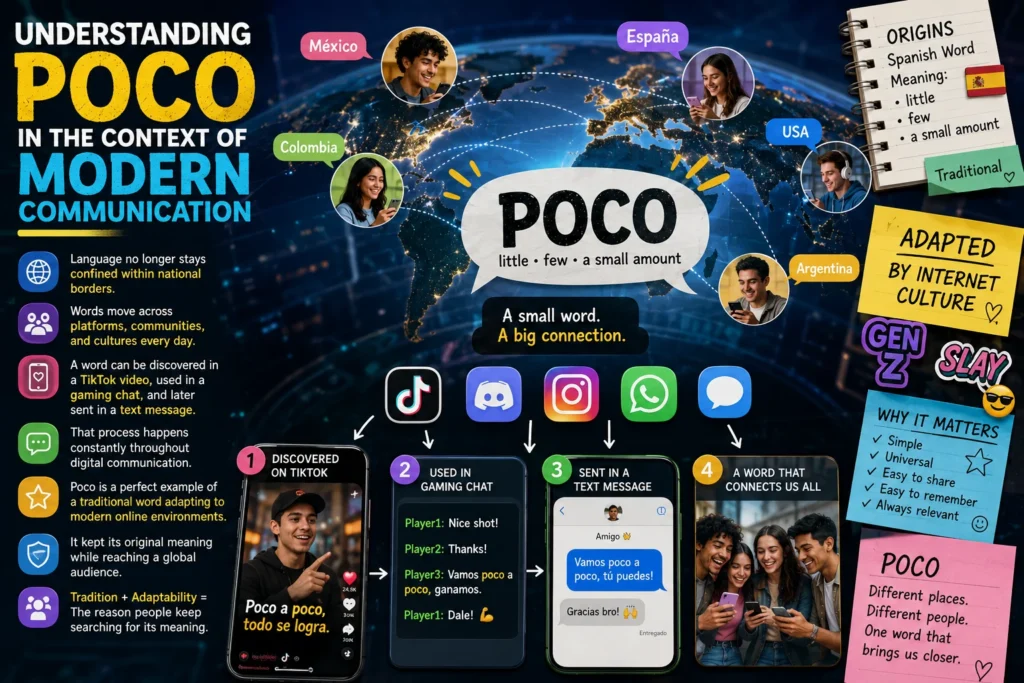
The story of poco illustrates a broader trend.
Language no longer stays confined within national borders.
Words move across platforms, communities, and cultures every day.
Someone in one country may encounter a Spanish expression through a TikTok video, use it in a gaming chat, and later include it in a text message.
That process happens constantly throughout digital communication.
Poco stands as an excellent example of a traditional word adapting to modern online environments without losing its original meaning.
Rather than becoming a completely new slang term, it maintained its identity while expanding its audience.
That combination of tradition and adaptability explains why people continue searching for its meaning online.
Poco in Internet Culture and Digital Communication
Modern communication often breaks traditional language boundaries.
Online communities create unique linguistic environments where multiple languages blend naturally.
Poco represents this phenomenon perfectly.
People use it because:
- It sounds expressive.
- It feels casual.
- It reflects cultural identity.
- It creates a conversational tone.
What began as a standard Spanish word has become part of broader internet vocabulary.
Even users who know very little Spanish often understand the word’s basic meaning.
This widespread recognition highlights the influence of global digital communication.
Frequently Asked Questions
What does poco mean in slang?
Poco generally means little, few, or not much. Online users typically keep the same meaning as the original Spanish word.
Is poco a slang word?
Not originally. Poco is a standard Spanish vocabulary word. However, some people view it as internet slang because it appears frequently in online conversations.
What does poco mean in text messages?
In text messages, poco usually means a small amount, very little, or not much.
What is the difference between poco and poquito?
Poco means little. Poquito means a very small amount or tiny bit.
What does un poco mean?
Un poco translates to “a little.”
What does poco a poco mean?
Poco a poco means “little by little” or “step by step.”
Why do people say poco online?
People use poco online because it is short, expressive, culturally recognizable, and easy to understand.
Final Thoughts
The search for poco slang meaning often leads people to believe they have discovered a mysterious internet expression. The reality is simpler and more interesting.
Poco is a genuine Spanish word that means little, few, or not much. While it isn’t traditional slang, social media, texting, and online communities have helped transform it into a familiar part of internet communication.
Whether you encounter it in a meme, a TikTok caption, a gaming chat, or a text message, the meaning usually stays consistent. It refers to a small amount, limited quantity, or something minor.
Understanding related expressions such as un poco, poquito, and poco a poco gives you an even deeper appreciation of how the word functions across languages and cultures.
In today’s connected world, words travel quickly. Poco is a perfect example of how a simple Spanish expression can become a recognizable part of global online conversation while still keeping its original meaning intact.