
Last Updated on October 2, 2026
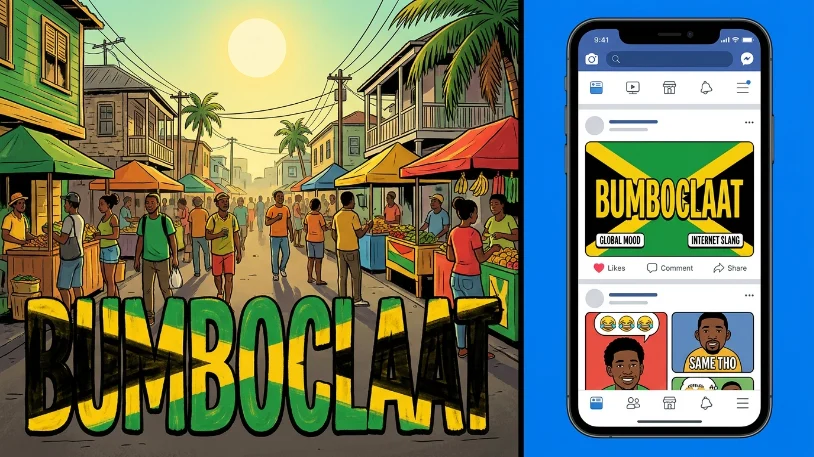
Bomboclat meaning slang refers to a highly offensive Jamaican Patois swear word, more accurately spelled bumboclaat. The term is historically associated with a sanitary cloth and is used as a strong expletive in Jamaican speech. On social media, bomboclat has also become an internet slang expression for shock, disbelief, or amazement, depending on context.
An internet user scrolling through TikTok, X (formerly Twitter), or Instagram will inevitably encounter the word bomboclat. It appears under chaotic videos, shocking news headlines, and bizarre images. Frequently, it serves as a standalone caption for reaction memes.
The global internet treats it as a funny, casual exclamation of surprise. However, the true bomboclat Jamaican meaning is deeply rooted in history, raw language, and cultural taboos.
Understanding what does bomboclat mean requires looking beyond social media algorithms. In its homeland of Jamaica, this word carries immense weight. It is not just a trendy piece of internet slang; it is a serious, historically charged expletive.
This comprehensive guide breaks down the true bomboclat definition, its fascinating etymology, its linguistic mechanics, and its massive digital transformation.
The Raw Etymology: Where Does Bomboclat Come From?
To grasp the literal meaning of bomboclat in English, the word must be dissected into its original components within Jamaican Patois. Jamaican Patois, or Maroon Creole, is a colorful, expressive language built from a mixture of West African languages and English.
The term consists of two distinct Patois words: bombo and claat.
Breaking Down the Components
- Bombo (or Bumbo): This is a Patois noun that refers specifically to a person’s backside, buttocks, or female genitalia. Its roots trace back to West African languages, where similar phonetics describe pelvic or bodily regions.
- Claat (or Clot): This is the Jamaican Patois pronunciation and spelling of the English word “cloth.” It refers to any piece of fabric, rag, or clothing material.
The Historic Literal Definition
When these two tokens combine, the literal bomboclat translation is “butt-cloth” or “vagina-cloth.”
Historically, before the widespread commercial availability of disposable toilet paper and modern feminine hygiene products in the early-to-mid 20th century, people utilized reusable cloth rags for daily bathroom hygiene and menstrual cycles. Therefore, a bumboclaat was quite literally a sanitary cloth or menstrual rag.
Because human societies globally treat bodily waste and menstruation as highly private, taboo subjects, words associated with these concepts naturally evolved into severe profanities. Over time, the literal household object disappeared, but the linguistic token remained, transforming into one of the most volatile Jamaican curse words in existence.
The Suffix Family of Jamaican Expletives
The word does not exist in isolation. It belongs to a specific family of profane informal language expressions in Jamaica that utilize the -claat suffix. Each variant swaps the prefix to alter the specific shade of disgust.
- Bloodclaat: Combines blood and claat, referencing a soiled menstrual cloth. It is arguably just as common and severe as bomboclat.
- Rassclaat: Combines rass (rear end/buttocks) and claat. It translates directly to “tail-cloth” or toilet paper.
- Tittleclaat: A lesser-known variant referring to a cloth used to wipe filth or grease, utilized as a minor insult.
The Cultural Weight: Is Bomboclat Offensive?
A common misconception among international web users is that the term is harmless social media slang trends material. In reality, if an individual examines a bomboclat urban dictionary entry, the community notes will quickly reveal how offensive it is in the real world.
The Shock Value in Jamaica
In polite Jamaican society, shouting this word is a major social transgression. It carries the exact same emotional weight, vulgarity, and aggressive impact as the word “fuck” or “motherfucker” in United States English.
Using these rude words in Jamaican Patois in front of children, elders, law enforcement officers, or in a professional environment is considered deeply disrespectful.
Warning: In Jamaica, using profanity like bumboclaat in a public space can lead to a legal fine or arrest under the country's Town and Communities Act, which outlaws "indecent, or obscene language" in public thoroughfares.
The Generational Divide
Within Jamaican culture language dynamics, a massive generational divide exists regarding profanity.
Older generations of Jamaicans view the word with genuine disgust due to its hygienic, taboo origins.
Conversely, younger generations and the global diaspora utilize it with greater frequency in casual, secular spaces, such as dancehall events and youth subcultures. However, even among youth, the boundaries of respect remain clearly defined.
Linguistic Mechanics: How to Use Bomboclat
One reason this term has captured the imagination of global linguists is its sheer versatility. It does not occupy a single part-of-speech slot. Depending entirely on the speaker’s vocal inflection, facial expressions, and placement within a sentence, it can morph into various grammatical forms.
1. As an Adjective (The Intensive Modifier)
Just as English speakers use “fucking” to emphasize an adjective, Patois speakers use this term to add extreme emphasis to a description.
- Patois: “Di food bumboclaat hot!”
- English: “The food is incredibly, Crazily hot!”
2. As an Exclamation of Pure Anger
When things go completely wrong, the word acts as a sudden release of emotional frustration.
- Patois: “Bumboclaat! Mi just drop mi phone.”
- English: “Fuck! I just dropped my phone.”
3. As an Expression of Absolute Amazement
Curse words often flip from negative to positive when someone witnesses something unbelievable. When an individual displays incredible talent or an attractive appearance, the word denotes high praise.
- Patois: “Bumboclaat, watch di gyal shape!”
- English: “Oh my god, look at how incredible that girl looks!”
4. As an Aggressive Noun
The word can be hurled directly at an individual as an insulting noun, stripping them of dignity by comparing them to a filthy rag.
- Patois: “Move from side mi, yuh bumboclaat.”
- English: “Get away from me, you piece of trash.”
Contextual Translation Matrix
To master how to use bomboclat conceptually, one must study how the exact same word shifts across different scenarios. The table below outlines the multi-functional syntax of the term based on the emotional state of the speaker.
| Emotional State | Patois Usage Example | Standard English Translation | Functional Role |
| Extreme Anger | “Weh di bumboclaat yuh nuh lef mi alone!” | “Why the fuck won’t you leave me alone!” | Intensive Noun Modifier |
| Shock / Disbelief | “Bumboclaat! You see the size of that car crash?” | “Holy shit! Did you see the size of that car crash?” | Standalone Interjection |
| High Praise | “Bumboclaat! Di youth can sing for true.” | “Wow! That kid can seriously sing.” | Positive Exclamation |
| Frustration / Stress | “Wat a bumboclaat day mi a afternoon.” | “What a miserable, godforsaken day I’m having.” | Descriptive Adjective |
| Direct Insult | “Shut yuh mouth, yuh bumboclaat.” | “Shut your mouth, you absolute idiot.” | Derogatory Noun |
The Digital Transformation: The Bomboclat Meme Meaning
The transition of this word from a localized Caribbean taboo to a staple of internet slang expressions is a masterclass in modern digital folklore. It highlights how web algorithms can completely strip a cultural token of its original gravity, turning a severe curse word into a harmless aesthetic.
The 2019 Twitter/X Breakthrough
The widespread proliferation of the word as a meme caption slang phenomenon began tracking heavily around late 2019 on Twitter.
Prior to this era, another West African phrase, sco pa tu manaa (a Hawaiian/Ghanaian viral phrase meaning “What does this remind you of?”), dominated the platform.
When users grew tired of that phrase, Nigerian and global black Twitter circles substituted it with bomboclat.
How the Meme Functions
In the online space, the bomboclat meme meaning deviates entirely from its Jamaican roots. It does not mean “butt-cloth,” nor does it mean “fuck.” Instead, online spaces treat it as a direct synonym for:
- “Caption this photo.”
- “What is your reaction to this shocking image?”
- “Can you believe this is real?”
An account will post an image of a cat looking completely shocked, a bizarre architectural failure, or a highly relatable awkward social scenario, placing the single word in the text box above it. The audience responds by quote-tweeting the post with their funniest interpretations.
The TikTok Auditory Phenomenon
As the meme migrated to TikTok, it evolved from static text into an auditory tool. Users began creating audio tracks using audio clips of dancehall artists shouting the word with intense energy.
These sounds quickly became the default background tracks for videos showing extreme stunts, public arguments, terrifying near-miss accidents, or mind-blowing optical illusions. In this context, it serves purely as an expression of surprise slang.
The Linguistic Journey: From Kingston to London
The global footprint of Caribbean slang expressions extends far beyond American social media apps. It has played a massive role in shaping the urban dialects of major European cities, most notably London, England.
The British-Caribbean Slang Influence
Due to the post-World War II migration of Caribbean citizens to the United Kingdom often referred to as the Windrush Generation Jamaican Patois deeply infused itself into the working-class neighborhoods of London. Over decades, this linguistic fusion gave birth to Multicultural London English (MLE).
In modern London youth culture, terms like bloodclaat, wagwan (what’s going on), and star are used daily by youths of all ethnic backgrounds.
In MLE, the word loses its sharp, taboo edge and functions smoothly as a casual conversational filler, much like the word “bloody” or “hell” in traditional British English.
Cultural Sensitivity: The Risk of Appropriation and Misuse
While language evolution is natural, the rapid adoption of this term by individuals completely detached from Caribbean heritage has sparked debates surrounding cultural appropriation and linguistic ignorance.
The “Brain Rot” Misconception
Because the term went viral alongside nonsense phrases like skibidi or gyatt, many internet users mistakenly classify it as Gen Z or Gen Alpha “brain rot.” This classification is culturally erasure.
Jamaican Patois is a structured, historically significant language born out of resistance, survival, and the blending of cultures during the transatlantic slave trade. Labeling a core, historic expletive of that language as a meaningless internet meme reduces an entire culture’s speech patterns to a disposable joke.
Guidelines for Appropriate Usage
To avoid committing a severe cultural faux pas, non-Caribbean individuals should observe basic communication boundaries:
- Avoid Public Shouting: Do not scream the word in Caribbean restaurants, public streets, or around West Indian families just because you heard it on TikTok. It can be perceived as an intentional provocation or a lack of basic manners.
- Understand the Vibe: If you use it online, recognize that actual Jamaicans viewing your profile will instantly know whether you understand the culture or are simply chasing viral engagement metrics.
- Context Matters: Never direct the word at a person of Caribbean descent during a disagreement unless you are prepared for a highly escalated confrontation.
The Complete Glossary of Related Jamaican Slang Words
To truly understand how this term fits into the wider tapestry of Caribbean communication, one must look at the surrounding vocabulary. The list below features prominent Jamaican slang words that frequently appear alongside the term in music, digital media, and casual street talk.
- Wagwan: A contraction of “what is going on.” It is the universal greeting used across Jamaica and the global diaspora.
- Zeen: A term used to indicate agreement, understanding, or acknowledgment, similar to saying “okay” or “I see.”
- Rhaatid: An exclamation of shock or surprise. Unlike bumboclaat, rhaatid is a clean, socially acceptable word that can be used in front of children.
- Chander: To talk continuously or gossip in an annoying fashion.
- Gorgon: A highly respected individual; a person who is an absolute master of their craft or profession.
- Deah So: A spatial indicator meaning “right here.
- Pickney: A Patois noun used to describe a young child.
Frequently Asked Questions
Is bomboclat a swear word?
Yes, it is a premier, highly volatile swear word in Jamaican Patois. It ranks among the most severe profanities in the Caribbean region, holding a status equivalent to the English “f-word.”
Why do people say bomboclat on Twitter and TikTok?
Global social media platforms transformed the word into a viral reaction trend. Users employ it as a caption style to mean “look at this,” “caption this,” or to express total astonishment at a video clip.
What is the correct spelling: bomboclat or bumboclaat?
The traditional, phonetically accurate spelling within Jamaican Patois literature is bumboclaat. The spelling bomboclat is a westernized, modernized variation popularized by global internet users who spell the word based on how it sounds in viral audio clips.
Can you use bomboclat in a positive way?
Surprisingly, yes. While it is inherently a vulgar word, it can be used dynamically to voice supreme awe, excitement, or high praise regarding an incredible achievement or an impressive physical appearance.
What is the difference between bomboclat and bloodclaat?
While both words share the exact same level of severity and grammatical functions, their literal etymological definitions differ. Bomboclat refers historically to a general sanitary or buttocks cloth, while bloodclaat explicitly references a menstrual cloth.
Final Verdict
The journey of this word highlights how modern digital spaces can completely transform a localized linguistic taboo into a global aesthetic. In the streets of Kingston, the word remains a raw, heavy-hitting expletive that demands social caution and respect. On a smartphone screen in London or New York, it serves as a lightweight, viral vehicle for human humor and collective shock.
Navigating this digital landscape requires recognizing the deep history behind the internet’s favorite reaction phrase. Treating it as a meaningless piece of social media jargon strips a legitimate Creole language of its cultural context. By understanding its true roots, etymology, and usage rules, content creators and web users can appreciate the vibrant, expressive power of Jamaican Patois without crossing the line into cultural ignorance.