Last Updated on June 11, 2026
TLDR means “Too Long; Didn’t Read.” It is a popular internet abbreviation used to summarize long content or indicate that a message, article, or post is lengthy. People commonly use TLDR in texting, social media, online forums, Reddit discussions, emails, and chat conversations. A TLDR section provides a short summary of the most important points so readers can quickly understand the main message without reading everything.
If you’ve spent any time online, you’ve probably seen someone write TLDR, TL;DR, or even tldr at the beginning or end of a message. The abbreviation appears everywhere, from social media posts and Reddit discussions to emails, blog articles, and text messages.
Yet many people still ask the same question:
What does TLDR mean?
The answer is simple. TLDR means “Too Long; Didn’t Read.”
Originally, internet users used it to say that a piece of content was too long for them to read completely. Over time, the meaning evolved. Today, people often use TLDR to provide a brief summary of lengthy content rather than criticize it.
In modern online communication, TLDR acts as a shortcut that helps readers quickly understand key points without scrolling through hundreds or thousands of words.
Whether you’re browsing Reddit, reading social media posts, chatting with friends, or receiving lengthy emails, understanding the meaning of TLDR helps you communicate more effectively in today’s digital world.
What Does TLDR Mean?
The TLDR meaning is:
Too Long; Didn’t Read
The phrase serves as a quick way to indicate that content is lengthy and that a shorter summary follows.
In many situations, TLDR functions like a mini conclusion. Instead of forcing readers to go through an entire article, post, or message, the writer presents the most important information in a few sentences.
For example:
Long Version:
“I spent three weeks researching different smartphones. I compared battery life, camera quality, display technology, software support, durability, and overall value before making my decision.”
TLDR Version:
TLDR: The phone with the best overall value had the strongest battery and longest software support.
The summary allows readers to understand the key takeaway instantly.
Simple TLDR Definition
The easiest way to understand the TLDR definition is this:
| Term | Meaning |
|---|---|
| TLDR | Too Long; Didn’t Read |
| Purpose | Provide a short summary |
| Category | Internet slang |
| Type | Acronym |
| Common Usage | Texting, social media, forums, emails |
| Tone | Informal to semi-professional |
Many people think TLDR is always negative. That isn’t true anymore.
Modern internet culture often uses TLDR as a helpful summary tool rather than a complaint about lengthy writing.
What Does TLDR Stand For?
The TLDR acronym meaning comes from four words:
| Letter | Word |
|---|---|
| T | Too |
| L | Long |
| D | Didn’t |
| R | Read |
Together they form:
Too Long; Didn’t Read
You may also see it written in different formats:
- TLDR
- TL;DR
- tldr
- tl;dr
All versions mean exactly the same thing.
The semicolon in TL;DR comes from the original internet spelling. Over time, many users dropped the punctuation because it is faster to type on phones and keyboards.
Today, both forms are widely accepted.
TLDR Acronym Meaning Explained
The original TLDR acronym meaning was somewhat sarcastic.
Years ago, internet users often replied with TLDR when a forum post seemed excessively long. The phrase essentially meant:
“Your post is too long, so I didn’t read it.”
As online communication evolved, the expression became more constructive.
Instead of using TLDR as criticism, writers began adding TLDR sections themselves.
For example:
TLDR: Here are the three key points from this article.
This approach helps readers find important information quickly.
As a result, TLDR transformed from a dismissive internet response into one of the most useful tools in online communication.
The Origin and History of TLDR
Internet slang develops rapidly. Some phrases disappear within months while others remain popular for decades.
TLDR belongs to the second category.
Early Internet Forums
The phrase emerged during the early days of online discussion boards and message forums.
Users frequently posted lengthy opinions, stories, and debates. Not everyone wanted to read thousands of words before responding.
As a result, readers began replying with:
“Too long; didn’t read.”
The phrase eventually shortened into TLDR.
Growth Through Message Boards
As forums became larger, TLDR spread across:
- Discussion boards
- Community forums
- Technology websites
- Gaming communities
- Blog comment sections
The abbreviation saved time and quickly communicated a reader’s reaction.
Rise of Social Media
The growth of social media accelerated TLDR’s popularity.
Platforms encouraged quick interactions, shorter attention spans, and fast content consumption.
As users encountered longer posts, TLDR became increasingly valuable.
Today, millions of people use TLDR daily across multiple platforms.
How TLDR Became Part of Internet Culture
Internet culture constantly creates new words and abbreviations.
Most disappear.
TLDR survived because it solves a real communication problem.
People face enormous amounts of information every day:
- Articles
- Emails
- Text messages
- Social media posts
- Discussion threads
- News stories
- Work documents
A quick summary helps readers process information faster.
That’s why TLDR remains relevant even as digital communication continues evolving.
Why People Love TLDR
Several factors explain its popularity:
- Saves time
- Highlights key points
- Improves readability
- Helps busy readers
- Makes long content easier to understand
- Encourages engagement
In many ways, TLDR functions as an internet-age version of an executive summary.
TLDR Meaning in Texting
One of the most common searches online is:
What does TLDR mean in texting?
In texting, TLDR carries the same meaning:
Too Long; Didn’t Read
However, people usually use it differently than they would in forums.
TLDR as a Summary
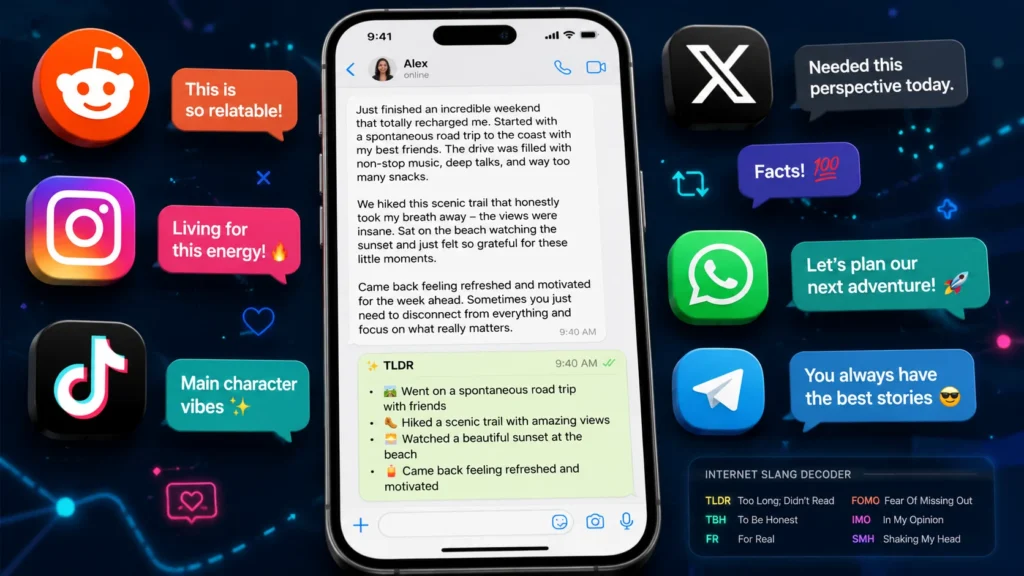
Friends often add a TLDR section after sending a long message.
Example:
“Here’s everything that happened during the meeting, including the budget discussion, timeline changes, staffing updates, and project concerns.
TLDR: The project is delayed by two weeks.”
The summary gives the recipient the essential information immediately.
TLDR as a Response
Sometimes someone responds with TLDR after receiving a very long text.
Example:
Friend 1: Sends a 20-paragraph explanation.
Friend 2: “TLDR 😂”
This usage usually means:
“That message was extremely long.”
Depending on the relationship, it can be humorous or slightly dismissive.
TLDR Meaning in Chat
The TLDR meaning in chat remains largely the same.
Whether you’re using:
- Messenger
- Discord
- Telegram
- Slack
- Team chats
- Gaming chats
TLDR typically signals a quick recap.
Example in a Group Chat
A team member writes:
“We analyzed customer feedback, reviewed support tickets, examined churn rates, identified product issues, and proposed several improvements.”
TLDR: Customers want faster support responses.
The summary helps everyone understand the main conclusion quickly.
Example in Gaming Communities
Gaming discussions can become lengthy.
Players often write:
TLDR: The update improves performance but introduces several bugs.
Readers instantly understand the key point.
TLDR Text Meaning in Everyday Conversations
The TLDR text meaning continues expanding beyond internet forums.
Many people now use it in:
- Personal messages
- Family group chats
- Workplace communication
- School discussions
- Project updates
- Online communities
The abbreviation has become part of mainstream digital language.
Why TLDR Works So Well
Modern communication values efficiency.
People often skim rather than read every word.
A TLDR section helps by:
| Benefit | Explanation |
|---|---|
| Faster reading | Readers understand the main point quickly |
| Better retention | Key information stands out |
| Improved communication | Important details don’t get lost |
| Higher engagement | More people finish reading |
| Better accessibility | Easier for busy readers |
Because of these advantages, many professional communicators now use TLDR sections regularly.
TLDR Meaning on Social Media
Social media users frequently encounter lengthy posts.
As a result, TLDR meaning on social media has become increasingly important.
Platforms where TLDR appears often include:
- TikTok
- X (Twitter)
- Discord communities
The abbreviation helps users navigate large amounts of content efficiently.
Typical Social Media Example
A creator writes a detailed explanation about a product review.
At the bottom:
TLDR: Great camera, excellent battery, expensive price.
Readers can immediately grasp the conclusion.
TLDR Meaning on Instagram
Instagram captions sometimes become surprisingly long.
Influencers, businesses, and creators often tell stories or explain experiences in detail.
To help followers, many add a summary.
Example:
TLDR: The product works well and is worth buying.
This approach improves readability and encourages engagement.
Readers who want details can continue reading. Others can simply read the summary.
TLDR Meaning on Reddit
When discussing the TLDR meaning on Reddit, it’s impossible to ignore the platform’s role in popularizing the abbreviation.
Reddit contains millions of discussion threads covering everything from technology and gaming to relationships and career advice. Many posts become extremely detailed, sometimes reaching thousands of words.
To help readers, Reddit users frequently add a TLDR section at either the beginning or the end of their posts.
Example of TLDR on Reddit
A user might write a long story about a workplace disagreement, explaining multiple events, conversations, and outcomes.
At the bottom, they add:
TLDR: I reported an issue to management, and the situation was resolved.
This allows readers to understand the outcome without reading every detail.
Why Reddit Users Use TLDR Frequently
Reddit discussions often involve:
- Personal stories
- Detailed explanations
- Advice requests
- Product reviews
- Technical troubleshooting
- Community debates
A TLDR section makes these posts easier to digest.
In many Reddit communities, adding a TLDR is considered good writing etiquette because it respects readers’ time.
TLDR Meaning on TikTok
The TLDR meaning on TikTok is identical to its meaning elsewhere online, but the context is slightly different.
TikTok focuses on short-form content. Even so, creators often use TLDR when sharing:
- Long captions
- Storytime posts
- Multi-part explanations
- Comment discussions
- Educational content
Example of TLDR on TikTok
A creator explains a complicated situation involving several events.
At the end, they write:
TLDR: Everything worked out, and the misunderstanding was resolved.
Viewers immediately understand the conclusion.
Why TLDR Fits TikTok Culture
TikTok users consume content quickly.
They often want:
- Fast answers
- Key takeaways
- Concise explanations
- Quick summaries
TLDR aligns perfectly with these preferences.
TLDR Meaning on X (Twitter)
Although X encourages short posts, TLDR still appears regularly.
Many users create:
- Long threads
- Detailed analyses
- Industry commentary
- Educational posts
After several connected posts, they often include a summary.
Example
A user posts a lengthy thread about artificial intelligence trends.
The final post reads:
TLDR: AI tools are becoming more capable, more accessible, and more integrated into daily work.
Readers instantly understand the overall message.
Why TLDR Works on X
Long threads can contain dozens of individual posts.
A concise summary helps readers:
- Save time
- Understand the conclusion
- Decide whether to read the entire thread
TLDR Meaning in Social Media
Across all platforms, the TLDR meaning in social media remains consistent.
It serves as a quick recap of longer content.
Common Social Media Platforms Where TLDR Appears
| Platform | Common Usage |
|---|---|
| Post summaries | |
| Caption summaries | |
| TikTok | Story explanations |
| X (Twitter) | Thread summaries |
| Long post recaps | |
| Discord | Community updates |
| Professional content summaries |
The goal remains the same:
Provide important information quickly.
How to Use TLDR Correctly
Many people understand what TLDR means but aren’t sure how to use it.
Fortunately, using it correctly is simple.
Place TLDR at the Beginning
Some writers put the summary first.
Example:
TLDR: The software update improves battery life.
The rest of the post then explains the details.
This method works well when readers want immediate information.
Place TLDR at the End
Others prefer adding it after the main content.
Example:
Detailed explanation
TLDR: Battery life improved significantly after the update.
This approach allows readers to choose whether they want the summary or the full version.
Keep the Summary Short
A TLDR should be concise.
Good example:
TLDR: The restaurant is affordable and serves excellent food.
Bad example:
A five-paragraph summary.
Remember, the purpose is speed and clarity.
Examples of TLDR in a Sentence
Understanding real-world examples helps clarify the concept.
Casual Conversation
TLDR: I’m running late because traffic is terrible.
Workplace Update
TLDR: The project will launch next month.
Product Review
TLDR: Excellent performance but expensive.
School Assignment
TLDR: Climate change affects weather patterns worldwide.
Social Media Post
TLDR: The trip was amazing despite a few delays.
Reddit Story
TLDR: We fixed the problem after replacing the router.
Each example delivers the most important information in a single sentence.
When Should You Use TLDR?
Knowing when to use TLDR is just as important as understanding its meaning.
Use TLDR for Long Content
If your content takes several minutes to read, a summary can help readers.
Examples include:
- Articles
- Essays
- Reports
- Long emails
- Detailed messages
- Forum posts
Use TLDR for Complex Topics
Some subjects contain many details.
Examples:
- Technical tutorials
- Product comparisons
- Business updates
- Research summaries
A TLDR helps readers understand the key conclusion.
Use TLDR for Busy Audiences
People often skim content before deciding whether to read more.
A summary improves accessibility and engagement.
When You Should Not Use TLDR
Although TLDR is useful, it isn’t appropriate in every situation.
Very Short Messages
If your message contains only a few sentences, a TLDR is unnecessary.
For example:
“Meeting starts at 2 PM.”
Adding a TLDR would be redundant.
Formal Academic Writing
Many academic papers use:
- Abstracts
- Executive summaries
- Conclusions
These sections already serve the same purpose.
Sensitive Conversations
In serious discussions, a TLDR can sometimes appear insensitive if used carelessly.
Context matters.
Is TLDR Rude?
One of the most common questions online is:
Is TLDR rude?
The answer depends on how it’s used.
When TLDR Is Not Rude
Most modern uses are completely acceptable.
Examples:
- Summarizing an article
- Summarizing an email
- Providing key takeaways
- Helping readers save time
In these situations, TLDR is helpful rather than offensive.
When TLDR Can Sound Rude
Problems arise when someone uses TLDR as a response.
Example:
Person A sends a thoughtful explanation.
Person B replies:
“TLDR.”
This may imply:
“I didn’t bother reading your message.”
Without context, that response can feel dismissive.
Best Practice
Use TLDR to help readers rather than criticize writers.
This approach keeps communication positive.
Why Do People Write TLDR?
The popularity of TLDR comes from a simple reality:
People are overwhelmed with information.
Every day, internet users consume:
- News articles
- Emails
- Social media posts
- Text messages
- Discussion threads
- Work documents
A TLDR helps filter the noise.
Main Reasons People Use TLDR
| Reason | Benefit |
|---|---|
| Save time | Faster reading |
| Improve clarity | Easier understanding |
| Increase engagement | More readers finish content |
| Highlight key points | Important details stand out |
| Improve communication | Reduces confusion |
The abbreviation survives because it solves a genuine problem.
TLDR vs Summary
Many people wonder whether TLDR and summary mean the same thing.
They are closely related, but not identical.
Similarities
Both provide:
- Condensed information
- Key takeaways
- Essential points
Both help readers understand content quickly.
Differences
| TLDR | Summary |
|---|---|
| Usually informal | Can be formal or informal |
| Common online | Used everywhere |
| Internet slang | Standard language |
| Often one sentence | Can be multiple paragraphs |
| Popular on social media | Common in education and business |
Which Should You Use?
For online communication, TLDR works well.
For professional reports or academic documents, “summary” may sound more appropriate.
TLDR Explained for Beginners
If you’ve never encountered internet slang before, TLDR is one of the easiest abbreviations to learn.
Simple Explanation
Imagine someone sends you a ten-page document.
Instead of reading everything immediately, you look at a short paragraph that explains the main point.
That short paragraph functions as a TLDR.
Everyday Analogy
Think of a movie trailer.
A trailer doesn’t show the entire film.
Instead, it highlights the most important moments.
TLDR works the same way for written content.
The Evolution of TLDR in Modern Digital Communication
The internet changes rapidly.
Many slang terms fade away within a few years.
TLDR continues thriving because it remains useful.
Today, people use it in:
- Professional emails
- Team collaboration tools
- Project management updates
- Business newsletters
- Educational content
- Technical documentation
What began as forum slang has become a mainstream communication tool.
Modern Usage Trends
Current internet users often view TLDR as:
- Helpful
- Efficient
- Reader-friendly
- Time-saving
This shift represents a significant change from its original sarcastic roots.
TLDR and the Rise of Short Attention Spans
Digital communication encourages quick consumption.
People often:
- Scan headlines
- Skim articles
- Browse rapidly
- Jump between platforms
As a result, summaries have become increasingly valuable.
Why Summaries Matter More Than Ever
Modern readers want:
- Fast answers
- Immediate value
- Clear conclusions
- Actionable insights
TLDR delivers all four.
Rather than replacing detailed content, it complements it.
Readers can choose between the quick version and the complete version.
Common Mistakes People Make When Using TLDR
Although TLDR is simple, mistakes still happen.
Writing an Overly Long TLDR
A summary should be concise.
If the TLDR takes several paragraphs, it defeats the purpose.
Including Too Many Details
Focus on the core takeaway.
Readers don’t need every minor detail.
Forgetting the Main Point
A good TLDR highlights the most important conclusion.
Using It in the Wrong Context
Not every message requires a summary.
Short content usually doesn’t need one.
TLDR Writing Formula
A useful formula is:
Problem → Outcome → Key Takeaway
Example:
Long article about improving productivity.
TLDR: Eliminating distractions and prioritizing important tasks significantly improves productivity.
The reader immediately understands the conclusion.
TLDR Meaning in Business Communication
Although TLDR started as internet slang, it has gradually entered professional communication.
Today, many teams use TLDR sections in emails, reports, project updates, and internal documents. Busy professionals often receive hundreds of messages every week. A concise summary helps them understand the most important information immediately.
Why Businesses Use TLDR
Modern workplaces value efficiency.
Employees often need to:
- Review project updates
- Read status reports
- Analyze proposals
- Process client communications
- Evaluate performance summaries
A TLDR section helps readers identify the key takeaway without searching through multiple paragraphs.
Example of TLDR in a Business Update
Project Update
The development team completed testing, fixed critical bugs, improved loading speeds, and prepared the final release candidate for deployment next week.
TLDR: The product is ready for launch next week.
The summary communicates the essential information in seconds.
Benefits of TLDR in Professional Settings
| Benefit | Impact |
|---|---|
| Faster communication | Saves time |
| Improved clarity | Reduces misunderstandings |
| Better productivity | Helps teams focus on priorities |
| Higher engagement | More people read important updates |
| Easier decision-making | Key information stands out |
As workplace communication becomes increasingly digital, TLDR continues gaining acceptance.
TLDR Meaning in Email Communication
Emails often become lengthy.
Some include project details, background information, attachments, timelines, and action items.
Many professionals now include a TLDR section near the top of important emails.
Example Email Structure
TLDR: Client approved the proposal. Final contract review happens Friday.
Then the email contains supporting details below.
This format allows readers to understand the outcome immediately.
When TLDR Works Best in Emails
Use TLDR when:
- The email exceeds several paragraphs
- Multiple topics are discussed
- Executives need quick updates
- Action items are included
- Decisions need approval
Avoid using TLDR in very short emails because the summary may be longer than the actual message.
TLDR in Content Creation
Content creators use TLDR frequently because online audiences consume information differently than traditional readers.
People often skim before they commit to reading an entire article.
Why Content Creators Use TLDR
A strong summary can:
- Increase reader satisfaction
- Improve readability
- Highlight important points
- Reduce information overload
- Help users find answers quickly
Many successful articles include a short recap near the beginning.
This approach benefits both readers and publishers.
Common Places Creators Add TLDR
- Blog posts
- Guides
- Tutorials
- Product reviews
- Case studies
- News articles
- Educational resources
The practice has become increasingly common as digital content grows longer and more detailed.
What Is a TLDR Summary?
A TLDR summary is a brief overview that captures the main point of a longer piece of content.
Think of it as the shortest possible explanation that still preserves the essential meaning.
Characteristics of a Good TLDR Summary
A strong TLDR should be:
- Short
- Accurate
- Clear
- Helpful
- Easy to understand
Characteristics of a Bad TLDR Summary
Poor summaries often:
- Leave out key information
- Include unnecessary details
- Create confusion
- Misrepresent the content
The goal is not to summarize everything.
The goal is to communicate the most important takeaway.
Example
Long Version:
A company analyzed customer feedback, redesigned its checkout process, improved site speed, and reduced cart abandonment.
TLDR: Website improvements increased completed purchases.
The summary captures the primary outcome.
How TLDR Improves Online Communication
Digital communication presents unique challenges.
People face information overload every day.
News feeds, social media updates, work messages, notifications, and emails compete for attention.
TLDR helps solve this problem.
Communication Problems TLDR Addresses
Information Overload
Users receive more content than they can realistically consume.
Limited Attention
Readers often skim before committing to full articles.
Time Constraints
Many people want answers immediately.
Content Fatigue
Long explanations can overwhelm readers.
A well-written TLDR reduces these barriers.
The Psychology Behind TLDR
The popularity of TLDR reflects how people process information.
Human attention is limited.
Readers naturally seek shortcuts that help them understand content efficiently.
Why Readers Like Summaries
People often ask themselves:
- Is this worth reading?
- What is the main point?
- Can I get the answer quickly?
A TLDR answers those questions instantly.
Cognitive Benefits
TLDR can improve:
- Information retention
- Reading efficiency
- Comprehension
- Decision-making
By highlighting the most important idea, summaries help readers focus on what matters most.
Modern Reading Habits
Research consistently shows that many internet users scan content rather than read every word.
They look for:
- Headlines
- Bullet points
- Key takeaways
- Highlighted information
- Summaries
TLDR fits naturally into these reading patterns.
TLDR and Internet Culture
The story of TLDR is also the story of internet culture.
The abbreviation reflects how online communities adapt language to meet practical needs.
Why Internet Slang Develops
Internet users create shorthand to:
- Save time
- Communicate faster
- Express ideas efficiently
- Build community identity
TLDR emerged because it solved a common problem.
Long content required quick summaries.
Other Characteristics of Internet Language
Online communication often favors:
- Speed
- Brevity
- Convenience
- Shared understanding
TLDR embodies all four qualities.
TLDR Compared to Other Internet Acronyms
TLDR belongs to a larger family of internet abbreviations.
Many of these terms originated in chat rooms, forums, and messaging platforms.
Popular Internet Acronyms
| Acronym | Meaning |
|---|---|
| TLDR | Too Long; Didn’t Read |
| LOL | Laughing Out Loud |
| OMG | Oh My God |
| BRB | Be Right Back |
| TBH | To Be Honest |
| FYI | For Your Information |
| IDK | I Don’t Know |
| IMO | In My Opinion |
| IMHO | In My Humble Opinion |
| SMH | Shaking My Head |
| TTYL | Talk To You Later |
| IYKYK | If You Know, You Know |
Unlike many slang terms that express emotions or reactions, TLDR serves a practical function.
It summarizes information.
That usefulness helps explain its longevity.
TLDR vs Executive Summary
Although they share similarities, TLDR and executive summaries differ.
TLDR
- Informal
- Internet-focused
- Usually very short
- Common in digital communication
Executive Summary
- Professional
- Often used in business
- More detailed
- Common in reports and proposals
Comparison Table
| Feature | TLDR | Executive Summary |
|---|---|---|
| Tone | Informal | Professional |
| Length | One sentence to one paragraph | Multiple paragraphs |
| Purpose | Quick takeaway | Comprehensive overview |
| Audience | General readers | Decision makers |
| Usage | Internet content | Business documents |
In many situations, TLDR functions as a simplified version of an executive summary.
TLDR vs Abstract
People sometimes compare TLDR to an academic abstract.
While they serve similar purposes, they are not identical.
Abstract
An abstract provides a structured overview of research.
It often includes:
- Objectives
- Methods
- Findings
- Conclusions
TLDR
A TLDR focuses only on the key takeaway.
It prioritizes speed over detail.
Example
Research Abstract:
Several paragraphs explaining methodology and findings.
TLDR:
The study found that sleep quality significantly affects productivity.
The TLDR delivers the main conclusion immediately.
How Social Media Changed TLDR Usage
Originally, TLDR appeared mainly on forums and message boards.
Today, social media platforms have transformed its usage.
Before Social Media
TLDR often meant:
“I didn’t read your long post.”
After Social Media
TLDR increasingly means:
“Here’s a helpful summary.”
This shift reflects changing online communication habits.
The abbreviation became more positive and more useful.
Why TLDR Remains Popular Decades Later
Many internet slang terms disappear quickly.
TLDR continues thriving because it solves an ongoing problem.
Reasons for Its Longevity
It Saves Time
People value efficiency.
It Improves Clarity
Readers find information faster.
It Works Everywhere
The abbreviation functions across multiple platforms.
It Is Easy to Understand
The meaning becomes obvious once learned.
It Provides Real Utility
Unlike trendy slang, TLDR serves a practical purpose.
As long as people create long content, TLDR will remain relevant.
Best Practices for Writing Effective TLDR Sections
A poorly written summary can confuse readers.
A strong summary improves comprehension.
Focus on the Main Point
Ask:
“What is the single most important takeaway?”
Then write that.
Keep It Brief
Most effective TLDR sections contain:
- One sentence
- Two sentences maximum
- Direct language
Avoid Unnecessary Details
Readers can find details in the full content.
The TLDR should emphasize the conclusion.
Use Plain Language
Complicated wording defeats the purpose.
Clarity always wins.
Examples of Strong TLDR Summaries
Product Review
TLDR: Excellent performance and battery life, but the price is high.
Travel Story
TLDR: The trip was unforgettable despite several flight delays.
Business Report
TLDR: Revenue increased while operating costs decreased.
Technology Article
TLDR: The software update improves speed and stability.
Educational Guide
TLDR: Consistent practice is the fastest way to improve language skills.
Each example communicates value immediately.
Common Misunderstandings About TLDR
Several myths surround the abbreviation.
Myth: TLDR Is Always Rude
Reality: Most modern uses are helpful and respectful.
Myth: TLDR Is Only for Teenagers
Reality: Professionals, educators, writers, and business leaders use it regularly.
Myth: TLDR Is Outdated
Reality: It remains one of the most widely recognized internet abbreviations.
Myth: TLDR Means Readers Are Lazy
Reality: Summaries help people manage information efficiently.
Modern communication often requires quick understanding.
TLDR supports that goal.
TLDR for Beginners: Quick Reference Guide
| Question | Answer |
|---|---|
| What does TLDR mean? | Too Long; Didn’t Read |
| What does TLDR stand for? | Too Long; Didn’t Read |
| Is TLDR an acronym? | Yes |
| Is TLDR internet slang? | Yes |
| Is TLDR rude? | Usually no |
| Where is TLDR used? | Texting, social media, forums, emails |
| What is a TLDR summary? | A short recap of longer content |
| Why do people use TLDR? | To save time and improve clarity |
Frequently Asked Questions
What Does TLDR Mean?
TLDR means “Too Long; Didn’t Read.”
It is an internet abbreviation used to summarize long content or indicate that a message, article, or discussion contains a lot of information. Today, TLDR most commonly appears as a helpful summary rather than a criticism.
What Does TLDR Stand For?
TLDR stands for:
Too Long; Didn’t Read
Each letter represents a word:
- T = Too
- L = Long
- D = Didn’t
- R = Read
You may also see it written as TL;DR, which has the same meaning.
What Is the Meaning of TLDR in Texting?
In texting, TLDR usually provides a quick summary of a long message.
Example:
“Here’s everything that happened during the conference, including the presentations, networking sessions, and client meetings.
TLDR: The event was successful and generated several new business opportunities.”
What Does TLDR Mean in Chat?
The TLDR meaning in chat is the same as in texting.
People use it in:
- Discord
- Telegram
- Messenger
- Slack
- Gaming chats
The abbreviation helps participants quickly understand lengthy discussions.
What Does TLDR Mean on Social Media?
On social media, TLDR introduces a concise summary of a longer post.
You’ll often see it on:
- TikTok
- X (Twitter)
The summary highlights the most important takeaway.
What Does TLDR Mean on Reddit?
On Reddit, TLDR commonly appears at the end of long posts.
Users write detailed stories, explanations, or advice requests and then add a short recap.
Example:
TLDR: I changed careers and became much happier.
This allows readers to understand the outcome immediately.
What Does TLDR Mean on Instagram?
Instagram creators often use TLDR in long captions.
Instead of requiring followers to read every paragraph, they include a brief summary.
Example:
TLDR: The product exceeded expectations and was worth the price.
What Does TLDR Mean on TikTok?
On TikTok, TLDR frequently summarizes:
- Storytime content
- Educational videos
- Long captions
- Comment explanations
It helps viewers grasp the main point quickly.
Why Do People Write TLDR?
People use TLDR because it:
- Saves time
- Improves readability
- Highlights key points
- Helps readers skim content
- Increases engagement
- Makes communication clearer
In a world filled with information, summaries are incredibly useful.
Is TLDR Considered Rude?
Usually, no.
Most modern uses of TLDR are helpful.
However, context matters.
If someone responds to a thoughtful message with only:
“TLDR.”
It may sound dismissive or sarcastic.
When used as a summary, TLDR is generally viewed positively.
How Do You Use TLDR Correctly?
The easiest method is:
- Write your full content.
- Identify the most important takeaway.
- Summarize it in one or two sentences.
- Label it with “TLDR.”
Example:
TLDR: The update improves performance and fixes major bugs.
Should TLDR Go at the Beginning or End?
Both positions are acceptable.
Beginning:
Useful when readers want the summary first.
End:
Useful when readers finish the content and want a recap.
Many writers prefer placing TLDR at the end because it functions like a conclusion.
Is TLDR an Acronym or Abbreviation?
Technically, TLDR is both.
It is:
- An acronym
- An abbreviation
- Internet slang
- Online shorthand
Most people simply refer to it as an internet abbreviation.
Is TLDR Still Popular?
Yes.
Despite being one of the internet’s older abbreviations, TLDR remains extremely popular.
Its continued success comes from its usefulness.
Many internet slang terms disappear because trends change.
TLDR survives because people always need summaries.
Advanced TLDR Examples
Understanding advanced examples helps demonstrate how versatile TLDR can be.
Example: Product Review
After reviewing camera quality, battery life, performance, display technology, and software support:
TLDR: Great phone with excellent battery life, but it’s expensive.
Example: Travel Experience
After describing hotels, transportation, sightseeing, and local food:
TLDR: Fantastic destination that’s worth visiting despite high travel costs.
Example: Career Advice
After discussing education requirements, certifications, salary expectations, and job opportunities:
TLDR: The field offers strong growth potential for motivated professionals.
Example: Software Review
After evaluating features, user interface, security, and performance:
TLDR: Powerful software with a learning curve but excellent long-term value.
Example: Business Report
After reviewing quarterly metrics:
TLDR: Revenue increased while expenses decreased.
Related Internet Slang Terms Often Seen With TLDR
People who search for the TLDR meaning often encounter other internet abbreviations.
Understanding these terms improves overall digital literacy.
Common Internet Acronyms
| Acronym | Meaning |
|---|---|
| LOL | Laughing Out Loud |
| OMG | Oh My God |
| BRB | Be Right Back |
| TBH | To Be Honest |
| FYI | For Your Information |
| IDK | I Don’t Know |
| IMO | In My Opinion |
| IMHO | In My Humble Opinion |
| SMH | Shaking My Head |
| TTYL | Talk To You Later |
| IYKYK | If You Know, You Know |
| DM | Direct Message |
| PM | Private Message |
| TLDR | Too Long; Didn’t Read |
These abbreviations form part of modern internet culture and online communication.
TLDR in the Age of Artificial Intelligence
The rise of artificial intelligence has increased demand for concise information.
People now consume:
- AI-generated summaries
- Search snippets
- Quick answers
- Knowledge panels
- Smart assistants
Interestingly, these tools perform a function similar to TLDR.
Why TLDR Remains Relevant
Even with advanced technology, users still want:
- Fast insights
- Quick takeaways
- Digestible information
- Efficient communication
TLDR aligns perfectly with these expectations.
In many ways, the popularity of AI-generated summaries reinforces the importance of TLDR-style communication.
The Future of TLDR
Language evolves constantly.
Some phrases fade away.
Others become permanent.
TLDR appears to belong in the second category.
Reasons TLDR Will Likely Continue Growing
Information Volume Keeps Increasing
People encounter more content every year.
Summaries Save Time
Readers appreciate efficiency.
Digital Communication Continues Expanding
Online communication remains central to daily life.
The Concept Is Universal
Every audience benefits from concise explanations.
Because TLDR solves a practical problem, its future looks secure.
When a TLDR Can Improve Your Writing
Adding a TLDR can significantly improve reader experience.
Consider using one when:
- Writing lengthy articles
- Creating tutorials
- Publishing reviews
- Sending detailed emails
- Posting on forums
- Sharing complex explanations
A concise summary often increases reader satisfaction.
Signs Your Content Needs a TLDR
Ask yourself:
- Is this longer than several paragraphs?
- Does it contain multiple ideas?
- Could readers benefit from a quick recap?
- Is the conclusion important?
If the answer is yes, a TLDR may help.
Quick Comparison: TLDR Across Different Platforms
| Platform | Typical Usage |
|---|---|
| Texting | Summarize long messages |
| Summarize lengthy posts | |
| Recap long captions | |
| TikTok | Explain storytime content |
| Highlight key takeaways | |
| X (Twitter) | Summarize threads |
| Discord | Condense discussions |
| Slack | Recap workplace conversations |
| Highlight important information | |
| Blogs | Provide article summaries |
The purpose remains consistent across platforms:
Make information easier to understand.
Common TLDR Formats
One-Line Format
TLDR: The update improves performance.
Bullet Point Format
TLDR:
- Faster performance
- Better battery life
- Improved stability
Paragraph Format
TLDR: The company launched a new product, increased revenue, and expanded into additional markets.
All formats work as long as the summary remains concise.
Key Facts About TLDR
Fact: TLDR stands for “Too Long; Didn’t Read.”
Fact: TLDR originated in online forums and message boards.
Fact: Both TLDR and TL;DR are correct spellings.
Fact: Modern users primarily employ TLDR as a summary tool.
Fact: TLDR appears across texting, social media, Reddit, email, and workplace communication.
Fact: The abbreviation remains one of the most recognized internet slang terms worldwide.
Final Thoughts
The TLDR meaning is simple yet remarkably powerful.
It stands for “Too Long; Didn’t Read”, an internet abbreviation that began as a reaction to lengthy posts and evolved into one of the web’s most useful communication tools.
Today, TLDR appears across nearly every corner of the internet. You’ll find it in texting, social media posts, Reddit discussions, workplace emails, blog articles, online forums, and messaging apps.
What makes TLDR special isn’t the abbreviation itself. It’s the idea behind it.
People value clarity.
They appreciate concise explanations.
They want quick access to important information.
A well-written TLDR delivers exactly that.
Whether you’re trying to understand the TLDR acronym meaning, learning the TLDR definition, exploring the TLDR slang meaning, or simply wondering what does TLDR mean, the answer remains the same:
TLDR = Too Long; Didn’t Read.
And in today’s fast-moving digital world, that simple abbreviation has become one of the most useful tools for effective online communication.