
Last Updated on June 10, 2026
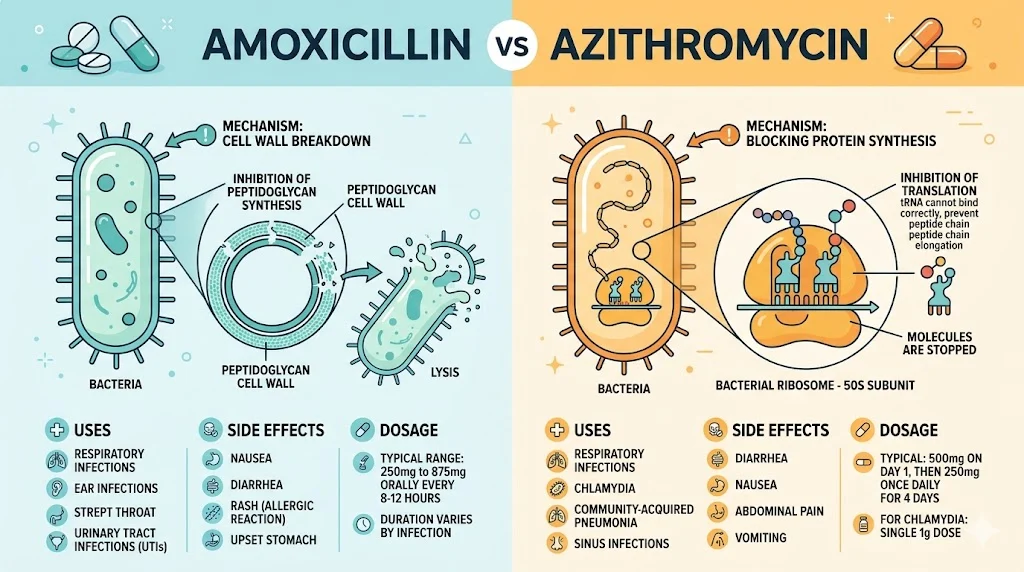
Amoxicillin and Azithromycin are both antibiotics used to treat bacterial infections, but they belong to different drug classes and work in different ways. Amoxicillin is a penicillin-type antibiotic that stops bacterial cell wall formation, while azithromycin is a macrolide that blocks bacterial protein production. Doctors choose between them based on infection type, patient allergies, and resistance patterns.
The comparison between amoxicillin vs azithromycin is one of the most common questions in antibiotic treatment. Both medicines are widely prescribed for bacterial infections such as throat infections, respiratory infections, ear infections, and skin problems. However, they are not the same.
Many patients get confused when doctors prescribe either amoxicillin or azithromycin for similar symptoms. Some wonder why one antibiotic works for them but not the other. Others are unsure about safety, effectiveness, or side effects.
The truth is simple: these antibiotics belong to different classes and target bacteria in different ways. The choice depends on the type of infection, patient allergy history, and bacterial resistance.
Understanding amoxicillin vs azithromycin helps patients follow treatment correctly, avoid misuse, and improve recovery outcomes. It also reduces the risk of antibiotic resistance, which is a growing global health concern.
In this guide, we will break down everything in simple language. You will learn how each drug works, when doctors use them, their pros and cons, real-world examples, and common mistakes to avoid.
Quick Answer: Amoxicillin vs Azithromycin Overview
If you need a fast comparison:
- Amoxicillin is a penicillin antibiotic that kills bacteria by destroying their cell walls.
- Azithromycin is a macrolide antibiotic that stops bacteria from making proteins.
Key takeaway:
- Amoxicillin is often first choice for common infections.
- Azithromycin is used when patients are allergic to penicillin or when specific bacteria are suspected.
What is Amoxicillin?
Amoxicillin is a broad-spectrum antibiotic in the penicillin family. It is one of the most commonly used antibiotics in the world.
How it works
Amoxicillin kills bacteria by stopping them from building their cell walls. Without a strong wall, bacteria burst and die.
Common uses
- Strep throat
- Ear infections
- Sinus infections
- Urinary tract infections (UTIs)
- Chest infections
Key features
- Fast acting
- Well studied and safe
- Usually taken 2–3 times per day
Limitations
- Not effective against viral infections
- Some bacteria are resistant
- Cannot be used in penicillin-allergic patients
What is Azithromycin?
Azithromycin is a macrolide antibiotic. It is often used when penicillin antibiotics cannot be used.
How it works
Azithromycin stops bacteria from making proteins. Without proteins, bacteria cannot grow or multiply.
Common uses
- Respiratory infections like bronchitis
- Pneumonia
- Throat infections
- Some sexually transmitted infections
- Skin infections
Key features
- Long half-life (stays in body longer)
- Short treatment courses (3–5 days)
- Taken once daily
Limitations
- Increasing bacterial resistance
- May cause stomach upset
- Not always first-line treatment
Amoxicillin vs Azithromycin: Key Differences
Mechanism of action
- Amoxicillin: destroys bacterial cell wall
- Azithromycin: blocks bacterial protein production
Drug class
- Amoxicillin: penicillin antibiotic
- Azithromycin: macrolide antibiotic
Dosing schedule
- Amoxicillin: multiple doses per day
- Azithromycin: once daily
Treatment duration
- Amoxicillin: 5–10 days
- Azithromycin: 3–5 days
Allergy suitability
- Amoxicillin: not safe for penicillin allergy
- Azithromycin: safe alternative for penicillin allergy
Comparison Table: Amoxicillin vs Azithromycin
| Feature | Amoxicillin | Azithromycin |
| Drug class | Penicillin | Macrolide |
| Mechanism | Cell wall destruction | Protein synthesis inhibition |
| Dosing frequency | 2–3 times daily | Once daily |
| Treatment duration | 5–10 days | 3–5 days |
| Best for | Ear, sinus, throat infections | Respiratory infections, atypical bacteria |
| Allergy option | No | Yes (penicillin alternative) |
| Resistance level | Moderate | Increasing in some regions |
| Side effects | Rash, diarrhea | Nausea, stomach pain |
How Doctors Decide Between Amoxicillin vs Azithromycin
Doctors do not choose randomly. Several factors influence the decision:
Type of infection
- Ear and sinus infections → often amoxicillin
- Atypical pneumonia → often azithromycin
Allergy history
If a patient is allergic to penicillin, azithromycin is preferred.
Bacterial resistance
Some bacteria no longer respond to certain antibiotics.
Severity of infection
Severe infections may require combination therapy or different antibiotics.
Patient factors
- Age
- Pregnancy
- Liver or kidney function
Advantages and Disadvantages
Amoxicillin advantages
- Highly effective for common infections
- Safe for children and pregnant women (when prescribed)
- Affordable and widely available
Amoxicillin disadvantages
- Cannot treat penicillin-resistant bacteria
- Requires multiple daily doses
- Risk of allergic reactions
Azithromycin advantages
- Short treatment duration
- Once-daily dosing improves compliance
- Works well for atypical infections
Azithromycin disadvantages
- Growing resistance in some bacteria
- Can cause digestive issues
- Not suitable for all infections
Mechanism of Action Explained Simply
Amoxicillin
Think of bacteria as a balloon filled with water. Amoxicillin weakens the balloon wall, causing it to burst.
Azithromycin
Think of bacteria as a factory. Azithromycin shuts down the factory machines that produce proteins.
Real-World Examples of Amoxicillin vs Azithromycin Use
Example 1: Child with ear infection
A child with ear pain is often prescribed amoxicillin because it targets common bacteria causing ear infections.
Example 2: Adult with penicillin allergy
An adult with pneumonia and penicillin allergy may be prescribed azithromycin.
Example 3: Strep throat
Amoxicillin is commonly used for confirmed strep throat infections.
Example 4: Bronchitis
Azithromycin may be used when atypical bacteria are suspected.
Regional and Global Usage Trends
Amoxicillin
- Most widely prescribed antibiotic globally
- First-line treatment in many countries
- Included in essential medicine lists
Azithromycin
- Very popular due to short course treatment
- Increasing use in respiratory infections
- Resistance concerns in some regions
In many healthcare systems, amoxicillin vs azithromycin decisions follow strict guidelines to prevent overuse.
Common Mistakes Patients Make
Stopping antibiotics early
Many people stop medication when they feel better. This can lead to resistance.
Using antibiotics for viral infections
Neither amoxicillin nor azithromycin works on viruses like flu or cold.
Sharing antibiotics
Sharing medication is unsafe and ineffective.
Self-medication
Taking antibiotics without prescription can lead to complications.
Ignoring dosage instructions
Incorrect dosing reduces effectiveness.
Exercises with Answers
Exercise 1
Which antibiotic is a penicillin-type drug?
A. Azithromycin
B. Amoxicillin
Answer: B. Amoxicillin
Exercise 2
Which antibiotic is often used for penicillin allergy?
A. Amoxicillin
B. Azithromycin
Answer: B. Azithromycin
Exercise 3
Which works by blocking protein synthesis?
A. Amoxicillin
B. Azithromycin
Answer: B. Azithromycin
Exercise 4
True or False: Antibiotics treat viral infections.
Answer: False
Exercise 5
Which antibiotic usually has a shorter course?
Answer: Azithromycin
Related Concepts and Comparisons
Antibiotics vs antivirals
- Antibiotics treat bacteria
- Antivirals treat viruses
Broad-spectrum vs narrow-spectrum
- Amoxicillin is broad-spectrum
- Azithromycin is also broad-spectrum but more targeted in some cases
Resistance development
Overuse of antibiotics leads to resistant bacteria.
Combination therapy
Sometimes antibiotics are combined for severe infections.
FAQs
What is the main difference between amoxicillin vs azithromycin?
Amoxicillin kills bacteria by breaking cell walls, while azithromycin stops bacterial protein production.
Which is stronger, amoxicillin or azithromycin?
Neither is universally stronger. Effectiveness depends on infection type.
Can I take azithromycin instead of amoxicillin?
Only if prescribed by a doctor. They treat different infections.
Is amoxicillin safe for children?
Yes, when prescribed correctly by a healthcare professional.
Why is azithromycin given for 3 days only?
Because it stays in the body longer and continues working after the course ends.
Which has more side effects, amoxicillin vs azithromycin?
Both can cause side effects, but they are generally mild when used correctly.
Can I use these antibiotics for cold or flu?
No. Cold and flu are caused by viruses.
What happens if I miss a dose?
Take it as soon as you remember, but do not double dose.
Is azithromycin better for cough?
Only if bacterial infection is suspected. Not all coughs need antibiotics.
Can resistance affect amoxicillin vs azithromycin effectiveness?
Yes. Bacterial resistance can make either drug less effective.
Conclusion
The comparison of amoxicillin vs azithromycin shows that both antibiotics are powerful but different tools. Amoxicillin is a penicillin-based drug that works best for common infections like ear, throat, and sinus infections. Azithromycin is a macrolide antibiotic that is often used for respiratory infections and in patients who cannot take penicillin.
The key to proper use is medical guidance. Neither antibiotic should be used without prescription or for viral infections. Misuse can lead to resistance and reduced effectiveness in the future.
Understanding the differences helps patients follow treatment correctly and improves recovery outcomes. When used properly, both medications are highly effective and safe. Always follow your healthcare provider’s instructions for the best results.