
Last Updated on June 10, 2026
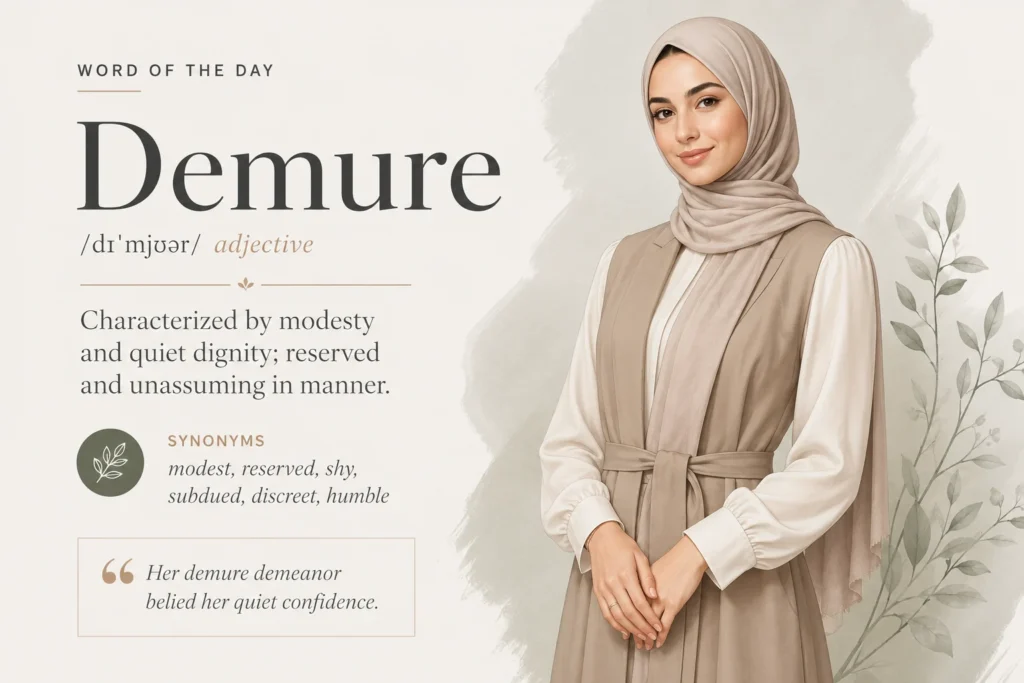
Demure means modest, reserved, polite, and quietly confident in behavior, appearance, or manner. A demure person usually avoids drawing excessive attention to themselves and often displays grace, self-control, courtesy, and elegance.
The word is commonly used to describe someone who appears:
- Modest
- Well-mannered
- Soft-spoken
- Respectful
- Reserved
- Graceful
- Unassuming
In modern slang and social media culture, particularly on TikTok, “demure” gained popularity as a playful way to describe someone acting polished, mindful, classy, or intentionally restrained.
Demure Meaning: Understanding the Word Completely
The English language contains many words that describe personality and behavior. Few words, however, carry the same combination of elegance, restraint, and quiet confidence as demure.
When people search for demure meaning, they often want more than a simple dictionary definition. They want to understand how the word feels in real conversation, what type of person it describes, and whether it carries a positive or negative meaning.
At its core, demure describes someone whose behavior appears modest and reserved. The person doesn’t seek attention. Instead, they present themselves with dignity, composure, and self-control.
Imagine entering a crowded room.
One person dominates every conversation and constantly seeks attention.
Another person listens carefully, speaks thoughtfully, behaves politely, and carries themselves with calm confidence.
Most people would describe the second person as demure.
The word often refers to women because of its historical usage. However, modern English allows the word to describe anyone regardless of gender.
What Does Demure Mean?
Simple Definition
Demure means:
Modest, reserved, polite, and quiet in appearance, behavior, or attitude.
The word functions as an adjective.
Demure Definition in Plain English
A demure person typically:
- Speaks respectfully
- Behaves politely
- Shows self-control
- Avoids arrogance
- Displays grace and humility
- Appears calm and composed
Being demure does not necessarily mean being shy.
Many people mistakenly confuse demure behavior with insecurity. In reality, a demure individual may possess tremendous confidence. They simply express it quietly rather than loudly.
Dictionary-Style Meaning
Demure (adjective):
- Modest and reserved in appearance or behavior
- Characterized by quiet dignity
- Showing polite restraint
- Appearing well-mannered and composed
Demure Pronunciation
Many English learners encounter the word in books or online before hearing it spoken.
How to Pronounce Demure
Demure pronunciation:
di-MYOOR
Phonetic spelling:
/dɪˈmjʊr/
Breakdown:
- di
- myoor
Examples:
- She gave a demure smile.
- His demure manner impressed everyone.
- The actress appeared demure despite her fame.
Common Pronunciation Mistakes
People sometimes pronounce it as:
- deh-mure
- dee-mure
- duh-mure
The correct pronunciation emphasizes the second syllable.
The Origin and History of Demure
Understanding a word’s history often reveals why it carries certain meanings today.
The term demure traces its roots to older forms of European languages where it originally referred to being serious, settled, or composed.
Over centuries, English speakers gradually associated the word with:
- Modesty
- Reserve
- Proper conduct
- Graceful behavior
As social norms evolved, demure became strongly connected to etiquette and polite behavior.
Historically, writers frequently used it to describe women who exhibited social refinement and restraint.
Today, however, the meaning has expanded. The word can describe anyone whose demeanor reflects modesty and composure.
Evolution of Meaning
| Time Period | Common Meaning |
|---|---|
| Early Usage | Serious, settled, composed |
| Middle Usage | Modest and restrained |
| Modern English | Reserved, polite, graceful |
| Social Media Era | Classy, mindful, elegant behavior |
Demure Word Meaning in Different Contexts
One reason the word remains popular is its flexibility.
The meaning shifts slightly depending on context.
Demure Appearance
When discussing appearance, demure refers to a modest and understated look.
Characteristics may include:
- Conservative style
- Elegant clothing
- Subtle makeup
- Graceful posture
- Refined presentation
A demure appearance focuses on sophistication rather than attention-seeking.
Demure Behavior
Demure behavior emphasizes manners and self-control.
Examples include:
- Speaking respectfully
- Listening attentively
- Remaining calm under pressure
- Avoiding dramatic reactions
- Showing courtesy toward others
Demure Personality
A demure personality combines several traits:
- Humility
- Quiet confidence
- Respectfulness
- Grace
- Emotional control
- Thoughtfulness
These individuals often make strong impressions despite speaking less than others.
Demure Communication Style
Communication also affects whether someone appears demure.
Traits include:
- Soft-spoken language
- Careful word choice
- Respectful tone
- Active listening
- Controlled emotional expression
Such people often communicate with purpose rather than volume.
Demure Personality Traits
Many people wonder what truly defines a demure personality.
The answer extends beyond simple shyness.
Quiet Confidence
Perhaps the most misunderstood aspect of demure behavior is confidence.
A demure person may feel completely secure in their abilities.
The difference lies in expression.
Rather than announcing achievements, they allow actions to speak for themselves.
Humility
Humility plays a major role.
Demure individuals rarely boast.
Instead, they acknowledge accomplishments without exaggeration.
Respectfulness
Respect appears consistently in demure personalities.
They:
- Value politeness
- Consider others’ feelings
- Practice good etiquette
- Communicate thoughtfully
Emotional Composure
Life creates stressful situations.
Demure people often maintain calm reactions even during difficult moments.
This composure contributes significantly to their reputation.
Grace Under Pressure
When challenges arise, a demure person usually responds with patience and dignity.
This quality often earns admiration from others.
Characteristics of a Demure Woman
The phrase demure woman meaning appears frequently in search results.
Traditionally, a demure woman displays a combination of modesty, elegance, and self-respect.
Common Characteristics
A demure woman often demonstrates:
- Polite communication
- Graceful body language
- Emotional maturity
- Respectful interactions
- Quiet confidence
- Thoughtful decision-making
Appearance and Style
Demure fashion generally emphasizes:
- Modest clothing
- Timeless designs
- Understated elegance
- Neat presentation
- Sophisticated simplicity
Importantly, demure style is not about hiding individuality.
Instead, it prioritizes refinement over attention-seeking.
Social Behavior
In social situations, a demure woman often:
- Listens attentively
- Speaks thoughtfully
- Treats others respectfully
- Maintains composure
- Avoids unnecessary conflict
These traits contribute to perceptions of elegance and maturity.
Can a Man Be Demure?
Absolutely.
Although the word historically appeared more often in descriptions of women, modern English applies it to men as well.
A demure man may be:
- Polite
- Reserved
- Respectful
- Humble
- Soft-spoken
- Well-mannered
Examples:
- A demure executive who leads quietly.
- A demure student who excels without seeking praise.
- A demure public figure known for humility.
The essence remains the same regardless of gender.
The focus is on behavior, demeanor, and attitude rather than appearance alone.
Demure Behavior Examples
Understanding examples often makes vocabulary easier to remember.
Everyday Examples
Example 1:
A student receives an award and simply thanks everyone rather than boasting.
That response appears demure.
Example 2:
Someone remains calm during an argument and speaks respectfully.
That behavior demonstrates demureness.
Example 3:
A professional dresses elegantly without seeking attention.
That appearance may be described as demure.
Example 4:
A guest listens attentively during a conversation and speaks thoughtfully.
Many people would consider that person demure.
Example 5:
A successful entrepreneur remains humble despite major achievements.
That attitude reflects quiet confidence and demure behavior.
Demure in Sentences
Here are practical examples showing correct usage.
- She offered a demure smile before entering the room.
- His demure personality made him easy to trust.
- The actress appeared demure during the interview.
- Their daughter has a demure and respectful manner.
- The guest spoke in a demure tone.
- Her demure appearance reflected timeless elegance.
- Despite his success, he remained remarkably demure.
- The student responded with a demure thank-you.
Demure Synonym: Words Similar to Demure
When learning the demure meaning, it helps to understand related words. While no synonym matches demure perfectly, several words share parts of its meaning.
Common Synonyms for Demure
| Synonym | Meaning | Similarity to Demure |
|---|---|---|
| Modest | Not boastful or attention-seeking | Very High |
| Reserved | Quiet and restrained | Very High |
| Polite | Respectful and courteous | High |
| Humble | Free from arrogance | High |
| Graceful | Elegant and refined | High |
| Well-mannered | Shows proper etiquette | High |
| Unassuming | Not seeking attention | High |
| Soft-spoken | Speaks gently | Medium |
| Bashful | Slightly shy | Medium |
| Courteous | Respectful and considerate | High |
| Discreet | Careful and restrained | Medium |
| Composed | Calm and controlled | High |
Although these words overlap with demure, each highlights a different aspect of behavior.
For example:
- Modest focuses on humility.
- Reserved focuses on quietness.
- Graceful focuses on elegance.
- Demure combines several of these qualities into one concept.
Synonyms in Sentences
- She remained modest despite winning the competition.
- His reserved nature made him a careful listener.
- The manager maintained a composed demeanor during the crisis.
- Her graceful conduct impressed everyone at the event.
Demure Antonym: Opposite Meaning of Demure
To fully understand a word, it helps to examine its opposites.
Common Antonyms for Demure
| Antonym | Meaning |
|---|---|
| Bold | Confident in a highly visible way |
| Loud | Drawing attention through speech or behavior |
| Arrogant | Excessively proud |
| Flashy | Designed to attract attention |
| Boastful | Frequently bragging |
| Dramatic | Emotionally expressive and attention-seeking |
| Aggressive | Forceful or confrontational |
| Ostentatious | Showing wealth or importance openly |
| Showy | Seeking admiration |
| Brash | Self-assertive and often rude |
Example Comparisons
Demure:
She quietly accepted praise and thanked her team.
Boastful:
She spent the entire evening talking about her accomplishments.
Demure:
He dressed elegantly and simply.
Flashy:
He wore clothing designed specifically to attract attention.
The contrast becomes clear. Demure behavior tends to minimize self-promotion while flashy behavior often amplifies it.
Demure vs Modest: What’s the Difference?
Many people use these words interchangeably.
However, subtle differences exist.
Demure vs Modest Comparison
| Feature | Demure | Modest |
|---|---|---|
| Focus | Behavior and appearance | Humility |
| Includes reserve | Yes | Sometimes |
| Includes elegance | Often | Not necessarily |
| Includes politeness | Usually | Sometimes |
| Includes humility | Usually | Always |
Understanding the Difference
A modest person avoids bragging.
A demure person avoids bragging and often displays quiet elegance, restraint, and courteous behavior.
Think of modest as one ingredient inside the larger concept of demure.
Example
A talented athlete who never boasts is modest.
A talented athlete who remains humble, respectful, composed, and understated could be described as demure.
Demure vs Reserved
Another common source of confusion involves the words demure and reserved.
Side-by-Side Comparison
| Trait | Demure | Reserved |
|---|---|---|
| Quiet | Yes | Yes |
| Polite | Usually | Not always |
| Elegant | Often | Rarely implied |
| Friendly | Can be | Sometimes |
| Emotionally private | Sometimes | Often |
Key Difference
A reserved person may simply keep thoughts private.
A demure person combines reserve with grace, politeness, and modesty.
Someone can be reserved without appearing warm.
Demure usually carries a more positive and refined impression.
Example
Reserved:
He rarely talks about himself.
Demure:
He rarely talks about himself and treats everyone with quiet respect.
Demure vs Shy
Many learners mistakenly assume demure means shy.
The two concepts overlap but remain different.
Comparison Table
| Characteristic | Demure | Shy |
|---|---|---|
| Confidence | Often present | Often lacking |
| Social comfort | Usually comfortable | Often uncomfortable |
| Politeness | Strong feature | Not required |
| Choice | Often intentional | Often emotional |
A shy person may avoid social situations because of nervousness.
A demure person may engage comfortably while remaining modest and composed.
Example
A confident speaker who remains humble can be demure.
A nervous speaker who avoids conversation may be shy.
The distinction matters.
Demure often implies strength through restraint rather than fear.
Demure Fashion Meaning
Fashion conversations frequently include the term demure.
What Is Demure Fashion?
Demure fashion refers to clothing styles that emphasize:
- Modesty
- Elegance
- Sophistication
- Refinement
- Timelessness
The goal is not to hide personality.
The goal is to present oneself with understated confidence.
Common Features of Demure Fashion
- Clean lines
- Classic silhouettes
- Modest necklines
- Appropriate hemlines
- Neutral color palettes
- Minimal embellishments
- Quality fabrics
Demure Fashion Traits
| Element | Description |
|---|---|
| Clothing | Conservative yet stylish |
| Accessories | Simple and refined |
| Makeup | Natural appearance |
| Hairstyle | Neat and polished |
| Presentation | Understated elegance |
Demure fashion values balance.
It does not reject beauty.
Instead, it favors sophistication over excess.
Why Demure Fashion Remains Popular
Fashion trends change constantly.
Demure style remains relevant because it focuses on principles rather than trends.
Those principles include:
- Grace
- Simplicity
- Quality
- Timeless appeal
As a result, demure fashion often ages better than highly trend-driven styles.
Demure Appearance: What It Really Means
The phrase demure appearance extends beyond clothing.
It involves the overall impression someone creates.
Characteristics of a Demure Appearance
A demure appearance often includes:
- Calm facial expressions
- Respectful body language
- Gentle eye contact
- Neat grooming
- Composed posture
Physical Traits vs Behavioral Traits
An important distinction exists.
Demure is primarily a behavioral word.
Appearance may contribute to the impression, but behavior matters more.
Someone wearing expensive clothing may not appear demure if their attitude is arrogant.
Likewise, someone dressed simply may appear highly demure because of their conduct.
Demure Body Language
Body language communicates as much as words.
Many people project demure qualities through nonverbal behavior.
Signs of Demure Body Language
- Relaxed posture
- Controlled gestures
- Attentive listening
- Appropriate eye contact
- Calm facial expressions
- Respectful personal space
Why Body Language Matters
People form impressions quickly.
Before someone speaks, others often notice:
- Posture
- Facial expression
- Movement
- Demeanor
Demure body language signals confidence without dominance.
It conveys self-respect without arrogance.
Demure Meaning in Slang
Language constantly evolves.
In recent years, demure entered online slang culture.
Traditional Meaning vs Slang Meaning
Traditional meaning:
Modest, reserved, and graceful.
Modern slang meaning:
Classy, tasteful, mindful, polished, and intentionally elegant.
The slang usage does not replace the traditional definition.
Instead, it expands it.
Many younger speakers use demure humorously while still referencing the original idea of restraint and refinement.
Examples of Slang Usage
- That’s a very demure outfit.
- Her response was so demure.
- He’s being surprisingly demure today.
- That choice feels demure and thoughtful.
The tone may be playful, but the underlying idea remains similar.
Demure Meaning in Text Messages
Text messaging created new ways to use vocabulary.
Common Text Usage
When someone writes “demure” in a text, they often mean:
- Tasteful
- Classy
- Elegant
- Reserved
- Mindful
Examples:
Text Message Example 1
Person A:
What do you think about this outfit?
Person B:
Very demure. Very classy.
Text Message Example 2
Person A:
I stayed quiet during the argument.
Person B:
That’s pretty demure of you.
The meaning usually remains positive.
Demure Meaning on Social Media
Social media accelerated the popularity of the word.
Platforms helped introduce the term to millions of people who may never have encountered it before.
Why Social Media Revived the Word
Several factors contributed:
- Short-form videos
- Fashion content
- Lifestyle creators
- Humor trends
- Personality discussions
Users began describing behaviors, outfits, and attitudes as demure.
The word quickly became associated with:
- Grace
- Mindfulness
- Classiness
- Self-awareness
- Good manners
Unlike many slang terms, demure already existed in standard English.
Social media simply gave it new visibility.
Demure Meaning in Modern Culture
Modern culture often rewards visibility and self-promotion.
Because of that, demure behavior can feel distinctive.
Many people appreciate qualities such as:
- Humility
- Respect
- Emotional control
- Courtesy
- Quiet confidence
Demure behavior reflects these values.
That may explain why the word continues to resonate across generations.
In a world filled with noise, restraint often stands out.
Sometimes the quietest person in the room leaves the strongest impression.
What Does Demure Mean on TikTok?
One reason searches for demure meaning exploded recently is the popularity of the phrase on TikTok and other social media platforms.
While the traditional definition remains unchanged, social media gave the word a fresh cultural twist.
On TikTok, people often use demure to describe behavior that is:
- Thoughtful
- Classy
- Polished
- Respectful
- Self-aware
- Tasteful
- Intentionally restrained
Instead of focusing only on modesty, modern users often connect demure behavior with making elegant and mindful choices.
Why the Trend Became Popular
The trend resonated because it contrasted with online behaviors that are often:
- Attention-seeking
- Excessive
- Chaotic
- Dramatic
People began celebrating the opposite approach.
The idea was simple:
You don’t need to be the loudest person in the room to make a positive impression.
That message connected with millions of users.
Examples of TikTok Usage
People might say:
- “That’s very demure.”
- “She’s being very demure today.”
- “That’s a demure response.”
- “Very demure. Very mindful.”
In these examples, the word usually signals approval.
Very Demure, Very Mindful Meaning
The phrase “very demure, very mindful” became one of the most recognizable expressions associated with the word.
What the Phrase Means
The phrase encourages intentional behavior.
It suggests:
- Thinking before acting
- Showing consideration for others
- Maintaining composure
- Presenting yourself respectfully
- Practicing self-awareness
The phrase often appears humorously, yet it carries a genuine message about mindfulness and social awareness.
Why People Loved It
The expression became popular because it was:
- Easy to remember
- Playful
- Positive
- Relatable
It transformed an older vocabulary word into part of everyday internet culture.
Traditional Meaning vs Trend Meaning
| Traditional Demure | Social Media Demure |
|---|---|
| Modest | Mindful |
| Reserved | Intentional |
| Polite | Self-aware |
| Graceful | Classy |
| Restrained | Thoughtful |
Both meanings overlap significantly.
The trend simply broadened the word’s modern appeal.
How to Use Demure in Conversation
Understanding a word is one thing.
Using it naturally is another.
Everyday Situations
You can use demure when describing:
- People
- Clothing
- Behavior
- Attitudes
- Communication styles
- Social interactions
Natural Examples
- Her demure smile made her seem approachable.
- He maintained a demure attitude despite his success.
- The event called for a demure and elegant dress code.
- She answered the criticism in a demure manner.
- Their daughter has a remarkably demure personality.
Professional Context
The word also works in workplace settings.
Examples:
- The executive maintained a demure leadership style.
- His demure communication approach built trust.
- She accepted the promotion with a demure sense of gratitude.
Social Context
You may hear people say:
- “I like her demure style.”
- “He’s surprisingly demure.”
- “That response was very demure.”
These uses sound natural and contemporary.
Demure Personality Traits Explained
A demure personality consists of several interconnected qualities.
No single trait defines demureness.
Instead, multiple characteristics work together.
Humility
Demure individuals rarely seek validation through constant self-promotion.
They allow achievements to speak for themselves.
Quiet Confidence
Confidence remains one of the most misunderstood aspects of demure behavior.
Demure people often possess strong self-belief.
They simply express it differently.
Instead of announcing confidence, they demonstrate it through actions.
Emotional Intelligence
Many demure individuals display high emotional awareness.
They tend to:
- Read situations carefully
- Manage emotions effectively
- Communicate respectfully
- Avoid unnecessary conflict
Courtesy
Courtesy plays a major role.
Demure people often value:
- Good manners
- Respectful communication
- Proper etiquette
- Consideration for others
Self-Control
Self-control helps distinguish demure behavior from impulsive behavior.
Demure individuals often think before they speak.
That doesn’t mean they lack opinions.
It means they choose the right moment to express them.
Demure Behavior Examples in Real Life
Many readers understand concepts better through practical examples.
Example: Workplace
An employee receives praise during a meeting.
Instead of taking all the credit, they acknowledge their team’s contribution.
That response reflects demure behavior.
Example: School
A student earns the highest grade in class.
Rather than boasting, they quietly celebrate and continue working hard.
That demonstrates demureness.
Example: Friendship
A friend listens carefully during a difficult conversation.
They offer thoughtful advice without dominating the discussion.
This behavior appears demure.
Example: Leadership
A leader guides a team effectively without constantly seeking recognition.
Their influence comes from competence rather than attention.
This represents quiet confidence.
Example: Public Speaking
A speaker delivers a powerful presentation calmly and respectfully.
They don’t rely on dramatic theatrics.
Their confidence appears controlled and composed.
Many would describe that style as demure.
Common Misconceptions About Demure
Several myths surround the word.
Let’s clarify them.
Myth: Demure Means Weak
Reality:
Demure behavior often requires considerable self-control and confidence.
Strength does not always appear loud.
Sometimes strength appears calm.
Myth: Demure Means Shy
Reality:
A demure person can be highly social and confident.
The key difference is restraint rather than fear.
Myth: Demure Is Only for Women
Reality:
Modern English applies the word to anyone.
people of all genders can both display demure qualities.
Myth: Demure Means Boring
Reality:
Demure people often possess vibrant personalities.
They simply express themselves thoughtfully rather than dramatically.
Myth: Demure Means Old-Fashioned
Reality:
The word remains highly relevant.
Modern social media trends helped introduce it to new generations.
The Psychology Behind Demure Behavior
Human behavior often reflects deeper psychological patterns.
Demure characteristics connect with several positive social traits.
Self-Awareness
Demure individuals often understand how their actions affect others.
This awareness influences communication choices.
Social Intelligence
Social intelligence involves understanding:
- Timing
- Context
- Tone
- Interpersonal dynamics
Many demure individuals demonstrate these skills naturally.
Emotional Regulation
Research consistently shows that emotional regulation contributes to positive relationships.
Demure behavior often reflects strong emotional management.
Confidence Without Validation
Perhaps the most powerful psychological aspect of demureness is internal confidence.
Demure individuals frequently rely less on external approval.
As a result, they feel less pressure to constantly prove themselves.
Why People Admire Demure Qualities
Throughout history, many cultures have valued traits associated with demureness.
Positive Characteristics People Notice
| Quality | Why It Is Appreciated |
|---|---|
| Humility | Creates trust |
| Courtesy | Encourages respect |
| Grace | Improves social interactions |
| Composure | Signals maturity |
| Self-control | Demonstrates discipline |
| Quiet confidence | Feels authentic |
| Thoughtfulness | Strengthens relationships |
These qualities often create positive first impressions.
More importantly, they help build lasting relationships.
Long-Term Impact
People may initially notice charisma.
However, they often remember:
- Character
- Integrity
- Respectfulness
- Consistency
Demure behavior frequently communicates these qualities.
When Demure Is a Compliment
One of the most common questions is:
Is Demure a Compliment?
In most situations, yes.
The word usually carries positive associations.
When someone describes a person as demure, they often mean:
- Respectful
- Elegant
- Well-mannered
- Thoughtful
- Graceful
Examples of Positive Usage
- She has a demure charm.
- His demure personality earns respect.
- Their daughter carries herself in a demure manner.
These examples generally express admiration.
Situations Where Context Matters
Like many adjectives, context influences meaning.
Occasionally, someone may use demure sarcastically.
However, this remains relatively uncommon.
Most uses remain positive.
Frequently Asked Questions
What Does Demure Mean?
Demure means modest, reserved, polite, and graceful in behavior, appearance, or attitude.
What Is the Demure Definition?
The demure definition refers to someone who displays quiet confidence, restraint, courtesy, and modesty.
How Do You Pronounce Demure?
Demure is pronounced:
di-MYOOR
Phonetic spelling:
/dɪˈmjʊr/
Is Demure a Positive Word?
Yes.
In most situations, demure is considered a compliment.
Can Men Be Demure?
Absolutely.
The word can describe anyone who demonstrates modesty, politeness, and restraint.
What Is the Opposite of Demure?
Common antonyms include:
- Bold
- Arrogant
- Flashy
- Boastful
- Loud
- Showy
What Is a Demure Personality?
A demure personality typically includes:
- Humility
- Courtesy
- Grace
- Quiet confidence
- Emotional composure
What Does Demure Mean in Slang?
In modern slang, demure often means classy, mindful, polished, tasteful, and self-aware.
What Does Demure Mean on TikTok?
On TikTok, demure generally refers to thoughtful, elegant, and intentional behavior.
How Is Demure Used in a Sentence?
Example:
She accepted the award with a demure smile and sincere gratitude.
Conclusion
The demure meaning extends far beyond simple shyness or quietness. It describes a unique blend of modesty, grace, restraint, courtesy, and confidence. A demure person does not need constant attention to make an impact. Their actions, character, and demeanor speak for them.
Whether you encounter the word in literature, everyday conversation, fashion discussions, professional settings, or social media trends, the underlying message remains remarkably consistent. Demure behavior reflects thoughtful self-presentation, respect for others, and quiet strength.
In a world that often rewards loudness, demure qualities remind us that elegance, humility, and composure still carry lasting value. That is why the word continues to resonate across generations and why so many people search for the true meaning of demure today.