Last Updated on October 2, 2026
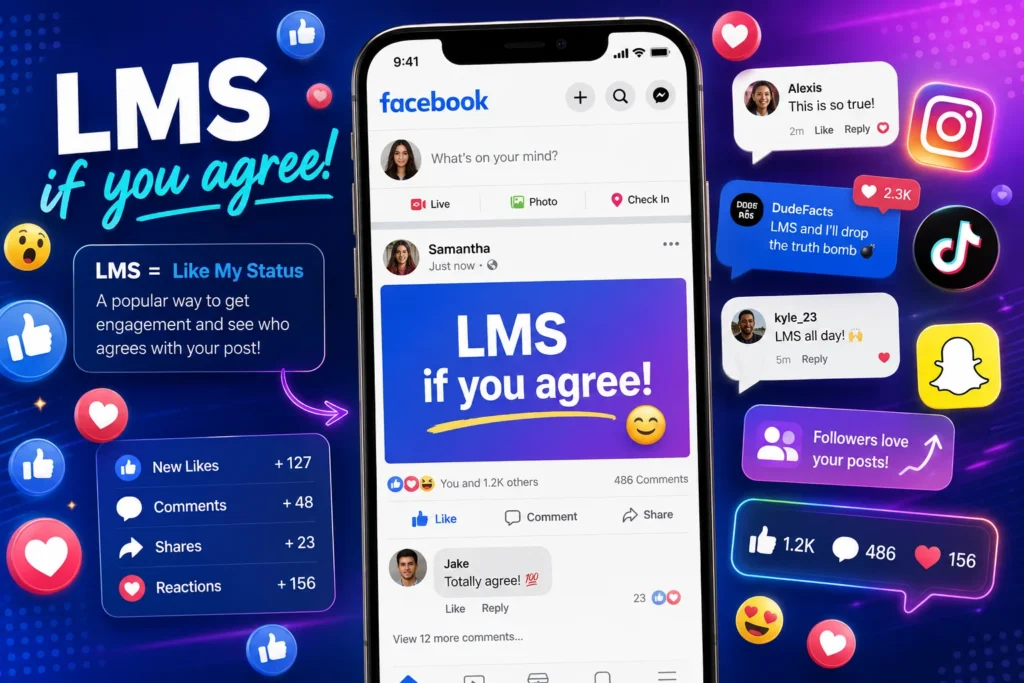
LMS meaning slang most commonly stands for “Like My Status,” an internet slang abbreviation used on social media to encourage people to like or engage with a status update or post. For example, “LMS if you’re excited for summer” asks followers to like the post. In some contexts, LMS can also mean “Love My Status,” depending on the platform and conversation.
If you’ve spent time on social media, you’ve probably seen someone post a message like:
“LMS if you agree!”
“LMS for a TBH.”
“LMS and I’ll message you.”
At first glance, the acronym may seem confusing. Many internet abbreviations have multiple meanings depending on context. However, when discussing LMS meaning slang, the most common definition is surprisingly simple.
LMS stands for “Like My Status.”
People use it as a social media engagement phrase to encourage others to like a post, status update, photo, opinion, question, or challenge.
The acronym became especially popular during the peak years of Facebook status culture when users frequently posted interactive updates designed to generate reactions from friends.
Today, LMS remains part of internet slang vocabulary even though newer platforms such as Instagram, Snapchat, and TikTok have changed how users interact online.
Quick Definition Table
| Term | Meaning |
|---|---|
| LMS | Like My Status |
| Type | Internet Slang |
| Category | Social Media Acronym |
| Used On | Facebook, Instagram, Snapchat, TikTok |
| Purpose | Increase engagement |
| Audience | Teens, Gen Z, Social Media Users |
| Alternative Meaning | Love My Status |
Understanding LMS helps decode countless online conversations and social media posts.
What Does LMS Mean in Slang?
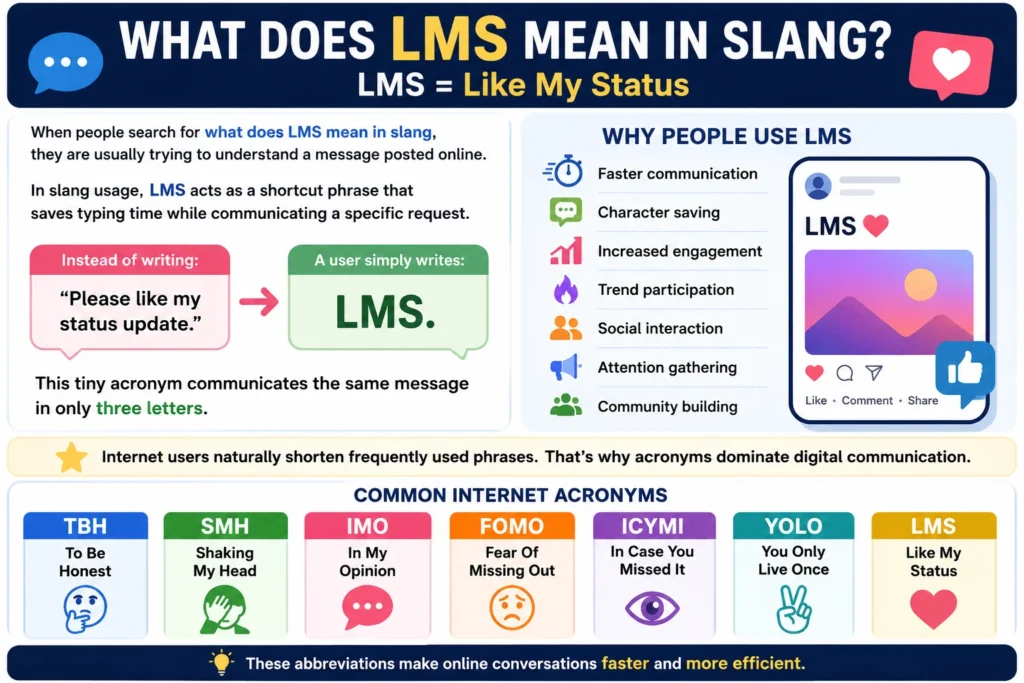
When people search for what does LMS mean in slang, they are usually trying to understand a message posted online.
In slang usage, LMS acts as a shortcut phrase that saves typing time while communicating a specific request.
Instead of writing:
“Please like my status update.”
A user simply writes:
“LMS.”
This tiny acronym communicates the same message in only three letters.
Why People Use LMS
Several factors explain why LMS became popular:
- Faster communication
- Character saving
- Increased engagement
- Trend participation
- Social interaction
- Attention gathering
- Community building
Internet users naturally shorten frequently used phrases. That’s why acronyms dominate digital communication.
Examples include:
| Acronym | Meaning |
|---|---|
| TBH | To Be Honest |
| SMH | Shaking My Head |
| IMO | In My Opinion |
| FOMO | Fear Of Missing Out |
| ICYMI | In Case You Missed It |
| YOLO | You Only Live Once |
| LMS | Like My Status |
These abbreviations make online conversations faster and more efficient.
LMS Meaning on Social Media
Social media is where LMS became famous.
The phrase emerged during a period when users actively competed for likes, comments, and interactions.
A status update wasn’t simply information anymore.
It became a conversation starter.
How LMS Works on Social Platforms
A user publishes a post.
The post contains LMS.
Followers see the request.
They react by liking the status.
This creates higher engagement and visibility.
A typical example looks like this:
LMS if you love pizza.
Users who enjoy pizza click the like button.
The post gains engagement while creating a mini-community around a shared interest.
Common LMS Post Formats
People often use LMS in creative ways.
Examples include:
- LMS if you agree
- LMS if you’re bored
- LMS if you’re awake
- LMS for a TBH
- LMS and I’ll rate your profile
- LMS if you’re excited for the weekend
- LMS if you love music
- LMS if you’ve seen this movie
These posts encourage interaction while keeping participation easy.
LMS Meaning on Facebook
When discussing LMS slang, Facebook deserves special attention.
Facebook played a major role in popularizing the acronym.
In the early and mid-2010s, status updates dominated the platform.
Users constantly searched for ways to boost interaction.
As a result, LMS became a viral engagement tactic.
Popular Facebook LMS Posts
Many Facebook users posted:
LMS for a truth.
LMS and I’ll describe you.
LMS and I’ll post a memory.
LMS if we’re friends.
These posts encouraged likes while offering something in return.
The strategy worked because it created a social exchange.
The user received engagement.
The audience received attention or entertainment.
Why LMS Became Viral on Facebook
Several factors fueled its growth:
- Easy participation
- Low effort interaction
- Social validation
- Friendship building
- Curiosity
- Viral sharing
For years, LMS remained one of Facebook’s most recognizable slang terms.
LMS Meaning on Instagram
Instagram changed social media behavior but did not completely eliminate LMS.
Although Instagram focuses heavily on images and videos, users still employ LMS-style engagement techniques.
Examples include:
LMS if you want Part 2.
LMS if this made you laugh.
LMS if you’ve been here before.
In these cases, LMS functions as a call to action.
The goal remains the same:
Increase user interaction.
How Instagram Influencers Use LMS Concepts
Even when creators don’t explicitly write LMS, they often use the same strategy.
Examples include:
- Double tap if you agree
- Like this post if you relate
- Like for more content
- Tap the heart if you understand
These phrases follow the same engagement principle that made LMS famous.
LMS Meaning on Snapchat
Snapchat users frequently communicate through short messages and abbreviations.
As a result, LMS naturally fits the platform’s culture.
On Snapchat, LMS may appear in:
- Stories
- Group chats
- Direct messages
- Public profiles
Examples:
LMS if you’re online.
LMS and I’ll send a streak.
LMS for a snap back.
These interactions help maintain social connections and ongoing conversations.
LMS Meaning on TikTok
TikTok has transformed internet culture, yet older slang terms still appear.
While creators often focus on comments, shares, and follows, LMS occasionally appears in captions.
Examples include:
LMS if this happened to you.
LMS if you want another part.
LMS if you can relate.
The intention remains consistent:
Generate engagement.
Social media algorithms often reward interaction, making engagement-focused phrases attractive to creators.
LMS Meaning in Texting
Many people wonder whether LMS has the same meaning in text messages.
In most cases, yes.
LMS meaning in texting usually means “Like My Status.”
However, context matters.
Unlike Facebook or Instagram, texting doesn’t always involve public status updates.
Because of this, LMS sometimes appears in messages referencing social media profiles.
Example:
“Hey, LMS when you get online.”
The sender wants the recipient to like a recent status update.
Example Text Conversations
Example 1
Friend A:
Just posted something important. LMS.
Friend B:
Done.
Example 2
Friend A:
LMS and tell me what you think.
Friend B:
I liked it. Great post.
Example 3
Friend A:
LMS if you’re going tonight.
Friend B:
Just did.
These examples show how LMS works naturally in texting environments.
What Does LMS Stand For?
Although Like My Status remains the dominant definition, LMS can occasionally have alternative meanings.
Context determines which interpretation is correct.
Most Common LMS Meanings
| LMS Meaning | Usage Frequency |
|---|---|
| Like My Status | Very Common |
| Love My Status | Less Common |
| Learning Management System | Common Outside Slang |
| Let Me See | Rare |
| Laughing Myself Silly | Rare |
When discussing social media slang, Like My Status is almost always the intended meaning.
How Context Changes Meaning
Consider these examples:
LMS if you agree.
This clearly means Like My Status.
Now compare:
Our school switched to a new LMS.
This refers to a Learning Management System.
The surrounding words reveal the intended definition.
Understanding context prevents confusion.
Like My Status: The Most Popular LMS Definition
Among all possible meanings, Like My Status dominates internet slang discussions.
The phrase directly reflects the culture of social networking.
Users want reactions.
They want engagement.
They want participation.
LMS offers a simple way to ask for it.
Why Status Updates Matter
Status updates allow users to:
- Share opinions
- Express emotions
- Ask questions
- Start conversations
- Announce events
- Share achievements
- Build social connections
When someone says LMS, they are inviting others into that interaction.
In many ways, LMS acts as a digital handshake.
It signals:
“Join the conversation.”
Love My Status Meaning
Another interpretation occasionally appears online.
In this variation, LMS stands for:
Love My Status
Although less common, some users prefer this version because it sounds more positive and enthusiastic.
Examples include:
LMS if you love this quote.
LMS because this photo took forever to capture.
LMS if this made your day.
Despite these examples, internet slang dictionaries and social media usage overwhelmingly favor Like My Status as the primary meaning.
For that reason, most people automatically interpret LMS as Like My Status.
The History of LMS in Internet Culture
Internet slang evolves quickly.
Some expressions disappear within months.
Others survive for years.
LMS belongs to a generation of social media acronyms that emerged as online communities expanded.
During the rise of Facebook status culture, users increasingly relied on shorthand communication.
Several popular abbreviations appeared during this period:
- TBH
- LMS
- TBT
- LOL
- OMG
- SMH
- ROFL
These acronyms simplified communication while creating a shared digital language.
The Rise of Engagement-Based Slang
Many slang terms focused on interaction.
Users wanted:
- Likes
- Comments
- Shares
- Reactions
- Friend requests
As engagement became a form of social currency, phrases like LMS naturally gained popularity.
The acronym became a shortcut for encouraging participation.
That simple purpose explains why it spread so rapidly across social networks.
LMS Meaning Slang in Modern Internet Culture
Internet language changes constantly.
A phrase that dominates social media today may disappear next year. Yet some abbreviations remain recognizable long after their peak popularity.
LMS falls into that category.
Even though newer platforms focus more on videos than status updates, many users still understand the acronym immediately.
The reason is simple.
LMS represents a universal social media behavior:
Seeking engagement.
Whether someone posts on Facebook, Instagram, Snapchat, TikTok, or a future platform, they still want reactions from other people.
That desire keeps the idea behind LMS relevant.
How Internet Slang Evolves
Most online slang follows a predictable pattern:
New Phrase Appears
        ↓
Early Users Adopt It
        ↓
Social Media Spreads It
        ↓
Mainstream Usage Grows
        ↓
New Variations Develop
        ↓
Term Becomes Part of Internet Culture
LMS followed this exact path.
It started as a practical shortcut.
Then it spread through social networks.
Eventually, it became part of the broader vocabulary of online communication.
How LMS Is Used Online Today
Although LMS is older than many modern social media trends, people still use it in several ways.
Engagement Requests
The most common use remains requesting likes.
Examples:
LMS if you’re excited for summer.
LMS if you agree.
LMS if you’ve watched this show.
These posts encourage quick participation.
Opinion Polls
Users often combine LMS with questions.
Examples:
LMS if pineapple belongs on pizza.
LMS if you’d move abroad.
LMS if you prefer dogs over cats.
This creates a simple voting system.
Friendship Posts
Some users use LMS to strengthen social connections.
Examples:
LMS if we’ve been friends for years.
LMS if you remember this memory.
LMS if we’ve met in real life.
These posts encourage nostalgic interaction.
Challenges and Games
Social media games frequently include LMS.
Examples:
LMS and I’ll rate your profile.
LMS and I’ll describe you in one word.
LMS for a truth.
These activities became especially popular among teenagers.
Examples of LMS in Real Conversations
Understanding slang becomes easier when you see it in context.
Example One
Person A:
Just got accepted into college. LMS if you’re happy for me.
Person B:
Congratulations!
In this case, LMS invites support and celebration.
Example Two
Person A:
LMS if you’re staying up late tonight.
Person B:
Definitely.
The phrase acts like a quick poll.
Example Three
Person A:
LMS and I’ll tell you what celebrity you remind me of.
Person B:
Liked.
Here, LMS starts a social media game.
Example Four
Person A:
LMS if this meme made you laugh.
Person B:
That was hilarious.
The acronym encourages engagement with content.
LMS vs Other Popular Social Media Slang
Many internet abbreviations serve different purposes.
Some express emotions.
Others share opinions.
LMS focuses primarily on engagement.
Comparison Table
| Slang Term | Meaning | Purpose |
|---|---|---|
| LMS | Like My Status | Increase engagement |
| TBH | To Be Honest | Share opinions |
| SMH | Shaking My Head | Express disappointment |
| IMO | In My Opinion | Introduce viewpoints |
| FOMO | Fear Of Missing Out | Describe anxiety about missing experiences |
| YOLO | You Only Live Once | Encourage risk-taking |
| ICYMI | In Case You Missed It | Share missed information |
| DM | Direct Message | Private communication |
| PM | Private Message | Private communication |
| TBT | Throwback Thursday | Share past memories |
Each acronym fills a unique role in online communication.
LMS stands out because it directly asks for interaction.
LMS vs L4L
Many people confuse LMS with L4L.
While both relate to social media engagement, they are not identical.
LMS
Meaning:
Like My Status
Purpose:
Requesting likes on a specific post.
Example:
LMS if you agree.
L4L
Meaning:
Like For Like
Purpose:
Exchanging likes between users.
Example:
L4L anyone?
The difference is important.
LMS requests engagement.
L4L proposes a mutual exchange.
Quick Comparison
| Feature | LMS | L4L |
|---|---|---|
| Full Form | Like My Status | Like For Like |
| Goal | Gain likes | Exchange likes |
| Common Use | Status updates | Growth strategies |
| Interaction Type | One-sided request | Mutual agreement |
Understanding the distinction helps decode social media conversations more accurately.
Why Teens and Gen Z Use LMS
Young internet users helped popularize LMS.
Several factors explain its appeal.
Simplicity
Three letters communicate an entire request.
That’s efficient.
Speed
Typing LMS takes seconds.
Writing “Please like my status update” takes much longer.
Social Interaction
The phrase encourages engagement.
Users enjoy receiving reactions from friends.
Trend Participation
Social media often rewards participation.
When one person posts LMS content, others may follow.
Community Building
LMS creates opportunities for conversation.
Even a simple like can start a discussion.
The Psychology Behind LMS Posts
LMS isn’t just a random acronym.
It reflects deeper social behaviors.
Desire for Connection
Humans naturally seek interaction.
Social media provides a digital version of that experience.
When someone posts LMS, they’re often looking for acknowledgment.
Social Validation
Likes function as signals.
They show that others noticed a post.
Many users enjoy receiving this feedback.
Curiosity
Posts such as:
LMS and I’ll tell you something about yourself.
encourage participation through curiosity.
People want to know the outcome.
Community Participation
LMS transforms passive viewers into active participants.
That shift increases engagement levels.
Common LMS Post Types
Not all LMS posts look the same.
Several categories appear repeatedly across social media.
Opinion-Based LMS Posts
Examples:
- LMS if you agree
- LMS if this is true
- LMS if you feel the same way
These posts gather opinions.
Entertainment LMS Posts
Examples:
- LMS if this meme is funny
- LMS for a challenge
- LMS for a game
These focus on entertainment.
Friendship LMS Posts
Examples:
- LMS if we’re friends
- LMS if you remember me
- LMS if we’ve talked recently
These strengthen relationships.
Event LMS Posts
Examples:
- LMS if you’re coming
- LMS if you’re interested
- LMS if you’ll attend
These help measure interest.
Situations Where LMS May Cause Confusion
Because acronyms often have multiple meanings, misunderstanding can occur.
Educational Context
In schools and universities, LMS usually means:
Learning Management System
Examples include online education platforms used for assignments, courses, and training.
Example:
The professor uploaded homework to the LMS.
This has nothing to do with social media slang.
Workplace Context
Businesses also use LMS to describe training software.
Example:
Employees completed the training through the LMS.
Again, the meaning differs entirely from internet slang.
Social Media Context
When used alongside posts, likes, comments, and status updates, LMS almost always means:
Like My Status
Context determines the correct interpretation.
Signs That LMS Means Like My Status
Several clues help identify the slang definition.
Look for words such as:
- Like
- Status
- Post
- Comment
- Snapchat
- Profile
- Engagement
- Friends
Examples:
LMS if you’re excited.
LMS and share your thoughts.
LMS for a TBH.
These clearly indicate the social media meaning.
Internet Slang and Digital Communication
Acronyms like LMS exist because digital communication rewards speed.
Instead of typing lengthy sentences, users compress ideas into a few characters.
Benefits include:
- Faster communication
- Easier texting
- Reduced typing effort
- Greater efficiency
- Shared community language
Over time, these abbreviations become part of internet culture.
Some disappear.
Others remain recognizable for years.
LMS belongs to the second group.
Frequently Asked Questions
What does LMS mean in slang?
LMS most commonly means Like My Status. People use it on social media platforms to encourage others to like a post or status update.
What does LMS mean in texting?
In texting, LMS usually means Like My Status and refers to a social media post that the sender wants others to engage with.
What does LMS mean on Facebook?
On Facebook, LMS almost always stands for Like My Status. Users add it to posts to increase engagement and interaction.
What does LMS mean on Instagram?
On Instagram, LMS generally means Like My Status or functions as a request for likes and engagement on content.
What does LMS mean on Snapchat?
On Snapchat, LMS can mean Like My Status or serve as a shorthand request for interaction with stories and posts.
Is LMS the same as L4L?
No.
LMS means Like My Status.
L4L means Like For Like.
One requests engagement while the other proposes a mutual exchange.
Does LMS have other meanings?
Yes.
Outside internet slang, LMS may refer to:
- Learning Management System
- Let Me See
- Laughing Myself Silly
However, social media users most often mean Like My Status.
Is LMS still used today?
Yes.
Although it is less dominant than during Facebook’s peak years, many people still recognize and use LMS across social media platforms.
Conclusion
Understanding LMS meaning slang is straightforward once you know the context.
In social media conversations, LMS most commonly stands for Like My Status. Users place it in posts, captions, stories, and messages to encourage interaction and engagement.
The acronym became popular through Facebook status culture and later spread across Instagram, Snapchat, TikTok, and other online communities. Its purpose has remained remarkably consistent: invite people to participate.
Whether someone writes:
LMS if you agree.
or
LMS for a TBH.
the goal is usually the same generate reactions and create conversation.
Like many internet abbreviations, LMS reflects how digital communication evolves. People shorten phrases, create shared online language, and develop new ways to connect through social networks.
Even as trends change, LMS remains one of the most recognizable social media acronyms in internet culture. Knowing its meaning helps you understand online discussions, decode social media posts, and navigate modern digital communication with confidence.