Last Updated on June 10, 2026
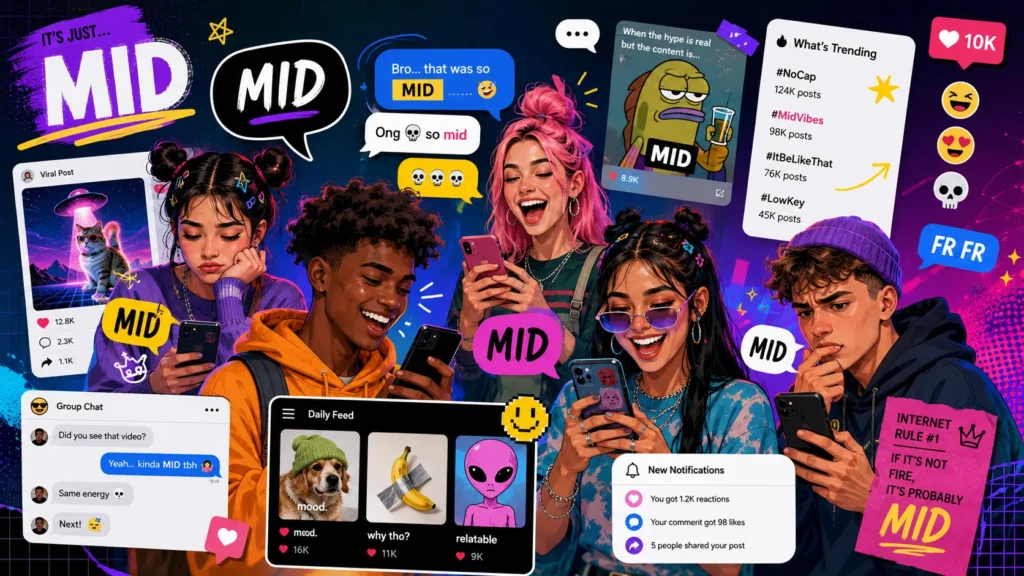
Mid meaning slang refers to something that is average, mediocre, or underwhelming. When people call something “mid,” they mean it is not impressive, exciting, or worth the hype. The term is widely used by Gen Z on TikTok, Instagram, Snapchat, X, and in text messages to describe products, movies, music, games, trends, or experiences that feel ordinary or disappointing.
If you’ve spent even a few minutes scrolling through social media lately, you’ve probably seen someone call a movie, song, celebrity, trend, or product “mid.”
Maybe somebody commented:
“That album is mid.”
Or perhaps you noticed someone posting:
“The new season was kinda mid.”
At first glance, the word seems simple. After all, “mid” traditionally means middle or halfway between two points. Yet in modern internet culture, the term has taken on an entirely different meaning.
Today, mid meaning slang has become one of the most popular expressions in online communication. People use it across social media platforms, group chats, gaming communities, and everyday conversations.
The slang word has become especially popular among Gen Z, who often use it to judge entertainment, products, experiences, and trends.
In this guide, you’ll learn:
- What does mid mean?
- Mid slang meaning explained
- Where the term came from
- Why Gen Z uses it so often
- How to use mid in a sentence
- Whether mid is an insult
- What mid means on TikTok and social media
- Similar slang terms and alternatives
Let’s dive in.
What Does Mid Mean? The Simple Definition
Mid Slang Meaning Explained
The modern mid slang meaning is straightforward.
When someone calls something mid, they’re saying it is:
- Average
- Mediocre
- Underwhelming
- Not impressive
- Nothing special
- Overrated
- Forgettable
In other words, it isn’t terrible, but it isn’t great either.
The term sits somewhere between praise and criticism.
Think of it as the internet’s way of saying:
“It’s okay, but I expected more.”
Quick Definition Table
| Term | Meaning |
|---|---|
| Mid | Average or mediocre |
| Mid slang meaning | Something not impressive |
| Mid internet slang | Underwhelming or overrated |
| Mid in texting | Used to describe average quality |
| Mid on social media | A criticism meaning “nothing special” |
For example:
| Statement | Meaning |
|---|---|
| “That movie was mid.” | The movie was average. |
| “The burger was mid.” | The burger wasn’t impressive. |
| “This game is mid.” | The game feels mediocre. |
| “Her new song is mid.” | The song isn’t very good. |
Notice that none of these examples suggest something is awful.
Instead, they communicate disappointment.
That’s what makes the term powerful.
Calling something bad is expected.
Calling something mid suggests it failed to live up to expectations.
Meaning of Mid in Slang Versus Traditional English
Before becoming internet slang, “mid” simply meant middle.
Examples include:
- Midday
- Midpoint
- Midterm
- Midsection
Traditional usage focuses on position or location.
Slang usage focuses on quality.
Traditional Meaning
“The meeting starts at mid-afternoon.”
Meaning: around the middle of the afternoon.
Slang Meaning
“The meeting presentation was mid.”
Meaning: average and uninspiring.
Although the same word appears in both examples, the meanings are completely different.
Context determines which definition applies.
Why Does Mid Mean Average?
Language changes constantly.
Words often develop new meanings through popular culture.
The slang version of “mid” evolved from the idea of being in the middle.
Think about a ranking system:
| Ranking | Quality |
|---|---|
| Top | Excellent |
| Middle | Average |
| Bottom | Poor |
Over time, internet users began shortening “middle-tier” or “middle quality” to simply “mid.”
Eventually, the term became shorthand for:
“Average and not worth the hype.”
That concise meaning helped it spread rapidly across online communities.
Mid Meaning Gen Z: Why Younger Generations Love the Term
How Gen Z Uses Mid
Among Gen Z, efficiency matters.
Short words dominate online communication because they quickly express opinions.
“I found that experience somewhat disappointing because it failed to meet expectations.”
A Gen Z user simply says:
“Mid.”
One word communicates everything.
It signals:
- Disappointment
- Lack of excitement
- Average quality
- Unmet expectations
The simplicity makes it perfect for:
- Social media comments
- Group chats
- Memes
- Gaming discussions
- Video reactions
As a result, the word spread rapidly through youth culture.
Why Mid Became So Popular
Several factors fueled the rise of the term.
It’s Short
People love concise communication.
One word often replaces an entire paragraph.
It’s Flexible
You can apply it to almost anything:
- Music
- Movies
- TV shows
- Restaurants
- Celebrities
- Fashion
- Technology
- Sports
It’s Funny
Many people use the term humorously.
Calling a heavily hyped product “mid” often creates strong reactions.
It’s Relatable
Everyone has experienced disappointment.
The word perfectly captures that feeling.
Mid as a Cultural Judgment
Interestingly, calling something mid often says more than calling it bad.
Why?
Because bad products can still be memorable.
Average products usually aren’t.
Consider these reactions:
“That movie was terrible.”
The movie might still be entertaining in a strange way.
Now compare:
“That movie was mid.”
The speaker is saying:
- It wasn’t exciting.
- It wasn’t memorable.
- It wasn’t worth discussing.
That subtle difference explains why the word carries so much weight online.
Mid Meaning on Social Media
How Mid Is Used Across Social Platforms
Social media accelerated the popularity of the term.
Users regularly evaluate content in real time.
Every day, millions of people review:
- Videos
- Songs
- Influencers
- Trends
- Brands
- Memes
The word “mid” became a convenient way to express disappointment.
Instead of writing lengthy critiques, users simply type:
“Mid.”
That single word often generates thousands of reactions.
Mid Meaning on TikTok
Among all platforms, TikTok helped popularize the term more than most.
TikTok users frequently label content as mid when:
- A trend feels repetitive
- A viral product disappoints
- A song is overhyped
- A creator’s content becomes predictable
Examples:
“Everyone hyped this trend up. It’s mid.”
“Tried it today. Definitely mid.”
“The movie wasn’t terrible, just mid.”
Because TikTok revolves around rapid opinions, the term fits naturally into the platform’s culture.
Mid Meaning on Instagram
On Instagram, the term commonly appears in:
- Comments
- Reels discussions
- Story replies
- Meme pages
Examples include:
“This fashion trend is mid.”
“That edit is mid.”
“The update is mid.”
The word allows users to critique content without sounding overly harsh.
Mid Meaning on Snapchat
On Snapchat, people often use the term in private conversations.
Examples:
Friend 1: “How was the restaurant?”
Friend 2: “Mid honestly.”
Or:
“The concert was mid.”
“That movie was mid.”
Because Snapchat conversations tend to be casual, slang terms spread quickly there.
Mid Meaning on X
On X, users frequently debate entertainment, sports, politics, and pop culture.
The term often appears in controversial opinions.
Examples:
“That album is mid.”
“The sequel is mid.”
“This season has been mid.”
Such comments often spark lengthy discussions because fans disagree with the criticism.
Mid Meaning on YouTube
YouTube viewers commonly use the word in comments.
Typical examples include:
- Reviewing videos
- Discussing creators
- Evaluating movies
- Rating music
Comments might read:
“This content used to be amazing. Now it’s mid.”
Or:
“Everyone loves this song but it’s mid.”
These brief opinions often receive significant engagement.
Why Social Media Loves Calling Things Mid
Several psychological factors contribute to the trend.
Social Validation
People enjoy sharing opinions.
Community Participation
Using popular slang creates a sense of belonging.
Efficient Communication
One word communicates a complete judgment.
Humor
The bluntness often feels funny.
Meme Culture
Internet humor thrives on exaggerated reactions.
Calling something mid has become a meme in itself.
Mid Meaning in Text Messages
What Does Mid Mean in Texting?
In texting, mid meaning in text remains largely the same.
The word describes something average or disappointing.
Examples:
“How was the game?”
“Mid.”
“Did you like the restaurant?”
“Pretty mid.”
“Thoughts on the movie?”
“Honestly mid.”
Notice how little explanation is required.
The recipient immediately understands the opinion.
That’s one reason the term became so widespread.
Mid in Group Chats
Group chats provide another common environment for the slang term.
Someone shares:
“Just watched the new episode.”
A friend responds:
“Mid.”
Immediately everyone understands the reaction.
The message conveys:
- Mild disappointment
- Lack of excitement
- Average quality
without requiring a lengthy review.
Can Mid Mean Something Different in Text?
Occasionally, context changes the meaning.
In non-slang situations, mid may still mean:
- Middle
- Midpoint
- Midday
- Midweek
Examples:
“Let’s meet mid-week.”
“We’re at the mid-point of the project.”
However, among younger users and internet communities, the slang definition is often assumed first.
Signs Someone Is Using Mid as Slang
Look for clues.
If someone is discussing:
- Entertainment
- Products
- Experiences
- Trends
- Food
- Fashion
they probably mean:
Average or underwhelming.
If they’re discussing:
- Time
- Location
- Position
they likely mean:
Middle.
Understanding context prevents confusion.
Mid Slang Origin: Where Did Mid Come From?
Understanding the origin of mid slang helps explain why the term became such a dominant part of internet culture.
Many people assume the word suddenly appeared on TikTok. In reality, the story goes back much further.
Language rarely changes overnight. Most slang develops gradually through communities, music, social circles, and online discussions before reaching mainstream audiences.
The Original Meaning of Mid
Historically, the word “mid” simply meant:
- Middle
- Intermediate
- Between two extremes
Examples include:
- Midday
- Midpoint
- Midterm
- Midsection
For centuries, English speakers used the word to describe position rather than quality.
Eventually, however, people began applying the concept of “middle” to rankings and evaluations.
If something sits in the middle of a quality scale, it isn’t great and it isn’t terrible.
It’s average.
That idea laid the foundation for the modern slang definition.
How Mid Evolved Into Slang
Many slang words emerge from shortened expressions.
People likely began using “mid” as shorthand for phrases such as:
- Middle tier
- Mid-level
- Mid-quality
- Middle of the road
Over time, internet users dropped the extra words.
Instead of saying:
“That movie is middle tier.”
They simply said:
“That movie is mid.”
The shorter version sounded punchier and more memorable.
That efficiency helped the term spread quickly.
The Influence of Online Communities
Internet forums played a major role in popularizing the term.
Gaming communities, meme pages, discussion boards, and social media groups constantly evaluate products and entertainment.
People needed a fast way to describe something that wasn’t terrible yet wasn’t impressive either.
“Mid” filled that gap perfectly.
Unlike words such as:
- Amazing
- Awful
- Incredible
- Terrible
Mid occupies the middle ground.
It describes experiences that leave little lasting impression.
How Meme Culture Accelerated the Trend
Internet humor thrives on exaggeration.
Ironically, the word “mid” became popular because it feels understated.
Imagine a heavily promoted movie receiving months of hype.
Then someone posts:
“Mid.”
That brief response can feel funnier than a long review.
The contrast creates humor.
Many memes now revolve around dramatically dismissing something as mid.
As meme culture expanded, the term spread into mainstream conversation.
When Did Mid Become Popular?
Although the slang existed earlier, its popularity exploded during the early 2020s.
Several factors contributed:
Growth of Short-Form Content
People increasingly consumed content in quick bursts.
Short opinions became more valuable.
Rise of Gen Z Internet Culture
Younger users embraced concise slang.
Viral Trends
Social media platforms amplified slang faster than ever.
Online Reviews
Everyone suddenly became a critic.
Products, shows, restaurants, games, and influencers faced constant evaluation.
The word “mid” became a universal review score.
Why Do People Say Mid?
The Psychology Behind Calling Something Mid
The popularity of the term isn’t random.
It satisfies a specific communication need.
People often experience things that aren’t amazing or terrible.
Traditional language struggles to describe that middle ground efficiently.
Words like:
- Fine
- Okay
- Decent
- Average
don’t always capture disappointment.
Mid does.
When someone says:
“The movie was mid.”
They often mean:
“People told me it would be great, but it wasn’t.”
That subtle emotional layer makes the term powerful.
Mid Expresses Disappointment Better Than Average
Consider these statements:
“The phone is average.”
Versus:
“The phone is mid.”
The second version feels more critical.
It implies unmet expectations.
That’s why many people choose it over traditional vocabulary.
Why Mid Became a Favorite Internet Criticism
Internet culture loves simplicity.
A single word can:
- Start arguments
- Generate memes
- Trigger discussions
- Challenge fan communities
Calling something mid often creates stronger reactions than calling it bad.
Fans may accept criticism.
Being told their favorite thing is merely average can feel more insulting.
Mid Slang Examples in Real Conversations
Everyday Examples of Mid Usage
The best way to understand slang is through context.
Here are common examples.
Entertainment
“That movie was mid.”
Meaning:
The movie wasn’t awful, but it wasn’t memorable either.
Music
“The album is mid.”
Meaning:
The music feels average despite the hype.
Food
“That restaurant was mid.”
Meaning:
The food wasn’t impressive.
Video Games
“This game is mid.”
Meaning:
The gameplay feels ordinary.
Fashion
“Those shoes are mid.”
Meaning:
The design lacks excitement.
Technology
“The update is mid.”
Meaning:
The new features aren’t impressive.
Mid Slang Examples in Text Messages
Example 1
Friend:
“How was the new superhero movie?”
Response:
“Mid.”
Meaning:
It wasn’t worth the excitement.
Example 2
Friend:
“Did you like the concert?”
Response:
“Pretty mid honestly.”
Meaning:
The experience felt average.
Example 3
Friend:
“Thoughts on the new game?”
Response:
“Mid but playable.”
Meaning:
The game isn’t special but remains enjoyable.
Mid Slang Examples on Social Media
Social media often features blunt opinions.
Examples include:
“Everyone hyped this up. It’s mid.”
“Most overrated show ever. Mid.”
“The new season feels mid compared to last year.”
“Tried it. Mid.”
These short comments quickly communicate disappointment.
Is Mid an Insult?
The Short Answer
Usually, yes.
But the severity depends on context.
Calling something mid generally communicates criticism.
However, it isn’t as harsh as calling something:
- Terrible
- Garbage
- Awful
- Trash
Instead, it suggests average quality.
Why Some People Find It Offensive
Many people invest significant time, effort, and emotion into things they create.
Imagine spending years making:
- A film
- An album
- A video game
- A product
Then someone reviews it with one word:
“Mid.”
The dismissal can feel harsh because it minimizes the effort involved.
Mid Versus Direct Insults
Compare these statements.
| Statement | Severity |
|---|---|
| Amazing | Positive |
| Good | Positive |
| Decent | Mildly Positive |
| Mid | Mildly Negative |
| Bad | Negative |
| Terrible | Strongly Negative |
Mid sits between neutral and negative.
That positioning makes it uniquely effective.
Can Mid Be Playful?
Absolutely.
Friends often use it jokingly.
Examples:
“Your taste in movies is mid.”
“That outfit is kinda mid.”
Among close friends, these comments may be humorous rather than offensive.
Tone matters.
Relationship context matters too.
Mid vs Average: What’s the Difference?
Are Mid and Average the Same?
Not exactly.
Although people often use them interchangeably, subtle differences exist.
Average
A neutral description.
Mid
A judgment.
The word mid usually carries disappointment.
Comparison
| Term | Emotional Tone |
|---|---|
| Average | Neutral |
| Ordinary | Neutral |
| Typical | Neutral |
| Mid | Negative |
| Mediocre | Negative |
| Underwhelming | Negative |
Average simply describes.
Mid evaluates.
That’s the key difference.
Why Mid Feels Stronger
Imagine someone saying:
“The restaurant was average.”
That sounds objective.
Now compare:
“The restaurant was mid.”
That sounds more dismissive.
The emotional impact is stronger.
Mid vs Basic
What Does Basic Mean?
Basic refers to something common, predictable, or unoriginal.
Examples:
- Following trends
- Choosing safe options
- Lacking individuality
How Basic Differs From Mid
| Basic | Mid |
|---|---|
| Unoriginal | Underwhelming |
| Predictable | Mediocre |
| Common | Average |
| Trend-following | Disappointing |
Something can be:
- Basic but good
- Mid but unique
The words aren’t interchangeable.
Example
“That outfit is basic.”
Means:
It looks common.
“That outfit is mid.”
Means:
It doesn’t look impressive.
The focus changes.
Mid vs Cringe
What Does Cringe Mean?
Cringe describes something embarrassing or awkward.
Examples:
- Forced jokes
- Awkward behavior
- Uncomfortable content
Comparison
| Mid | Cringe |
|---|---|
| Average | Embarrassing |
| Underwhelming | Awkward |
| Mediocre | Uncomfortable |
| Forgettable | Secondhand embarrassment |
Something can be cringe without being mid.
Something can be mid without being cringe.
Example
“That speech was cringe.”
Means:
It was embarrassing.
“That speech was mid.”
Means:
It was unremarkable.
Different criticism entirely.
Mid vs Fire
What Does Fire Mean?
Fire is one of the strongest compliments in modern slang.
It means:
- Excellent
- Amazing
- Outstanding
- High quality
Opposite Meanings
| Fire | Mid |
|---|---|
| Excellent | Average |
| Exciting | Underwhelming |
| Memorable | Forgettable |
| Impressive | Ordinary |
Examples:
“That song is fire.”
Very positive.
“That song is mid.”
Clearly negative.
Why People Compare These Terms
Modern internet culture frequently ranks things quickly.
Fire and mid represent opposite ends of the spectrum.
One elevates.
The other dismisses.
Mid vs Valid
What Does Valid Mean in Slang?
When someone says something is valid, they’re expressing approval.
Examples:
“That’s a valid opinion.”
“Your playlist is valid.”
“Those shoes are valid.”
The term means acceptable, respectable, or good.
Mid Versus Valid
| Valid | Mid |
|---|---|
| Approved | Criticized |
| Respectable | Average |
| Worthwhile | Underwhelming |
| Supported | Dismissed |
Calling something valid shows support.
Calling it mid signals disappointment.
Mid vs NPC
What Does NPC Mean?
NPC stands for “Non-Player Character.”
In slang, it describes someone perceived as:
- Generic
- Predictable
- Lacking originality
The term originated from video games.
Comparison With Mid
| NPC | Mid |
|---|---|
| Describes people | Usually describes things |
| Generic behavior | Average quality |
| Predictable personality | Mediocre experience |
Although both terms criticize, they target different subjects.
NPC usually focuses on people.
Mid usually focuses on products, content, or experiences.
The Growing Influence of Mid in Internet Culture
The rise of mid reflects a larger trend in digital communication.
People increasingly communicate through:
- Short comments
- Quick reactions
- Memes
- Viral phrases
As attention spans shrink, language becomes more compressed.
A single word now communicates what once required several sentences.
Mid perfectly represents this shift.
It is concise, flexible, and instantly understood by millions of internet users.
Most importantly, it captures a feeling everyone recognizes:
The disappointment of something that should have been great but turned out merely average.
How to Use Mid in a Sentence Correctly
Understanding the definition is one thing. Using the term naturally is another.
The word “mid” works because it’s flexible. You can apply it to almost anything that can be evaluated.
That includes:
- Movies
- Music
- Food
- Technology
- Sports
- Fashion
- Games
- Social media content
- Products
- Experiences
The common thread is simple.
You’re expressing that something feels average, mediocre, or underwhelming.
Mid Slang Sentence Examples
Entertainment
“The movie trailer looked amazing, but the film was mid.”
“Everyone recommended the show, yet it turned out mid.”
“The ending felt mid compared to the earlier episodes.”
Music
“The album isn’t bad. It’s just mid.”
“The production is great, but the songs are mid.”
“People called it a masterpiece. I think it’s mid.”
Food
“That burger was mid for the price.”
“The dessert looked incredible but tasted mid.”
“Honestly, the restaurant was mid.”
Gaming
“The graphics are amazing, but the gameplay is mid.”
“The update was mid and didn’t fix much.”
“This year’s release feels mid compared to previous versions.”
Everyday Life
“My weekend was pretty mid.”
“The event sounded exciting but ended up being mid.”
“The experience wasn’t terrible. Just mid.”
Common Grammar Patterns
Most people use the term in one of these ways:
Pattern One
“It’s mid.”
Examples:
- “The movie is mid.”
- “That song is mid.”
- “The food is mid.”
Pattern Two
“Pretty mid.”
Examples:
- “The game was pretty mid.”
- “The concert felt pretty mid.”
Pattern Three
“Kind of mid.”
Examples:
- “The ending was kind of mid.”
- “The update is kind of mid.”
Pattern Four
“Extremely mid.”
Examples:
- “The sequel was extremely mid.”
- “The product launch was extremely mid.”
Even though “mid” already means average, people often intensify it for emphasis.
How to Respond When Someone Says Mid
When You Agree
If you share the same opinion, you can respond with:
“I completely agree.”
“Yeah, it wasn’t that impressive.”
“Definitely overhyped.”
“Exactly what I thought.”
“It had potential but fell short.”
These responses continue the conversation naturally.
When You Disagree
People often challenge the term because it can feel dismissive.
Examples:
“Mid? That’s crazy.”
“I thought it was amazing.”
“You’re underrating it.”
“What didn’t you like about it?”
“I completely disagree.”
Disagreements around the word frequently fuel social media debates.
When Someone Calls Your Favorite Thing Mid
This situation happens constantly online.
You might see:
“That artist is mid.”
“That movie is mid.”
“That game is mid.”
Instead of reacting emotionally, consider asking:
- What specifically felt average?
- Compared to what?
- Which part disappointed them?
Often you’ll discover that opinions differ because expectations differ.
What Is the Opposite of Mid?
If mid represents average quality, what represents the opposite?
Several slang terms occupy the positive end of the spectrum.
Popular Opposites of Mid
| Slang Term | Meaning |
|---|---|
| Fire | Excellent |
| Amazing | Outstanding |
| Elite | Top-tier |
| Peak | Exceptional |
| Legendary | Extremely impressive |
| Bussin | Extremely good |
| GOAT | Greatest of all time |
| Valid | Approved or respected |
These words express admiration instead of disappointment.
Quality Scale Comparison
| Rating | Modern Slang |
|---|---|
| Excellent | Fire |
| Very Good | Valid |
| Good | Solid |
| Average | Mid |
| Poor | Trash |
| Terrible | Garbage |
This chart helps place mid within modern internet vocabulary.
Why Mid Became One of the Biggest Gen Z Slang Terms
The Rise of Opinion Culture
The internet transformed everyone into a reviewer.
Today people evaluate:
- Products
- Services
- Music
- Influencers
- Athletes
- Apps
- Movies
every single day.
As a result, short evaluation words became incredibly valuable.
Mid emerged as one of the most useful.
Gen Z Prefers Efficient Communication
Modern communication rewards brevity.
Instead of writing:
“I found the product somewhat disappointing relative to expectations.”
A user simply writes:
“Mid.”
The message remains clear.
The effort decreases dramatically.
The Influence of Viral Content
Viral culture rewards memorable language.
A word must be:
- Short
- Flexible
- Funny
- Easy to understand
Mid checks every box.
That explains why it spread so quickly across digital communities.
Mid Meaning on TikTok and Viral Trends
Why TikTok Accelerated the Word’s Popularity
TikTok thrives on rapid opinions.
Users constantly react to:
- Trends
- Challenges
- Music
- Fashion
- Technology
- Entertainment
The platform’s structure encourages quick judgments.
That environment helped “mid” become mainstream.
Common TikTok Examples
Comments often include statements like:
“This trend is mid.”
“The hype was bigger than the result.”
“Tried it. Mid.”
“Everyone loves it. I don’t get it.”
These reactions frequently generate thousands of replies.
Why Calling Something Mid Goes Viral
Several psychological factors explain the phenomenon.
Contrarian Opinions
People enjoy challenging popular opinions.
Engagement
Disagreement creates discussion.
Simplicity
One word sparks debate.
Humor
The bluntness feels entertaining.
Together, these factors make “mid” highly shareable.
Mid Meaning in Meme Culture
How Memes Use the Word
Modern memes often exaggerate opinions.
A common meme format works like this:
Expectation
“This will change my life.”
Reality
“Mid.”
The humor comes from the contrast.
Why Mid Works So Well in Memes
The word delivers maximum impact with minimal effort.
It instantly communicates:
- Disappointment
- Skepticism
- Criticism
- Indifference
Few slang terms achieve so much in three letters.
The Meme Evolution of Mid
Originally, the term described average quality.
Over time, it evolved.
Now people sometimes use it ironically.
For example:
“Oxygen is mid.”
Obviously oxygen isn’t average.
The joke comes from applying the term to something essential or universally accepted.
This ironic usage has become increasingly common.
Modern Slang Terms Like Mid
Understanding mid becomes easier when you compare it with related internet expressions.
These terms often appear in the same conversations.
Cap Meaning Slang
Cap means:
A lie or false statement.
Examples:
“That’s cap.”
“You’re capping.”
If someone doubts a claim, they may call it cap.
No Cap Meaning
No cap means:
I’m telling the truth.
Examples:
“That was the best concert ever, no cap.”
“No cap, the food was incredible.”
The phrase emphasizes honesty.
Sus Meaning
Sus comes from suspicious.
It describes behavior that seems questionable.
Examples:
“That’s sus.”
“His explanation sounds sus.”
The term gained enormous popularity through gaming culture.
Bussin Meaning
Bussin means:
Extremely good.
Most commonly used for food.
Examples:
“This pizza is bussin.”
“Those tacos are bussin.”
Bussin sits on the opposite side of the spectrum from mid.
Ratio Meaning
Ratio refers to a social media post receiving more replies than likes.
It often suggests people disagree with the original post.
Examples:
“Ratio.”
“You’re getting ratioed.”
The term became especially common on social platforms.
Valid Meaning
Valid means:
Approved, respectable, or acceptable.
Examples:
“That’s valid.”
“Your opinion is valid.”
It represents a positive evaluation.
NPC Meaning
NPC stands for Non-Player Character.
In slang, it describes someone viewed as predictable or lacking originality.
Examples:
“NPC behavior.”
“He’s acting like an NPC.”
The term comes from video game culture.
Gen Z Vocabulary and the Evolution of Internet Slang
Why Slang Changes So Quickly
Internet slang evolves faster than traditional language.
Several factors drive this process:
Social Media
New phrases spread instantly.
Online Communities
Users share language across platforms.
Memes
Humor accelerates adoption.
Youth Culture
Young people constantly create new expressions.
The Life Cycle of Internet Slang
Most viral slang follows a predictable pattern.
Creation
A small group begins using the term.
Growth
Online communities adopt it.
Mainstream Popularity
Social media spreads it widely.
Peak Usage
Everyone starts using it.
Decline
Users move on to newer terms.
Mid currently remains one of the most recognizable modern slang expressions.
Is Mid Losing Popularity?
The Current Status of Mid
Unlike many internet phrases, mid has shown remarkable staying power.
Several reasons explain this.
It Fills a Useful Gap
Few words communicate “underwhelming but not terrible” so effectively.
It’s Easy to Use
The word requires no explanation.
It Applies Everywhere
Almost anything can be described as mid.
It Remains Relevant
People constantly evaluate products and experiences.
As long as opinions exist, the term remains useful.
Will Mid Stay Around?
Predicting slang is difficult.
However, mid possesses qualities that often increase longevity.
It is:
- Simple
- Memorable
- Flexible
- Practical
Many slang terms disappear because they only fit specific trends.
Mid describes a universal experience.
That gives it a better chance of lasting longer than many viral expressions.
Why Understanding Mid Matters
Some people dismiss internet slang as meaningless.
In reality, slang reveals how cultures communicate.
The popularity of mid tells us several things.
Modern audiences value:
- Efficiency
- Humor
- Direct opinions
- Shared cultural references
The word has become more than slang.
It functions as a cultural shorthand for disappointment.
Rather than writing a lengthy review, people can communicate their feelings instantly.
That efficiency explains why the term continues to thrive across:
- Text messages
- Group chats
- Social media
- Gaming communities
- Meme culture
- Everyday conversations
And that influence shows no sign of disappearing anytime soon.
Frequently Asked Questions
What Does Mid Mean?
The word mid is a slang term used to describe something that is average, mediocre, or underwhelming.
When people call something mid, they usually mean:
- It isn’t terrible
- It isn’t impressive
- It doesn’t live up to expectations
- It feels ordinary or forgettable
Example
“The movie was mid.”
Meaning:
The movie was average and not especially memorable.
What Does Mid Mean in Slang?
The mid slang meaning refers to something considered mediocre or lacking excitement.
The term often appears when discussing:
- Movies
- Music
- Food
- Fashion
- Sports
- Technology
- Social media trends
Instead of saying:
“I found it somewhat disappointing.”
Many people simply say:
“Mid.”
What Does Mid Mean in Text Messages?
In texting, mid means exactly what it means in internet slang.
It describes something that feels average or disappointing.
Example Conversation
Friend:
“How was the restaurant?”
Response:
“Mid.”
Meaning:
The food wasn’t terrible, but it wasn’t particularly good either.
What Does Mid Mean on Social Media?
On social media, mid is commonly used to criticize content that receives more hype than it deserves.
Users often call something mid when:
- A trend disappoints
- A product feels overrated
- A song doesn’t live up to expectations
- A viral video isn’t impressive
The word appears frequently across:
- TikTok
- Snapchat
- X
- YouTube
What Does Mid Mean on TikTok?
On TikTok, mid usually means:
“Overhyped and average.”
People use it to review:
- Viral products
- Trending songs
- Challenges
- Influencers
- Movies
- Fashion trends
Example
“Everyone said this trend was amazing. It’s mid.”
Meaning:
The trend failed to impress.
What Does Mid Mean on Snapchat?
On Snapchat, users typically use mid in private conversations and group chats.
Examples:
“The concert was mid.”
“That restaurant is mid.”
“The game was mid.”
The meaning remains average, mediocre, or underwhelming.
What Does Mid Mean on Instagram?
Instagram users often use the term in:
- Reels comments
- Story replies
- Meme pages
- Influencer discussions
Example
“This outfit is mid.”
Meaning:
The outfit isn’t particularly stylish or impressive.
What Does Mid Mean on X (Formerly Twitter)?
On X, the term frequently appears in debates about:
- Sports
- Movies
- Music
- Technology
- Celebrities
Users often use it as a quick way to challenge popular opinions.
Example
“That album is mid.”
Meaning:
The album is average despite receiving praise.
What Does Mid Mean in Gen Z Language?
Among Gen Z, mid has become one of the most recognizable slang expressions.
The word represents:
- Average quality
- Mediocre performance
- Lack of excitement
- Disappointment
Gen Z values fast communication.
As a result, a single word often replaces a full explanation.
Is Mid a Bad Word?
No.
Mid is not considered profanity or offensive language.
However, it is usually a criticism.
Calling something mid implies:
- It isn’t impressive
- It isn’t memorable
- It doesn’t deserve significant praise
Because of this, some people may view the term negatively.
Is Calling Something Mid an Insult?
Often, yes.
The severity depends on context.
When someone calls a product, movie, or experience mid, they’re expressing dissatisfaction.
However, the criticism is usually milder than words such as:
- Terrible
- Garbage
- Awful
- Trash
Mid generally means average rather than completely bad.
Why Do People Say Mid?
People use the term because it efficiently communicates disappointment.
Instead of saying:
“This product failed to meet my expectations.”
They can simply say:
“Mid.”
The word saves time while conveying the same message.
When Did Mid Become Popular?
The term gained mainstream popularity during the early 2020s.
Several factors contributed:
- Growth of social media
- Rise of meme culture
- Expansion of Gen Z slang
- Short-form video content
- Online review culture
Although the word existed earlier, its widespread adoption accelerated dramatically during this period.
Where Did Mid Slang Come From?
The slang evolved from the traditional meaning of “middle.”
Over time, people began associating middle-tier quality with average performance.
Eventually:
Middle-tier
became:
Mid
The shorter version spread rapidly through online communities.
Is Mid the Same as Average?
Not exactly.
Both words describe something ordinary.
However, average often sounds neutral.
Mid usually carries a negative tone.
Comparison
| Word | Tone |
|---|---|
| Average | Neutral |
| Typical | Neutral |
| Ordinary | Neutral |
| Mid | Negative |
| Mediocre | Negative |
Mid suggests disappointment.
Average simply describes quality.
Is Mid the Same as Mediocre?
They are very similar.
Both terms describe something unimpressive.
However, mid often feels more conversational and modern.
Mediocre appears more frequently in formal writing.
Mid dominates online communication.
What Is the Opposite of Mid?
Several slang terms represent the opposite meaning.
Common Opposites
| Slang | Meaning |
|---|---|
| Fire | Excellent |
| Bussin | Extremely good |
| Elite | Outstanding |
| Peak | Exceptional |
| GOAT | Greatest of all time |
| Valid | Worthy of approval |
These words express positive evaluations.
Mid expresses criticism.
Can People Be Called Mid?
Yes.
People sometimes use the term to describe:
- Appearance
- Talent
- Skills
- Social media content
Example
“People say that influencer is mid.”
Meaning:
The influencer is considered average or unimpressive.
Because this usage targets individuals, it may feel more personal and offensive.
Is Mid Always Negative?
Not completely.
The word generally carries a negative tone, but it does not suggest complete failure.
Think of it this way:
Quality Scale
| Rating | Description |
|---|---|
| Excellent | Outstanding |
| Good | Above average |
| Mid | Average |
| Poor | Below average |
| Terrible | Extremely bad |
Mid sits in the middle.
It criticizes without being overly harsh.
Why Does Mid Trigger Strong Reactions?
Interestingly, many people react more strongly to being called mid than being called bad.
Why?
Because mid implies:
- Lack of uniqueness
- Lack of impact
- Lack of memorability
Something bad can still be memorable.
Something mid often feels forgettable.
That distinction explains why the term frequently sparks online arguments.
Is Mid Still Popular?
Yes.
Mid remains one of the most commonly used internet slang terms.
Its popularity continues because:
- It’s short
- It’s versatile
- It’s easy to understand
- It applies to almost anything
Unlike many viral expressions, mid continues to remain relevant across platforms and communities.
Conclusion
The modern mid meaning slang has become one of the defining expressions of internet culture. What started as a simple reference to the middle eventually evolved into a powerful way of describing something that feels average, mediocre, underwhelming, or not worth the hype.
Whether you encounter the term on TikTok, Instagram, Snapchat, YouTube, Reddit, X, or in text messages, the meaning remains remarkably consistent. When someone says a movie, song, product, trend, or experience is mid, they’re signaling that it failed to stand out.
The word’s popularity comes from its efficiency. In just three letters, people can communicate disappointment, skepticism, and evaluation without writing lengthy explanations. That simplicity explains why the term has become deeply embedded in modern internet slang, Gen Z vocabulary, meme culture, and everyday online communication.
The next time you see someone describe something as mid, you’ll know exactly what they mean: it isn’t terrible, but it certainly isn’t impressive either. In a world driven by viral trends and constant opinions, that’s often one of the strongest judgments a person can make.