
Last Updated on June 10, 2026
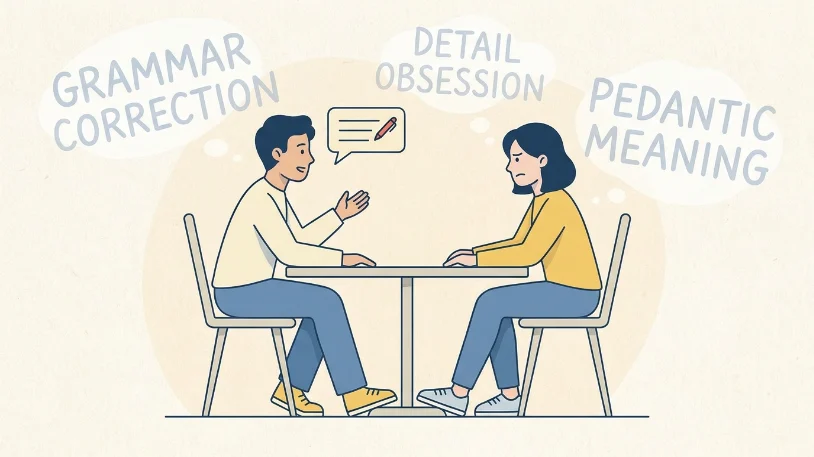
Pedantic meaning refers to an overly strict or formal focus on small details, rules, or accuracy, especially when it disrupts communication or context. A pedantic person often corrects minor errors, even when they do not matter, prioritizing technical correctness over clarity or practicality. While precision can be useful, pedantry is usually seen as annoying or unnecessary in everyday conversation.
You’ve probably heard someone say, “Don’t be so pedantic.” And honestly, it can sting a little.
But here’s the truth. Most people use the word without fully understanding it.
So let’s fix that.
The pedantic meaning is simple at its core, but the behavior behind it is more layered than it looks.
In English, pedantic is an adjective that describes someone who focuses too much on small details, rules, or formal correctness, especially when it interrupts the flow of communication.
In plain terms, a pedantic person cares more about being technically right than being helpful or clear.
Think of it like this:
You’re telling a story. Someone interrupts just to correct a tiny grammar slip that doesn’t change your message.
That interruption? That’s pedantic behavior.
Pedantic Definition in Simple English
Let’s break down the pedantic definition without unnecessary complexity.
Pedantic means:
- Overly concerned with minor details
- Focused on strict rules or exact correctness
- Unnecessarily correcting small mistakes
- Prioritizing form over meaning
A more natural way to define it:
To be pedantic is to treat small details like they are extremely important, even when they are not.
It’s not always about intelligence. It’s about judgment.
Pedantic Pronunciation and Word Form
Understanding pronunciation helps you use the word confidently in conversation.
- Pedantic pronunciation: /pɪˈdæn.tɪk/
- Sounds like: pih-DAN-tik
Word type:
- Pedantic → adjective
- Pedant → noun (a person who is pedantic)
- Pedantry → noun (the behavior or quality)
So if someone is acting this way, you can say:
- “He is being pedantic.”
- “She has a pedantic tone.”
- “That explanation feels pedantic.”
Where the Word “Pedantic” Comes From
The pedantic meaning becomes clearer when you look at its origin.
The word comes from:
- Italian pedante meaning “teacher” or “schoolmaster”
- Later influenced by French usage
- Entered English in the 1600s
Originally, it wasn’t fully negative.
But over time, something changed.
Teachers and scholars who focused too heavily on strict rules and corrections became associated with:
- Over-correction
- Rigidity
- Lack of flexibility
And that’s how “pedantic” slowly turned into a mildly insulting term in modern English.
Today, calling someone pedantic usually carries a negative tone.
Pedantic Tone Meaning in Communication
Tone matters more than most people realize.
A pedantic tone sounds:
- Overly formal
- Excessively precise
- Emotionally detached
- Slightly superior or corrective
For example:
Instead of saying:
“Yeah, I get what you mean.”
A pedantic response might be:
“Actually, your statement is semantically inaccurate based on grammatical structure.”
Same idea. Very different impact.
One builds connection. The other breaks it.
Pedantic Meaning in a Sentence (Real Usage Examples)
Let’s ground this in real-life examples so you can actually use it.
Here are natural pedantic in a sentence examples:
- “Stop being pedantic, I know what I meant.”
- “His pedantic corrections made the conversation exhausting.”
- “She gave a pedantic explanation of a simple idea.”
- “The teacher’s pedantic style confused more than it helped.”
- “Online debates often turn pedantic very quickly.”
Notice something?
The word often appears in situations where communication becomes strained.
Pedantic Person Traits
A pedantic person is not just someone who knows details. Many experts know details.
The difference lies in behavior.
Common traits include:
- Correcting minor grammar mistakes in casual talk
- Interrupting to fix wording instead of understanding meaning
- Over-explaining simple ideas
- Prioritizing technical accuracy over clarity
- Struggling with informal conversation flow
- Focusing on rules even when context doesn’t require it
However, not every detail-oriented person is pedantic.
That distinction matters.
Pedantic vs Precise: A Key Difference People Miss
This is where most confusion happens.
Let’s clear it up.
| Aspect | Precise Person | Pedantic Person |
|---|---|---|
| Focus | Clarity and accuracy | Minor correctness |
| Intent | Help understanding | Enforce rules |
| Effect | Improves communication | Interrupts flow |
| Context awareness | High | Often low |
| Social impact | Positive or neutral | Often negative |
Here’s the key idea:
Precision helps communication. Pedantry interrupts it.
For example, a scientist writing a paper must be precise.
But correcting someone’s casual story about “yesterday” vs “last night” timing? That leans pedantic.
Pedantic vs Pragmatic: Why Balance Matters
The pedantic vs pragmatic contrast is even more important in real life.
A pragmatic person asks:
- “Does this detail matter right now?”
A pedantic person asks:
- “Is this technically perfect?”
Both perspectives have value.
But in conversation, pragmatism usually wins.
Why?
Because communication is about meaning first, not perfection.
Pedantic Behavior in Real Life Situations
Let’s look at how pedantic behavior shows up in everyday life.
In conversations
Someone tells a story casually. Another person interrupts to fix a small word choice.
In classrooms
A student focuses more on formatting rules than understanding concepts.
In workplaces
A colleague insists on exact wording in a message that already communicates clearly.
Online discussions
Threads derail into arguments about grammar instead of ideas.
It’s rarely about intelligence.
It’s about priorities.
Why People Find Pedantic Behavior Annoying
There’s a psychological reason behind the frustration.
People feel:
- Interrupted
- Corrected unnecessarily
- Undermined
- Distracted from their point
So the reaction is often emotional.
Even if the correction is technically right, it can still feel unnecessary.
That’s why tone and timing matter so much.
When Being Pedantic Is Actually Useful
Here’s something important: pedantic behavior isn’t always bad.
In fact, it becomes valuable in specific fields.
Useful situations include:
- Legal writing
- Programming and debugging
- Scientific research
- Engineering documentation
- Medical instructions
- Formal editing
In these areas:
- Small details can change outcomes
- Precision prevents errors
- Rules matter a lot
So pedantry can be a strength when accuracy is critical.
Pedantic Meaning vs Nitpicking vs Fastidious
These words are related but not identical.
| Word | Meaning | Tone |
|---|---|---|
| Pedantic | Overly focused on rules/details | Negative |
| Nitpicking | Finding trivial faults | Negative |
| Fastidious | Very careful about cleanliness or detail | Neutral/positive |
| Exacting | Demanding precision | Neutral |
So while people mix them up, each word has a slightly different emotional weight.
Synonyms and Antonyms of Pedantic
Synonyms
- Nitpicky
- Fastidious
- Exacting
- Overly precise
- Bookish (context-dependent)
Antonyms
- Flexible
- Easygoing
- Informal
- Pragmatic
- Relaxed
Pedantic Meaning in Modern Internet Culture
Online spaces gave the word new life.
You’ve probably seen this phrase:
“Well actually”
That’s become a stereotype for pedantic behavior.
On social media:
- People correct minor details in comment threads
- Arguments shift away from meaning
- Humor often mocks overly technical corrections
It’s not always fair, but it reflects a real communication pattern.
How to Avoid Being Pedantic Without Losing Accuracy
You don’t need to stop caring about correctness.
You just need balance.
Try this approach:
- Ask yourself: “Does this change the meaning?”
- Focus on understanding before correcting
- Save small corrections for appropriate contexts
- Let casual speech stay casual
- Use questions instead of corrections
For example:
Instead of saying:
“That’s incorrect grammar.”
Try:
“Did you mean it this way?”
Small shift. Big difference.
Pedantic Meaning in Linguistics and NLP Context
From a language processing angle, the term “pedantic meaning” connects to how language is structured and interpreted.
Key NLP ideas involved:
- Tokenization: “pedantic” + “meaning” treated as separate tokens
- Part of Speech: pedantic = adjective, meaning = noun
- Lemmatization: pedantic stays stable; meaning → mean
- Query intent: informational search
- Dependency relation: “pedantic” modifies “meaning”
Semantically, the phrase belongs to:
- Language behavior analysis
- Personality trait description
- Communication tone classification
Final Thoughts
The pedantic meaning refers to a person or behavior that focuses too much on small details, rules, or correctness, often at the expense of clarity or communication flow.
It can be useful in technical fields.
But in everyday conversation, it often feels unnecessary or overly strict.
So the real skill is balance. Know when precision helps.
And know when it just gets in the way.