Last Updated on October 11, 2026
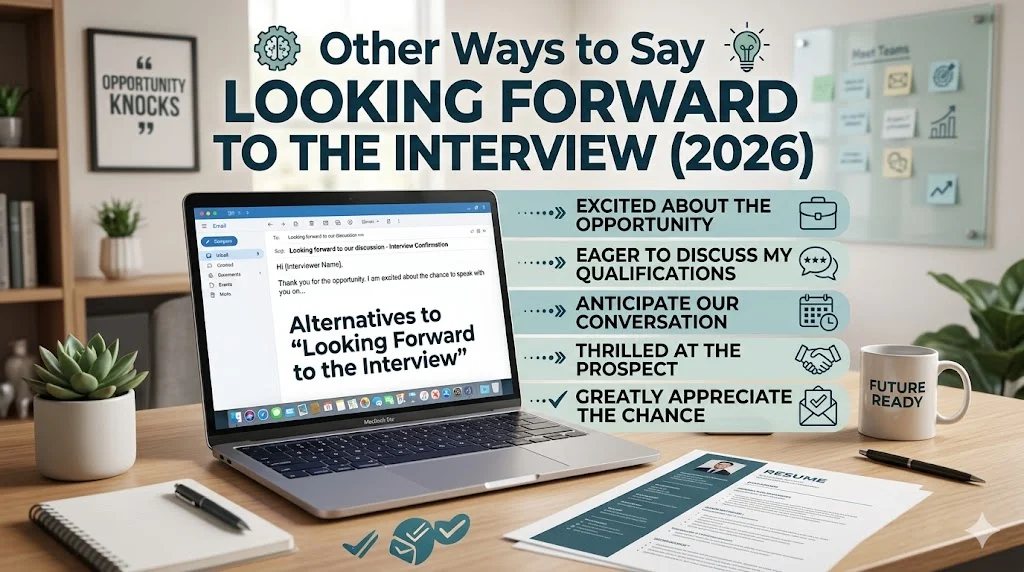
If you want other ways to say looking forward to the interview, try:
I’m eager to speak with you, I appreciate the opportunity, I’m excited about the discussion, I look forward to our conversation, I’m keen to meet with you.
These alternatives help you sound more professional, polished, and confident in emails.
Want to sound more confident and professional before your next job interview? Instead of repeating “looking forward to the interview,” you can use more natural, polished expressions that help you stand out and leave a positive impression.
Whether you’re replying to a recruiter, confirming an interview, or following up with a hiring manager, choosing the right words can make your email sound more genuine and professional.
In this guide, you’ll discover 30+ professional alternatives to “looking forward to the interview,” complete with practical examples for emails and workplace communication. You’ll also learn which phrases work best in formal situations and how to express enthusiasm professionally without sounding repetitive.
Explore these alternatives to make your next interview email clearer, more confident, and more memorable.
Quick Categories
Formal alternatives to “looking forward to the interview”
- I anticipate our meeting
- I look forward to our discussion
- I welcome the opportunity to speak
Pro Tip: Use these in formal emails to recruiters or senior professionals.
Casual alternatives
- Can’t wait to chat
- Excited to talk soon
- Looking forward to connecting
Pro Tip: Suitable for startups or informal company culture.
Professional alternatives
- I’m eager to discuss this role
- I appreciate the opportunity
- I’m keen to meet with you
Pro Tip: Best for job applications, LinkedIn messages, and follow-ups.
Informal expressions
- Can’t wait for our conversation
- Excited for the interview
- Looking forward to it
Pro Tip: Avoid overly informal phrases unless company culture is relaxed.
Common Mistakes
- Overusing the same phrase
Example: “Looking forward to the interview” in every email - Being too casual
Example: “Can’t wait!!!” in a corporate email - Lack of enthusiasm
Example: “Okay, see you for the interview.” - Overly long sentences
Example: “I am extremely and incredibly looking forward…” - No personalization
Example: Generic closing without referencing the role
What Does “Looking Forward to the Interview” Mean?
It expresses anticipation and positive expectation about an upcoming interview.
Grammar Tip:
- “Looking forward to” is followed by a noun or gerund (verb + ing).
Example Sentence:
“I am looking forward to the interview next week.”
When to Use It
- Job application emails
- Interview confirmations
- Follow-up messages
- Networking communication
Spoken vs Written:
- Written: more common and structured
- Spoken: usually replaced with “excited to meet you”
Formal vs Informal:
- Formal: “I look forward to our discussion”
- Informal: “Excited to chat soon”
Is It Professional or Polite to Say “Looking Forward to the Interview”?
Polite? ✔️ Yes
Professional? ✔️ Yes
However, it can feel generic if overused.
Business Example:
“I look forward to discussing how I can contribute to your team.”
Pros and Cons
Pros
- Clear and polite
- Widely accepted
- Professional tone
- Easy to use
Cons
- Overused
- Lacks uniqueness
- Limited emotional range
- Can sound generic
“Small wording changes can make your email sound more confident and memorable.”
Other Ways to Say “Looking Forward to the Interview” With Examples
These alternatives will help you sound more fluent, confident, and natural in different situations.
Use them according to tone, context, and audience to express excitement, admiration, or professionalism.
1. Phrase: I look forward to our discussion
Meaning: Anticipating a professional conversation
Explanation: Formal and widely accepted
Example Sentence: “I look forward to our discussion next week.”
Best Use: formal emails
Worst Use: casual chats
Tone: formal, professional
Context Variability: professional
2. Phrase: I’m eager to speak with you
Meaning: Shows enthusiasm
Explanation: Slightly more expressive than standard phrase
Example Sentence: “I’m eager to speak with you about the role.”
Best Use: job emails
Worst Use: very formal letters
Tone: positive, engaged
Context Variability: professional
3. Phrase: I appreciate the opportunity to interview
Meaning: Shows gratitude
Explanation: Combines appreciation with anticipation
Example Sentence: “I appreciate the opportunity to interview.”
Best Use: polite responses
Worst Use: casual chats
Tone: respectful, professional
Context Variability: professional
4. Phrase: I’m excited about our conversation
Meaning: Expresses enthusiasm
Explanation: Slightly less formal
Example Sentence: “I’m excited about our conversation tomorrow.”
Best Use: modern workplaces
Worst Use: formal letters
Tone: enthusiastic, friendly
Context Variability: both
5. Phrase: I’m keen to meet with you
Meaning: Strong interest
Explanation: Common in professional British English
Example Sentence: “I’m keen to meet with you soon.”
Best Use: interviews
Worst Use: casual chats
Tone: professional, confident
Context Variability: professional
6. Phrase: I anticipate our meeting
Meaning: Formal expectation
Explanation: Very professional tone
Example Sentence: “I anticipate our meeting next week.”
Best Use: corporate roles
Worst Use: informal
Tone: formal, reserved
Context Variability: professional
7. Phrase: I look forward to speaking with you
Meaning: Polite anticipation
Explanation: Slight variation of standard phrase
Example Sentence: “I look forward to speaking with you soon.”
Best Use: emails
Worst Use: none
Tone: neutral, professional
Context Variability: professional
8. Phrase: I’m enthusiastic about the opportunity
Meaning: Strong excitement
Explanation: Focuses on role
Example Sentence: “I’m enthusiastic about the opportunity to interview.”
Best Use: applications
Worst Use: casual
Tone: positive, energetic
Context Variability: professional
9. Phrase: I’m delighted to have this opportunity
Meaning: Gratitude + excitement
Explanation: Formal and warm
Example Sentence: “I’m delighted to have this opportunity.”
Best Use: formal emails
Worst Use: casual
Tone: polite, warm
Context Variability: professional
10. Phrase: I look forward to learning more
Meaning: Interest in role
Explanation: Subtle and professional
Example Sentence: “I look forward to learning more about the role.”
Best Use: interviews
Worst Use: informal
Tone: curious, professional
Context Variability: professional
11. Phrase: I’m excited to discuss this role
Meaning: Focus on job
Explanation: Modern and common
Example Sentence: “I’m excited to discuss this role with you.”
Best Use: startups
Worst Use: formal letters
Tone: enthusiastic
Context Variability: both
12. Phrase: I welcome the opportunity to speak
Meaning: Formal acceptance
Explanation: Polished tone
Example Sentence: “I welcome the opportunity to speak with you.”
Best Use: corporate emails
Worst Use: casual
Tone: formal, respectful
Context Variability: professional
13. Phrase: I’m looking forward to connecting
Meaning: Professional networking tone
Explanation: Slightly modern phrasing
Example Sentence: “I’m looking forward to connecting soon.”
Best Use: LinkedIn
Worst Use: formal docs
Tone: modern, friendly
Context Variability: both
14. Phrase: I’m excited to meet you
Meaning: Friendly enthusiasm
Explanation: More personal tone
Example Sentence: “I’m excited to meet you next week.”
Best Use: interviews
Worst Use: formal
Tone: warm, friendly
Context Variability: both
15. Phrase: I look forward to our meeting
Meaning: Standard formal phrase
Explanation: Widely used
Example Sentence: “I look forward to our meeting.”
Best Use: formal emails
Worst Use: none
Tone: professional
Context Variability: professional
16. Phrase: I’m pleased to have this opportunity
Meaning: Appreciation
Explanation: Professional gratitude
Example Sentence: “I’m pleased to have this opportunity to interview.”
Best Use: formal
Worst Use: casual
Tone: polite
Context Variability: professional
17. Phrase: I’m eager to learn more about the position
Meaning: Interest in job
Explanation: Shows curiosity
Example Sentence: “I’m eager to learn more about the position.”
Best Use: interviews
Worst Use: casual
Tone: professional
Context Variability: professional
18. Phrase: I’m excited for our upcoming discussion
Meaning: Enthusiasm
Explanation: Slightly formal
Example Sentence: “I’m excited for our upcoming discussion.”
Best Use: emails
Worst Use: casual
Tone: positive
Context Variability: both
19. Phrase: I appreciate your time and consideration
Meaning: Gratitude
Explanation: Polite closing
Example Sentence: “I appreciate your time and consideration.”
Best Use: closing line
Worst Use: casual
Tone: respectful
Context Variability: professional
20. Phrase: I look forward to the opportunity
Meaning: Anticipation
Explanation: Slightly indirect
Example Sentence: “I look forward to the opportunity to interview.”
Best Use: formal
Worst Use: casual
Tone: professional
Context Variability: professional
21. Phrase: I’m glad to have the chance to interview
Meaning: Appreciation
Explanation: Friendly tone
Example Sentence: “I’m glad to have the chance to interview.”
Best Use: modern
Worst Use: formal
Tone: warm
Context Variability: both
22. Phrase: I’m excited to explore this opportunity
Meaning: Curiosity
Explanation: Modern phrasing
Example Sentence: “I’m excited to explore this opportunity.”
Best Use: startups
Worst Use: formal
Tone: enthusiastic
Context Variability: both
23. Phrase: I’m looking forward to our conversation
Meaning: Friendly professional
Explanation: Common variation
Example Sentence: “I’m looking forward to our conversation.”
Best Use: emails
Worst Use: none
Tone: neutral
Context Variability: both
24. Phrase: I’m happy to discuss this further
Meaning: Openness
Explanation: Less enthusiastic
Example Sentence: “I’m happy to discuss this further.”
Best Use: follow-ups
Worst Use: interviews
Tone: neutral
Context Variability: professional
25. Phrase: I’m eager for our upcoming meeting
Meaning: Strong interest
Explanation: Formal enthusiasm
Example Sentence: “I’m eager for our upcoming meeting.”
Best Use: interviews
Worst Use: casual
Tone: professional
Context Variability: professional
26. Phrase: I’m enthusiastic about speaking with you
Meaning: Positive tone
Explanation: Strong energy
Example Sentence: “I’m enthusiastic about speaking with you.”
Best Use: modern workplaces
Worst Use: formal docs
Tone: energetic
Context Variability: both
27. Phrase: I look forward to discussing my application
Meaning: Focus on candidacy
Explanation: Specific and professional
Example Sentence: “I look forward to discussing my application.”
Best Use: job emails
Worst Use: casual
Tone: professional
Context Variability: professional
28. Phrase: I’m excited to share more about my experience
Meaning: Confidence
Explanation: Highlights candidate
Example Sentence: “I’m excited to share more about my experience.”
Best Use: interviews
Worst Use: formal
Tone: confident
Context Variability: both
29. Phrase: I’m eager to connect and discuss further
Meaning: Professional networking
Explanation: Balanced tone
Example Sentence: “I’m eager to connect and discuss further.”
Best Use: LinkedIn
Worst Use: formal docs
Tone: modern
Context Variability: both
30. Phrase: I look forward to our upcoming interview
Meaning: Direct alternative
Explanation: Slight variation
Example Sentence: “I look forward to our upcoming interview.”
Best Use: formal emails
Worst Use: casual
Tone: professional
Context Variability: professional
“Combining enthusiasm with professionalism is key in interview communication.”
Mini Quiz / Self-Check
1. Most formal option?
A. Can’t wait to chat
B. I anticipate our meeting
C. Excited to talk
Answer: B
2. Best for startup culture?
A. I’m excited to discuss this role
B. I welcome the opportunity
C. I anticipate our meeting
Answer: A
3. Best closing for corporate email?
A. I’m looking forward to our discussion
B. Can’t wait
C. Super excited
Answer: A
Comparison Table: Top Alternatives
| Phrase | Tone | Best Use |
|---|---|---|
| I look forward to our discussion | Formal | Corporate emails |
| I’m eager to speak with you | Professional | Job applications |
| I appreciate the opportunity | Polite | Interview replies |
| I’m excited about our conversation | Friendly | Startups |
| I anticipate our meeting | Formal | Executive roles |
| I’m keen to meet with you | Professional | Interviews |
| I look forward to speaking with you | Neutral | Emails |
| I welcome the opportunity | Formal | Corporate |
| I’m excited to discuss this role | Modern | Tech/startups |
| I’m looking forward to connecting | Casual | Networking |
FAQs
1. What is the best professional alternative?
“I look forward to our discussion” or “I welcome the opportunity to speak.”
2. Can I say “excited” in a professional email?
Yes, but use it moderately in less formal environments.
3. Should I always include this phrase?
Yes, it’s a good closing line for interview emails.
4. What should I avoid?
Avoid overly casual phrases like “Can’t wait!!!”
5. How can I stand out?
Personalize the sentence by mentioning the role or company.
Conclusion
Using other ways to say looking forward to the interview helps you sound more professional, confident, and engaging. It also prevents your communication from sounding repetitive.
Practice these alternatives daily and adapt them based on tone, context, and company culture to leave a strong impression in your job applications.