Last Updated on June 10, 2026
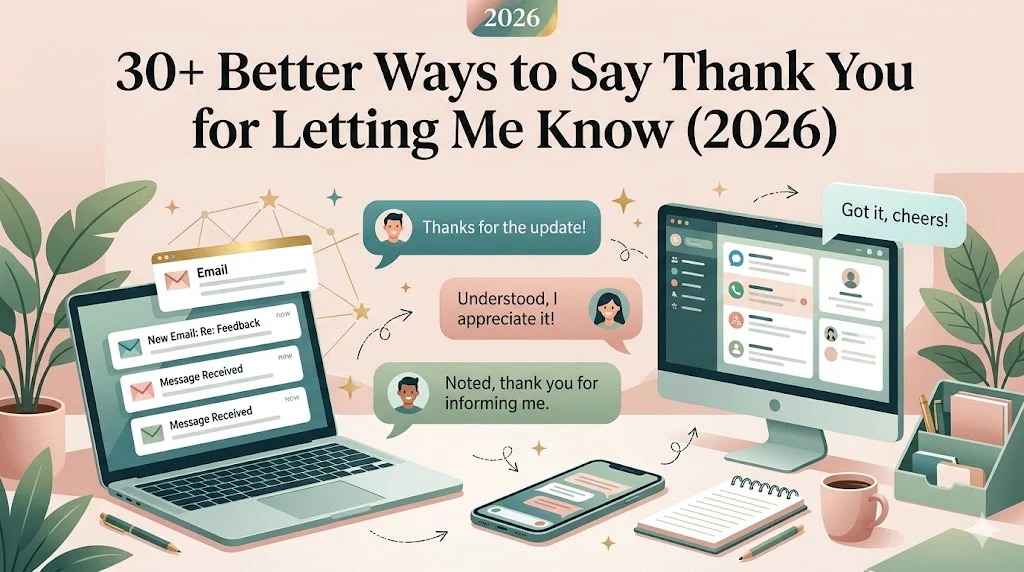
Looking for other ways to say thank you for letting me know? Try:
I appreciate the update, Thanks for the information, Good to know, I appreciate you informing me, Thanks for keeping me posted.
These alternatives help you sound more professional, natural, polished, or conversational depending on the context.
The phrase “thank you for letting me know” is commonly used in emails, workplace communication, and everyday conversations. It politely acknowledges information someone has shared with you.
While it’s useful and professional, repeating the same phrase too often can make your communication sound repetitive or generic. Learning alternatives to “thank you for letting me know” helps you improve fluency, vary your tone, and communicate more naturally in both professional and casual situations.
Whether you’re replying to a manager, client, coworker, teacher, or friend, using varied responses can make your English sound more polished and confident.
“Professional communication becomes stronger when your responses sound intentional instead of repetitive.”
Quick Categories
Formal alternatives to “thank you for letting me know”
- I appreciate the information
- Thank you for the update
- I appreciate your notification
- Thank you for informing me
Pro Tip: Use these in workplace emails, client communication, or formal situations.
Casual alternatives
- Good to know
- Got it, thanks
- Thanks for the heads-up
- Appreciate it
Pro Tip: Great for texting, team chats, or informal communication.
Professional alternatives
- Thanks for keeping me informed
- I appreciate the clarification
- Thank you for bringing this to my attention
- I appreciate the update
Pro Tip: Best for office communication and business emails.
Friendly / conversational alternatives
- Thanks for sharing
- Glad you told me
- Thanks for the info
- I’m happy you mentioned it
Pro Tip: Helps conversations feel warmer and less robotic.
Common Mistakes
- Using the exact same phrase repeatedly
Example: “Thank you for letting me know” in every email thread - Sounding too casual professionally
Example: “Cool, thanks!” in a client email - Being overly formal in casual chats
Example: “I appreciate your notification.” to a friend - Not matching the tone of the message
Example: Casual response to serious information - Giving very short cold replies
Example: “Noted.”
What Does “Thank You for Letting Me Know” Mean?
The phrase means you appreciate someone for informing or updating you about something.
Grammar Tip
“Letting me know” uses a gerund phrase after “thank you for.”
Example Sentence
“Thank you for letting me know about the schedule change.”
When to Use “Thank You for Letting Me Know”
- Responding to updates
- Acknowledging new information
- Confirming receipt of a message
- Workplace communication
- Customer service replies
Spoken vs Written
- Written: extremely common in emails/messages
- Spoken: often replaced with shorter responses like “Good to know”
Formal vs Informal
- Formal: “Thank you for informing me.”
- Informal: “Got it, thanks.”
Is It Professional or Polite to Say “Thank You for Letting Me Know”?
Polite? ✔️ Yes
Professional? ✔️ Yes
However, overusing it can make your responses feel repetitive.
Business Example
“Thank you for letting me know about the revised timeline.”
Pros and Cons of Using “Thank You for Letting Me Know”
Pros
- Professional and polite
- Universally understood
- Easy to use
- Appropriate in most situations
Cons
- Overused in emails
- Can sound generic
- Lacks personality
- Sometimes too formal for casual chats
“The best email responses are polite, concise, and naturally varied.”
Other Ways to Say “Thank You for Letting Me Know” (With Examples)
These alternatives will help you sound more fluent, professional, and natural in different situations.
Use them according to tone, audience, and context to communicate appreciation effectively.
1. Phrase: I appreciate the update
Meaning: Gratitude for new information
Explanation: Professional and versatile
Example Sentence: “I appreciate the update regarding the project.”
Best Use: workplace emails
Worst Use: casual texting
Tone: professional, polite
Context Variability: professional
2. Phrase: Thanks for the information
Meaning: Appreciation for shared details
Explanation: Simple and neutral
Example Sentence: “Thanks for the information about the event.”
Best Use: general communication
Worst Use: highly formal documents
Tone: neutral, polite
Context Variability: both
3. Phrase: Good to know
Meaning: Acknowledging useful information
Explanation: Casual and conversational
Example Sentence: “Good to know; I’ll plan accordingly.”
Best Use: chats, casual work communication
Worst Use: formal reports
Tone: relaxed, friendly
Context Variability: casual
4. Phrase: Thanks for keeping me posted
Meaning: Appreciation for updates
Explanation: Common workplace expression
Example Sentence: “Thanks for keeping me posted on the progress.”
Best Use: teamwork
Worst Use: highly formal writing
Tone: professional, conversational
Context Variability: both
5. Phrase: I appreciate you informing me
Meaning: Gratitude for notification
Explanation: Slightly formal alternative
Example Sentence: “I appreciate you informing me in advance.”
Best Use: professional emails
Worst Use: casual chat
Tone: respectful, formal
Context Variability: professional
6. Phrase: Thanks for the heads-up
Meaning: Appreciation for advance warning
Explanation: Informal but common
Example Sentence: “Thanks for the heads-up about the delay.”
Best Use: team chats
Worst Use: corporate legal emails
Tone: casual, helpful
Context Variability: casual
7. Phrase: Thank you for the update
Meaning: Gratitude for current information
Explanation: One of the most professional alternatives
Example Sentence: “Thank you for the update on the meeting schedule.”
Best Use: business communication
Worst Use: casual texting
Tone: professional, polished
Context Variability: professional
8. Phrase: Got it, thanks
Meaning: Confirmation and gratitude
Explanation: Short conversational response
Example Sentence: “Got it, thanks for letting me know.”
Best Use: messaging apps
Worst Use: formal emails
Tone: casual, concise
Context Variability: casual
9. Phrase: I appreciate the clarification
Meaning: Gratitude for clearer information
Explanation: Best when correcting misunderstandings
Example Sentence: “I appreciate the clarification regarding the policy.”
Best Use: professional communication
Worst Use: casual chats
Tone: formal, thoughtful
Context Variability: professional
10. Phrase: Thanks for bringing this to my attention
Meaning: Appreciation for important information
Explanation: Common in workplace communication
Example Sentence: “Thanks for bringing this to my attention.”
Best Use: workplace issues
Worst Use: casual conversations
Tone: professional, attentive
Context Variability: professional
11. Phrase: I appreciate the notice
Meaning: Gratitude for being informed
Explanation: Polite and concise
Example Sentence: “I appreciate the notice about the changes.”
Best Use: scheduling updates
Worst Use: casual texting
Tone: polite, professional
Context Variability: professional
12. Phrase: Thanks for sharing
Meaning: Appreciation for information sharing
Explanation: Friendly and warm
Example Sentence: “Thanks for sharing this with me.”
Best Use: conversations
Worst Use: formal business emails
Tone: warm, casual
Context Variability: casual
13. Phrase: I’m glad you told me
Meaning: Appreciation plus emotional response
Explanation: More personal and conversational
Example Sentence: “I’m glad you told me about the issue.”
Best Use: personal conversations
Worst Use: corporate reports
Tone: warm, sincere
Context Variability: personal
14. Phrase: Thank you for informing me
Meaning: Formal gratitude
Explanation: Professional and direct
Example Sentence: “Thank you for informing me about the policy update.”
Best Use: formal emails
Worst Use: friendly chats
Tone: formal, respectful
Context Variability: professional
15. Phrase: Thanks for making me aware
Meaning: Appreciation for awareness
Explanation: Common in workplace communication
Example Sentence: “Thanks for making me aware of the situation.”
Best Use: office communication
Worst Use: casual social texting
Tone: professional, neutral
Context Variability: professional
16. Phrase: I appreciate your message
Meaning: Gratitude for communication
Explanation: Slightly warmer tone
Example Sentence: “I appreciate your message and update.”
Best Use: emails
Worst Use: fast casual chats
Tone: professional, warm
Context Variability: both
17. Phrase: Thanks for the reminder
Meaning: Gratitude for remembering something
Explanation: Useful for deadlines/events
Example Sentence: “Thanks for the reminder about tomorrow’s meeting.”
Best Use: scheduling
Worst Use: serious issues
Tone: casual, appreciative
Context Variability: both
18. Phrase: Much appreciated
Meaning: Short gratitude expression
Explanation: Concise but warm
Example Sentence: “Much appreciated; thanks for the update.”
Best Use: short replies
Worst Use: formal documents
Tone: warm, concise
Context Variability: both
19. Phrase: I appreciate your transparency
Meaning: Gratitude for honesty
Explanation: Good for sensitive information
Example Sentence: “I appreciate your transparency regarding the issue.”
Best Use: professional discussions
Worst Use: casual chats
Tone: respectful, thoughtful
Context Variability: professional
20. Phrase: Thank you for the clarification
Meaning: Appreciation for explanation
Explanation: Best when confusion existed
Example Sentence: “Thank you for the clarification on the timeline.”
Best Use: meetings/emails
Worst Use: casual texting
Tone: professional
Context Variability: professional
21. Phrase: Appreciate the info
Meaning: Casual gratitude
Explanation: Relaxed conversational alternative
Example Sentence: “Appreciate the info about the event.”
Best Use: team chats
Worst Use: formal writing
Tone: casual, friendly
Context Variability: casual
22. Phrase: Thanks for updating me
Meaning: Appreciation for ongoing communication
Explanation: Friendly and natural
Example Sentence: “Thanks for updating me on the situation.”
Best Use: work or personal
Worst Use: legal communication
Tone: conversational, polite
Context Variability: both
23. Phrase: I appreciate being informed
Meaning: Gratitude for inclusion
Explanation: Formal and polished
Example Sentence: “I appreciate being informed ahead of time.”
Best Use: professional settings
Worst Use: casual messaging
Tone: formal, respectful
Context Variability: professional
24. Phrase: Thank you for notifying me
Meaning: Formal acknowledgment
Explanation: Often used in official communication
Example Sentence: “Thank you for notifying me of the changes.”
Best Use: corporate communication
Worst Use: social conversations
Tone: formal, professional
Context Variability: professional
25. Phrase: Glad you mentioned it
Meaning: Friendly acknowledgment
Explanation: Casual and conversational
Example Sentence: “Glad you mentioned it before the meeting.”
Best Use: casual conversations
Worst Use: formal reports
Tone: relaxed, friendly
Context Variability: casual
26. Phrase: I appreciate the communication
Meaning: Gratitude for being informed
Explanation: Professional and broad
Example Sentence: “I appreciate the communication regarding the issue.”
Best Use: client communication
Worst Use: casual texting
Tone: professional
Context Variability: professional
27. Phrase: Thank you for keeping me informed
Meaning: Appreciation for continuous updates
Explanation: Common workplace phrase
Example Sentence: “Thank you for keeping me informed throughout the process.”
Best Use: teamwork
Worst Use: casual chats
Tone: professional, appreciative
Context Variability: professional
28. Phrase: I’m happy you let me know
Meaning: Warm appreciation
Explanation: More emotional and conversational
Example Sentence: “I’m happy you let me know ahead of time.”
Best Use: personal communication
Worst Use: formal business writing
Tone: warm, friendly
Context Variability: personal
29. Phrase: Thank you for sharing this
Meaning: Gratitude for communicated information
Explanation: Slightly softer tone
Example Sentence: “Thank you for sharing this important information.”
Best Use: presentations/emails
Worst Use: casual slang contexts
Tone: professional, warm
Context Variability: both
30. Phrase: I appreciate your update and support
Meaning: Combined gratitude and professionalism
Explanation: Useful in collaborative settings
Example Sentence: “I appreciate your update and support during the transition.”
Best Use: workplace communication
Worst Use: casual texting
Tone: professional, appreciative
Context Variability: professional
“Strong communication isn’t just about information — it’s about tone, clarity, and connection.”
Mini Quiz / Self-Check
1. Which phrase is most formal?
A. Got it, thanks
B. Thank you for notifying me
C. Good to know
Answer: B
2. Best phrase for team chat?
A. Thanks for the heads-up
B. I appreciate your notification
C. Thank you for informing me
Answer: A
3. Best for a professional email?
A. Appreciate the info
B. Thanks for updating me
C. I appreciate the update
Answer: C
Comparison Table: Top Alternatives
| Phrase | Tone | Best Use |
| I appreciate the update | Professional | Workplace emails |
| Thanks for the information | Neutral | General communication |
| Good to know | Casual | Conversations |
| Thanks for keeping me posted | Conversational | Team communication |
| I appreciate the clarification | Formal | Clarifications |
| Thanks for bringing this to my attention | Professional | Important issues |
| Thanks for the heads-up | Casual | Advance notice |
| Thank you for informing me | Formal | Official emails |
| Thanks for updating me | Friendly | Ongoing communication |
| Thank you for keeping me informed | Professional | Projects/teamwork |
FAQs
1. What is the most professional alternative?
“I appreciate the update” or “Thank you for informing me.”
2. What’s a casual alternative?
“Good to know” or “Thanks for the heads-up.”
3. Is “thank you for letting me know” too formal?
No, but it can sound repetitive if overused.
4. What’s best for workplace emails?
“Thank you for the update” is one of the safest options.
5. How can I sound less robotic in emails?
Use warmer alternatives like “I appreciate the update” or “Thanks for keeping me posted.”
Conclusion
Learning other ways to say thank you for letting me know helps your communication sound more natural, polished, and context-aware. By varying your responses, you avoid repetition and create more engaging professional and personal conversations.
Practice these alternatives regularly in emails, messages, and meetings to improve your fluency and tone awareness. Small wording changes can make your communication sound significantly more confident and professional.