
Last Updated on June 24, 2026
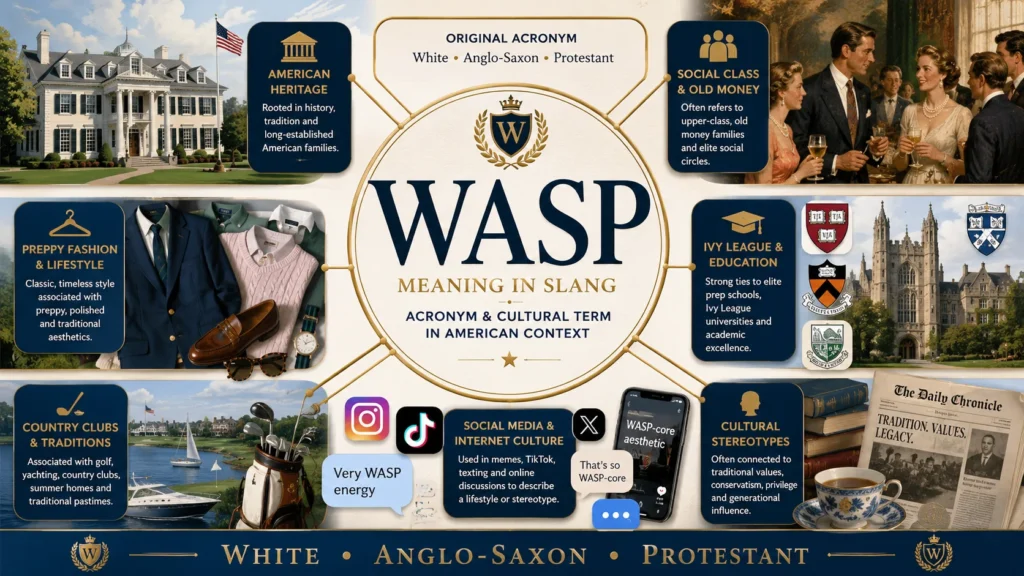
WASP is an acronym that most commonly stands for White Anglo-Saxon Protestant. In American culture, the term refers to a traditional social group historically associated with wealth, influence, and old-money families. While WASP is sometimes used as slang online, its primary meaning remains cultural and sociological rather than internet-based. On social media, texting apps, TikTok, Reddit, and other online platforms, people often use WASP to discuss social class, stereotypes, elite backgrounds, lifestyle trends, or cultural identity.
Although many people search for wasp meaning slang, the term carries a much deeper cultural meaning than most internet slang expressions.
For decades, WASP has served as a shorthand description for a particular social group in the United States. Historically, this group held significant influence in politics, business, education, finance, and cultural institutions.
Unlike many demographic labels, WASP combines elements of ancestry, religion, culture, and social standing. Because of that, the term often appears in discussions about American history, class systems, privilege, and cultural identity.
The Traditional WASP Identity
Traditionally, a WASP was someone who belonged to a family with:
- White European ancestry
- Anglo-Saxon heritage
- Protestant religious roots
- Long-established American family history
The label became especially associated with families whose ancestors arrived in America generations before large waves of immigration from Southern Europe, Eastern Europe, Asia, and Latin America.
In many cases, being considered a WASP had less to do with wealth alone and more to do with cultural background.
WASP Social Class Meaning
One reason the term remains popular today is its connection to social class.
Historically, WASPs occupied many positions of power throughout American society. As a result, the term gradually became linked with:
| Association | Description |
|---|---|
| Wealth | Generational wealth and inherited assets |
| Education | Elite private schools and universities |
| Politics | Strong representation in government |
| Business | Leadership in major corporations |
| Social Status | Membership in influential social circles |
Not every WASP was wealthy.
However, the stereotype became so common that many people now automatically associate WASPs with privilege and upper-class lifestyles.
Upper-Class American Associations
When people discuss WASPs today, they often refer to the traditional American upper class.
Common associations include:
- Private boarding schools
- Ivy League education
- Country clubs
- Family trusts
- Historic family estates
- Professional careers
- Generational wealth
These associations helped create the modern image of the WASP as part of America’s old establishment.
Old Money Families and WASP Culture
Many discussions about WASPs overlap with discussions about “old money.”
Old money generally refers to wealth passed through multiple generations rather than wealth earned recently.
As a result, many famous American families historically identified as WASP families.
Characteristics often associated with old-money WASP culture include:
- Emphasis on tradition
- Private rather than flashy displays of wealth
- Strong educational expectations
- Community involvement
- Family legacy preservation
A common stereotype suggests that old-money WASPs avoid showing off wealth and instead value social reputation and long-term influence.
Influence on Politics, Business, and Education
Throughout American history, WASPs held many leadership positions.
Their influence could be seen in:
- Government institutions
- Banking systems
- Major corporations
- Prestigious universities
- Religious organizations
- Charitable foundations
For much of the twentieth century, many of America’s most influential leaders came from backgrounds commonly described as WASP.
Today, American leadership is far more diverse. Nevertheless, the historical impact of WASP culture remains an important topic in discussions about social change and power structures.
WASP Stereotype Explained
One reason people frequently search for meaning of WASP slang is because they encounter the term in jokes, memes, and cultural commentary.
Most of these references rely on stereotypes.
Understanding those stereotypes helps explain how the term is used in modern conversation.
Common Characteristics Associated With WASPs
Popular stereotypes often portray WASPs as:
- Reserved
- Polite
- Formal
- Educated
- Wealthy
- Traditional
- Conservative in behavior
- Socially connected
These characteristics are broad generalizations rather than accurate descriptions of every individual.
Still, they have become deeply embedded in American popular culture.
Popular Cultural Stereotypes
The stereotypical WASP is often imagined as someone who:
- Attends elite schools
- Plays golf or tennis
- Lives in affluent suburbs
- Belongs to exclusive clubs
- Values etiquette and tradition
- Comes from a long-established family
In movies and television, these stereotypes frequently appear as shortcuts for identifying a character’s social background.
Why the Stereotype Exists
Several factors contributed to the development of WASP stereotypes.
First, many influential institutions in America were historically dominated by people who fit the WASP profile.
Second, media representations reinforced certain images over time.
Third, social class differences created visible cultural patterns that became associated with the group.
As these patterns repeated across generations, they evolved into recognizable stereotypes.
Criticism of WASP Stereotypes
Many scholars and cultural commentators criticize WASP stereotypes because they oversimplify a large and diverse population.
Problems with stereotypes include:
- Ignoring individual differences
- Assuming wealth or privilege
- Reducing people to social labels
- Reinforcing outdated assumptions
- Misrepresenting cultural diversity
Like any broad demographic term, WASP cannot accurately describe every person who falls under the category.
Differences Between Reality and Stereotypes
The reality is far more complex than the stereotype.
For example:
| Stereotype | Reality |
|---|---|
| All WASPs are rich | Many are middle class |
| All WASPs are Protestant | Religious practice varies greatly |
| All WASPs are politically similar | Political views differ widely |
| All WASPs come from old money | Many do not |
| All WASPs share the same culture | Regional differences are significant |
Because of these differences, many people use the term cautiously today.
WASP Meaning on Social Media
Social media has introduced the term WASP to younger audiences who may know little about its historical background.
As a result, wasp social media meaning often differs from the traditional definition.
WASP Meaning on TikTok
On TikTok, users frequently mention WASPs when discussing:
- Old-money aesthetics
- Wealthy family traditions
- Elite social circles
- Preppy fashion
- Country club culture
- Generational privilege
In many videos, WASP serves as a cultural reference rather than a precise demographic label.
Creators often use the term to describe a lifestyle image rather than actual ancestry or religion.
WASP Meaning on Instagram
Instagram users commonly connect WASP culture with visual aesthetics.
Examples include:
- Coastal homes
- Tennis outfits
- Luxury summer vacations
- Traditional fashion
- Ivy League imagery
- New England lifestyles
This content often focuses on appearance and lifestyle branding.
WASP Meaning on X and Reddit
On discussion-based platforms, the term usually appears in conversations about:
- American history
- Social class
- Wealth inequality
- Politics
- Cultural identity
- Family background
Unlike image-driven platforms, these discussions tend to explore the historical and sociological meaning of WASP.
Why Younger Users Mention WASPs Online
Many younger internet users encounter the term through:
- Fashion trends
- Lifestyle influencers
- Pop culture references
- Meme accounts
- Historical discussions
As a result, the meaning often becomes simplified into an aesthetic rather than a social classification.
Modern Meme Culture and WASP References
Memes frequently exaggerate WASP stereotypes for humor.
Examples might focus on:
- Expensive boarding schools
- Summer homes
- Sailing trips
- Tennis clubs
- Family legacies
These jokes work because audiences recognize the cultural stereotypes attached to the term.
However, the memes rarely reflect the full historical meaning behind WASP identity.
WASP Internet Slang and Online Usage
The growing popularity of social media has caused many users to wonder whether WASP qualifies as internet slang.
The answer is somewhat complicated.
Is WASP Considered Online Slang?
Technically, WASP is not a modern internet-created slang term.
Unlike abbreviations such as:
- LOL
- BRB
- IMO
- FYP
WASP existed long before the internet.
However, because people now use it casually online, some users categorize it as internet slang.
How People Use WASP in Internet Discussions
Online conversations often use WASP to discuss:
- Cultural stereotypes
- Social privilege
- Wealthy communities
- Historical influence
- American traditions
The exact meaning depends heavily on context.
Typical Social Media Contexts
You may encounter WASP in posts about:
- Fashion
- Wealth
- Family backgrounds
- Politics
- History
- Lifestyle trends
The term often acts as cultural shorthand.
Examples of WASP Usage Online
Example 1:
“That movie portrays classic WASP culture.”
Example 2:
“The neighborhood has a traditional WASP reputation.”
Example 3:
“People keep calling that aesthetic WASP-inspired.”
In each example, the term refers to culture rather than an internet abbreviation.
Common Misunderstandings
One of the biggest misunderstandings involves assuming WASP is a new social media acronym.
In reality:
- It predates the internet by decades.
- It originated as a cultural and sociological term.
- Its primary meaning remains White Anglo-Saxon Protestant.
- Social media merely expanded its visibility.
Understanding this distinction helps prevent confusion when encountering the term online.
WASP Meaning in Text Messages
Many people search for what does WASP mean in a text message because they encounter the acronym in chats, comments, or social media conversations.
Unlike texting abbreviations such as “LOL” or “IDK,” WASP usually keeps the same core meaning it has had for decades. Most of the time, it refers to White Anglo-Saxon Protestant or the cultural characteristics associated with that group.
The challenge is that text messages often lack context. A single acronym can mean different things depending on the conversation.
What Does WASP Mean in a Text?
In most texting situations, WASP refers to:
- A person’s cultural background
- A social class stereotype
- An old-money family image
- Traditional American elite culture
- A lifestyle associated with historical privilege
For example:
Text Message Example
Person A: “His family seems very WASP.”
Person B: “Yeah, they’ve been in that town for generations.”
In this case, WASP refers to family background and cultural identity rather than religion alone.
Texting Examples in Different Contexts
The meaning changes slightly depending on the conversation.
| Text Message | Meaning |
|---|---|
| “She has a very WASP style.” | Traditional preppy aesthetic |
| “That neighborhood is pretty WASP.” | Historically affluent demographic |
| “The movie focuses on a WASP family.” | White Anglo-Saxon Protestant background |
| “People call that look WASP-core now.” | Fashion or lifestyle trend |
| “He’s from a classic WASP household.” | Cultural and family heritage |
Notice that the term often describes culture rather than ethnicity alone.
Group Chat Usage
In group conversations, WASP often appears during discussions about:
- Television shows
- Celebrities
- Fashion trends
- Wealthy communities
- Historical topics
- College culture
For example:
“That entire show is basically about WASP families and old money.”
The speaker is referring to social class and cultural traditions.
Casual Conversation Examples
You might also see phrases like:
- “Very WASP energy.”
- “That town feels WASP.”
- “Classic WASP aesthetic.”
- “Old-school WASP culture.”
- “WASP family traditions.”
These examples show how the term has evolved into a broader cultural description.
How Context Changes the Meaning
Context remains everything.
When discussing:
- History → demographic meaning
- Politics → social influence meaning
- Fashion → aesthetic meaning
- Family background → cultural identity meaning
- Memes → stereotype meaning
Without context, interpreting WASP correctly becomes difficult.
WASP Urban Dictionary Meaning
Many users also search for wasp urban dictionary because they want to understand how internet communities use the term.
Urban Dictionary entries often differ from traditional dictionary definitions because users create them rather than professional editors.
As a result, definitions can range from accurate explanations to exaggerated jokes.
How Urban Dictionary Typically Describes WASP
Most user-submitted definitions reference:
- White Anglo-Saxon Protestant
- Wealthy American families
- Traditional upper-class culture
- Preppy lifestyles
- Elite educational backgrounds
Many definitions also emphasize stereotypes connected to wealth and privilege.
User-Generated Interpretations
Because Urban Dictionary relies on public submissions, interpretations vary widely.
Some definitions focus on:
- Social class
- Family history
- Cultural habits
- Fashion styles
- Political influence
Others use humor and exaggeration.
That variation explains why internet users sometimes become confused about the term’s actual meaning.
Differences Between Formal and Informal Definitions
The difference between formal definitions and internet definitions is important.
| Formal Definition | Informal Internet Definition |
|---|---|
| White Anglo-Saxon Protestant | Wealthy old-money person |
| Historical demographic group | Preppy lifestyle |
| Sociological term | Elite stereotype |
| Cultural identity | Meme personality type |
| Academic classification | Social media aesthetic |
Both uses exist today.
However, the formal definition remains the original meaning.
Why Online Definitions Vary
Online communities often reshape language.
Over time, people begin using terms in broader ways.
As a result, WASP can describe:
- A person
- A family
- A neighborhood
- A fashion style
- A social class
- A cultural stereotype
That flexibility explains its popularity across social media platforms.
Different Ways People Use WASP Today
The meaning of WASP has expanded considerably over the years.
While the acronym itself remains unchanged, modern usage varies depending on the speaker and context.
Describing a Person
One of the most common uses involves describing an individual.
Examples include:
- “He’s very WASP.”
- “She comes from a WASP family.”
- “They have a WASP background.”
In these situations, the term usually refers to cultural identity or family history.
Describing a Family Background
Many people use WASP when discussing family origins.
Examples:
- Long-established American ancestry
- Protestant traditions
- Generational social status
- Historical community influence
Family background remains one of the most common associations.
Describing a Lifestyle
Modern social media frequently uses WASP to describe a lifestyle.
Common lifestyle references include:
- Sailing
- Tennis
- Golf
- Country clubs
- Boarding schools
- Summer homes
- Traditional etiquette
These associations stem from longstanding stereotypes.
Describing Social Status
The term also appears in discussions about class.
People may use WASP to refer to:
- Established wealth
- Elite institutions
- Influential networks
- Upper-middle-class culture
- Old-money traditions
Not every WASP belongs to these categories.
Still, the association remains common.
Describing Cultural Habits
Some conversations focus on cultural behaviors rather than economic status.
Examples include:
- Reserved communication styles
- Formal social customs
- Family traditions
- Educational expectations
- Community involvement
These cultural patterns often appear in discussions of American social history.
Examples of WASP Used in Sentences
Understanding real-world examples helps clarify the term.
Everyday Conversation Examples
- “That family has deep WASP roots.”
- “The town developed around traditional WASP communities.”
- “Many people associate the region with WASP culture.”
- “His grandparents came from a classic WASP background.”
- “The novel explores WASP family dynamics.”
Social Media Examples
- “This outfit is giving major WASP vibes.”
- “Everyone keeps calling that trend WASP-core.”
- “The aesthetic feels very New England WASP.”
- “That’s peak WASP summer energy.”
- “The creator posts a lot of WASP-inspired content.”
Text Message Examples
Friend 1: “Why does everyone call that style WASP?”
Friend 2: “Because it looks like traditional old-money East Coast fashion.”
Friend 1: “What does WASP mean?”
Friend 2: “White Anglo-Saxon Protestant. It’s also used to describe a certain social culture.”
Humor and Meme Examples
Internet humor often exaggerates stereotypes.
Examples include:
- “Born to sail. Forced to work.”
- “WASP starter pack.”
- “Country club speedrun.”
- “Boarding school final boss.”
- “Peak WASP summer.”
These jokes rely on recognizable cultural references.
Cultural Discussion Examples
Academic or historical discussions often use more precise language.
For example:
“The term WASP has historically described a dominant social group within American institutions.”
This usage focuses on sociology rather than humor.
WASP Lifestyle and Cultural Traits
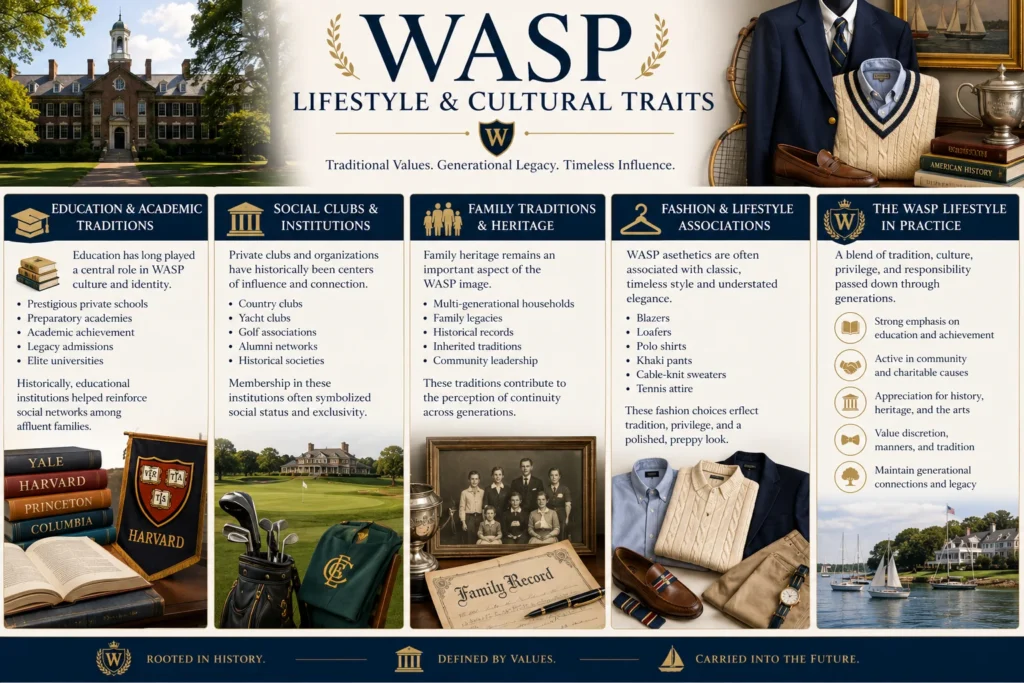
One reason the term remains relevant is its connection to recognizable cultural traits.
Although stereotypes can oversimplify reality, several recurring themes appear in discussions of WASP culture.
Education and Academic Traditions
Education has long played a central role.
Common associations include:
- Prestigious private schools
- Preparatory academies
- Academic achievement
- Legacy admissions
- Elite universities
Historically, educational institutions often helped reinforce social networks among affluent families.
Social Clubs and Institutions
Another recurring theme involves private organizations.
Examples include:
- Country clubs
- Yacht clubs
- Golf associations
- Alumni networks
- Historical societies
Membership in these institutions often symbolized social status.
Family Traditions
Family heritage remains an important aspect of the WASP image.
Common themes include:
- Multi-generational households
- Family legacies
- Historical records
- Inherited traditions
- Community leadership
These traditions contribute to the perception of continuity across generations.
Fashion and Lifestyle Associations
Fashion discussions frequently reference WASP aesthetics.
Typical elements include:
- Blazers
- Loafers
- Polo shirts
- Khaki pants
- Cable-knit sweaters
- Tennis attire
In recent years, these fashion choices have reappeared through social media trends.
Regional Connections in the United States
Certain regions receive stronger WASP associations than others.
Examples include:
| Region | Common Association |
|---|---|
| New England | Traditional WASP culture |
| Connecticut | Old-money communities |
| Massachusetts | Historic family networks |
| New York suburbs | Elite institutions |
| Mid-Atlantic states | Established social circles |
These associations reflect historical migration and settlement patterns rather than modern demographics alone.
WASP vs Other Similar Terms
Many people mistakenly assume WASP means the same thing as several related terms.
In reality, important differences exist.
WASP vs Old Money
Old money refers primarily to inherited wealth.
WASP refers to:
- Ethnic background
- Religious heritage
- Cultural identity
- Historical social status
A family can be old money without being WASP.
Likewise, a WASP family may not be wealthy.
WASP vs Upper Class
Upper class focuses on economic position.
WASP focuses on cultural background.
Although overlap exists, the terms are not interchangeable.
WASP vs Elite
Elite describes influence or status.
WASP describes a specific historical demographic group.
Many elite individuals today are not WASPs.
WASP vs Preppy
Preppy mainly refers to fashion and lifestyle.
WASP refers to a broader cultural identity.
The two often overlap because preppy fashion emerged from institutions historically associated with WASP culture.
WASP vs Wealthy
Not every wealthy person is a WASP.
Not every WASP is wealthy.
This distinction remains one of the most misunderstood aspects of the term.
The overlap created the stereotype, but the concepts are not identical.
Is WASP an Insult?
One of the most common questions people ask after learning the WASP slang meaning is whether the term is offensive.
The answer depends heavily on context, tone, and intent.
Unlike obvious insults, WASP is primarily a descriptive term. However, people sometimes use it neutrally and sometimes use it critically.
Neutral Usage
In many situations, WASP functions as a demographic or cultural description.
Examples include:
- Academic discussions
- Historical analysis
- Cultural commentary
- Genealogical research
- Sociological studies
For example:
“The book examines the influence of WASP families in twentieth-century America.”
In this sentence, the term simply identifies a social group.
Descriptive Usage
Many people use WASP as shorthand for a particular cultural background.
Examples:
- “She comes from a WASP family.”
- “The neighborhood has a traditional WASP history.”
- “The school was originally founded by WASP communities.”
These statements describe cultural characteristics rather than making judgments.
Negative Usage
Like many social labels, WASP can sometimes appear in a critical context.
For example, discussions about:
- Social privilege
- Class inequality
- Institutional power
- Historical exclusion
may use the term in a negative way.
Example:
“Critics argue that WASP institutions historically limited opportunities for outsiders.”
Here, the focus is on social structures rather than individuals.
Context Matters
The same word can sound completely different depending on how it is used.
Consider these examples:
| Statement | Tone |
|---|---|
| “He comes from a WASP family.” | Neutral |
| “The novel explores WASP culture.” | Informational |
| “That’s such a WASP stereotype.” | Critical |
| “The area has a WASP history.” | Descriptive |
| “People blame everything on WASPs.” | Opinionated |
The surrounding conversation determines whether the term feels neutral, positive, or negative.
How People React to the Term
Reactions vary widely.
Some people see WASP as:
- A useful historical label
- A cultural descriptor
- A sociological category
Others view it as:
- Outdated
- Oversimplified
- Stereotypical
Because opinions differ, many writers explain the term rather than assuming everyone understands it.
Why Are People Called WASPs?
The phrase often appears in searches such as what is a WASP person and why is someone called a WASP.
Historically, the label referred to people who fit several characteristics.
Family Heritage
Most traditional definitions begin with ancestry.
Historically, WASPs descended primarily from:
- English settlers
- Scottish settlers
- Certain German Protestant communities
- Other Northern European Protestant groups
The exact definition has evolved over time.
However, ancestry remains an important part of the term’s history.
Cultural Background
Culture plays an equally significant role.
People were often identified as WASPs because of:
- Family traditions
- Social customs
- Educational backgrounds
- Community involvement
- Historical family networks
As a result, the term became about more than genetics.
Religious Background
The “P” in WASP stands for Protestant.
Historically, Protestant churches held considerable influence within many American communities.
Common Protestant denominations included:
- Episcopalian
- Presbyterian
- Congregationalist
- Methodist
Today, many individuals identified as WASPs may not actively practice religion.
Historical Connections
For much of American history, many political, educational, and economic institutions were influenced by people from WASP backgrounds.
This historical connection helped strengthen the label’s cultural significance.
Social and Economic Factors
Over time, social status became closely linked to the term.
As a result, people often associate WASPs with:
- Established families
- Professional careers
- Influential institutions
- Higher education
- Long-standing community ties
While these associations remain common, they do not apply universally.
Common Myths About WASPs
The popularity of the term has created numerous misconceptions.
Understanding these myths helps clarify the actual meaning.
Myth: Every WASP Is Wealthy
This is perhaps the most widespread misunderstanding.
Reality:
Many WASPs belong to middle-class or working-class families.
The term describes cultural and historical identity rather than wealth alone.
Myth: WASP Only Refers to Religion
Religion forms part of the acronym, but the meaning extends far beyond faith.
WASP also includes:
- Cultural heritage
- Social traditions
- Historical identity
- Community background
Myth: WASPs No Longer Exist
The term remains widely used.
Although American society has become far more diverse, the label still appears in:
- News articles
- Academic studies
- Cultural discussions
- Social media conversations
- Historical analysis
Myth: WASP Is Always Offensive
Most usage remains descriptive.
Whether the term feels offensive depends largely on context and intent.
Myth: WASP Means the Same Thing Everywhere
Interpretations vary.
A historian, sociologist, TikTok creator, and comedian may all use the term differently.
That flexibility explains why confusion often arises.
Myth: WASP and Old Money Are Identical
Although the two concepts overlap, they are not the same.
| WASP | Old Money |
|---|---|
| Cultural identity | Wealth classification |
| Includes ancestry | Focuses on inherited wealth |
| Includes religion | Not tied to religion |
| Historical demographic term | Economic term |
| May or may not involve wealth | Always involves wealth |
WASP in Movies, Television, and Pop Culture
Pop culture has played a major role in shaping public understanding of WASPs.
Many people first encounter the term through films, television shows, books, or online commentary.
Famous Entertainment Themes
Media often portrays WASP characters as:
- Wealthy
- Well-educated
- Socially connected
- Traditional
- Reserved
These portrayals reinforce cultural stereotypes that audiences immediately recognize.
WASP Characters in Fiction
Fiction frequently uses WASP backgrounds to establish character traits quickly.
Writers may use the identity to suggest:
- Family prestige
- Social status
- Educational privilege
- Generational wealth
- Traditional values
This shorthand helps audiences understand characters without lengthy explanations.
Media Portrayals
Common media settings include:
- Private schools
- Country clubs
- Wealthy suburbs
- Historic family estates
- Elite universities
These environments have become strongly associated with the WASP stereotype.
Cultural Commentary
Modern films and television often use WASP culture as a lens for exploring broader topics such as:
- Class divisions
- Social mobility
- Family expectations
- Wealth inequality
- Cultural change
As a result, the term remains relevant in contemporary storytelling.
Influence on Public Perception
Many people’s understanding of WASPs comes more from entertainment than from history.
This can create exaggerated perceptions because fictional portrayals often prioritize drama over accuracy.
How the Meaning of WASP Has Changed
Language evolves constantly.
The meaning of WASP has expanded significantly since the term first entered public use.
Historical Meaning
Originally, WASP primarily identified a specific demographic group.
The focus centered on:
- Ethnicity
- Religion
- Family background
The term served as a sociological classification.
Modern Meaning
Today, the meaning often extends beyond ancestry.
People frequently use WASP to describe:
- Social class
- Lifestyle
- Fashion
- Behavior
- Cultural traditions
This broader usage reflects changing cultural conversations.
Internet-Era Usage
The internet introduced the term to younger audiences.
As discussions moved online, new interpretations emerged.
Examples include:
- WASP aesthetics
- WASP-core fashion
- WASP memes
- Lifestyle content
These trends shifted attention away from the original sociological meaning.
Social Media Evolution
On platforms such as TikTok, Instagram, Reddit, and X, the term often functions as cultural shorthand.
Users may focus on:
- Clothing styles
- Vacation destinations
- Home design
- Social habits
- Generational wealth
As a result, many younger users recognize the stereotype before learning the historical definition.
The Future of the Term
The future meaning of WASP will likely continue evolving.
Several trends may influence its usage:
- Increased cultural diversity
- Growing interest in social history
- Online lifestyle communities
- Continued discussions about class and identity
Even as society changes, the term remains a useful reference point for understanding certain aspects of American culture.
Frequently Asked Questions
What does WASP mean in slang?
WASP most commonly stands for White Anglo-Saxon Protestant. In modern slang and social media discussions, it may also refer to traditional upper-class American culture, old-money lifestyles, or preppy aesthetics.
What does WASP stand for?
WASP stands for:
- White
- Anglo-Saxon
- Protestant
The acronym originally described a historically influential demographic group in the United States.
What does WASP mean on TikTok?
On TikTok, WASP often refers to:
- Old-money aesthetics
- Preppy fashion
- Elite social culture
- Traditional East Coast lifestyles
Many creators use the term as a lifestyle descriptor rather than a demographic label.
What does WASP mean in texting?
In texting, WASP usually retains its traditional meaning. It may describe someone’s cultural background, family history, social class, or lifestyle.
Is WASP an insult?
Not necessarily.
The term is generally descriptive. However, tone and context can make it sound critical, humorous, or negative.
Why is someone called a WASP?
A person may be described as a WASP because of:
- Family ancestry
- Protestant heritage
- Cultural traditions
- Historical social background
The label reflects a combination of factors rather than a single characteristic.
Is WASP still used today?
Yes.
WASP continues to appear in:
- Academic discussions
- News reporting
- Cultural commentary
- Social media conversations
- Historical writing
What is a WASP person?
Traditionally, a WASP person is someone associated with White Anglo-Saxon Protestant heritage. Modern usage may also imply connections to certain social and cultural traditions.
What is the difference between WASP and old money?
WASP refers to a cultural and historical identity.
Old money refers specifically to inherited wealth passed through generations.
The two often overlap but are not identical.
What does WASP mean online?
Online, WASP can refer to:
- Cultural identity
- Wealth stereotypes
- Preppy aesthetics
- Old-money lifestyles
- Social class discussions
The exact meaning depends on context.
Final Thoughts
Understanding the wasp meaning slang requires looking beyond a simple acronym.
At its core, WASP stands for White Anglo-Saxon Protestant, a term deeply connected to American history, culture, religion, and social structure. Over time, the phrase expanded beyond its original demographic meaning and became associated with social class, traditional institutions, old-money families, and recognizable cultural stereotypes.
Today, the term appears across social media, texting conversations, memes, academic discussions, and popular culture. On platforms such as TikTok and Instagram, WASP often describes an aesthetic or lifestyle. In historical and sociological contexts, it continues to refer to a specific cultural group that played a significant role in shaping American institutions.
The most important takeaway is that context determines meaning. A reference to WASP in a history book may differ greatly from a reference in a TikTok video or meme. Understanding that distinction helps avoid confusion and provides a clearer picture of how the term functions in modern language.
Whether you encounter it in a text message, social media post, cultural discussion, or historical article, knowing the full WASP slang meaning gives you the context needed to interpret it accurately.